- The paper introduces Agentivism which distinguishes superficial performance gains from lasting learning through mechanisms that emphasize learner agency and transformative internalization.
- It presents empirical evidence showing that while AI assistance improves output quality and reduces cognitive load, it does not automatically enhance deep, transferable competence.
- The theory provides actionable guidelines for designing AI-supported learning environments that prioritize delegated agency, rigorous verification, and transfer under reduced support.
Agentivism: A Mid-Range Learning Theory for Human-AI Interaction
Theoretical Context and Motivation
The proliferation of generative and agentic AI has fundamentally altered the epistemic and cognitive landscape of learning. Unlike prior digital technologies that merely facilitated access, generative and agentic AI enable the real-time mobilization of external knowledge, sophisticated task decomposition, and direct participation in cognitive and practical problem solving. This paradigm shift exposes the inadequacy of classical learning theories—specifically behaviourism, cognitivism, constructivism, and connectivism—for explicating when and how AI-supported performance engenders durable human learning.
Empirical findings demonstrate that learners can produce higher-quality outputs and experience reduced cognitive load with AI assistance, yet they frequently show minimal gains in underlying understanding, metacognition, or transferable competence (2604.07813). This disjunction underscores the need for a theory that distinguishes superficial performance improvements from genuine learning—a distinction obfuscated in existing frameworks.
Core Tenets and Mechanisms of Agentivism
Agentivism conceptualizes learning in human-AI interaction as "durable growth in human capability" facilitated by four interlinked mechanisms: delegated agency, epistemic monitoring and verification, reconstructive internalization, and transfer under reduced support.
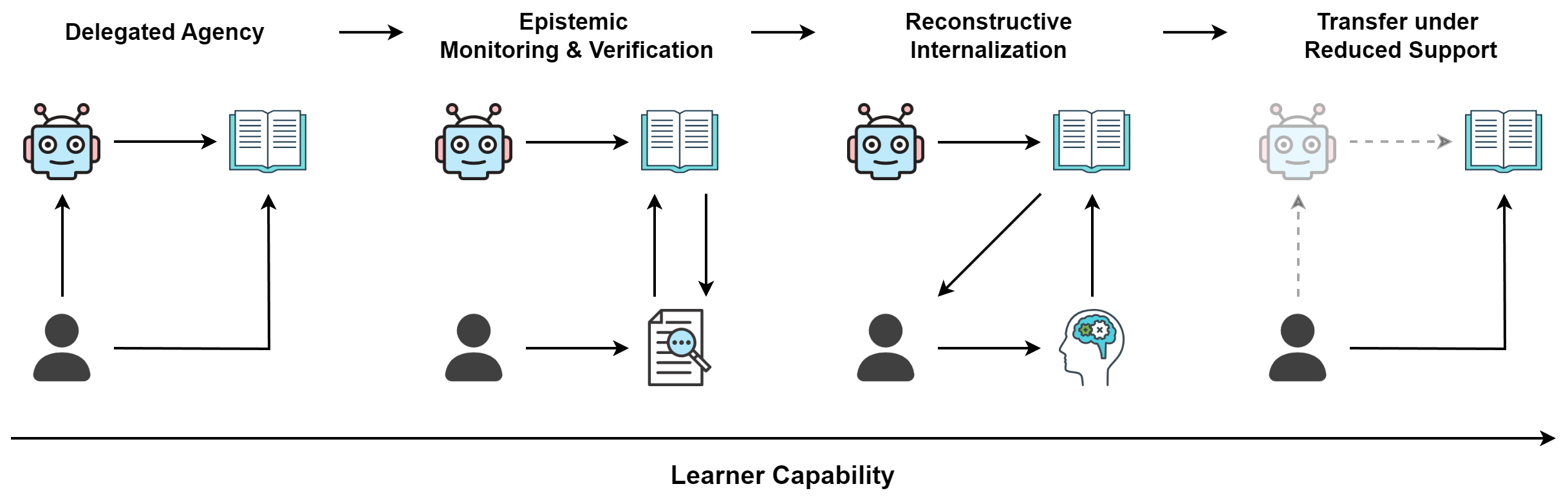
Figure 1: Diagrammatic summary of Agentivism's four core mechanisms and their integration within human-AI learning interactions.
Delegated Agency
Agentivism centers the "regulation of delegation" as a first-order explanatory construct. In practical terms, the extent and loci of agency dynamically shift across the human-AI boundary, depending on interaction structure, prompt trajectories, and system affordances. Empirical studies show wide variance in learner agency: from passive acceptance and cosmetic revision of AI outputs to active re-authoring and critical engagement. Learning is preserved when the human retains strategic ownership over problem framing, criteria selection, and justification; it is undermined when these are abdicated to the system.
Epistemic Monitoring and Verification
Given the fluency, rhetorical persuasiveness, and gap-filling tendencies of current LLMs, Agentivism posits epistemic vigilance as a primary mechanism safeguarding learning. Without systematic practices of verification, checking, and explicit justification, learners are prone to overconfidence, cognitive offloading, and susceptibility to system bias and normativity (2604.07813). Cognitive forcing interventions (e.g., requiring explanation before acceptance) have already shown effectiveness in mitigating over-reliance and promoting critical engagement.
Reconstructive Internalization
Successful task completion with AI assistance is not isomorphic with learning. The theory asserts that only when supported solutions are restructured, re-explained, and inflected through the learner’s prior schemata do they become durable and transferable. Evidence from writing, inquiry, and problem-solving demonstrates that transformative uptake and revision of AI outputs, rather than mere acceptance, are predictive of eventual independent competence.
Transfer Under Reduced Support
Agentivism operationalizes learning outcomes as successful performance on analogous or novel tasks with minimal or no AI support. This draws a decisive line between "assisted performance" and retained capability, aligning outcome measures with delayed transfer, adaptation, and justification rather than immediate product quality. Recent RCTs on AI tutoring and guided scaffolding corroborate this distinction, showing that only explicitly designed, reflective AI support yields sustained conceptual gains (2604.07813).
Empirical Propositions and Testable Predictions
Agentivism offers a set of empirically testable propositions, each corresponding to specific components of the core mechanisms:
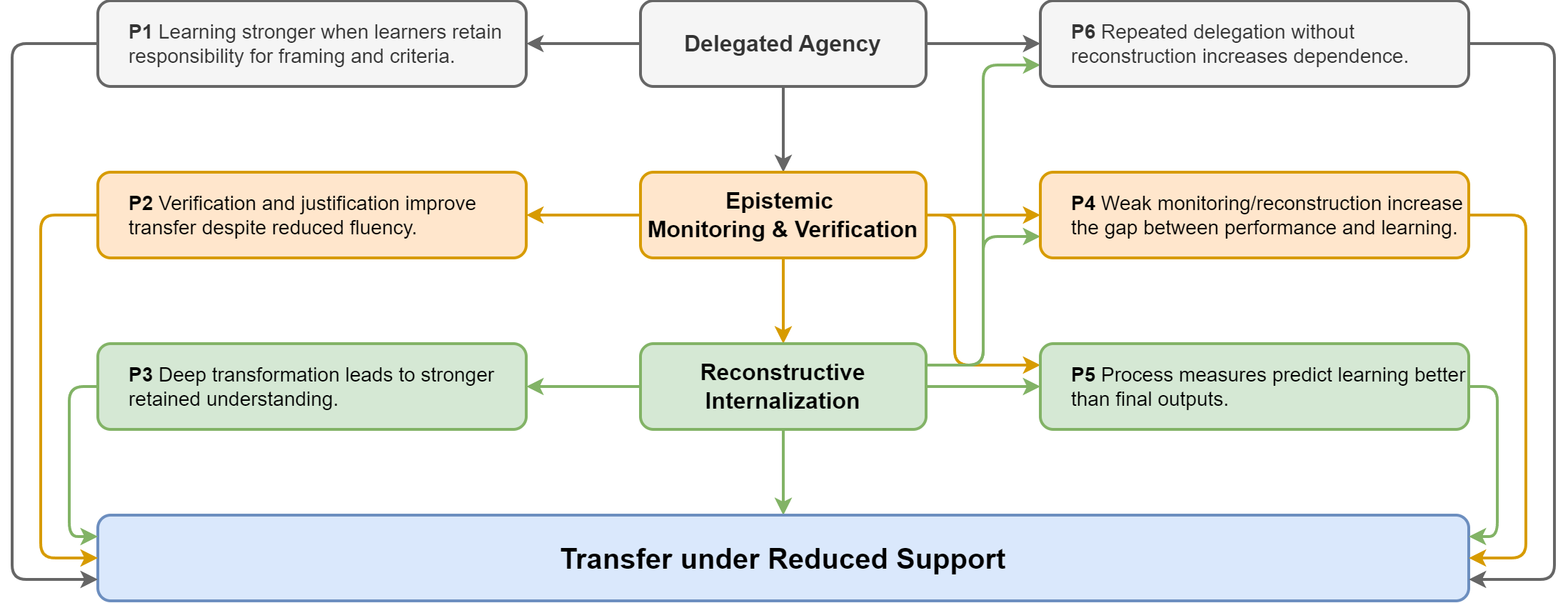
Figure 2: Mapping of Agentivism mechanisms to empirically testable propositions that structure future experimental and observational research.
- Preservation of learner agency in problem framing and justification should predict superior transfer compared to modalities where AI handles these dimensions.
- Mandated verification and comparison strategies, despite increased friction, improve delayed transfer and reduce reliance compared to seamless uptake conditions.
- Reconstructive processes (e.g., re-authoring, in-depth explanation) correlate more strongly with post-support learning gains than end-product quality alone.
- Cumulative dependence on low-friction, high-agency AI, absent reconstruction, leads to diminished competence calibration and increased long-term dependence.
Process analytics and trace data—prompt logs, revision sequences, evidence-checking actions—should supplant static product markers as primary predictors of learning under AI support.
Implications for Research, Pedagogy, and Assessment
Agentivism demands a paradigmatic re-orientation in learning analytics, instructional design, and assessment. The unit of analysis must shift from binary treatment conditions ("AI vs. non-AI") and output metrics to processual variables: agency distribution, epistemic activity, depth of reconstruction, and transfer performance. Pedagogical design should incorporate mechanisms and scaffolds that sustain the locus of control and judgment with the learner, structuring AI support to provoke monitoring and active transformation, rather than seamless pass-through assistance.
Assessment frameworks must increasingly rely on provenance, justification, and sequence data, rather than final artifacts, to validly infer durable competence. Additionally, governance and interface design must attend to not only efficacy but also risks of epistemic narrowing and over-calibration to dominant linguistic or conceptual norms.
Limitations and Future Directions
Agentivism, as delineated, constitutes a mid-range conceptual theory rather than a formal, computational model. Methodological work is required for the operationalization of core constructs (e.g., metrics for reconstructive internalization, scalable measures of agency distribution), especially across diverse domains, tasks, and learner characteristics. Longitudinal studies examining the effects of chronic delegation and the evolution of metacognitive calibration under persistent AI support are critical to validate the theory’s central predictions.
Further, the boundaries of Agentivism's applicability—across domains, novice-expert gradations, and varying forms of agentic AI—require empirical mapping. Finally, the impact of system-level design, accessibility, and inclusion on the efficacy of Agentivist mechanisms remains an open area for research.
Conclusion
Agentivism reframes the central question for AI-era learning theory: not simply whether AI can support performance, but under what interactional, regulatory, and cognitive conditions AI-assisted performance is transmuted into durable, human-controlled competence. By foregrounding delegation, epistemic monitoring and verification, reconstructive internalization, and transfer under reduced support, the theory specifies the mechanisms that regulate the translation of transient assisted success into independent, transferable learning. As generative and agentic AI become embedded in every facet of knowledge work, Agentivism offers both a clarifying conceptual vocabulary and a set of actionable research and design imperatives for sustaining human agency and learning in an era of ubiquitous machine augmentation.

