- The paper demonstrates that Markovian node dynamics can generate heavy-tailed inter-event time distributions, explaining burstiness in hypergraph interactions.
- The paper derives explicit formulas for IET distributions and autocorrelation functions, showing that larger hyperedges shift dynamics closer to Poissonian behavior.
- The paper validates the model against empirical data, highlighting its potential for understanding higher-order interactions in social, biological, and technological systems.
Modeling Non-Poissonian Temporal Hypergraphs via Markovian Node Dynamics
Introduction and Motivation
The paper "Modeling non-Poissonian temporal hypergraphs by Markovian node dynamics" (2604.07694) addresses the modeling of bursty, temporally correlated group interactions in real-world systems, where interactions are not limited to pairwise (dyadic) relationships but frequently involve higher-order group dynamics necessitating the hypergraph formalism. Empirical evidence demonstrates that the timing of such group events is non-Poissonian and displays memory effects, yet most analytical models either lack these temporal features or do not provide mathematical tractability in the presence of both temporal heterogeneity and higher-order interactions.
The proposed model is a temporal hypergraph defined on a static substrate, featuring N nodes and E hyperedges, each edge connecting arbitrary-sized node sets. Each node executes an independent Markov process, alternating between high (h) and low (ℓ) activity states, governed by constant transition probabilities rℓh and rhℓ, ensuring ergodic, stationary node activity.
At each discrete timestep, a hyperedge's event probability is a function of the number of its constituent nodes in state h, parameterized by two event-generation mechanisms:
- AND-rule: Events only occur with higher probability λh if all nodes in the hyperedge are in state h, otherwise with lower probability λℓ.
- LIN-rule: The event probability is a linear interpolation between E0 and E1 proportional to the fraction of E2-state nodes.
This setup is illustrated below.
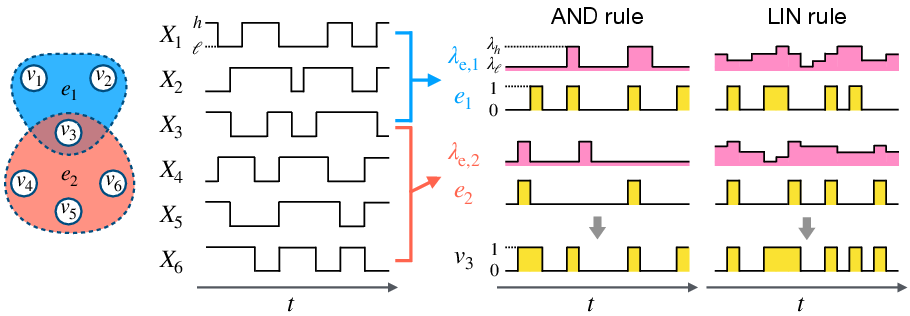
Figure 1: Schematic illustration of six nodes and two hyperedges, capturing node state evolution and hyperedge event probabilities.
Analytical Results: Inter-Event Time (IET) Distributions
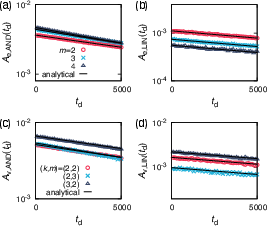
The explicit derivation of interevent time (IET) distributions for both edges and nodes is achieved. Despite underlying Markovian (i.e., memoryless) node dynamics, event sequences exhibit emergent heavy-tailed IETs—a hallmark of non-Poissonian, bursty dynamics—because each hyperedge aggregates over multiple nodes' stochastic trajectories. The IET for a hyperedge of size E3 is analytically obtained as a weighted mixture of geometric random variables indexed by the number of high-state nodes present. Importantly, as E4 increases, the IET distribution sharpens towards Poissonian behavior:
- AND-rule: Both the average event rate and IET tail decrease substantially with larger hyperedge size.
- LIN-rule: The mean event rate is almost independent of hyperedge size, while the tail of the IET still shortens with increasing E5.
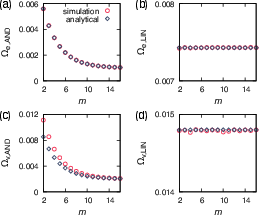
Figure 2: Theoretical and numerical results for average event probabilities under AND and LIN rules as a function of hyperedge and node size.
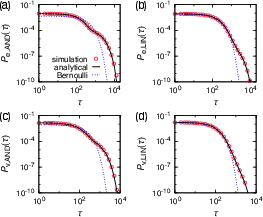
Figure 3: Empirical and analytical IET distributions, revealing mixture effects and heavier-than-geometric tails in both rules, especially for small E6.
IET distributions for nodes, which aggregate events from multiple hyperedges, are also determined as explicit mixtures, inheriting non-Poissonian statistics.
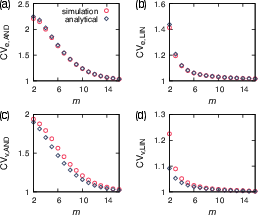
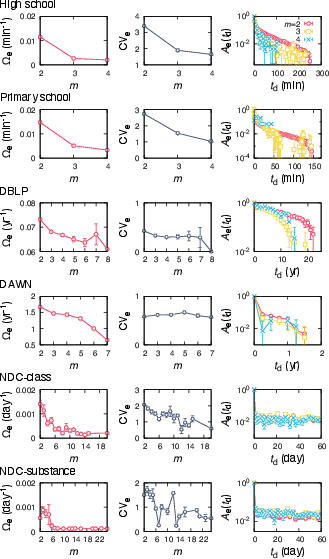
Figure 4: Coefficient of variation (CV) of IETs; heavier tails (high CV) for small E7, monotonic reduction as hyperedge size grows.
Analytical Results: Autocorrelation Functions (ACFs)
The authors provide closed-form autocorrelation functions (ACFs) for both hyperedges and nodes, demonstrating that, while underlying node processes are memoryless, the group’s event process possesses non-trivial, exponentially decaying correlations resulting from the collective state-dependent event emission.
Comparison with Empirical Temporal Hypergraphs
The theoretical framework is evaluated against six representative empirical temporal hypergraphs, spanning physical proximity, co-authorship, and pharmacological datasets. Analysis reveals:
Implications and Future Directions
This study formalizes a class of analytically tractable, node-based temporal hypergraph models capable of reproducing key empirical features of group interactions: burstiness, heavy-tailed IETs, and persistent autocorrelation, all arising from minimal (Markovian) intrinsic node dynamics nonlinearly mapped by the hyperedge event-generation function.
The findings provide a methodological bridge between low-level individual stochasticity and emergent temporal phenotypes of collective activity. Importantly, the hyperedge size-dependent transition from bursty to Poissonian event statistics is robust and matches observations in diverse domains.
Potential theoretical developments include:
- Extension to more complex, multi-state or non-Markovian node processes.
- Analytical treatment of joint temporal-topological couplings and their effects on dynamical processes (e.g., contagion, consensus, cooperative dynamics).
- Development of statistical inference techniques for hypergraph event-generation rules and parameter estimation from empirical data.
Practical consequences involve the possibility of more accurate, interpretable models for spreading or coordination phenomena on temporal hypergraphs, relevant in computational social science, epidemiology, and systems biology.
Conclusion
The paper makes a significant contribution by furnishing explicit, interpretable, and empirically validated analytical results for non-Poissonian temporal statistics in group-based systems via a straightforward Markovian node mechanism. It demonstrates how heterogeneous and temporally correlated hyperedge events can be generated from mixing simple stochastic node processes. The insights provide a foundational tool for further studies of dynamic processes on higher-order structures and for inferring generative mechanisms from real temporal hypergraph data.