- The paper demonstrates an integrated approach coupling reconfigurable LC antennas with LNN-based digital beamforming, achieving up to 88.6% higher spectral efficiency over baselines.
- It utilizes voltage-controlled antenna steering and codebook-driven analog beamforming to overcome phase shifter losses and enable agile beam patterns in sub-THz bands.
- The LNN employs ODE-governed state transitions and manifold optimization to robustly adapt to channel estimation errors, significantly reducing spectral efficiency degradation.
Motivation and Context
The drive towards 6G wireless necessitates exploiting sub-THz frequencies to achieve ultra-high throughput. However, system-level deployment is impeded by severe atmospheric absorption, reduced channel coherence time, hardware constraints in analog phase shifters above 100 GHz, and rapid channel variations. Conventional phased arrays and lens antennas introduce losses or suffer from limited agility in beam steering. This work addresses both hardware and algorithmic bottlenecks by jointly designing a reconfigurable liquid crystal (LC) antenna and a liquid neural network (LNN)-based digital beamforming (BF) protocol for robust multi-user MIMO (MU-MIMO) at 108 GHz.
LC-based metasurface antennas, featuring voltage-triggered permittivity adjustment, sidestep the loss and complexity of semiconductor phase shifters. The array comprises 48 elements, each loaded with GT3-23001 liquid crystal, enabling continuous steering in 5° steps over a 90° range with 6.87 dB element gain, and synthesizing 19 distinct beam patterns for codebook-driven analog BF.
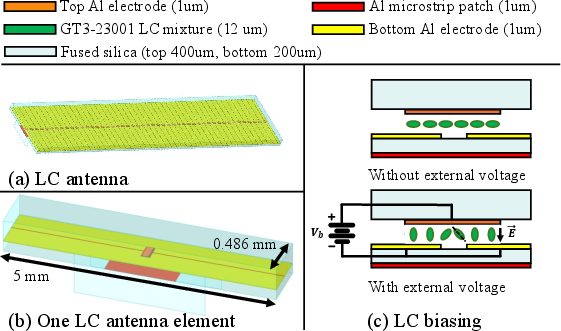
Figure 1: Schematic illustration of the 48-element LC antenna and its voltage-controlled unit cell structure enabling programmable permittivity and agile steering at 108 GHz.
The codebook is generated via full-wave EM simulation under optimized voltage distributions, maximizing main-lobe directivity per directional state while controlling sidelobes. Analog BF reduces the space of solutions to discrete pattern selection, emphasizing practical implementability in real sub-THz hardware.
Digital BF leverages LNN architectures, which encode the temporal channel dynamics as ODE-governed state transitions. Unlike GRUs or CNN-LSTM fusions, LNNs couple the current input and previous BF state via closed-form nonlinear ODE with learnable parameters, allowing informed gating and strong regularization against noisy channel estimates. The sigmoid gating inherent to the LNN restricts hidden-state drift and mitigates noise amplification in the BF output.
Manifold optimization further compresses the digital BF search space. The precoding matrix W is projected onto the row space of the estimated channel H^(p), yielding W=H^HX with X in CN×K. This approach exploits the massive MIMO regime (M≫N) to reduce computational complexity from CM×K to CN×K and enables efficient learning of channel-adaptive precoders.
Site-Specific Urban Simulation and Channel Realism
The evaluation employs NYURay, a ray-tracing simulator calibrated against extensive 142 GHz measurements, generating realistic, site-specific urban channels for Brooklyn MetroTech Commons. The simulation covers 1.8 km × 1.2 km, with the BS at 20 m height and UEs at 1.5 m, emulating proper propagation conditions at 108 GHz.
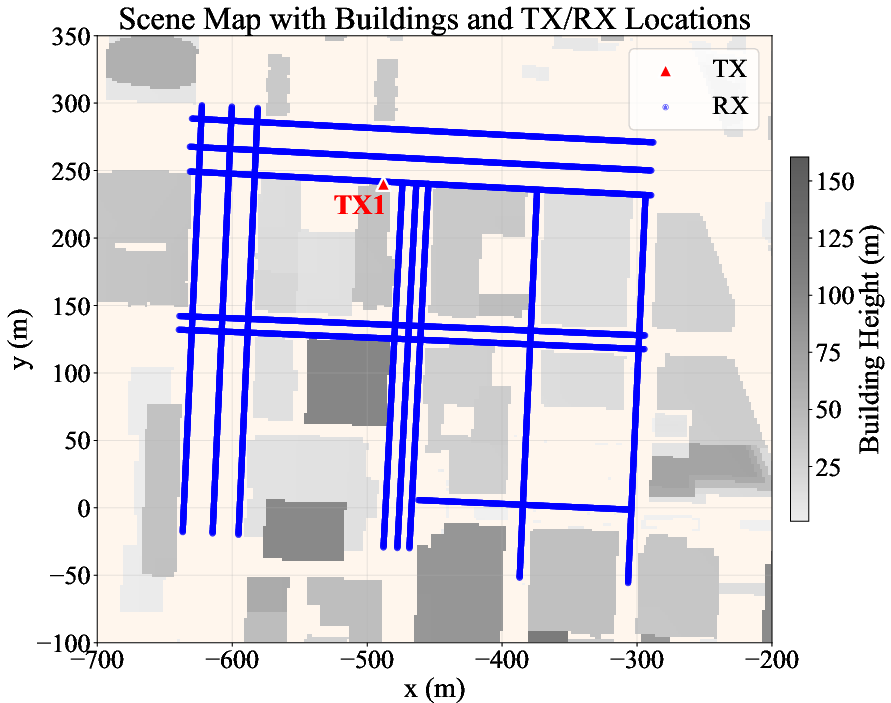
Figure 2: Urban deployment scenario with channel rays generated by NYURay, showing UE trajectories and BS positions equipped with the 48-element LC antenna.
This setting circumvents assumptions of Rayleigh fading and models per-path gains and delays via measured parameters, accurately representing multipath and blockage effects endemic to urban environments at sub-THz.
Numerical Results and Benchmarking
Spectral Efficiency (SE) Gains
Under a fixed channel estimation error (CEE) of −10 dB, the LNN+LC configuration achieves 88.6% higher SE than the learning-aided flexible gradient descent (LAGD) baseline and over 1.9× higher SE than the 3GPP TR38.901 standard array at P=30 dBm.
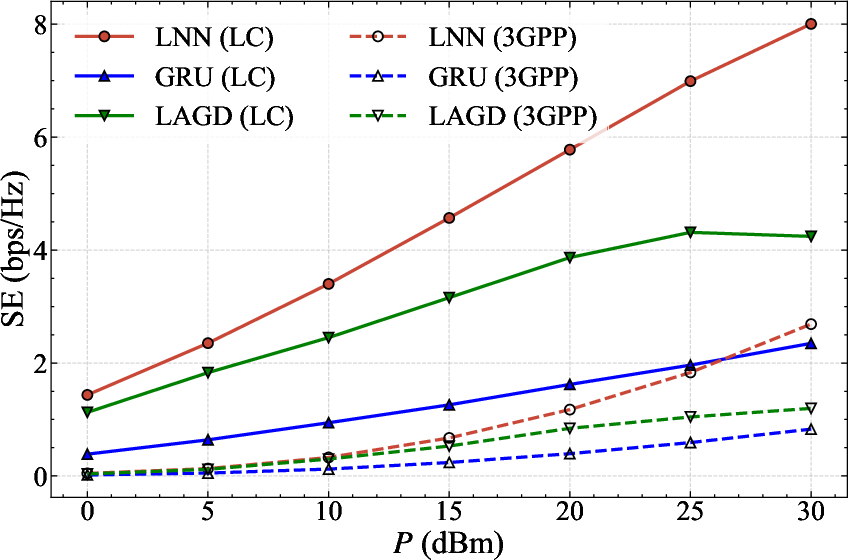
Figure 3: SE versus BS transmit power budget, illustrating that LNN+LC achieves 88.6% higher SE than LAGD+LC and >1.9× gain over 3GPP models at practical power levels.
These results validate the synergy of voltage-controlled analog steering with codebook selection and temporal learning in digital BF. The gain is directly attributed to the high directivity and pattern agility of LC antennas and the regularized adaptability of LNNs.
Robustness to Channel Estimation Error
When CEE is varied from H^(p)0 dB to H^(p)1 dB (simulating imperfect CSI), the SE reduction for LNN+LC is only 31.7%, compared to 55.4% for LAGD+LC. The gating mechanism and the manifold projection structure of LNN provide inherent regularization, limiting precoder volatility under noisy channel estimates.
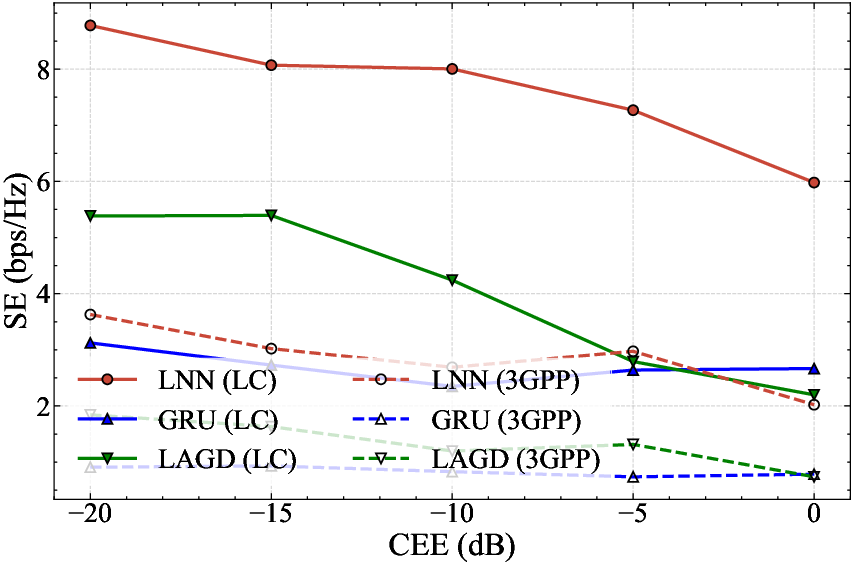
Figure 4: Robustness comparison (SE vs. CEE), demonstrating LNN+LC maintains SE under high estimation error, with 31.7% drop versus 55.4% for LAGD+LC.
Claims and Contradictions
- The paper makes a strong numerical claim that LC antenna hardware combined with codebook-driven analog BF outperforms conventional (3GPP) antennas in SE by a factor of 1.9, contradicting the widespread assumption of optimality in standard antenna models at sub-THz.
- The integration of LNNs in digital BF produces statistically superior SE and robustness than gradient-based and recurrent neural baselines, contradicting prior assertions on the limits of neural network approaches for rapid channel adaptation in MU-MIMO.
Practical and Theoretical Implications
At the hardware level, voltage-driven LC antennas offer an effective solution to the phase shifter loss bottleneck above 100 GHz, enabling scalable and power-efficient beam steering. The codebook-based operation ensures practical update rates and manageable calibration overhead. Algorithmically, LNN-enabled BF with manifold optimization aligns BF computation to real temporal channel variations while regularizing against CSI errors, facilitating robust adaptation in high-mobility scenarios. The combination demonstrates a path forward for deploying scalable, robust, and high-efficiency MU-MIMO in 6G bands.
On the theoretical side, the application of ODE-based LNN architectures validates the inductive bias for continuous-time channel modeling, potentially generalizing to other forms of physical learning across wireless domains. The manifold compression technique opens further avenues for low-complexity BF design in massive MIMO regimes.
Future Outlook
Further research is warranted to:
- Experimentally validate LC antenna performance in field measurements and compare aperture/element-matched arrays.
- Extend robustness analysis to per-user SE variance and cumulative SE distributions under time-correlated CSI errors.
- Scale evaluation across larger multi-user systems and higher-order antenna arrays.
- Investigate real-time integration with digital twin channel modeling and learning-driven site adaptation.
Conclusion
The proposed hybrid BF system, combining reconfigurable LC antennas and LNN-driven digital BF with manifold optimization, demonstrates substantial improvements in SE and robustness to imperfect CSI in realistic urban sub-THz channels. The approach directly addresses hardware and channel estimation limitations, setting a foundation for scalable 6G MU-MIMO deployment. The demonstrated numerical superiority over prevailing standards and prior learning-based methods challenges conventional assumptions and invites broader reconsideration of BF strategies for next-generation wireless.

