- The paper introduces the LOBSTER corpus to empirically quantify language-of-study bias in NLP peer reviews.
- It benchmarks several LLMs, with Gemini 3.1 Pro achieving 87.37 Macro F1, demonstrating robust bias detection capabilities.
- Results show non-English papers have up to 40-fold higher bias rates, highlighting the need for fair and transparent review practices.
Language-of-Study Bias in NLP Peer Review: Systematic Evidence and Implications
Introduction
This paper introduces the first comprehensive and empirical characterization of language-of-study (LoS) bias in NLP peer review, providing quantitative and qualitative evidence that review outcomes often depend not just on scientific merit but also on the specific human languages investigated. Despite prior anecdotal attention and explicit warnings in reviewing guidelines, LoS bias has remained poorly studied, with no formal taxonomy or large-scale measurements distinguishing between negative and positive forms. The authors construct the LOBSTER corpus, the first expert-annotated dataset focused specifically on LoS bias, and present robust LLM-based methodologies for detection and analysis across a large multi-venue corpus. The results show non-English papers are substantially more likely to be subject to both negative and positive biases—especially demands for generalizability and English-centric standards.
Dataset Construction and Annotation Methodology
A two-stage sampling and annotation strategy underpins the creation of LOBSTER, addressing both efficiency (surface likely bias candidates using LLMs) and coverage (ensuring label balance across languages and contribution types). Review segments, rather than entire reviews, are the classification unit to detect multiple potential biases per review. The dataset comprises 529 segments labeled as negative bias, positive bias, or no bias, each annotated by at least three NLP experts using full paper context. Substantial inter-annotator agreement (Cohen's kappa: mean 0.786) demonstrates reliability and label clarity.
The explicit operational definitions for negative and positive LoS bias are a major methodological contribution. Negative bias captures cases where reviewers penalize work for studying non-English (or low-resource) languages disproportionately, e.g., by demanding unwarranted cross-lingual generalization or treating English as a required validity check. Positive bias, though rarer, arises when reviewers praise language choice without engaging with methodologies or evidence—a pattern that can also distort scientific evaluation.
The paper benchmarks six contemporary LLMs (Gemini 3.1 Pro, Claude Opus 4.6, Grok 4.1, GPT 5.2, DeepSeek V3.2, Llama 4 Maverick) on LOBSTER, using a rigorously standardized prompt. Gemini 3.1 Pro achieves the best results with 87.37 Macro F1 and 93.60 Weighted F1, outperforming both random and majority-class baselines by over 50 points.
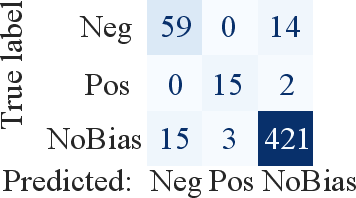
(Figure 1)
Figure 1: Gemini-3.1-Pro-Preview confusion matrix for bias classification, showing the conservative tendency to default to 'No Bias' in ambiguous cases.
The confusion matrix reveals that false negatives dominate, largely reflecting the prevalence of nuanced or lexically indirect bias types that challenge both humans and models. These robust results enable reliable corpus-scale extension of the analysis.
Quantitative Analysis: Rates, Polarity, and Scope
Applying the top-performing model to 15,645 reviews from six major NLP venues yields strong quantitative evidence that language-of-study bias is systematic and non-trivial:
Cross-Language, Contribution, and Temporal Factors
The prevalence and form of LoS bias are not homogeneous:
- Per-language Variation: Top non-English studied languages (Chinese, German, Arabic, etc.) all show elevated bias rates relative to English, but with variance reflecting field focus and reviewer familiarity.
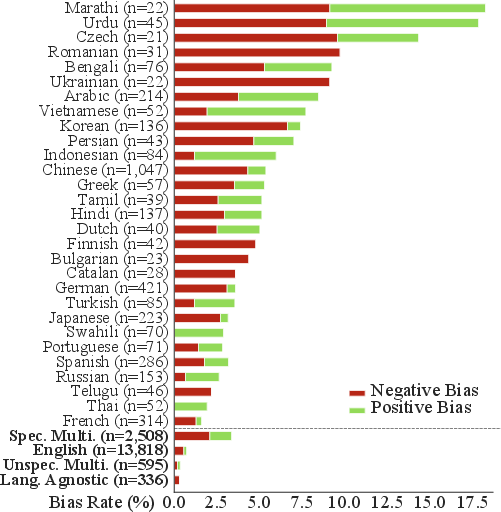
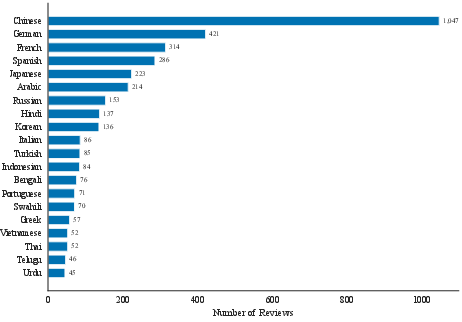
Figure 3: Top 20 non-English studied languages in the full analysis corpus, highlighting the diversity of language focus but overwhelming dominance by Chinese.
- Contribution Type: LoS bias correlates with paper type. Data/benchmarking and linguistic analysis papers (those intrinsically tied to language choice) are most affected (~2% bias rates), whereas modeling papers—which tend to frame contributions as language-agnostic—exhibit the lowest (0.66%).
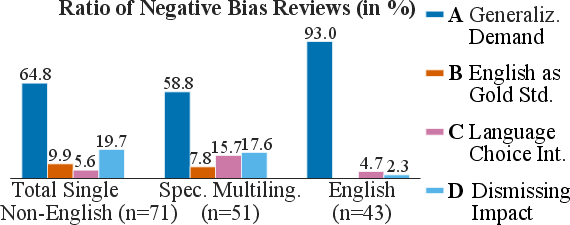
Figure 4: Distribution of contribution types in the full analysis corpus, with most frequent types in applications, data, and analytical studies.
- Temporal Stability: Negative bias rates are highest in the earliest review cycles, with a possible slight decrease over time, though venue sampling differences preclude strong conclusions about historical trends.
Qualitative Analysis: Subcategories of Negative Bias
Manual and automated subcategory analysis unpacks the qualitative landscape of how bias manifests, revealing four major patterns:
English-only papers overwhelmingly receive pattern A, while non-English and multilingual papers encounter a wider repertoire, including impact dismissal and explicit language-choice interrogation.
Implications and Future Directions
The findings demonstrate a structural pattern of linguistic inequality in NLP scientific evaluation. For reviewers, institutional actors, and policymakers, the evidence supports immediate interventions:
- Reviewing Practices: Guidelines should be restructured to require reviewers to explicitly justify criticisms about language scope with respect to the paper's stated claims, rather than implicit field-wide standards. The documented patterns provide concrete negative exemplars to avoid.
- Automated Oversight: The high F1 achieved by LLM-based detectors suggests feasibility for automated screening tools that flag candidate bias for further editorial review.
Practically, these results signal that non-English NLP research may face heightened publication barriers disconnected from methodological quality—potentially skewing scientific progress and resource allocation. Theoretically, these patterns represent a case study in how ingrained field norms and reviewer priors interact with peer evaluation, underlining the need for more sophisticated and context-sensitive fairness frameworks.
A key avenue for future work involves expanding the analysis to rejected papers (currently underrepresented due to data availability), non-NLP fields, and broader temporal horizons. Further, exploring the interplay between LoS bias and intersectional biases (gender, institutional prestige, topic selection) presents a rich domain for AI-driven meta-scientific research.
Conclusion
This work establishes, with both empirical and methodological rigor, that language-of-study bias is a systematic phenomenon in NLP peer review, affecting non-English work at rates orders of magnitude higher than field baselines and manifesting in both overt and subtle forms. The LOBSTER corpus and the associated classification pipeline create a foundation for scalable and reproducible research on bias in peer evaluation. Addressing these biases is critical for promoting linguistic equity, ensuring scientific quality, and broadening the scope of NLP research.
References
The essay is based on "Are Non-English Papers Reviewed Fairly? Language-of-Study Bias in NLP Peer Reviews" (2604.07119).