- The paper develops a comprehensive algebraic framework for persistence, establishing interleaving distances, barcode decompositions, and graded module equivalences.
- It systematically connects poset representations with quiver theory, graded algebra, and sheaf theory to deepen the understanding of persistent homology.
- The analysis highlights computational challenges and stability limits in multiparameter settings, motivating innovative invariant extraction techniques.
Algebraic Foundations and Structural Landscape of Persistence
Overview and Motivation
"An Algebraic Introduction to Persistence" (2604.07022) presents a comprehensive survey of persistence from the vantage point of the representation theory of posets, offering a systematic treatment of both one-parameter and multiparameter persistence. The exposition is tailored for researchers interested in algebraic, geometric, and computational aspects of persistent homology and the associated poset representations. The paper systematically develops key theoretical notions—such as interleaving distance, barcodes, bottleneck stability, and additive invariants—while critically addressing structural and computational challenges, especially those encountered in the multiparameter setting.
Fundamentals of Poset Representations and Persistent Homology
Poset representations are formalized as k-linear functors from a poset P to vector spaces (over a field k), providing the categorical context for persistence modules. The paper lays out connections with quiver theory, graded commutative algebra, and sheaf theory, highlighting equivalences between these representations and module categories over graded polynomial rings and incidence algebras.
The construction of persistent homology is described via filtrations f:X→Rn, where sublevel sets induce functors S(f):Rn→Top, and homology functors yield persistence modules PHd(f). This formalism extends to level set persistence via more sophisticated posets capturing interlevel and relative homological data.
The central one-parameter structure result is the unique direct sum decomposition of vecR representations into interval modules, providing the theoretical foundation for barcodes. The Isometry Theorem equates the interleaving and bottleneck distances in this case, grounding the stability guarantees for persistent homology under functional perturbations.
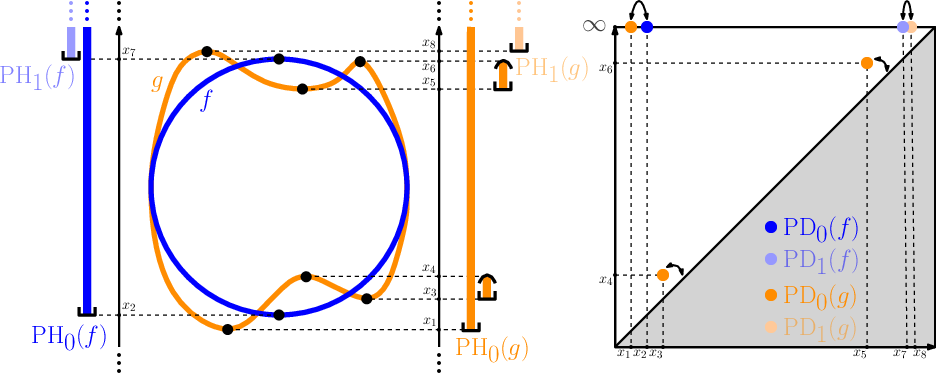
Figure 1: Barcodes and persistence diagrams for two functions on the circle, illustrating indecomposable decompositions and matchings under perturbations.
Applications in Data Analysis and Geometry
Persistent homology is leveraged for topological inference tasks such as clustering (d=0), circularity detection (d=1), and void detection (d≥2), with applications in neuroscience, astronomy, material science, and biology. Stability results ensure that topological features inferred from noisy data are robust. Pure mathematical connections are developed to Morse theory, symplectic topology, and coarse geometric counts, linking classical invariants and the structure of barcodes.
Level Set Persistent Homology
This intermediate theory generalizes one-parameter persistence, covering extended persistence, derived sheaf-theoretic encodings, and relative interlevel set homology. The equivalence between these approaches is established, each admitting bottleneck stability results and facilitating algebraic and computational advantages.
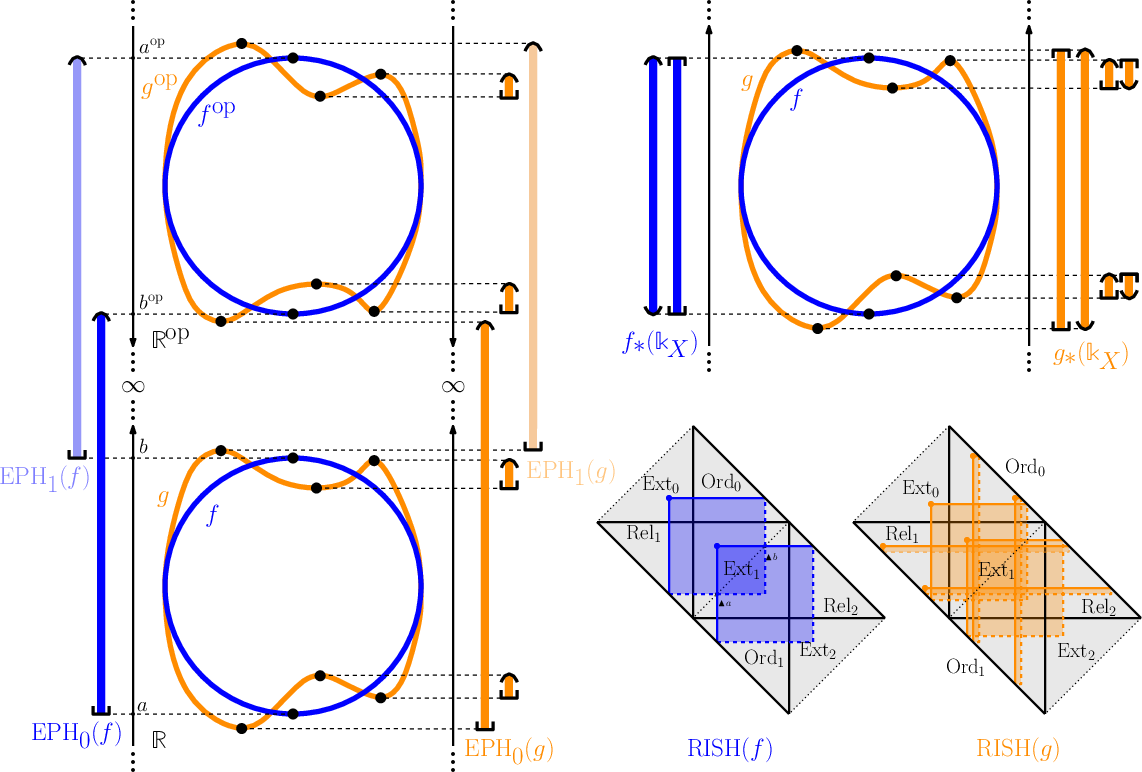
Figure 2: Extended persistence, derived sheaf, and interlevel set approaches for level set persistent homology and their mutual equivalences.
Breakdown and Challenges in Multiparameter Persistence
For multiparameter modules, wild representation type dominates, with indecomposable modules forming a dense and generic subspace. Consequently, the Structure and Isometry Theorems fail: arbitrarily close modules in interleaving distance can have vastly different decompositions. The bottleneck distance generalizes poorly, and no strong bound P0 holds universally.
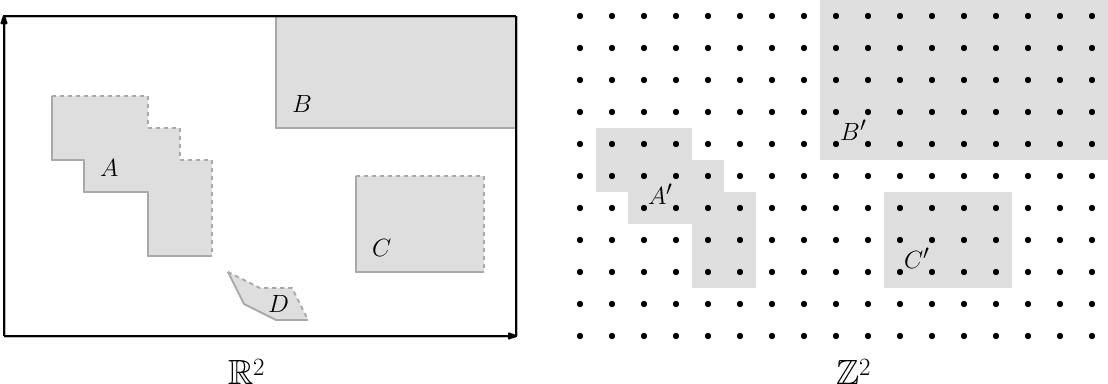
Figure 3: Examples of spread subsets within P1, illustrating finitely presented and infinitely generated spread representations, central to multiparameter decompositions.
Additive Invariants and Computational Complexity
Given the impossibility of classifying indecomposables in the multiparameter case, the paper focuses on additive invariants: dimension vectors, rank invariants, generalized rank invariants, dimhom invariants, Betti tables, Euler characteristics, and their relative versions with respect to chosen exact structures. M\"obius inversion is systematically employed to yield bases for invariants, notably converting rank invariants to barcodes in one-parameter persistence and to generalized persistence diagrams in higher parameters.
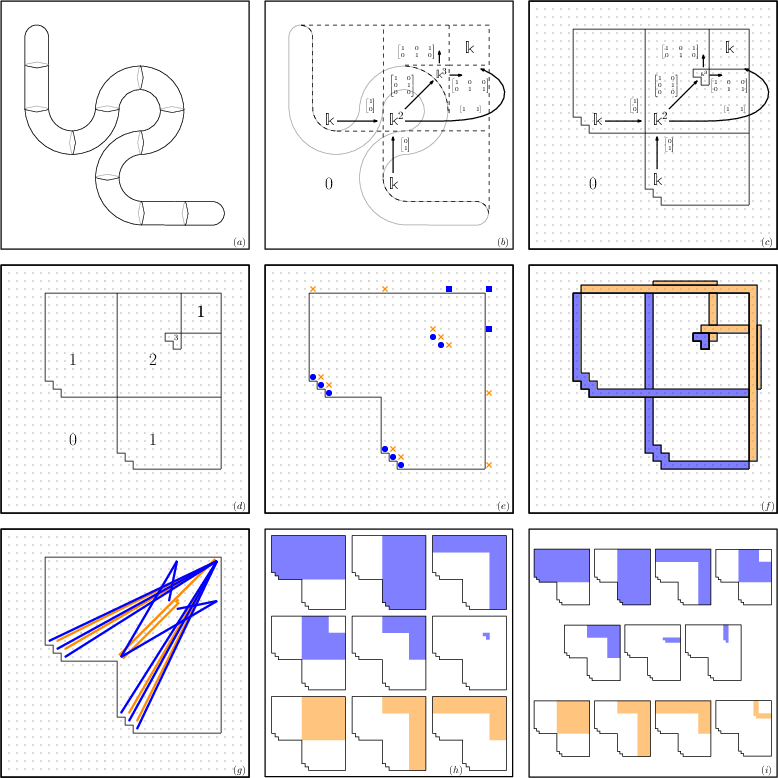
Figure 4: Invariants for a two-parameter poset representation, including dimension vectors, Betti tables, end-curves, signed barcodes, and persistence diagrams, ranked by space complexity.
Betti tables are computed via projective resolutions over incidence algebras, connecting classical homological algebra to persistence modules—syzygy results generalize Hilbert’s theorem in the multigraded case.
Bottleneck Stability and Negative Multiplicities
Selective stability results survive in specific non-wild subcategories (projectives, rectangle-decomposables), with bounds depending on the parameter count. Bottleneck stability results propagate to Betti tables and signed invariants, but typically yield weak lower bounds due to the presence of negative multiplicities in signed barcodes and group-valued invariants.
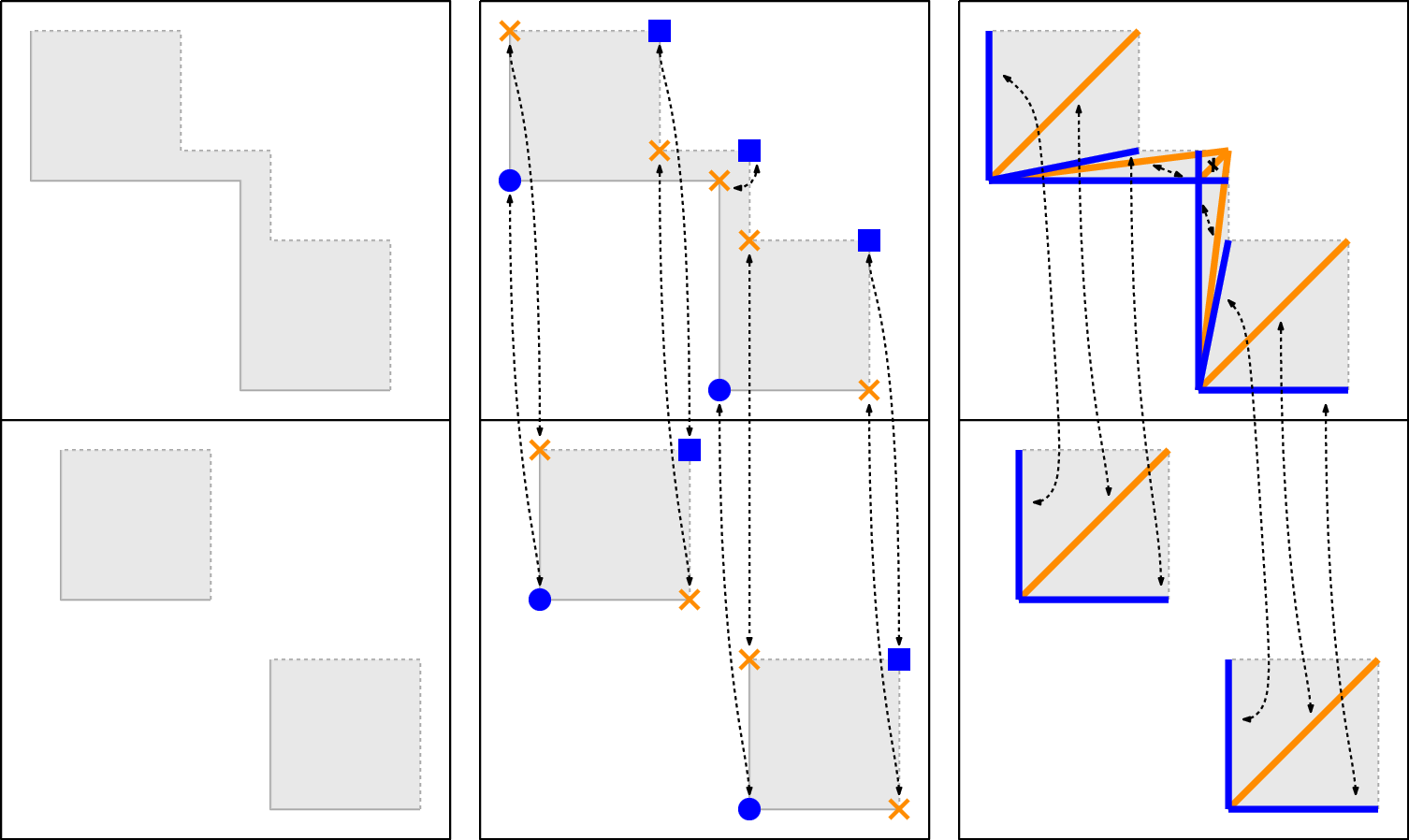
Figure 5: Signed matchings and bottleneck stability in two-parameter persistence, illustrating the limits of low-cost indecomposable matching.
A 'no-go' result rigorously shows that strong bottleneck stability cannot hold for group-valued invariants unless the interleaving distance is infinite. Erosion stability remains available for positive cone-valued invariants but lacks matching-based interpretations and strong lower bounds.
Representation Theory of Infinite Posets
Pointwise finite representation type is proposed as an analogue for continuous posets. Recent results characterize m-tame and q-tame representations—those admitting finite resolutions by upset-decomposables and with structure maps of finite rank, respectively. Abelian and Krull–Schmidt properties persist in observable categories of q-tame modules.
Zero-dimensional persistent homology remains tractable over certain posets (e.g., trees), reflecting finite representation type despite wildness elsewhere.
Computational Algorithms and Complexity
Cubic and matrix multiplication-time algorithms are developed for barcode decomposition and Betti table computation. Output-sensitive algorithms address the computation of signed barcodes and invariants, but complexity typically scales with the input size and homological dimension, motivating ongoing research in sparsification, covering-based approaches, and efficient invariant computations.
Conclusion
This paper constitutes an authoritative reference on the algebraic foundations and computational aspects of persistence, rigorously outlining the categorical, homological, and geometric connections. It establishes the theoretical limits of structural and stability results in multiparameter persistence, motivating further research into novel invariants, subcategories of tractable modules, and efficient computational frameworks. The implications span both theoretical advances in algebraic topology and practical applications in data-driven sciences, with ongoing challenges centered on effective structural classification and robust invariant extraction in high-dimensional and continuous settings (2604.07022).