- The paper proposes TBCR and SCA, two innovative tag-based PLA methods that circumvent decoding-induced interference to enhance authentication reliability.
- It uses challenge-response and series cancellation strategies to eliminate message interference and deliver near-ideal detection probability in high SNR conditions.
- Analytical results and simulations validate the schemes’ efficiency and robustness against fading, noise, and replay attacks, supporting secure wireless communications.
Summary of "Tag-based Physical-Layer Authentication Against Message Interference" (2604.06680)
Introduction and Motivation
This paper addresses critical limitations in current tag-based Physical-Layer Authentication (PLA) schemes, specifically the degradation in authentication performance due to message interference from decoding errors and the sub-optimality of detection thresholds resulting from analytical complexity. Standard schemes such as SUPerimposition (SUP) and Blind Tag-based PLA (BTP) rely on message decoding to retrieve authentication tags, which leads to performance loss. To overcome these pitfalls, two novel frameworks are introduced: the Tag-Based Challenge-Response (TBCR) scheme and the Series Cancellation Authentication (SCA) scheme. Both leverage signal design and authentication process innovations to eliminate or mitigate the impact of message interference and improve theoretical detectability and security.
System Model and Limitations of Conventional Approaches
The system consists of an authentication scenario involving Alice (transmitter), Bob (authenticator), and Eve (adversary/eavesdropper) as depicted in Figure 1.
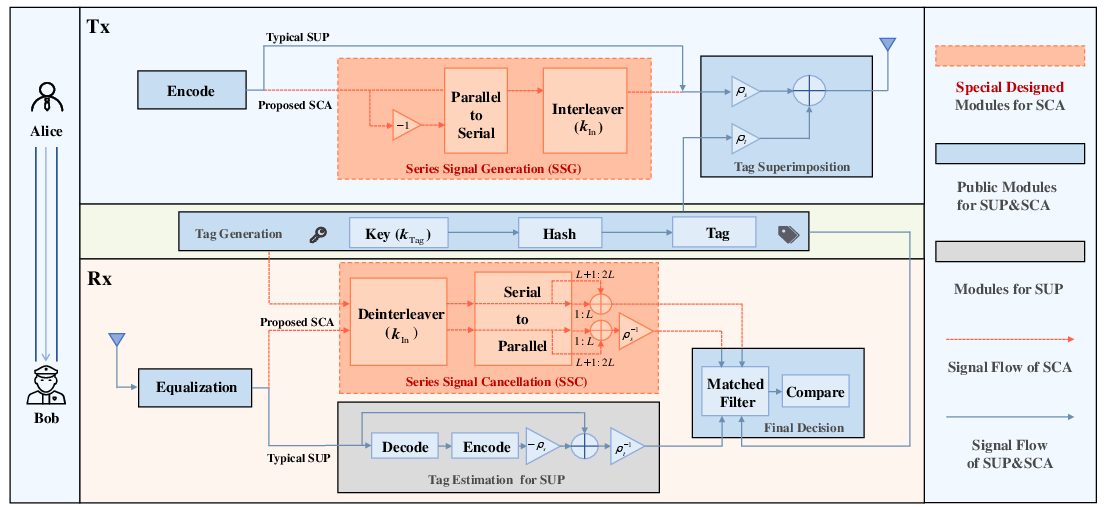
Figure 1: The signal flows in the authentication phase of the proposed SCA scheme versus the conventional SUP scheme, highlighting the paired modules in the SCA scheme, i.e., the novel Series Signal Generation (SSG) module at the transmitter (Alice) and the corresponding Series Signal Cancellation (SSC) module at the receiver (Bob).
Traditional schemes embed a tag into the message and rely on Bob to decode the message, subtract it from the received signal, and extract the tag. However, decoding errors introduce non-negligible message interference—mathematically, the estimated message s^=s+nD results in residual tag estimation r corrupted by both channel and decoding noise. This complication leads to analytically intractable error probability bounds and forces schemes to adopt sub-optimal thresholds based on unrealistic error-free assumptions.
TBCR Scheme: Challenge-Response Signal Manipulation
The TBCR scheme capitalizes on the challenge-response mechanism. Bob sends a known challenge signal, which Alice forwards and superimposes with a tag using secret keys. Since Bob is already aware of the challenge signal, tag estimation at the receiver is accomplished by direct subtraction, bypassing message decoding altogether. As a result, the TBCR scheme avoids message interference; however, forwarded noise from Alice is accumulated, affecting detection performance. Analytical results show that:
- TBCR achieves ideal detection probability in the absence of noise at Alice.
- In high SNR regimes, the robustness and security (detection probability, false alarm probability, key equivocation) outperform benchmarks with fewer key requirements.
Closed-form expressions for detection probability and thresholds are derived for non-ideal fading and noise, validating theoretical soundness.
SCA Scheme: Signal Frame and Cancellation Strategy
The SCA scheme introduces Series Signal Generation (SSG) and Series Signal Cancellation (SSC) modules. Alice generates a series signal by splicing two blocks of opposite-sign, identical-content signals and applies interleaving, then superimposes the tag. Bob utilizes deinterleaving and folding (serial-to-parallel conversion) to cancel the series signal—carefully designed so that tag extraction is done without any decoding:
- Only channel noise (not decoding noise) is present in tag estimation.
- Achieves theoretical ideal detection probability under error-free decoding assumptions for SUP.
- Requires a doubled key update rate relative to TBCR but offers stronger robustness against noise and channel estimation errors.
The mathematical treatment confirms that SCA matches SUP performance in absence of decoding errors, and outperforms SUP under practical (imperfect decoding) conditions.
Robustness and Security Analyses
Closed-form probabilities for detection, false alarms, optimal thresholds, and key equivocation are derived for both schemes. The theoretical claim is that SCA provides consistently ideal robustness, while TBCR approaches this benchmark as Alice's SNR increases. Security against Eve (adversarial detection and tag extraction) remains strong for both, with detection probability and equivocation favoring the legitimate receiver under all relevant parameter regimes:
- TBCR’s security increases with SNR at Alice and requires fewer keys.
- SCA offers equivalently high key equivocation as SUP, while TBCR surpasses SCA in high SNR regions.
- Neither scheme is susceptible to computational attacks by Eve, even under replay attack scenarios, provided Bob applies statistical detection (noise distribution analysis).
Practical Considerations and Bandwidth Efficiency
Both schemes are evaluated for time complexity, energy consumption, bandwidth efficiency (RBE), and authentication delay:
- TBCR and SCA provide linear time complexity (O(L)), substantially lower than SUP’s O(NLlog2L) requirement due to elimination of complex decoding.
- Bandwidth efficiency sacrifices are minimal (less than 3% in RBE for N=10) and diminish further as authentication signal/message ratio decreases.
- Key update frequency is higher for SCA, reflecting greater security for costlier resources.
Extensive numerical simulations demonstrate strong performance alignment with theory, robustness under practical channel conditions (estimation/synchronization errors), and security against adversarial signal analysis.
Implications and Future Directions
The research advances the theoretical and practical boundaries of tag-based PLA by:
- Proposing authentication strategies that circumvent decoding-induced limitations and optimize robustness/security trade-offs.
- Offering formalisms for threshold computation and detection probability that convey clear guidelines for system configuration.
- Suggesting application domains in industrial control and military communications where authentication reliability is paramount.
- Highlighting spectral efficiency, resource consumption, and key management considerations relevant to large-scale deployment.
Future developments may encompass further bandwidth optimization, adaptive frame structures, integration with ACK/NACK signals in standardized protocols, and enhanced replay attack resilience in dynamic fading environments.
Conclusion
The TBCR and SCA schemes represent significant progress in the design of tag-based PLA in the presence of message interference. The SCA scheme achieves ideal detectability by folding signal frames instead of decoding, while TBCR leverages the challenge-response mechanism for efficient authentication with reduced key overhead. Closed-form analytical results and simulations confirm strong robustness and security properties, providing practical guidelines for high-assurance wireless authentication in complex environments. Further refinement of resource efficiency and attack resilience promises to extend their applicability and impact in future secure communication frameworks.