- The paper introduces G-Defense, a graph-based framework that decomposes claims into atomic sub-claims and generates competing explanations using LLMs and retrieval-augmented generation.
- It employs defense-style inference over a claim-centered dependency graph to evaluate evidence quality and improve veracity assessments.
- Experiments on RAWFC and LIAR-RAW benchmarks show significant macro F1 gains and reduced confusion in human veracity judgment.
Graph-Enhanced Defense for Explainable Fake News Detection with LLM
The proliferation of fake news on social platforms introduces urgent demands for automated veracity detection systems that provide interpretable, contextually rich explanations. Traditional journalism and extractive explainable detection frameworks offer insufficient scalability and incomplete reasoning for fast-moving, multifaceted claims. Recent advances in LLMs and retrieval-augmented generation (RAG) have enabled reasoning backed by external information, yet incorporate risks from unverified sources and lack fine-grained interpretability. The paper "A Graph-Enhanced Defense Framework for Explainable Fake News Detection with LLM" (2604.06666) proposes G-Defense, a methodology leveraging claim decomposition, graph-centric modeling, and defense-like inference with LLMs to deliver structured explanations and robust veracity assessments, focusing on reasoning solely from unverified reports.
Framework Overview
The G-Defense system decomposes input claims into sets of sub-claims, models their logical dependencies as a claim-centered graph, and generates for each aspect competing explanations via RAG and LLM prompting. Final veracity inference uses defense-style reasoning across the graph structure, explicitly comparing quality of evidence and explanations, yielding both a comprehensive explanation graph and a succinct textual summary.
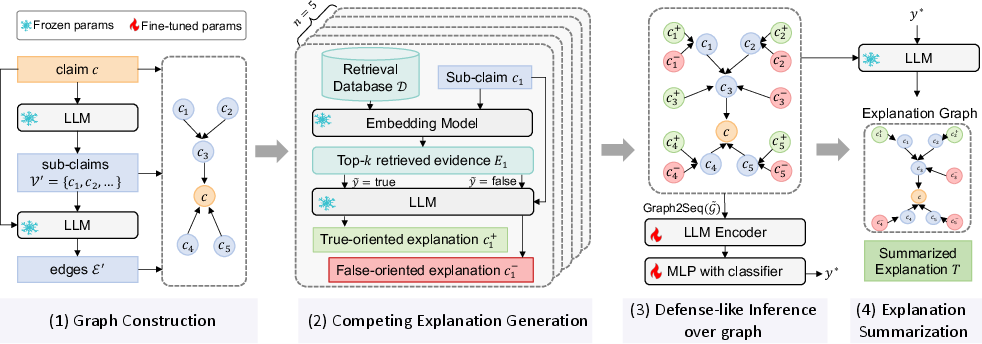
Figure 1: Framework architecture of G-Defense: claim decomposition, evidence retrieval, competing explanation generation, graph-based inference, and final explanation synthesis.
Graph Construction and Claim Decomposition
Complex claims are first decomposed by an LLM prompt into atomic, verifiable sub-claims. A second LLM prompt determines directed edges reflecting logical or evidential dependencies among claim and sub-claims, forming a claim-centered dependency graph. Each node represents a claim aspect; edges encode prerequisite, causal, or contextual relationships necessary for downstream reasoning.
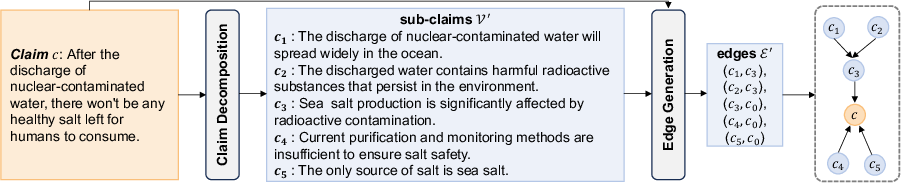
Figure 2: Process of decomposing a claim and constructing the claim-centered dependency graph.
This decomposition exposes claim complexity, explicit factual entailments, and inter-aspect reasoning requirements that vanilla extractive/detector models omit.
Competing Explanation Generation via RAG
For each sub-claim, evidence is retrieved from pre-indexed, unverified raw reports using embedding-based similarity. Two explanations—one supporting, one refuting—are generated for each sub-claim label via LLMs using abductive reasoning prompts, explicitly grounding the rationale in retrieved evidence.
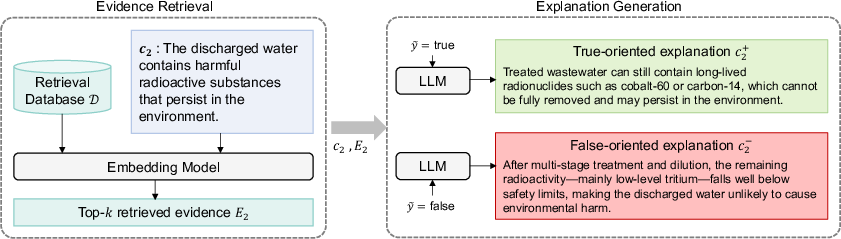
Figure 3: Generation of competing explanations for a sub-claim based on retrieved evidence.
Comparative analysis between the informativeness and soundness of opposing explanations enables assessment of evidence quality without presupposed reliability—critical in early detection settings.
Defense-Like Graph Inference
All explanations and their associated sub-claims are serialized in natural language, describing the graph structure for input to a fine-tuned LLM encoder. The classifier performs defense-style inference, evaluating the alignment, coherence, and evidential robustness along the graph to predict overall and local veracity labels.
Explanation Graph and Summarization
A final LLM prompt generates structured explanations: removal of explanations inconsistent with predicted sub-claim veracities yields the explanation graph; a summary rationalizes the claim-level decision with explicit reference to sub-claims and evidence.
Experimental Results
The framework is evaluated on two benchmarks (RAWFC and LIAR-RAW) that provide only unverified reports. G-Defense achieves superior macro F1 scores compared to prior approaches, with gains notably pronounced for claims of higher complexity.
RAWFC: G-Defense achieves a macro F1 of 64.31, outperforming the previous SOTA by over 3%.
LIAR-RAW: G-Defense attains competitive improvements, showing robustness to fine-grained label sets.
Performance improvements are highly significant (paired t-test p<10−4) relative to prior SOTA.
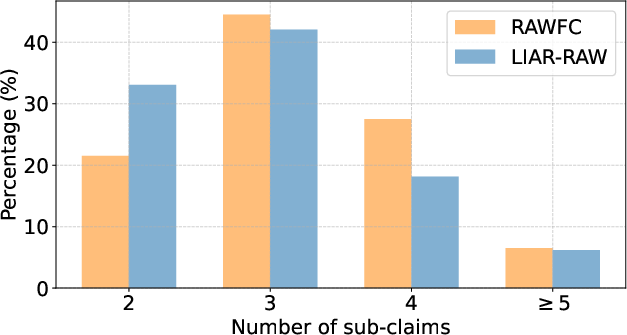
Figure 4: Distribution of claims grouped by decomposed sub-claim count in test sets, highlighting claim complexity.
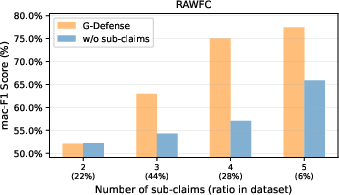
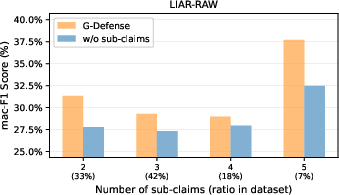
Figure 5: MacF1 segmentation by claim complexity, showing the impact of decomposition on detection performance.
Ablation studies demonstrate that sub-claim decomposition, evidence retrieval, and graph edges each contribute substantially. Removal of any element reduces macro F1 by ≥ 5%.
Explanation Quality and Human Evaluation
LLM-based evaluation and human annotation reveal that G-Defense explanations exhibit lowest misleadingness, highest informativeness and soundness, and maximal readability across all methods except the oracle. In blinded human trials, explanations from G-Defense reduce veracity judgment confusion and outperform both discrete and claim-level reasoning competitors.
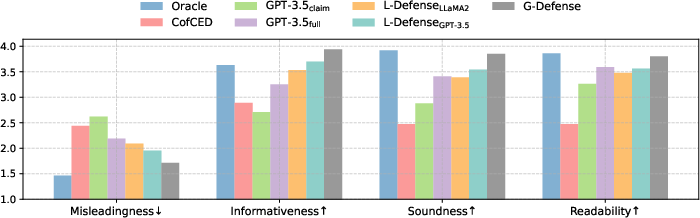
Figure 6: Human annotator Likert evaluation of explanation quality across methods.
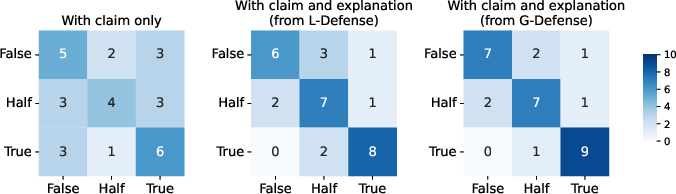
Figure 7: Confusion matrices of human judgments under three explanation conditions: claim only, L-Defense explanations, and G-Defense explanations. G-Defense explanations yield the least confusion.
Case Studies and Defense-Like Reasoning
Qualitative examples illustrate that decomposition and graph modeling capture multi-facet claims, allowing targeted reasoning and detection of misleading implications (“half-true”). Defense-style inference identifies weak or inconsistent explanations from evidence misaligned with the gold label, further bolstering robustness to unverified sources.
Practical and Theoretical Implications
G-Defense demonstrates that fine-grained graph modeling in tandem with adversarial explanation generation and defense-style inference substantially improves both veracity prediction and interpretability in realistic early-detection settings. Structured explanation graphs clarify contribution of individual aspects and evidence, facilitating human trust and rapid fact-checking.
From a theoretical lens, this approach underscores the value of combining explicit logical substructure and comparative reasoning within LLM-based, retrieval-augmented architectures. The integration of claim-centered dependency graphs can inform future development of graph-aware LLMs and multimodal misinformation detection.
Future Directions
- Extension to domains with scientific, financial, or health claims
- Integration with multimodal evidence (images/videos)
- Adoption of post-trained graph foundation models for improved structural reasoning
- Application to real-time detection and mitigation on social platforms
Conclusion
The G-Defense framework introduces a graph-based paradigm for explainable fake news detection leveraging LLMs and RAG, offering state-of-the-art veracity prediction accuracy and fine-grained, transparent explanations without reliance on curated, verified reports. Its graph-centric decomposition, defense-like inference, and structured output constitute a robust model architecture whose principles are likely to influence subsequent developments in AI-powered misinformation detection and interpretable automated reasoning.