- The paper presents a novel two-stage framework that distinguishes mandatory corrections from stylistic refinements using embedded association graphs.
- Embedded association graphs capture latent syntactic and semantic dependencies, enabling precise ranking of edits based on fluency gains.
- Experimental results demonstrate significant improvements over baselines across diverse languages, validating the method's scalability and robustness.
Scoring Edit Impact in Grammatical Error Correction via Embedded Association Graphs
Problem Motivation and Task Definition
The paper presents a formalization of the task of scoring edit impact in grammatical error correction (GEC), addressing the challenge of ranking system-generated edits by their relative linguistic necessity. Current GEC evaluation methodologies rely on reference sentences and edit similarity to human annotations; yet, grammatical correction is often non-deterministic and dependent on application context, resulting in multiple plausible corrections per sentence (Figure 1). Existing meta-evaluation frameworks—especially those requiring extensive human annotation—are not scalable to large, multilingual datasets. The proposed task seeks to estimate the significance of edits, distinguishing mandatory corrections from stylistic refinements, enabling integration into downstream applications such as writing assistants and learning systems.
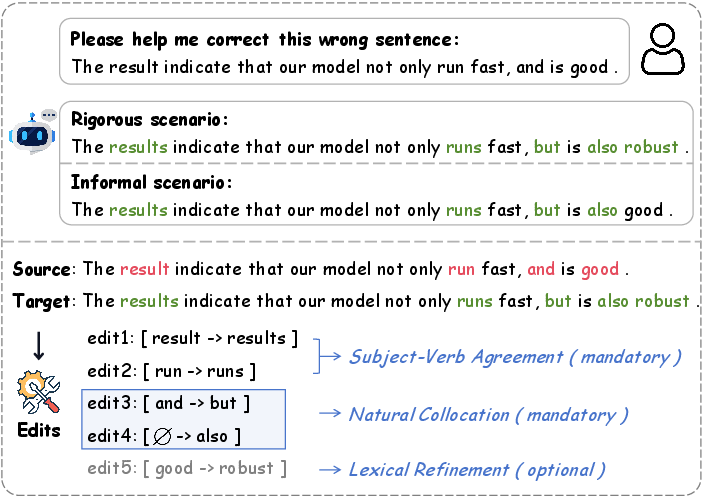
Figure 1: An example GEC instance illustrating the identification of edit impact, classifying system-predicted edits with respect to their importance based on human judgments.
Key challenges include: (i) quantifying the impact of each edit within a sentence context to precisely reflect fluency and grammatical completeness; (ii) robust identification and merging of latent associations between discontinuous edits, ensuring syntactic and semantic dependencies are respected.
Embedded Association Graph Scoring Framework
The authors propose a two-stage scoring architecture (Figure 2). The first stage involves mining latent associations between atomic edits by leveraging large-scale GEC corpora and association rule mining (ARM). Edits within a sentence are treated as “transactions,” and frequent co-occurrence patterns form the basis for initial associations. Embedding-based modeling, incorporating semantic proximity and negative sampling, is applied over these graphs to generalize observed edit associations to unseen pairs. Syntactic filtering via sequence and dependency distances ensures that only contextually relevant associations are maintained, mitigating over-merging from corpus-level biases.
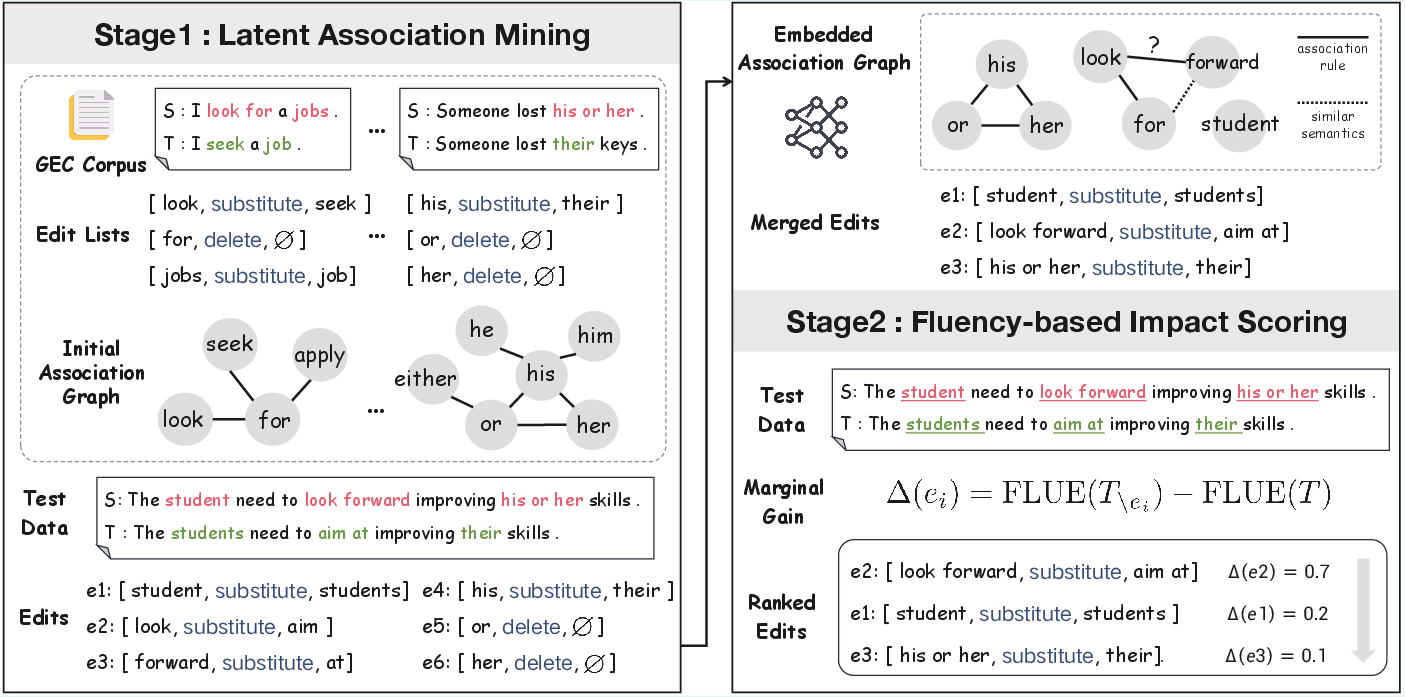
Figure 2: Overall architecture: latent association extraction followed by merged edit ranking based on sentence fluency reduction.
The second stage ranks these merged edit groups using fluency-based impact scoring. The marginal fluency gain Δ(ei) is defined as the difference in fluency score (e.g., perplexity, BERTScore) when all edits are applied except ei versus the fully corrected sentence. Higher Δ(ei) values indicate greater edit significance.
Experimental Validation and Analysis
Evaluation spans four GEC datasets in Chinese, English, Spanish, and German, utilizing outputs from standard GEC annotations, GPT-4o, GECToR, and T5-large systems. Systems are evaluated via reference-free, LLM-based annotation schemes labeling edits as “Corrected” (mandatory) or “Reasonable” (stylistic). Two metrics are employed: Boundary Score (Sbound), measuring partitioning quality between mandatory and optional edits, and Ranking Score (Srank), penalizing inversions where optional edits are ranked above mandatory ones.
The method consistently outperforms baselines—including random ordering, vanilla perplexity-based ranking, greedy sequential scoring, and syntax-only grouping using dependency trees—across all datasets, languages, and edit sources. Main results indicate significant gains, e.g., in CoNLL14 (English Std.) Sbound=86.33 and Srank=86.17 using the proposed approach, well above comparable methods.
Robustness and Cross-linguistic Structure
The approach demonstrates strong generalization to multiple languages and diverse error sources, showing stability across fluency scoring functions (perplexity, BERTScore, BARTScore). Analysis of edit density and sentence length confirms robust performance, especially in high-complexity scenarios requiring edit aggregation. Visualizations of association graphs reveal topology differences across languages, supporting the claim that the embedded association graph adapts to syntactic and morphological variations (Figure 3).
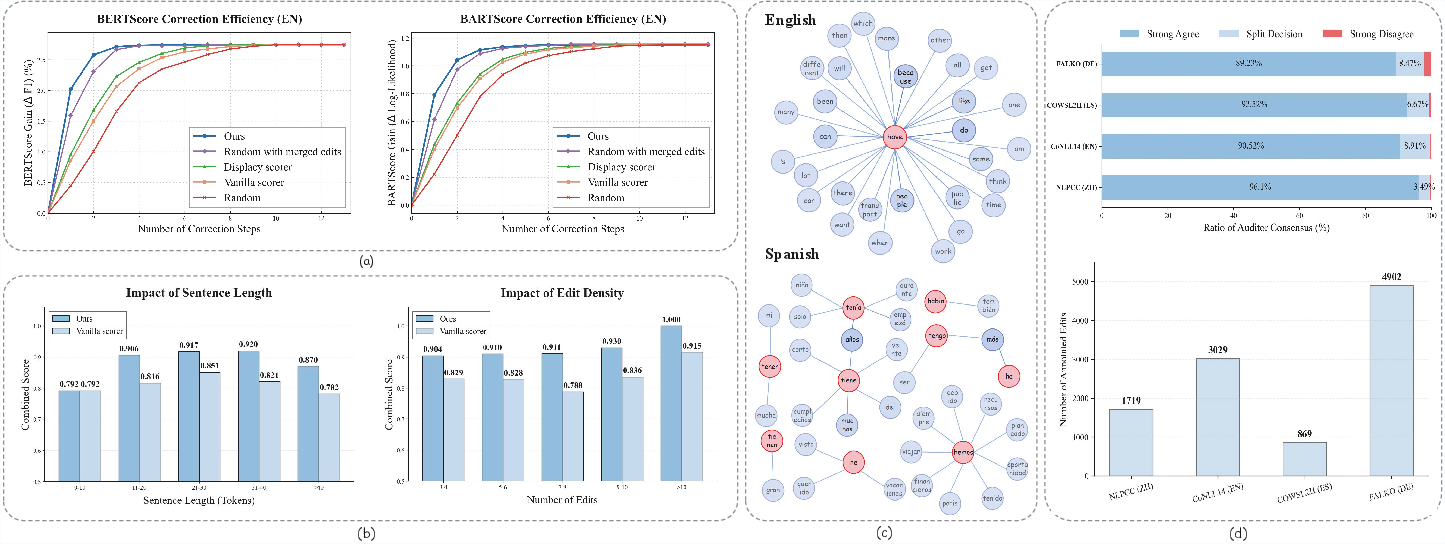
Figure 3: Experimental analysis: scoring gains by edit count in CoNLL14, performance across sentence lengths/edit densities, association graphs in English/Spanish, and LLM consensus audit results.
Annotation scheme audits using multiple LLMs yield high inter-annotator agreement (Cohen’s Kappa >0.80), establishing the reliability of the automated annotator as a proxy for human judgment.
Case studies (including cross-sentence dependencies, German separable verbs, and distinction of pseudo-association pairs via syntactic filtering) highlight the necessity of merging and context-sensitive evaluation. Statistical ARM alone over-merges co-occurring but unrelated edits, necessitating syntactic constraints for precision.
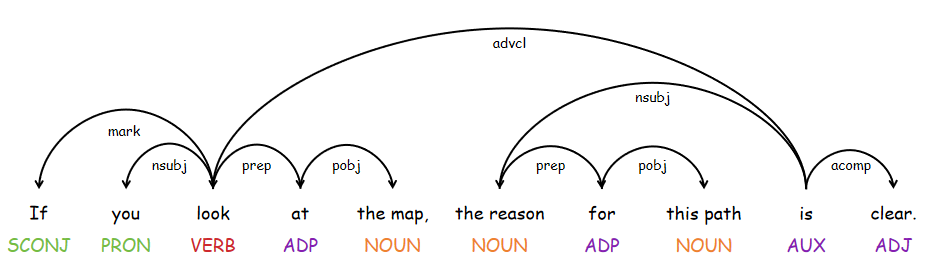
Figure 4: Dependency tree demonstrating syntactically distant but statistically frequent co-occurrence of “look” and “for” in context.
Implications and Future Directions
Theoretical implications include the bridging of edit-level evaluation with edit modeling paradigms, enhancing interpretability and control in GEC post-processing. Practically, the method enables fine-grained control over correction rigor and edit selection in writing aids and tutoring systems. The approach is agnostic to underlying GEC architectures, scalable to large datasets, and extensible to multilingual, morphologically diverse settings.
Future research may focus on automated threshold calibration to further generalize across typologically divergent languages and explore dynamic adaptation in real-time, low-latency environments.
Conclusion
This paper introduces an efficient, interpretable framework for scoring edit impact in grammatical error correction, leveraging embedded association graphs to capture cross-linguistic dependencies and fluency-based ranking. The approach advances edit selection and prioritization, enhancing both interpretability and utility across multilingual GEC systems (2604.06573).