Probing the Planck scale with quantum computation
Abstract: General relativity and quantum mechanics are incompatible at the Planck scale. This contention can be examined if a quantum computer is set to operate at a rate that exceeds the classical limit of one operation per Planck volume-time, or equivalently $2{491}$ m${-3}$ s${-1}$. Here we quantify the relation between the logical qubit count and the extent to which classicality is challenged. We argue that 500 logical qubits are sufficient to reject theories confined to a laboratory. We account for the operational cost of computation and communication at all scales up to and including the observable universe, ultimately constrained by a 1600-logical-qubit computer. Remarkably, current plans for commercial quantum computers are projected to surpass this limit, thereby putting the quantum-gravity standoff to the test.
Paper Prompts
Sign up for free to create and run prompts on this paper using GPT-5.
Top Community Prompts
Explain it Like I'm 14
What is this paper about?
This paper asks a bold question: can quantum computers tell us whether our universe follows “classical” rules at the tiniest possible scales, called the Planck scale? The authors show that running certain quantum programs fast enough, in a small space and for a short time, can stress-test any classical, bit-by-bit model of reality. They calculate how many high‑quality (“logical”) qubits are needed to do that.
The big idea in simple terms
- The Planck scale is the ultimate “small and fast” limit in physics:
- Planck length ≈ 1.6 × 10⁻³⁵ meters (way smaller than an atom).
- Planck time ≈ 5.4 × 10⁻⁴⁴ seconds (unimaginably short).
- If a device could do at least one basic operation in every tiny Planck-sized chunk of space during every Planck time, it would hit a natural “classical” limit on how fast information could be processed.
- Quantum computers are special because with n logical qubits, they can effectively perform about 2ⁿ “equivalent classical operations” (the paper calls this NEO). That exponential jump lets them pack an enormous amount of computation into a small lab and short time.
The authors ask: if a quantum computer demonstrates such extreme performance, could any hidden classical mechanism possibly be running underneath it? Their answer: only if that classical mechanism can process information at scales even smaller than the Planck length—which is a huge stretch.
What questions are they trying to answer?
In everyday words, the paper focuses on:
- How can we measure the “computational intensity” of a device? (They use computational rate density: how many operations happen per cubic meter per second.)
- Given a certain demonstrated performance, what smallest size must the device’s hidden parts have—if it were secretly classical? (If the performance is too high, the hidden classical parts would have to be smaller than the Planck length, which clashes with our current physics.)
- How many logical qubits would a quantum computer need to force that kind of contradiction with classical models?
- Does the answer change if we let the classical model use not just the lab, but the entire universe’s past to compute and communicate?
How do they approach it?
The authors build a simple, physics‑based model of computing that respects two everyday rules:
- Nothing travels faster than light (causality).
- You can only use resources (processors, memory, messages) that physically fit within space and time.
Using those rules, they do the following:
- Define computational rate density (CRD): how many operations happen per unit volume per unit time. Think of it as “how many steps per second in a shoebox-sized space.”
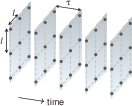
- Relate performance to a “cell size” l and a clock time τ. If you squeeze more operations into the same space and time, l must get smaller.
- Use lab-sized and universe-sized “resource budgets”:
- Lab-limited: count only what fits inside a lab over the duration of the experiment.
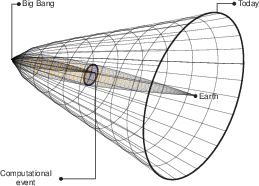
- Universe-limited: allow all possible computations anywhere in the past that could have influenced the result today (everything inside our past light cone since the Big Bang).
- Consider how connected the computations are:
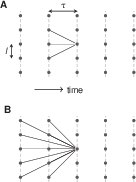
- Nearest‑neighbor (each step uses only a few inputs).
- Fully connected (each step can use every previous step it could possibly “hear from” at light speed).
- Translate a quantum computer’s capability (n logical qubits → about 2ⁿ equivalent classical operations) into a bound on the smallest classical “cell size” l that could explain the same performance. If l must be smaller than the Planck length to keep things classical, the classical model is in trouble.
Helpful terms in plain language:
- Logical qubit: a high‑quality, error‑protected qubit made from many physical qubits, like a super-reliable “virtual” bit.
- Past light cone: all places and times in the past that could have sent a light-speed signal to the here-and-now. It’s the absolute limit on what information could influence your experiment.
What did they find, and why does it matter?
Here are the main takeaways, stated as approximate “qubit thresholds” you’d need to reach the Planck scale:
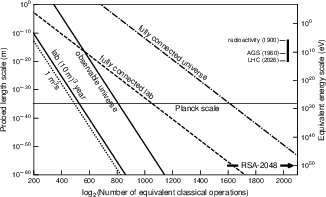
- Lab-limited (typical big lab, year-long run): around 500 logical qubits
- Their detailed estimate is about 525 logical qubits. Reaching this would push the computational rate density past one operation per Planck volume and time in a lab. That would force any classical explanation to use hidden parts smaller than the Planck length—an extremely strong challenge to classical models of reality in the lab.
- Universe-limited (use the whole past light cone of the universe): about 800 logical qubits
- Even if a classical model could “borrow” all the computations done anywhere in the universe that could influence your experiment, a quantum device with ~800 logical qubits would still push beyond the Planck limit.
- Fully connected lab (each step uses nearly all previous steps): about 1,050 logical qubits
- This counts communication overhead when everything talks to everything it can.
- Fully connected universe (the most generous classical assumption possible): about 1,600 logical qubits
- This is the ultimate “best case” for a classical explanation, counting both all computations and all communications allowed by causality across the entire history of the universe. Surprisingly, a quantum computer in the range planned for breaking RSA‑2048 encryption—roughly this many logical qubits—would surpass even this extreme classical bound.
Why it matters:
- These numbers suggest that the quantum computers companies plan to build (to run algorithms like Shor’s for breaking RSA‑2048) aren’t just about cryptography; they could also directly test whether classical rules can underlie quantum mechanics at the tiniest scales.
- If such a quantum computer succeeds, it pushes us to accept that classical “cell-by-cell” models can’t explain what’s happening—at least not without going beyond the Planck scale. If such efforts repeatedly fail for unexplained reasons, that might hint at limits to quantum mechanics itself.
What does this mean for the future?
- Near-term impact: As quantum hardware improves toward thousands of logical qubits, experiments may naturally wander into a regime that no classical model (limited by the Planck scale and the speed of light) can keep up with.
- Big-picture physics: Success would strengthen the case that quantum mechanics holds even against extreme “classicalization” ideas at the Planck scale. It would also put pressure on our understanding of gravity (general relativity) at those scales, since that’s where quantum mechanics and gravity famously clash.
- Technology and tests: The paper argues that it’s not enough for a classical model to “solve the same math problem.” It would also have to mimic the internal steps and verified subtests of the specific quantum algorithm and device—an even higher bar.
In short: building powerful quantum computers doesn’t just promise faster computing; it could help answer one of the deepest questions in physics—what really happens at the smallest, fastest scales of our universe.
Knowledge Gaps
Knowledge gaps, limitations, and open questions
Below is a concise, actionable list of what the paper leaves uncertain or unexplored, organized to guide future research.
- Definition and auditing of NEO: The paper equates a computation on n logical qubits with “Number of Equivalent classical Operations (NEO)” but does not provide a rigorous, algorithm-independent definition of NEO nor a standardized, auditable protocol to measure it in situ (including gate counts, depth, verification steps, and fault-tolerant overhead).
- Algorithm-specific NEO mapping: It remains unclear how to translate specific quantum algorithms (e.g., Shor, random circuit sampling, quantum simulation) into a certified lower bound on required classical operations that any classical-contending model must perform to reproduce the same verified outputs and intermediate subtests.
- Complexity-theoretic assumptions: The argument implicitly relies on widely believed but unproven classical simulation lower bounds (e.g., exponential cost to emulate certain quantum processes). A precise statement of the necessary complexity assumptions and their implications for the “classical capacity” bounds is missing.
- NISQ regime quantification: The paper explicitly sets aside how to quantify NEO in noisy, sampling-based demonstrations (random circuit sampling, Gaussian boson sampling). A framework is needed to translate noisy sampling tasks—with approximate verification and anti-concentration assumptions—into defensible NEO counts.
- Verification sufficiency: It is not established what verification evidence (e.g., factoring output alone vs. detailed access to subcomponents, gate tomography, intermediate checks) is necessary and sufficient to attribute a given NEO to a concrete experimental run in a way that a classical-contending model must mimic.
- Operation ontology: The notion of a “classical operation” in the CRD model is left informal. A precise mapping to actual bit operations, memory accesses, communication events, and analog processing is needed to avoid ambiguity in the c/l4 bound.
- Ignored thermodynamic and quantum speed limits: The causality-derived bound omits energy/entropy constraints (Landauer limit, Margolus–Levitin bound, Bremermann’s limit). Integrating energy, power density, and heat dissipation could materially change maximal classical capacities and resulting qubit thresholds.
- Memory and bandwidth limits: The capacity analysis does not incorporate memory size, bandwidth, and latency constraints of classical processors and networks—factors that might tighten (or in some cases relax) the operation-count bounds relative to c/l4.
- Communication cost modeling: The “fully connected” counting (pairwise integration of all past events) assumes a simple communication-as-operation model but does not specify message sizes, protocols, or routing constraints that determine how many “operations” communication actually entails.
- Sensitivity to lab geometry and runtime: The laboratory bounds assume volumes (e.g., 1000 m³) and runtimes (e.g., up to a year) without analyzing sensitivity to real device footprints, modular architectures, cryogenic infrastructure, or long runtimes that could change the effective spacetime volume available.
- Cosmology dependence and uncertainties: The universal bounds (via and ) depend on the cosmological model and parameters (e.g., , dark energy, early-universe expansion). The paper lacks an uncertainty analysis and does not explore how alternative histories (inflation details, varying ) shift the qubit thresholds.
- Inclusion of the Planck/early epoch: Integrals extend to the Big Bang while simultaneously treating Planck-scale physics as classical for the purpose of bounding capacity. The consistency and impact of unknown pre-inflation/Planck-epoch physics on accessible operation counts are not examined.
- Holographic/Bekenstein bounds: Potentially stronger information/entropy bounds (Bekenstein, holographic principle, black hole formation thresholds) are not integrated. Whether these would tighten or alter the c/l4-based limits is an open question.
- Nonlocal or superdeterministic loopholes: The analysis assumes causal, local classical models. It does not address whether nonlocal classical models, retrocausal theories, or superdeterministic initial-condition encodings could evade operation-count constraints without violating observed physics.
- Continuous classical fields and analog computing: The framework presumes discrete “operations” per Planck cell-time. How continuous classical field evolutions or analog computation paradigms map onto operation counts—and whether they could circumvent the CRD limit—remains unexplored.
- Definition of “classicality challenged”: The paper equates surpassing Planck CRD with challenging “classical theories,” but does not formalize the exact class of theories ruled out (e.g., local causal cellular automata vs. broader classical models) nor how to interpret a null or positive result in theory space.
- Threshold robustness (525, 1050, 1609 qubits): The qubit thresholds are reported without a quantified error budget. A sensitivity study is needed to show how modeling choices (lab size/time, connectivity, cosmology, verification rigor) and constants propagate to uncertainty in required logical qubit counts.
- Mapping logical to physical resources: There is no concrete integration of error-correction overheads (cycles, ancillas), gate speeds, and realistic device layouts that determine achievable CRD and runtime—i.e., turning the logical-qubit targets into physically realizable, time-bounded experiments.
- Depth and timing constraints: The connection between circuit depth/runtime and the NEO credited to a single experiment is not formalized. Guidance is needed on how to attribute NEO when an algorithm requires many sequential rounds or when repeated runs are needed due to probabilistic outputs.
- Intermediate results and storage: The counting for tabulated prior computations in the lab/universe scenario assumes inclusion of “all preceding calculations” but lacks a concrete model of data retention, accessibility, and addressing. Formal criteria for what prior computations “count” are required.
- Double counting and independence: In the fully connected universe model, it is unclear how to prevent double counting of overlapping causal influences or to account for dependence among events. A rigorous combinatorial/causal accounting is needed to justify squaring/integration steps.
- Experimental failure criterion: The proposal that “persistent failures with no apparent technical reasons” might signal a boundary of quantum mechanics is not operationalized. Clear statistical criteria, null hypotheses, and diagnostic protocols to separate fundamental limits from engineering challenges are missing.
- Application beyond factoring: The framework is tailored to factoring (verifiable outputs, large n). Extending it to other high-impact algorithms (e.g., quantum chemistry, materials, dynamics simulation) requires methods to define NEO and verification when ground-truth is expensive or unknown.
- Device-level causality constraints: The analysis does not examine whether speed-of-light constraints internal to large quantum processors (interconnects, control signaling) could limit effective CRD, nor how architecture (modularity, photonic links) influences the spacetime footprint of computation.
- Empirical metrology of CRD: There is no proposed experimental metrology for CRD—how to measure and report the “operations per volume per time” of a quantum run, with uncertainty, in a way that enables direct comparison to the derived classical bounds.
Practical Applications
Immediate Applications
The following items translate the paper’s concepts—Computational Rate Density (CRD), Number of Equivalent classical Operations (NEO), and causality-aware operation counting—into deployable uses across sectors. Each includes key dependencies/assumptions that affect feasibility.
- CRD/NEO benchmarking and reporting standard for quantum hardware (industry, standards, software)
- What: Define and publish a “CRD score” and “NEO score” per run, integrating lab volume, runtime, connectivity overhead, and verified gate sequences. Provide compiler/toolchain plugins (e.g., for Qiskit, Cirq) that emit CRD/NEO metadata and a “Planck-probe” score.
- Tools/products/workflows: CRD/NEO calculator SDK; device telemetry schema; run attestation reports that auditors can verify.
- Assumptions/dependencies: Community consensus on NEO accounting (e.g., counting 2n for n logical qubits only for verified algorithm steps); access to accurate runtime, volume, and connectivity data; trusted logging/attestation.
- Milestone setting for roadmaps: 500, 1050, 1600 logical-qubit “Planck-probe” targets (industry, policy, academia)
- What: Adopt milestone gates tied to the paper’s thresholds—~500 logical qubits to exclude lab-confined classical models; ~1050 for fully connected lab; ~1600 for fully connected universe—to guide funding, procurement, and program goals.
- Tools/products/workflows: Portfolio planning dashboards; progress badges for vendors/labs; grant review criteria referencing CRD thresholds.
- Assumptions/dependencies: Credible logical qubit counting under fault-tolerant operation; stable logical error rates; reproducible verification of submodules and full algorithms.
- Quantum advantage reporting anchored in NEO plus verification artifacts (academia, industry, standards)
- What: Complement “speedup” claims with audited NEO counts and step-by-step verification evidence that the quantum run mimicked the algorithm (e.g., Shor, boson sampling), addressing the paper’s call to tie claims to specific algorithmic steps.
- Tools/products/workflows: Structured test harnesses; interim-result logging; reproducible verification datasets.
- Assumptions/dependencies: Ability to introspect and log gate-level behaviors without compromising device performance; acceptance of verification protocols by journals/conferences.
- Interim “high-NEO” experiment design on NISQ devices (academia, industry)
- What: Prioritize and document NISQ workloads (random circuit sampling, Gaussian boson sampling) that plausibly realize high effective NEO, even if below fault-tolerant scales; quantify and certify their NEO where possible.
- Tools/products/workflows: Complexity-theory–backed NEO estimators for noisy experiments; certification methods (e.g., cross-entropy benchmarking, heavy-output generation).
- Assumptions/dependencies: Validity of complexity conjectures underpinning sampling hardness; community-accepted ways to translate noisy outcomes into conservative NEO bounds.
- Procurement and compliance: CRD-aware hardware acquisition and lab audits (industry, government, operations)
- What: Include CRD/NEO targets and run duration/volume constraints in procurement RFPs; audit labs for claimed “probed length scale” using the paper’s formulas.
- Tools/products/workflows: CRD audit checklists; lab volume and runtime measurement SOPs; compliance reporting templates.
- Assumptions/dependencies: Accurate, tamper-resistant telemetry; clarity on how to model communication overheads (nearest-neighbor vs fully connected).
- Accelerated post-quantum cryptography (PQC) migration (finance, healthcare, government, software, daily life)
- What: Use the paper’s linkage between RSA-2048 factoring capability (~1600 logical qubits) and fundamental-physics probing to strengthen the urgency of PQC adoption.
- Tools/products/workflows: Enterprise crypto-inventory dashboards; staged PQC rollout plans; red-team exercises assuming RSA-2048 compromise.
- Assumptions/dependencies: PQC standards availability (e.g., NIST finalists); budget and staffing for migration; realistic lead times acknowledging that fault-tolerant milestones may arrive unevenly.
- CRD-aware compiler and scheduler optimizations (software, quantum industry)
- What: Optimize circuit mapping, parallelism, and qubit placement to maximize NEO per unit volume-time, explicitly tracking communication overheads (nearest-neighbor vs dense connectivity).
- Tools/products/workflows: New objective functions in compilers; placement/routing passes that model causal communication costs.
- Assumptions/dependencies: Hardware connectivity maps and calibration data; stable gate sets; QEC code constraints (e.g., LDPC vs surface code).
- Energy and facilities planning for long-duration high-CRD runs (energy, operations)
- What: Forecast power, cooling, and uptime needs for year-long experiments aimed at CRD thresholds (e.g., ~1000 m3 over a year), aligning facilities upgrades with program timelines.
- Tools/products/workflows: Power and thermal models tied to qubit count and QEC overhead; resilience/maintenance schedules.
- Assumptions/dependencies: Reliable device energy profiles under QEC; facility redundancy; supply-chain stability for cryogenics.
- Risk and investment frameworks treating persistent QC failures as potential physics signals (finance, policy)
- What: Scenario-planning that distinguishes engineering bottlenecks from potential fundamental limits (as the paper suggests), informing portfolio hedging and public R&D diversification.
- Tools/products/workflows: Milestone-based risk triggers; independent technical review boards; stage-gate funding with contingency allocations.
- Assumptions/dependencies: Transparent failure analysis from vendors/labs; credible external evaluation; careful avoidance of premature conclusions.
- Curriculum and outreach linking quantum computing to fundamental physics (education, public engagement)
- What: Course modules and public materials explaining CRD/NEO, causality limits, and how QC milestones probe Planck-scale physics.
- Tools/products/workflows: Interactive CRD calculators; visualization of light cones and operation counting; lab exercises.
- Assumptions/dependencies: Access to open educational resources; instructor training; alignment with university/secondary curricula.
Long-Term Applications
These uses require further research, scaling, or ecosystem development, but they naturally extend the paper’s methods and thresholds.
- Laboratory tests of Planck-scale classical alternatives via fault-tolerant QC (academia, policy)
- What: Execute verified algorithms at or above Planck CRD (≥~525 logical qubits in a year-long 1000 m3 lab; ~1050 for fully connected lab; ~1600 for fully connected universe) to empirically challenge classical theories at the Planck scale.
- Tools/products/workflows: End-to-end verified Shor runs and other high-NEO algorithms; comprehensive telemetry and audit trails; pre-registered experimental protocols.
- Assumptions/dependencies: Achieving thousands of logical qubits with low logical error; community consensus on how to interpret negative/positive results; stable cosmological parameter inputs to the causal bounds.
- “CRD meters” and attestation hardware for extreme-CRD experiments (instrumentation, industry)
- What: Dedicated hardware that securely measures and attests to spatiotemporal operation density, connectivity overheads, and verified algorithm steps, enabling independent certification of Planck-probe claims.
- Tools/products/workflows: Secure enclaves for on-device logging; cryptographic attestations; third-party certification bodies.
- Assumptions/dependencies: Minimal performance impact of instrumentation; standardization across architectures; acceptance by regulators/journals.
- Causality-aware schedulers inspired by light-cone accounting (software, distributed systems)
- What: Apply the paper’s causal operation counting to optimize distributed workflow scheduling—penalizing cross-“light-cone” communication to reduce overhead and latency.
- Tools/products/workflows: New scheduling heuristics in cloud/distributed runtimes; topology-aware task graph compilers.
- Assumptions/dependencies: Measurable, stable network latencies; workload models that benefit from causal partitioning; integration with existing orchestration stacks.
- Open “CosmoQC” platforms connecting cosmology and QC resource bounds (academia, software)
- What: Software that parameterizes k_{4U}, k_{8U}, H0, and expansion histories to compute NEO-to-length-scale mappings for different cosmologies, exploring sensitivity of bounds and experimental design.
- Tools/products/workflows: Python/R packages; visualization dashboards; APIs that integrate with quantum workflow managers.
- Assumptions/dependencies: Community-maintained cosmological priors; versioning and provenance; validation against independent calculations.
- Standard-setting and regulatory frameworks for extreme-CRD claims (policy, standards)
- What: Establish criteria and review processes for declaring that a run surpasses Planck CRD or fully connected universe bounds, including evidence requirements and dispute resolution.
- Tools/products/workflows: ISO/NIST-style standards; multi-institution replication protocols; data retention and privacy policies for telemetry.
- Assumptions/dependencies: International cooperation; funding for oversight; alignment with export controls and dual-use considerations.
- Energy-efficient, year-scale fault-tolerant architectures (hardware, energy)
- What: Develop low-power, thermally stable architectures (e.g., high-rate LDPC codes, low-overhead syndrome extraction) that can sustain months-to-year runtimes needed by the paper’s scenarios.
- Tools/products/workflows: Co-design of QEC codes and hardware; lifecycle reliability engineering; green energy integration.
- Assumptions/dependencies: Advances in high-threshold, low-overhead QEC; improved qubit coherence and gate fidelity; supply of cryogenic and photonic infrastructure.
- High-NEO algorithm portfolios with verifiable outputs (academia, software, industry)
- What: Curate and optimize algorithms that combine exponential NEO growth with verifiable results (factoring, structured sampling, certain cryptographic or algebraic tasks), maximizing their value as physical probes.
- Tools/products/workflows: Algorithm-selection frameworks balancing NEO, verification ease, and hardware fit; certification protocols for outputs.
- Assumptions/dependencies: Stability of classical algorithmic baselines (so the NEO interpretation remains meaningful); availability of verification techniques that scale.
- Sectoral transition planning triggered by crossing ~1600 logical-qubit threshold (finance, government, healthcare, software)
- What: Treat the achievement of ~1600 logical qubits as a hard policy trigger for finalized PQC rollout, key-management rotations, and compliance deadlines.
- Tools/products/workflows: Automated policy enactment tied to public milestones; incident-response playbooks for legacy cryptography retirement.
- Assumptions/dependencies: Reliable, third-party confirmation of logical-qubit counts; readiness of PQC ecosystems; cross-border regulatory harmonization.
- Ethical and public-communication frameworks for experiments “that challenge gravity” (policy, education)
- What: Develop proactive communication and ethics guidelines for framing results that bear on foundational physics, mitigating hype and fostering public understanding.
- Tools/products/workflows: Communication playbooks; interdisciplinary ethics boards; public engagement programs.
- Assumptions/dependencies: Transparent scientific process; collaboration with science communicators; sensitivity to dual-use narratives.
- New scientific instruments that use QC as a probe of fundamental limits (academia)
- What: Conceptualize QC-based “computational microscopes” where exceeding CRD thresholds is the measured observable, analogous to energy/length scales in particle physics.
- Tools/products/workflows: Dedicated experimental facilities; cross-validation with tabletop quantum-gravity tests; shared data repositories.
- Assumptions/dependencies: Sufficient scale and stability of QC; theoretical frameworks to interpret null vs positive findings across competing quantum-gravity models.
Glossary
- Alternating Gradient Synchrotron: A mid-20th-century particle accelerator using alternating-gradient focusing to reach higher energies; referenced as a historical energy benchmark. "Marked years 1900, 1960 and 2026 correspond to the highest particle energies probed at those eras with radioactivity, the Alternating Gradient Synchrotron~\cite{1958:beth:the-Brookhaven-alternating-gradient-synchrotron}, and the Large Hadron Collider~\cite{2008:evans:lhc-machine}, respectively."
- causality: The relativistic constraint that information and influence cannot propagate faster than light, limiting which events can affect others. "Regardless of the intricacies of computing systems, all are ultimately limited by causality."
- co-moving distance: In cosmology, the distance between objects measured on coordinates that expand with the universe, remaining constant for objects moving with the Hubble flow. "The distance light travels from time to time , as measured today between the emitting and receiving galaxies (co-moving distance), is given by,"
- Computational Rate Density (CRD): The number of computational operations performed per unit volume per unit time. "The resulting number of operations per unit volume per unit time (CRD) is ; see Eq.~\ref{eq:calc_density}."
- cosmological scale factor: The time-dependent function that describes how the size of the universe expands with time. "The expansion history of the universe is shown by a black wireframe whose diameter is proportional to the cosmological scale factor ."
- fully connected lab: A network model where each computational event incorporates inputs from essentially all prior events in its causal past within a laboratory. "The length scale probed by the fully connected lab is shown by the dashed line of Fig.~\ref{fig:length-vs-qubits}."
- fully connected universe: An idealized model in which each computational event across cosmic history can receive inputs from all causally preceding events in the entire universe. "In a fully connected universe, every intermediate computational event can directly receive information from all other events within its past light cone (purple wireframe), adding to the operation count in Eq.~\ref{eq:calc_universe_fully_connected}, corresponding to the dash-dotted line in Fig.~\ref{fig:length-vs-qubits}."
- Gaussian boson sampling: A quantum computing scheme using Gaussian states and linear optics to perform sampling tasks believed to be classically hard. "and Gaussian boson sampling~\cite{2025:liu:robust-quantum-computational}."
- Hubble constant: The present-day rate of cosmic expansion, relating recessional velocity to distance. "where is the Hubble constant,"
- Large Hadron Collider: The world’s highest-energy particle collider used to probe fundamental physics. "even the most energetic accelerator to date, the Large Hadron Collider, reaches ~eV,"
- light-crossing time: The time it takes light to traverse a specified spatial scale, such as a laboratory’s size. "In a typical laboratory, the computation time, , is much longer than the lab light-crossing time."
- logical qubit: An error-corrected qubit encoded into multiple physical qubits to protect against noise. "We argue that 500 logical qubits are sufficient to reject theories confined to a laboratory."
- nearest-neighbor connectivity: A network topology where each node communicates only with adjacent nodes, limiting fan-in. "In the case of nearest-neighbor connectivity shown in Fig.~\ref{fig:connectivity}A, where each event is influenced by a small number of predecessors, the increased computational overhead will have negligible impact."
- Noisy Intermediate-Scale Quantum devices: Near-term quantum processors with tens to thousands of noisy qubits, not yet fully error-corrected. "to use Noisy Intermediate-Scale Quantum devices~\cite{2018:preskill:quantum-computing-in-the-nisq}"
- Number of Equivalent classical Operations (NEO): A metric mapping a quantum computation’s demonstrated capability to an equivalent count of classical operations. "The probed length scale is shown versus the Number of Equivalent classical Operations (NEO) demonstrated by a verified calculation of a quantum algorithm."
- past light cone: The set of spacetime events that could have causally influenced a given event, bounded by the speed of light. "For an external resource to contribute, it must be in the past light cone of the final output."
- Planck computational rate density: The benchmark density of one operation per Planck volume per Planck time. "Such a computer will reach the Planck computational rate density of"
- Planck energy: The energy scale at which quantum gravity effects are expected to become significant. "which is 15 orders of magnitude smaller than the Planck energy~\cite{2008:evans:lhc-machine}."
- Planck scale: The length/time/energy regime where both quantum mechanics and general relativity are expected to be simultaneously relevant. "The Planck scale is a point of contention where both should be significant and in contradiction."
- Planck time: The fundamental time unit , of order s, derived from fundamental constants. "the ability to reach very high computational rate densities that exceed one operation per Planck volume per Planck time may allow a direct test of classical theories at this scale"
- Planck volume-time: The product of a Planck-volume and a Planck-time, defining a spacetime “cell” at the Planck scale. "one operation per Planck volume-time, or equivalently ~m\ s."
- RSA-2048 encryption: A widely used 2048-bit public-key cryptosystem whose security relies on the hardness of factoring large integers. "breaking RSA-2048 encryption"
- Shor's algorithm: A quantum algorithm for efficient integer factorization, threatening RSA when run at sufficient scale. "by implementing Shor's algorithm for integer number factoring."
Collections
Sign up for free to add this paper to one or more collections.