- The paper introduces SBQE as a data-loading paradigm that leverages classical shot allocation to create a mixed-state input without quantum encoding gates.
- The methodology achieves significant performance gains on image-classification benchmarks, matching classical MLP accuracy and outperforming amplitude encoding.
- The approach integrates seamlessly into hybrid quantum-classical networks by reducing circuit depth and mitigating decoherence, while revealing new design variables.
Shot-Based Quantum Encoding: A Data-Loading Paradigm for Quantum Neural Networks
Motivation and Context
Efficient classical-to-quantum data embedding is a fundamental bottleneck in QML, particularly for NISQ hardware constrained by shallow circuit depth and pronounced decoherence. Canonical approaches—angle, amplitude, and basis encodings—exhibit intrinsic trade-offs: angle encoding is efficient and hardware-friendly but underutilizes Hilbert space; amplitude encoding saturates the available quantum capacity but demands exponentially deep circuits; basis encoding is suitable only for integer-valued data and scales poorly in practice. Shot-Based Quantum Encoding (SBQE) is proposed to circumvent these limitations by leveraging the hardware's natural resource allocation—shots—as a learnable, data-dependent degree of freedom, while eliminating the need for quantum data-encoding gates.
SBQE defines data embedding through the classical allocation of shots among a set of initial quantum states {∣ψj⟩}j=1n, forming a mixed-state input representation. For each data sample x, a classical network generates a probability vector p(x), which parameterizes a multinomial shot allocation across the states. The encoded state is
ρ(x)=j=1∑npj(x)∣ψj⟩⟨ψj∣,
which, after processing by a shallow VQC, yields observable expectation values linear in p(x), thus directly compatible with classical non-linear post-processing.
A crucial insight is the structural equivalence between the SBQE layer and a classical MLP, with “weights” given by quantum circuit-executed observables:
fi(x,θ)=j∑Wij(θ)pj(x),Wij(θ):=⟨ψj∣U†(θ)OiU(θ)∣ψj⟩,
where U(θ) is a trainable quantum unitary and Oi denotes measured observables. This hybrid blueprint allows stacking of multiple SBQE layers, employing non-linear classical activations (e.g., log-ReLU+softmax), yielding multilayer quantum perceptron analogues.
Benchmark Evaluation
The empirical evaluation targets two image-classification datasets, both projected to R8 via PCA to fit 8-qubit circuits:
- Semeion Handwritten Digits: 1,593 examples, 10 classes.
- Fashion-MNIST: 70,000 examples, 10 classes.
All models are parameter-count matched. For each, ten independent seeds are used; performance is assessed on stratified data splits, with model selection based on validation accuracy and test results reported as mean ± standard deviation.
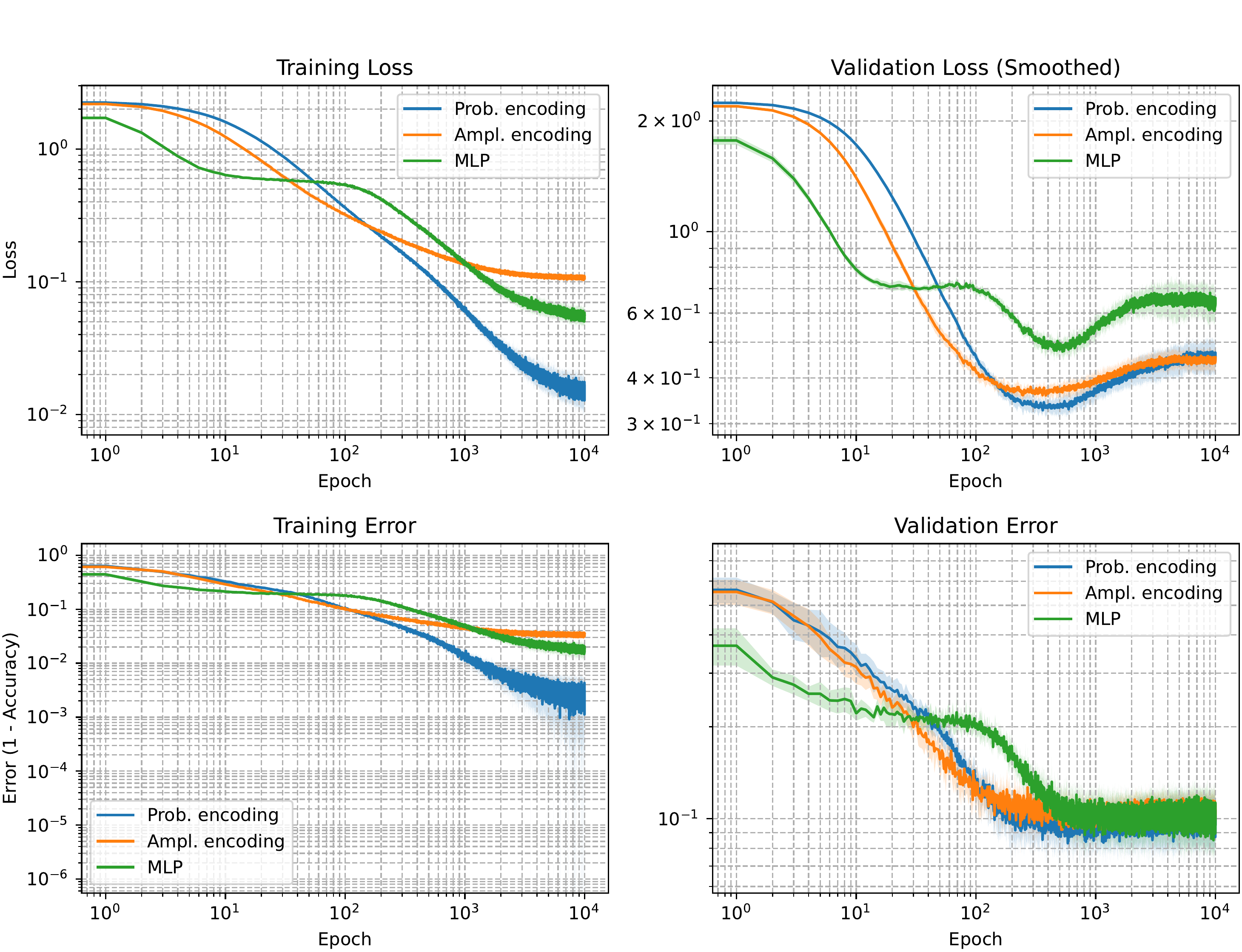
Figure 1: Learning trajectories on the Semeion benchmark (8 qubits, 4 layers), contrasting SBQE, amplitude encoding, and classical MLPs.
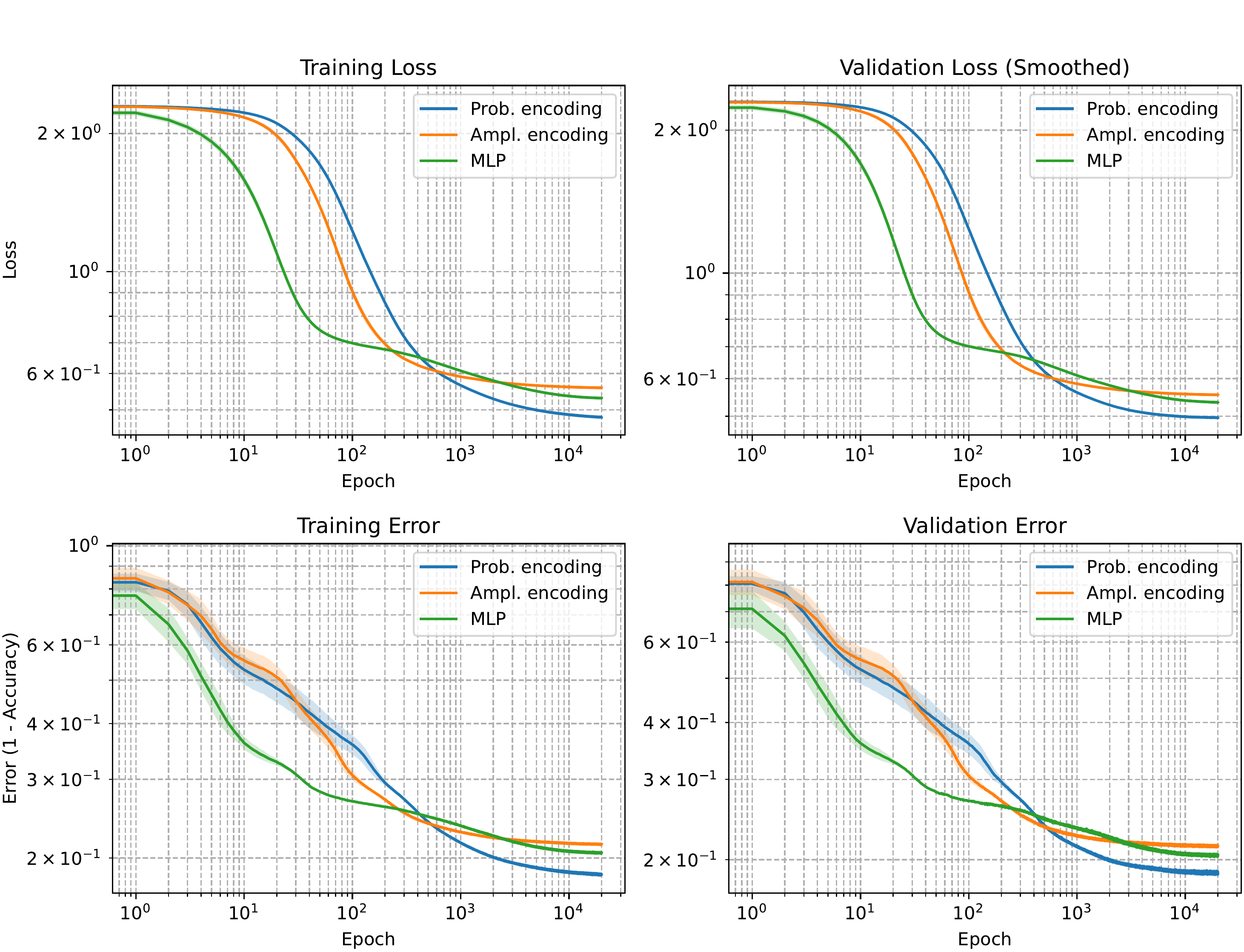
Figure 2: Learning trajectories on the Fashion-MNIST benchmark (8 qubits, 4 layers) indicating test accuracy across models.
SBQE attains 89.1%±0.9% test accuracy on Semeion, reducing classification error by 5.3% relative to amplitude encoding, and aligns statistically with a width-matched classical MLP, which achieves x0. For Fashion-MNIST, SBQE achieves x1, outperforming amplitude encoding by an absolute margin of 2.0% and the linear MLP by 1.3%. Paired x2-tests confirm these improvements are statistically significant (x3 and x4, respectively).
Practical and Theoretical Implications
Hardware Efficiency
SBQE eliminates quantum data-encoding gates, drastically reducing aggregate circuit depth and thus mitigating decoherence and hardware error. All data embedding is delegated to the software orchestrating the quantum experiment, i.e., the classical shot controller. This approach is inherently compatible with, and tuned to, the stochastic sampling-based measurement model of NISQ hardware.
Expressivity
By mapping classical data into probability distributions over an exponentially large pool of input states, SBQE matches amplitude encoding's exponential capacity but with only linear circuit depth. Unlike angle encoding, it is not restricted to periodic function classes of variational ansätze and is empirically shown to handle linear separability without the weaknesses associated with Fourier truncation.
Integration in Hybrid Architectures
The structurally linear input-probability to observable mapping in SBQE, together with arbitrary classical pre-processing and non-linear post-processing, allows straightforward composition into quantum-classical DNNs. Output probability vectors naturally serve as input distributions for additional SBQE layers, enabling network depth scaling with classical interleaving.
Limiting Factors and Open Directions
Notwithstanding its benefits, SBQE's expressivity depends on sufficient total shot count. Fidelity of the input distribution representation degrades as total shots per sample decrease, especially in high-dimensional feature spaces. Furthermore, the probability-mapping preprocessor introduces an additional classical architecture design variable, which must be tuned per dataset. Hardware limits on accessible initial states x5 might constrain flexibility, but extensions using superposed parameterized circuits are envisioned. Multilayer SBQE architectures require repeated circuit invocations, which may trade off wall-clock time versus accuracy.
Conclusion
Shot-Based Quantum Encoding provides a hardware-adapted, gate-free, and statistically robust solution to quantum data-loading on NISQ devices. It achieves empirical parity with classical MLPs and outperforms traditional amplitude-encoding QNNs of equivalent quantum resources on challenging image-classification benchmarks. SBQE exposes the classical shot-allocation dimension as a practical, learnable mechanism for efficient hybrid QML, with direct operational significance for scaling quantum-classical algorithms within near-term hardware constraints.
Reference:
"Shot-Based Quantum Encoding: A Data-Loading Paradigm for Quantum Neural Networks" (2604.06135)

