Search for soft unclustered energy patterns produced in association with a W or Z boson in proton-proton collisions at $\sqrt{s}$ = 13 TeV
Published 7 Apr 2026 in hep-ex | (2604.05996v1)
Abstract: A search for a Higgs boson produced in association with a W or Z boson and decaying via a soft unclustered energy pattern (SUEP) is presented. The analysis is based on proton-proton collision data corresponding to an integrated luminosity of 138 fb${-1}$ collected between 2016 and 2018 at the LHC. Final states with a leptonic W or Z boson decay associated with a high multiplicity of low-momentum charged particles are explored for the first time. The results show no significant excess over the standard model background expectation. Limits are set on the production cross section of a Higgs boson that decays to a SUEP, for a range of parameters of the SUEP model. Material is provided to facilitate further interpretation of the results.
The paper presents a search for SUEP production in association with W/Z bosons using 13 TeV proton-proton collision data from the CMS detector.
The paper employs advanced lepton triggering and a data-driven extended ABCD method to isolate low-pT SUEP signals from significant background noise.
The paper sets stringent upper limits on the cross section for hidden-valley models, significantly improving constraints compared to previous gluon-fusion strategies.
Search for Soft Unclustered Energy Patterns Produced in Association with a W or Z Boson in Proton-Proton Collisions at s=13 TeV
Introduction and Physics Motivation
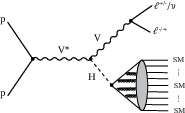
This study presents a search for soft unclustered energy patterns (SUEP) produced in association with a W or Z boson in proton-proton collisions at s=13 TeV, employing the CMS detector. SUEP signatures, predicted in hidden-valley (HV) scenarios with strong dark-QCD-like dynamics, manifest as high-multiplicity, low-momentum, isotropically distributed final states. Such signals represent compelling targets for beyond-the-Standard-Model (BSM) physics, particularly addressing elusive new sectors connected via a Higgs portal.
The analysis is differentiated from prior SUEP searches by exploiting associated production modes (VH) with leptonic decays of the vector boson, as opposed to the previously-studied gluon-fusion channel. This strategy enables more efficient trigger strategies while reducing the overwhelming QCD multijet background. Triggering on leptons from on-shell W or Z decays sharply increases the signal sensitivity, especially for SUEP models with low dark-meson mass and Boltzmann temperature, which enhance the typical multiplicity and spherical topology of the event.
Figure 1: Schematic diagram of the 125 GeV Higgs boson decaying to a SUEP shower, produced in association with a leptonically decaying vector boson.
Experimental Methodology and Data Analysis
Detector Overview and Reconstruction Algorithms
The CMS detector provides efficient reconstruction of electrons, muons, and jets with sub-GeV tracking precision and comprehensive calorimetry, essential for discriminating low-momentum SUEP constituents from SM processes. Global particle flow (PF) and advanced isolation, impact parameter, and identification criteria are employed to minimize the background from fake leptons and jets.
Signal and Background Modeling
Signal samples are generated for the pp→VH production (with V=W or Z, H→ SUEP) and various SUEP parameter configurations. Decays proceed via Higgs to a dense dark sector shower of dark mesons, each decaying to pairs of dark photons, themselves visible in the detector only via kinetic mixing. Multiple signal scenarios are considered:
Dominantly leptonic or hadronic dark photon decay modes,
Dark meson mass mdark between 1–8 GeV,
Boltzmann temperature Tdark spanning mdark/4 to s=130.
Backgrounds are modeled via both full simulation and data-driven techniques, with the dominant sources arising from Drell–Yan, s=131+jets, s=132, and multijet production.
Event Selection and Signal Regions
Two orthogonal channels are defined:
s=133 channel: Exactly one tight lepton (electron or muon) and a SUEP candidate clustered using anti-s=134 with s=135, alongside missing s=136.
s=137 channel: Exactly two opposite-sign, same-flavor leptons and a SUEP candidate, with further requirements on dilepton invariant and s=138.
Backgrounds are suppressed with stringent lepton identification, sphericity requirements on the SUEP candidate, and s=139-jet vetoes. Control regions with real photons (PR-WH, PR-ZH) and VH0-enriched/diluted selections allow validation of background estimates.
Data-Driven Background Estimation
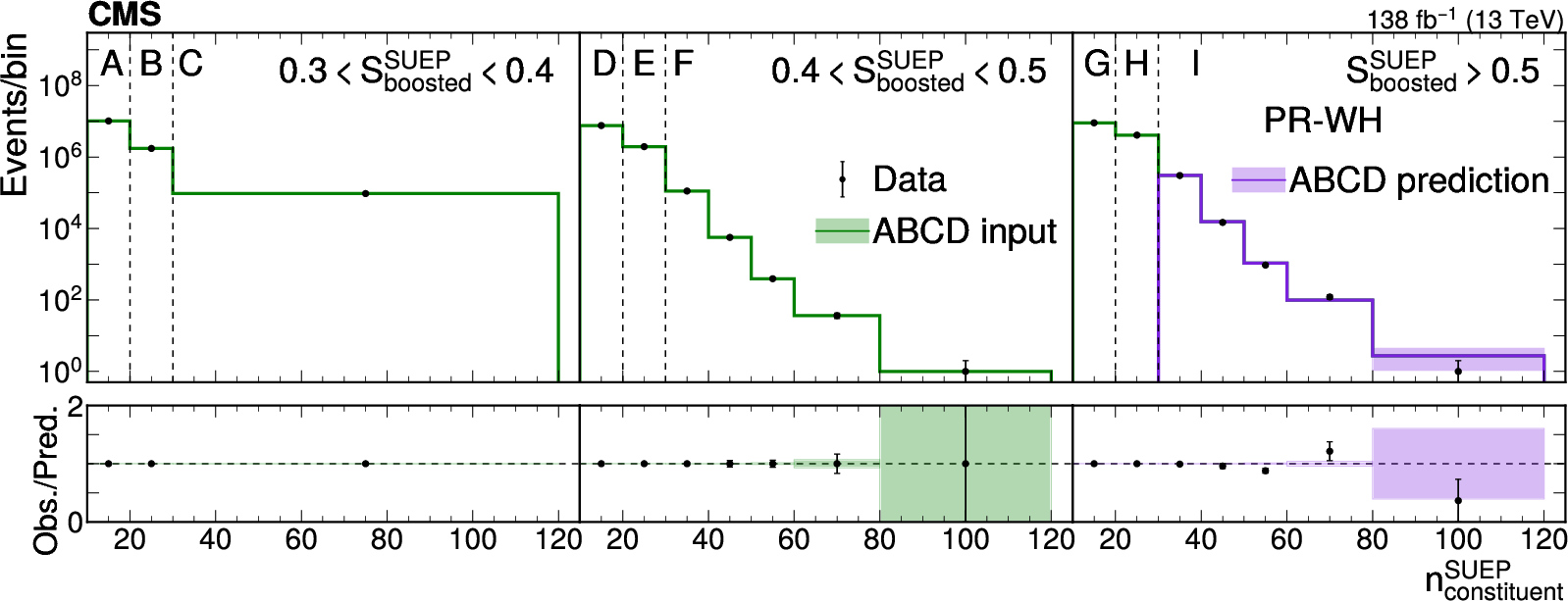
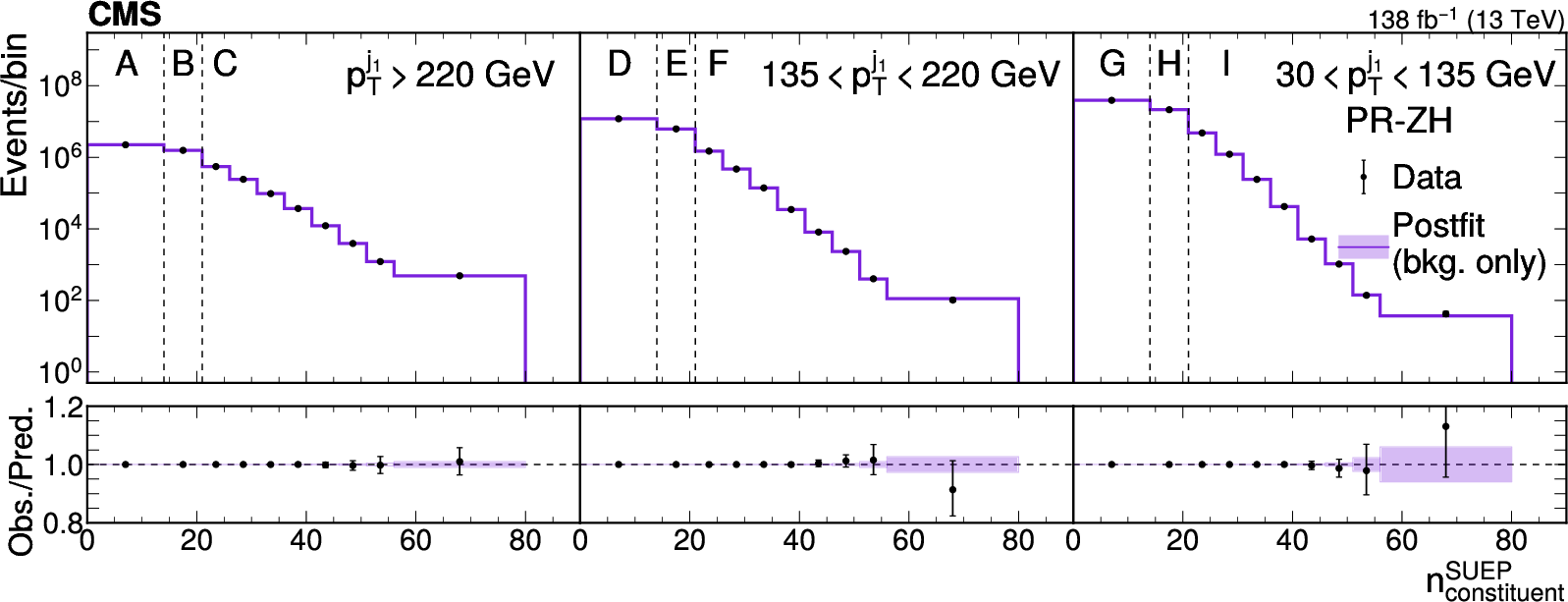
The extended ABCD method is adopted using VH1 (the multiplicity of SUEP candidate charged tracks) and another decorrelated variable as axes, dividing the sample into nine subregions. This methodology allows an essentially simulation-independent estimate of the SM background, including systematic evaluation of closure and non-closure effects, as established in real and signal-free control samples.
Figure 2: Distributions of VH2 in extended ABCD subregions for validation regions, illustrating agreement between data and background estimation with uncertainties.
Systematic uncertainties arising from lepton selection, jet calibration, tracking, VH3-tagging, pileup, initial/final state radiation, and luminosity are included as nuisance parameters in the likelihood fits. Cross-checks confirm that the omission of possible small signal leakage in background-dominated regions negligibly impacts the sensitivity.
Results
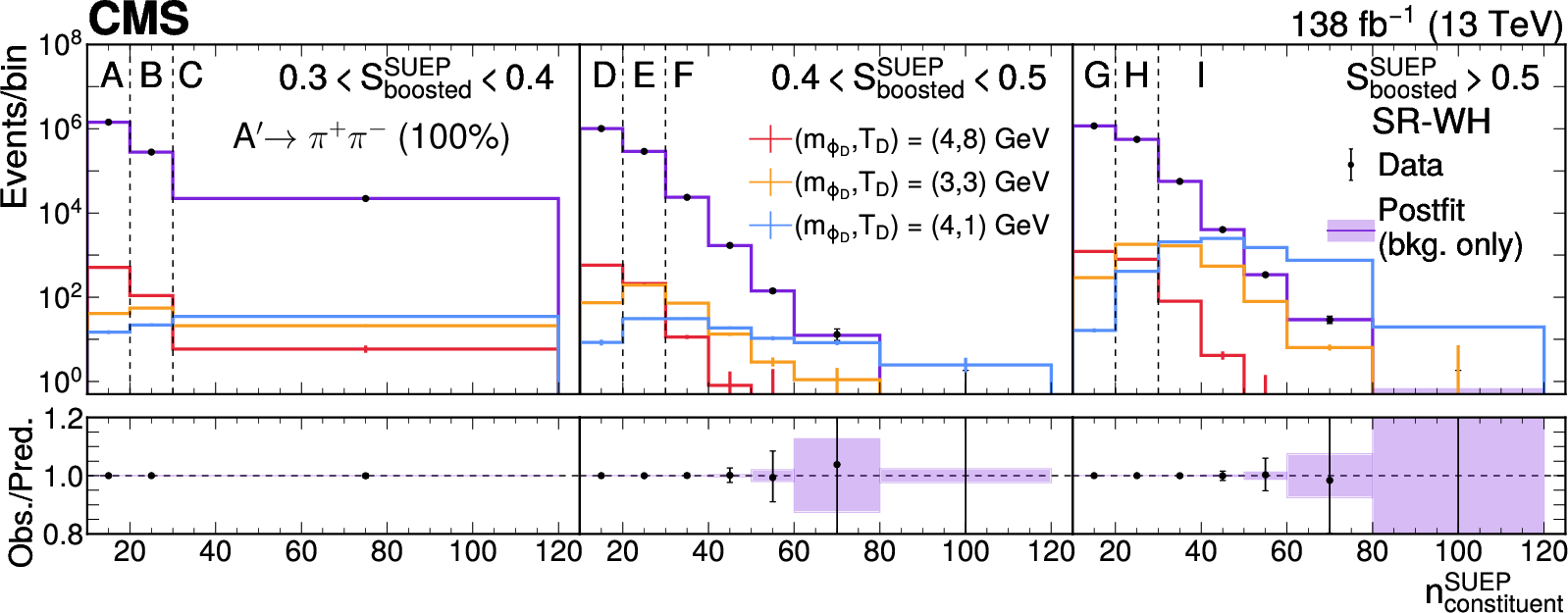
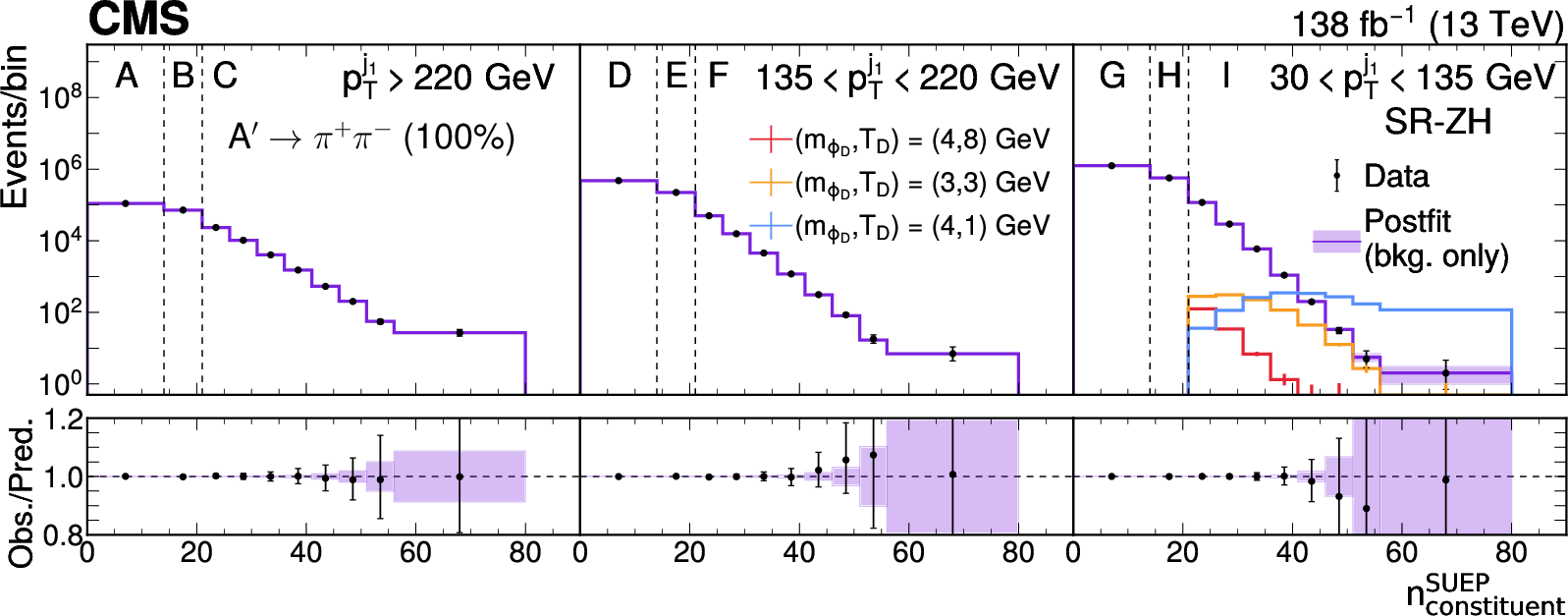
No statistically significant excess is observed beyond the SM expectation in either the VH4 or VH5 channel. The observed VH6 distributions are compatible with the post-fit SM backgrounds, and upper limits are set on the cross section times branching fraction to SUEP as a function of model parameters.
Figure 3: Distributions of VH7 in the signal regions for the VH8 (upper) and VH9 (lower) channels, post-fit, along with representative signal hypotheses.
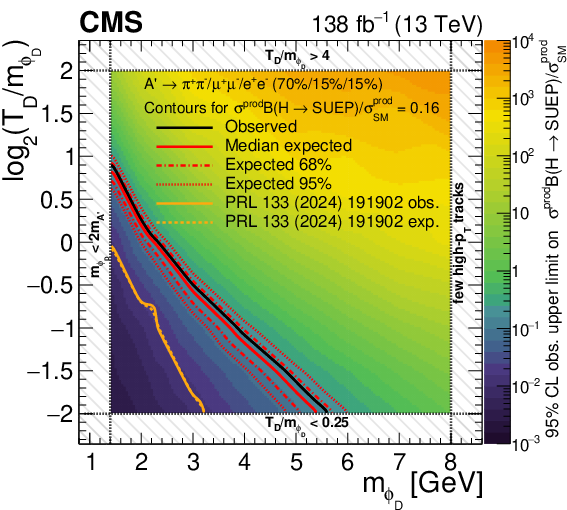
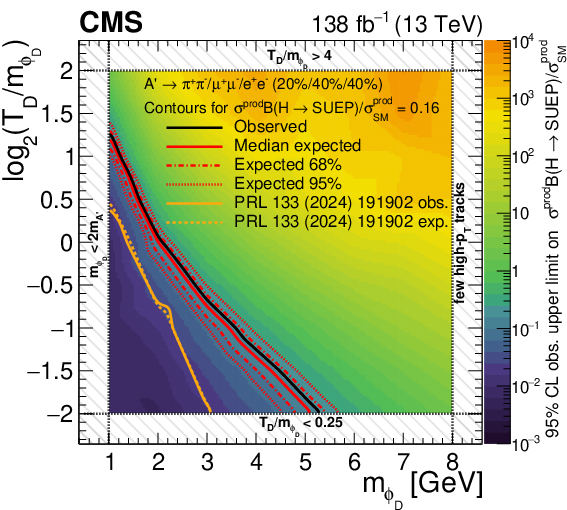
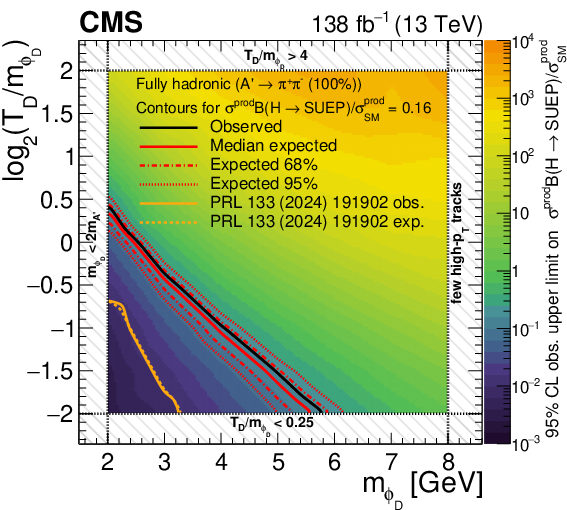
The analysis provides strong bounds, with the most stringent limits for low pp→VH0 and pp→VH1 due to their higher multiplicity of low-pp→VH2 particles. These limits improve upon previous gluon-fusion-based SUEP searches by up to two orders of magnitude for some parameter regimes.
Figure 4: Observed upper limits at 95\% CL on the pp→VH3 for hadronic dark photon decays as a function of pp→VH4 and pp→VH5.
Figure 5: Observed upper limits for models with dominantly leptonic dark photon decays.
Figure 6: Upper limits for scenarios where all dark photons decay hadronically (pp→VH6 hadrons) = 100%).
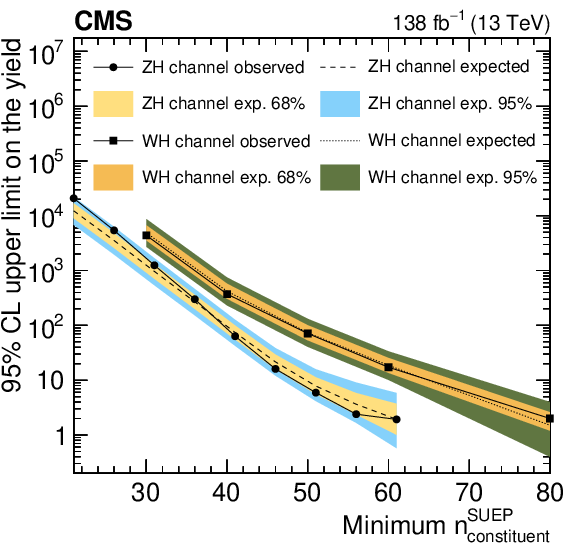
Model-agnostic, single-bin fits are also provided to facilitate reinterpretation, yielding absolute limits on excess events as a function of minimum observed track multiplicity.
Figure 7: 95\% CL upper limits on the signal yield for varying pp→VH7 in the two channels.
Implications and Outlook
The analysis demonstrates that associated Higgs production channels provide greatly enhanced sensitivity to SUEP final states compared to gluon-fusion production, particularly when leveraging leptonically decaying vector bosons for triggering and background rejection. No evidence for dark Higgs portal scenarios with large hidden sectors is observed in the probed parameter space, but substantial swaths of previously unexcluded territory in HV/SUEP models are now probed at the percent-level branching sensitivity.
The provided detailed statistical models and reinterpretation tools (e.g., via DELPHES+MADANALYSIS) significantly widen accessibility for future theoretical reinterpretations and alternate BSM model testing. The methodology and the model-agnostic approach could set the standard for future exotic, low-pp→VH8, high-multiplicity searches, applicable to next-generation LHC runs and other future hadron collider experiments.
Conclusion
This search provides a comprehensive, state-of-the-art approach to probing SUEP signatures in Higgs-associated production with vector bosons decaying to leptons. No evidence of hidden-sector SUEP production is found, and stringent upper bounds—improved by up to two orders of magnitude compared with previous strategies—are placed on such phenomena. Future work may exploit similar concepts across additional production topologies and with larger datasets, further enhancing the discovery potential for non-QCD-like or high-multiplicity BSM final states.