- The paper introduces a framework for distributed quantum property testing by modeling nodes that send compressed quantum data under strict communication constraints.
- It derives tight upper and lower bounds on sample complexity for state certification in both public-coin and private-coin settings, demonstrating a quadratic advantage with shared randomness.
- The study applies randomized unitary channels to preserve Hilbert-Schmidt distances, paving the way for efficient protocols in quantum network and federated learning applications.
Distributed Quantum Property Testing Under Communication Constraints
The paper "Distributed Quantum Property Testing with Communication Constraints" (2604.05962) introduces a structured framework for quantum inference in distributed settings where communication between nodes and a central aggregator is subject to stringent constraints. Specifically, it generalizes the classical distributed inference paradigm (as formulated by Acharya, Canonne, and Tyagi, COLT2019) to quantum networks, incorporating quantum resources such as quantum communication and shared entanglement. The model formalizes distributed quantum property testing by considering a network of m nodes, each receiving a single copy of an unknown d-dimensional quantum state ρ. These nodes engage in one-way communication—classical (of up to nc bits) and quantum (up to nq qubits)—with a central node, whose task is to infer properties of ρ.
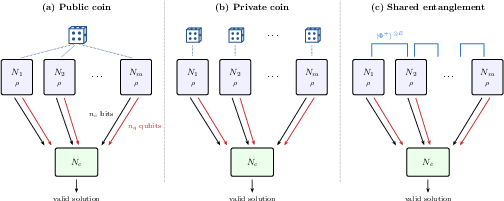
Figure 1: Model illustration—each node receives a copy of ρ and transmits limited classical/quantum information to a central node.
The formal definition encapsulates four parameters: (nc,nq,R,E), with R denoting public vs. private randomness and E the count of shared Bell pairs between nodes. The paper rigorously explores the impact such constraints—particularly quantum channel width—have on the sample complexity of quantum state certification, the quantum analogue of distribution identity testing.
Main Results
Complexity Bounds for Distributed State Certification
The authors derive both upper and lower bounds on the copy complexity of distributed state certification in scenarios where quantum communication is strictly limited (d0, d1):
- Public-coin setting: With shared randomness, the sample complexity is d2. This upper bound leverages randomized dimension reduction using unitary channels, achieving quadratic separation compared to classical channels of comparable dimension. Under a mixedness-preserving restriction (necessary for tightness), the lower bound matches the upper, establishing d3 as optimal.
- Private-coin setting: Without shared randomness, the complexity escalates to d4, exhibiting a pronounced gap against the public-coin scenario.
These results employ a quantum d5 generalization of the classical Ingster–Suslina technique, facilitating tight norm-based lower bounds and revealing the strong role of shared randomness as a communication resource.
Quantum-channel Characterization and Resource Advantage
The analysis demonstrates that quantum communication confers a quadratic advantage for distributed state certification over classical channels, contingent upon channel mixedness preservation. Furthermore, the presence of shared randomness substantially reduces quantum communication requirements, with dimension-dependent separations between public- and private-coin regimes.
Dimension Reduction via Quantum Channels
A key technical insight is that randomly chosen quantum channels—applying Haar-random unitaries and projecting to d6-dimensional subspaces—preserve the Hilbert-Schmidt distance up to a factor d7, which underpins the efficient certification protocol. The proof deploys Weingarten calculus for moment calculations and Paley-Zygmund tail bounds.
Technical Approach
The framework models the action of each distributed node as a channel d8, parameterizable by shared randomness in the public-coin setting. The central node receives d9 quantum outputs and executes optimal certification algorithms.
- Upper bounds are established by explicit construction: for each batch, nodes apply a random unitary and project, sending compressed states to the central node, which applies Hilbert-Schmidt state certification. Parameter choices ensure constant success probability, boosted via repetition.
- Lower bounds are derived via quantum generalization of classical product-ensemble indistinguishability arguments (Ingster–Suslina method), leveraging norm bounds on channel representations. Mixedness-preserving channels are central for tractability, as they maintain maximally mixed inputs post-processing.
- Resource tradeoffs and separation: The model quantifies the interdependence between quantum channel width, shared randomness, and sample complexity, demonstrating separations not only between classical and quantum communication, but also between public and private coin settings.
Implications and Future Directions
Practical Implications for Quantum Networks and Federated Protocols
The results establish fundamental complexity limits for quantum property testing under realistic network constraints, guiding the design of resource-efficient quantum federated learning, device certification, and distributed hypothesis testing. The demonstrated quadratic quantum advantage suggests significant savings in quantum network bandwidth and hardware investment, contingent on careful protocol design. The necessity and efficacy of shared randomness may motivate auxiliary classical communication channels or integrated classical-quantum resource management protocols.
Theoretical Implications and Open Problems
The authors conjecture that their bounds hold beyond mixedness-preserving strategies, but technical complications (especially with inverse terms in quantum ρ0) remain. The exact complexity in private-coin quantum settings, extensions to tomography and other inference tasks, and quantification of entanglement-assisted separations (with exponential complexity reductions for certain tasks) are all ripe for further investigation.
The model's flexibility enables generalization to two-state problems (like DIPE), non-iid distributed scenarios, settings with multi-copy-per-node, and cases with both classical and quantum communication. The results pose challenging questions regarding optimal channel constructions, simultaneous resource constraints, and the impact of node interactivity and network topology on inference complexity.
Conclusion
This work rigorously formulates and analyzes distributed quantum property testing under communication constraints, providing a comprehensive characterization of resource-dependent sample complexity for quantum state certification. It introduces techniques that generalize classical methods to the quantum regime, establishes quadratic (and higher) separations between communication resource classes, and opens multiple avenues for deeper exploration in both practical distributed quantum computing and quantum learning theory.