- The paper derives an exact quantization condition using the EWKB method, unifying all non-perturbative effects in the inverted triple-well potential.
- The paper demonstrates that precise algebraic relations among bounce and bion actions govern PT-symmetry breaking and the transition between real and complex spectra.
- The paper applies alien calculus to disentangle resurgent trans-series, establishing a universal minimal structure across different non-Hermitian boundary conditions.
Exact WKB Analysis of the Inverted Triple-Well: Non-Hermitian Quantum Quantization, PT Symmetry Breaking, and Resurgence
Introduction and Motivation
This work rigorously investigates the non-Hermitian quantum mechanics of the parity-symmetric inverted triple-well (ITW) potential via the exact WKB (EWKB) framework. Non-Hermitian quantum systems emerge naturally in the description of open systems and those with gain/loss, featuring generically complex spectra and non-unitary dynamics. However, PT-symmetric non-Hermitian Hamiltonians can admit entirely real spectra in parameter regimes, with the transition to complex eigenvalues—a hallmark of PT-symmetry breaking—governed by genuinely quantum and non-perturbative mechanisms.
The ITW system (Fig. 1, Fig. 7) selects a non-Hermitian polynomial potential as a tractable yet structurally rich arena to study these phenomena. Due to its symmetry, the ITW supports degenerate perturbative sectors, bounce and bion non-perturbative saddles, and multiple, physically inequivalent quantization problems determined by the choice of boundary conditions: PT-symmetric, resonant (outgoing at both infinities), and anti-resonant (incoming at both infinities).
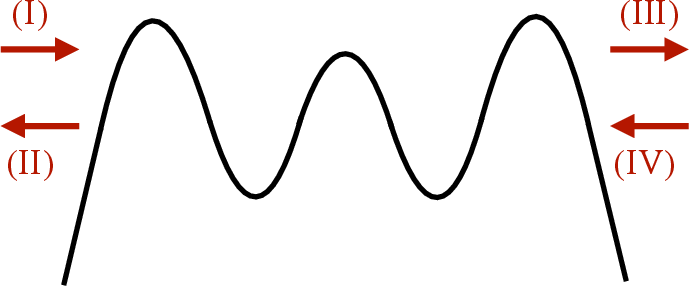
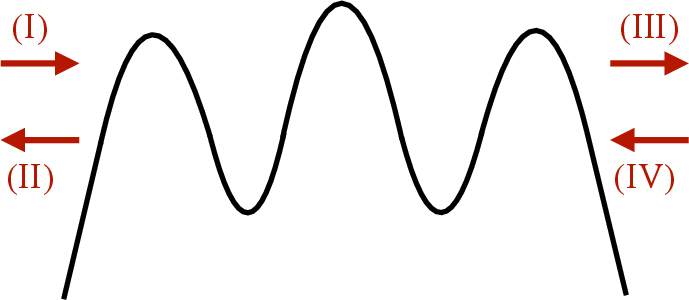
Figure 1: The ITW potential for x0<1 exhibits multiple wells and three barriers, supporting rich WKB cycle structures.
The EWKB method, grounded in the global analysis of Stokes graphs and Voros multipliers, allows the encoding of all physical boundary conditions on equal footing and gives access to trans-series solutions that capture the full non-perturbative content of the system (Fig. 2, Fig. 3, Fig. 5).
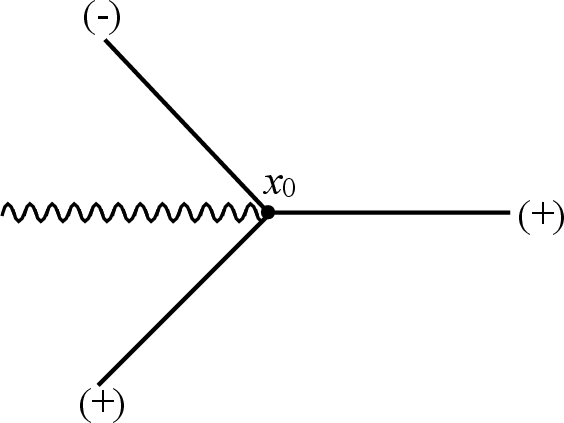
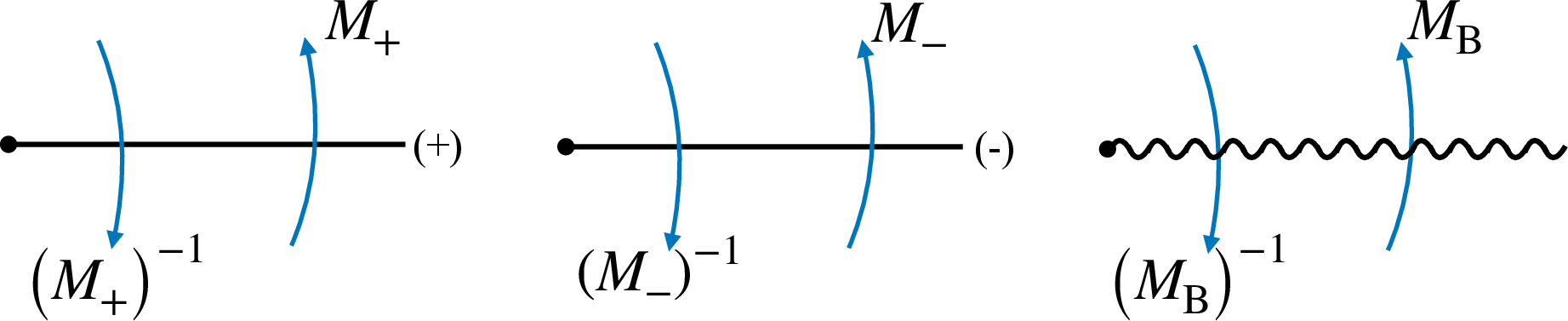
Figure 2: Stokes diagram for the Airy equation, representing local connection problems around a simple turning point.
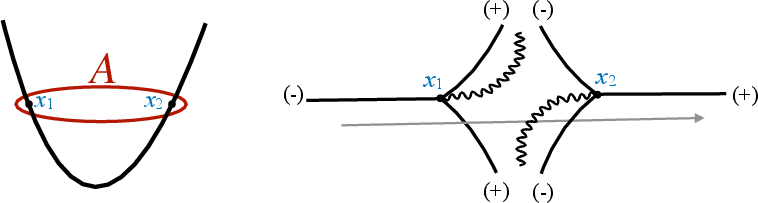
Figure 3: The WKB connection structure for a harmonic oscillator, with the classical action cycle indicated.
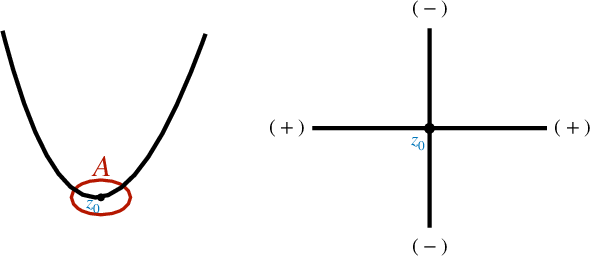
Figure 4: For a locally harmonic minimum, the Stokes diagram (right) displays the characteristic Weber-type cycle structure associated with the emergence of bounce and bion dynamics.
The fundamental boundary-value problems are formulated as transition matrix conditions relating the asymptotics at the spatial infinities. The selection of PT-symmetric, resonance, or anti-resonance boundary conditions singles out different matrix elements and determines the analytic properties and physical interpretations of the resulting spectra (Table 1).
The EWKB quantization conditions incorporate exponentially small tunnelings (B-cycles/bounce and bion actions) as well as the entire resurgent structure of the trans-series. This enables precise tracking of how the interplay of various non-perturbative saddles leads to real or complex eigenvalues, as required for a proper understanding of PT-symmetry breaking or resonance phenomena.
Semi-Classical Structure: Bounce, Bion, and Large Order Behavior
The system features two principal non-perturbative saddle contributions: the bounce (tunneling between an outer well and the rest, associated to B1-cycles) and the central bion (instanton/anti-instanton pair bridging the two central wells, B2-cycle; see Fig. 9).
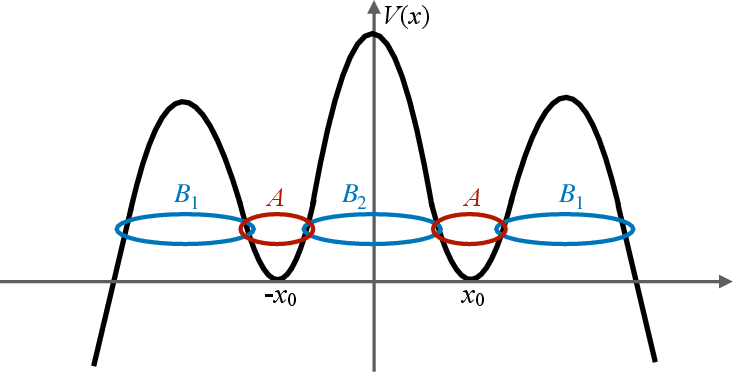
Figure 5: The ITW Stokes geometry at E=0 displays outer bounce cycles (B1) and a central bion cycle (B2) between symmetric wells.
Large-order perturbative expansions are factorially divergent, with the leading coefficients governed by the actions of the bounce and bion, as verified numerically via exact recursion (Fig. 6). The resurgent relation between perturbative ambiguities and the imaginary components of the non-perturbative saddles is explicit, with the minimal trans-series that is universal across all boundary conditions (Fig. 8).
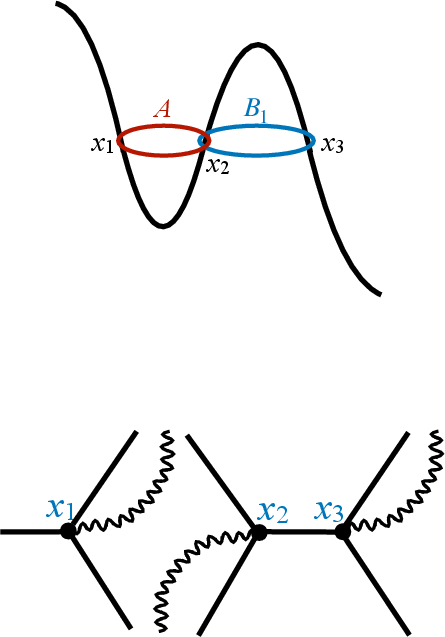
Figure 6: Stokes diagram and potential at ℏ=0 reveal how the nature of non-perturbative cycles changes as parameters cross the barrier-top.
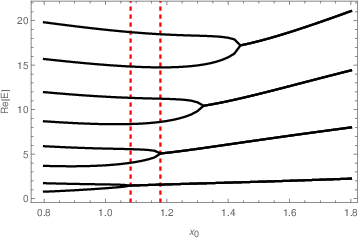
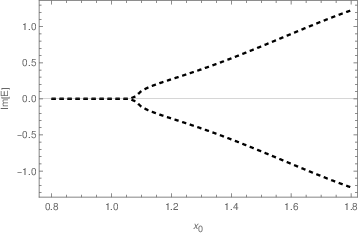
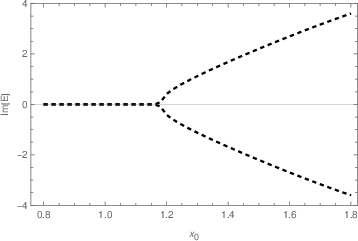
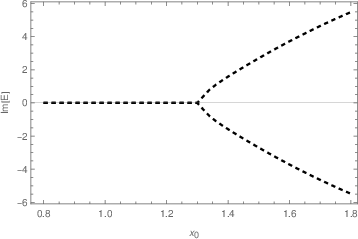
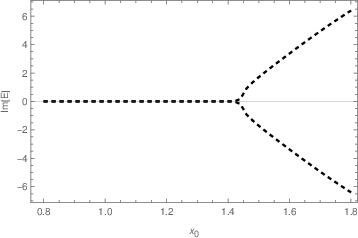
Figure 7: Numerical eigenvalues for the PT-symmetric system: real parts (top), and the emergence of pairs of imaginary components (bottom) at the sequence of exceptional points as x0 increases.
Exact Quantization: PT Symmetry Breaking and Exceptional Points
The exact median quantization condition (QC), formulated on the Stokes ray and accounting for all resurgent cancellations, is solved in closed form. The critical result is the identification of the phase boundary for PT-symmetry breaking as a simple algebraic condition on the non-perturbative actions:
ΠB2=4(1+ΠB1)ΠB12
where B0 are EWKB-exponentiated actions for the bounce and bion cycles.
At this "exceptional point," the non-perturbative median-summed correction vanishes identically, leaving only the perturbative median-summed spectrum—which remains real. The breaking transition is thus characterized as a reorganization of the non-perturbative trans-series: for B1 (unbroken phase), spectrum is strictly real; for the converse, eigenvalues move off the real axis in complex-conjugate pairs associated with PT-symmetry breaking.
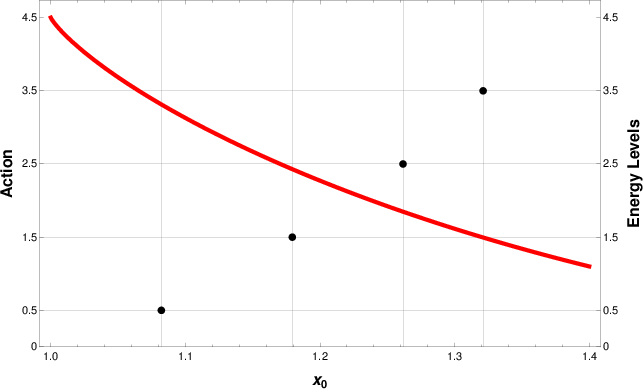
Figure 8: Comparison of the barrier-top action B2 with the exceptional point condition: only the first transitions (ground and first excited state) occur below the barrier, higher ones cross above or near the barrier-top.
Resurgence Structure and Alien Calculus
The rigorous analysis leverages Alien calculus to disentangle median-summed contributions and the hierarchy of ambiguity-canceling sectors. The result is a transparent classification: a universal minimal trans-series, determined purely by perturbative data, is present in all boundary condition choices and parameter regimes (including at the exceptional point), while sector-dependent corrections distinguish the physical regime (PT-symmetric, resonance, anti-resonance).
Resonant and anti-resonant cases (outgoing/incoming boundary conditions) are related by complex conjugation, corresponding to time-reversal, and result in necessarily complex spectra with imaginary parts of opposite sign. There are no exceptional points (no phase transition): the spectrum remains complex for all parameters. The analytic continuation of the quantization conditions and their relation through Stokes automorphisms and time-reversal are examined in detail (Fig. 11).
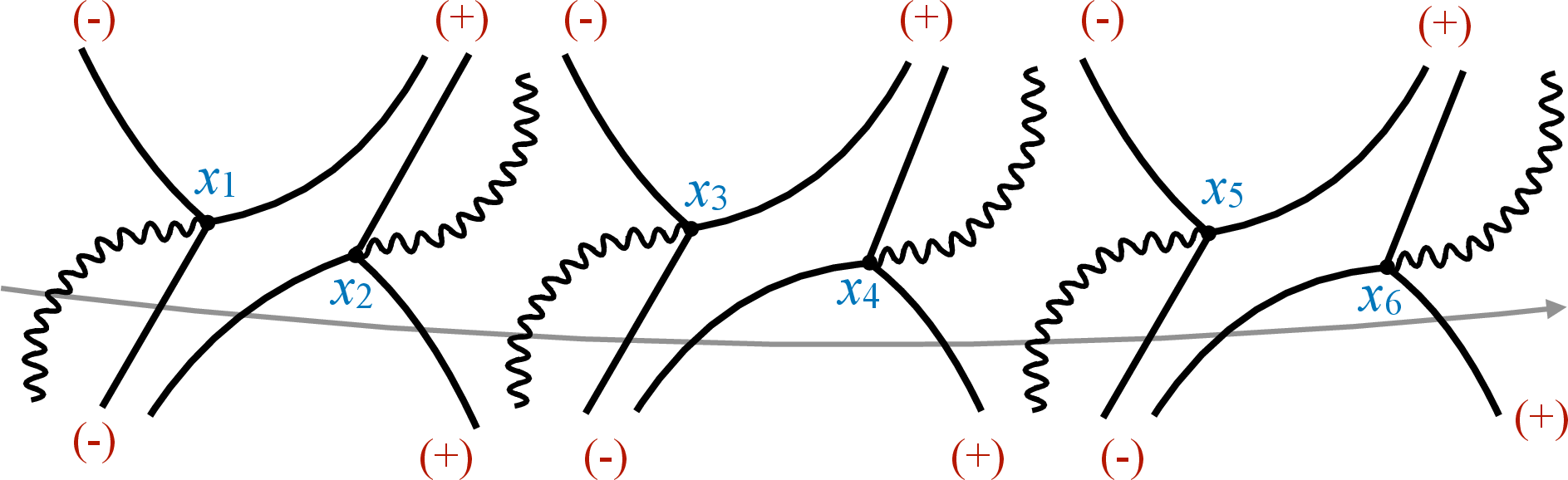
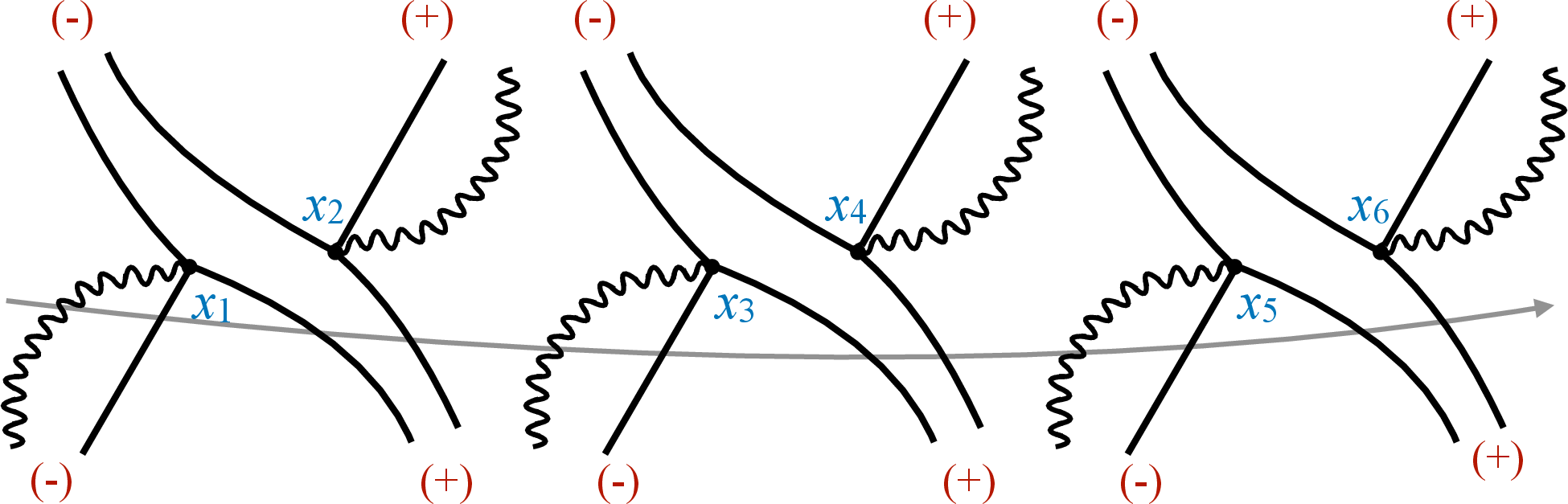
Figure 9: Analytic continuation of the Stokes diagram for B3, essential to understanding the origin of the ambiguity and the mapping between partner boundary conditions through Stokes automorphisms.
Implications and Future Directions
This study establishes several robust facts with implications for both mathematical physics and the analysis of open quantum systems:
- The EWKB formalism, with explicit path-integral links, serves as a unifying framework for all 1D non-Hermitian spectral problems, naturally capturing the role of all non-perturbative effects, including their resurgence structure and cancellations.
- PT-symmetry breaking is analytically determined by a precise relation amongst non-perturbative saddles; the vanishing of all median-summed corrections at the exceptional point provides a rigorous underpinning for the observed spectrum coalescence.
- The universality of the minimal trans-series, generated from perturbation theory, suggests a broader structural feature for non-Hermitian systems, even when real spectra are absent.
The insights obtained here should generalize to higher-degree non-Hermitian polynomial potentials, particularly in identifying and classifying exceptional points and determining the physical meaning of complexification in the spectrum.
Conclusion
The EWKB analysis of the inverted triple-well illustrates the interplay of resurgence theory, non-Hermitian boundary conditions, and non-perturbative quantum mechanics. The main achievements are: the explicit derivation of trans-series for all principal boundary conditions; mapping PT-symmetry breaking and its exceptional points to a simple algebraic condition linking bounce and bion actions; and the identification of the universality and survival of minimal resurgent structure across dynamically distinct regimes. These results offer a rigorous foundation for future studies of open quantum systems, PT symmetry, and non-Hermitian phenomena within and beyond quantum mechanics.