- The paper proposes a superstabilizer framework that adapts color codes to defective square lattice hardware, ensuring minimal loss in code distance.
- It details three ancilla defect remediation methods—superstabilizer, neighbor-assisted, and iSWAP-mediated—with specific trade-offs in code distance and temporal overhead.
- Simulation results confirm robust logical error suppression at 1% defect rates, supporting scalable fault-tolerant quantum computation on superconducting platforms.
Introduction
This work addresses the challenge of deploying topological stabilizer codes—specifically, the 6.6.6 triangular color code—on superconducting quantum hardware with non-negligible rates of defective qubits and couplers. Although defect adaptation is relatively mature for the surface code, color codes remain underdeveloped in this context despite their higher encoding efficiency and transversal Clifford gate support. The authors present a systematic superstabilizer-based defect adaptation framework, introduce optimization schemes for ancilla qubit defects, extend the superstabilizer framework to arbitrary stabilizer codes, and provide explicit support for hardware fault scenarios involving logical operators, boundaries, corners, and lattice surgery.

Figure 1: The 6.6.6 triangular color code mapped to a superconducting hardware layout, with data and ancilla qubits denoted by solid and hollow markers, respectively; syndrome extraction employs Bell-paired ancillas functioning as flags.
Universal Superstabilizer Approach for Data Qubit Defects
The core adaptation framework is the superstabilizer scheme, applicable to data qubit defects in any subsystem or stabilizer code. For an isolated data qubit defect, the protocol removes all affected stabilizer checks and replaces them with gauge operators of lower weight and superstabilizers formed from their products. The resulting subsystem code isolates the defective qubit and introduces at most a unit reduction in code distance per defect, as rigorously formalized:
- For f defective qubits, the logical distance df≥max(0,d−f) (where d is the original code distance).
This construction is supported analytically via generator normalization and logical operator mapping, ensuring that stabilizer measurement and error correction remain feasible after defect adaptation. The scheme is recursive; it systematically covers multiple, possibly clustered, defective regions.
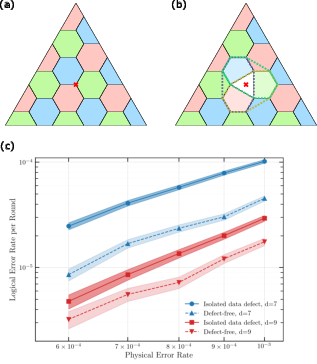
Figure 2: (a) Isolated interior data defect in a d=7 patch; (b) restructured lattice after defect handling; (c) logical error rate suppression persists after defect repair for both d=7 and d=9 codes.
Ancilla qubit defects require different techniques due to their role in stabilizer extraction. Three schemes are developed and compared:
- Superstabilizer Variant: Disables all data qubits connected to a faulty ancilla pair and replaces the affected stabilizers with larger-weight superstabilizers. This results in a code distance reduction of two in both bases but no increased time overhead.
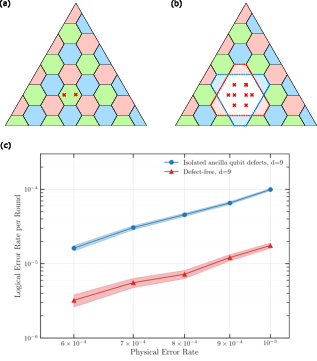
Figure 3: (a) Isolated ancilla defect; (b) modified circuit with data neighbors removed; (c) simulation demonstrates effective error suppression with increased code distance penalty.
- Neighbor-Assisted Scheme: Adapts the SNL strategy from surface codes by borrowing adjacent ancillas to measure gauge operators, then reconstructs the missing stabilizer via superstabilizer multiplication. This approach halves the code distance loss compared to the superstabilizer variant in certain defect cluster topologies but imposes additional time overhead due to sequenced measurement steps.
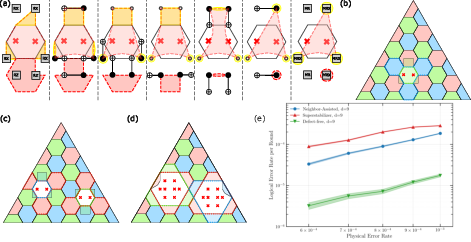
Figure 4: The Neighbor-Assisted scheme reassigns ancilla roles; superstabilizers are built from neighboring stabilizers, offering improved minimum-weight logical operator support in cluster scenarios, but at cost of doubled measurement time.
- iSWAP-Mediated Scheme: Utilizes iSWAP (CXSWAP) gates to rotate ancilla and data qubits around the defect, thus enabling syndrome extraction without disabling neighboring data qubits. This method maintains the code distance in both bases with only a marginal increase in time, provided measurement and reset remain the dominant temporal bottleneck.
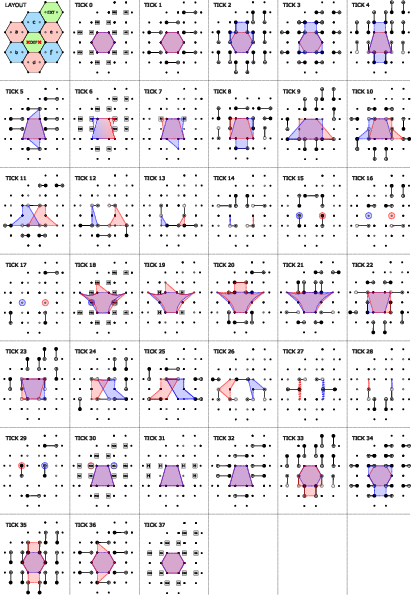
Figure 5: Circuit diagram for iSWAP-Mediated syndrome extraction around an isolated ancilla defect; time steps are increased by 50% over the baseline but maintain efficient error correction.
The superiority of each method depends on the defect topology, with simulation data indicating the significant logical error rate advantage for the iSWAP and Neighbor-Assisted schemes over pure superstabilizer adaptation in representative cluster scenarios.
Adaptive Defect Adapter and Boundary/Corner Analysis
By uniformly reducing ancilla and coupler defects to data qubit defects whenever possible, the authors design an adaptive "defect adapter." This adapter applies the superstabilizer construction recursively throughout the lattice, including at edges and corners. Crucial insights include:
- Boundary Defects: Most efficiently addressed via superstabilizer multiplication of affected boundary stabilizers, outperforming conventional boundary-redefinition methods in terms of code distance retention and logical error rate.
- Corner Defects: Corner ancilla defects can be equivalently treated as corner data defects, often resulting in less resource wastage and lower impact on code distance.
The full construction workflow handles defect clusters (mixed data, ancilla, and coupler defects), consistently ensuring logical operator commutation with resulting gauge operators and facilitating correct logical syndrome extraction for decoding and surgery.
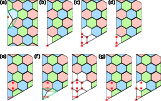
Figure 6: Schematic for various boundary and corner defect scenarios, with code distance reduction illustrated for each adaptation strategy.
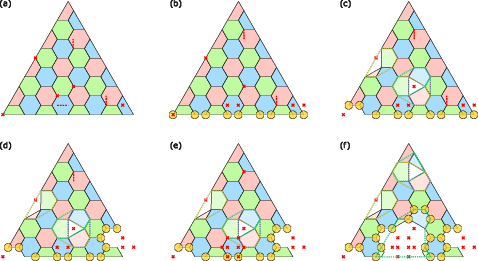
Figure 7: The adaptive superstabilizer generation process for color code defect clusters, including reduction to data defects and superstabilizer construction for code maintenance.
Simulation results validate that, under defect rates of 1%, the proposed superstabilizer handling enables scalable suppression of logical errors as code distance increases.
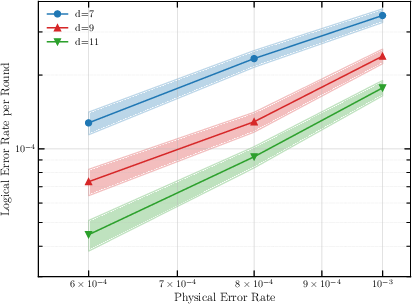
Figure 8: Simulation of superstabilizer adaptation for random defect clusters, confirming persistence of logical error reduction with code distance under 1% defect rates.
Logical Operations: Clifford Gates and Lattice Surgery on Defective Codes
The adaptive framework is shown to support the full transversal implementation of Clifford gates. Due to the self-duality of color code stabilizers, both H and S gates remain implementable by transversal gates over non-defective qubits after the formation of superstabilizers. For CNOT gates, identical defect distributions must be enforced on both code blocks to guarantee well-defined logical CNOT action, leading to increased synchrony and resource costs.
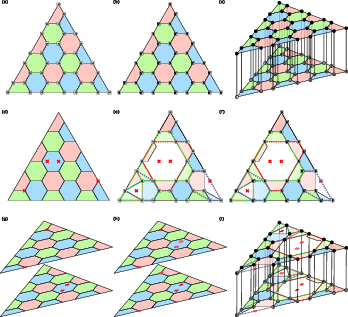
Figure 9: (a–c) Transversal H, S, and CNOT gates on pristine lattice; (d–i) appropriate gate patterns for defective lattices, ensuring stabilizer commutation.
Lattice surgery—required for certain non-Clifford gate protocols—is supported by extending the superstabilizer and gauge-measurement concepts into the merged patch, including defect-ridden auxiliary regions. The scheme disables not only defective data qubits but also their Bell-pair partners, suppressing the influence of short logical operators. Both Neighbor-Assisted and iSWAP-Mediated protocols are also extendable to support surgery, particularly around defective boundaries and within intermediate zones.
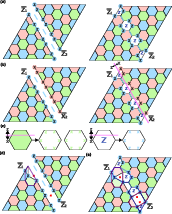
Figure 10: Lattice surgery schematic in defect-free and defective color codes; (a–c) classical merge/twist; (d–e) superstabilizer-enabled logical operator measurement in the presence of defects.
Numerical Stability and Resource Analysis
The authors provide stability experiment results confirming that the superstabilizer adaptation maintains exponential error suppression rate with respect to syndrome extraction rounds. The iSWAP-Mediated method incurs only marginal penalty in stability relative to defect-free and pure superstabilizer code, whereas Neighbor-Assisted circuits are affected by increased superstabilizer weight.
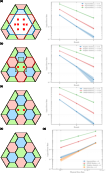
Figure 11: Comparative stability of code variants under repeated syndrome extraction; superstabilizer and iSWAP schemes demonstrate favorable error suppression compared to Neighbor-Assisted adaptation.
Implications and Future Directions
This framework enables near-optimal utilization of color code patches on realistic, defective quantum hardware, with minimal code distance loss and high flexibility. The universality of the superstabilizer scheme extends its applicability to any CSS or general stabilizer code, suggesting immediate potential for hardware deployment in heavy-hex codes, qLDPC variants, and other topological architectures. Notable practical implications include:
- Supports deployment of color codes on superconducting qubit arrays at industrial scales.
- Reduces resource wastage compared to naive qubit/ancilla disabling.
- Maintains transversal Clifford set, crucial for low-overhead threshold logic.
Open avenues include integrating optimized decoders for defective lattices, improved boundary/corner stabilizer weighting, and experimental validation on superconducting platforms.
Conclusion
The paper provides an authoritative, analytical, and general solution to the challenge of deploying color codes in the presence of hardware defects. By leveraging recursive superstabilizer generation and specialized ancilla defect remediation, the framework combines formal guarantees with practical flexibility. This offers a robust path towards large-scale, fault-tolerant quantum computation with color codes, with direct relevance for next-generation quantum processors (2604.05874).

