- The paper introduces a tight-binding model that captures interband optical conductivities in tilted 2D Dirac materials, surpassing traditional k·p approximations.
- It identifies four distinct critical frequencies—including partner, sharp-peak, and cutoff frequencies—arising from full Brillouin zone effects.
- Numerical analysis validates the model’s predictions, demonstrating tunable anisotropic responses influenced by tilt, doping, and energy shifts.
Interband Optical Conductivities in 2D Tilted Dirac Bands: Tight-Binding Model Insights
Introduction and Motivation
The investigation of optical responses in two-dimensional (2D) Dirac materials—including graphene, 8-Pmmn borophene, and monolayer transition metal dichalcogenides—requires precise modeling of their electronic band structures, especially when the Dirac cones exhibit strong tilt or energy shifts. Most existing studies focus on the linearized k⋅p model, which cannot capture higher-order lattice effects and related critical features in optical conductivity. This paper systematically develops and analyzes a generic tight-binding (TB) model for 2D tilted Dirac bands, providing a comprehensive calculation and classification of the interband longitudinal optical conductivities (LOCs) under general conditions of band tilting and Dirac point energy shifting. Strong emphasis is placed on understanding new types of critical frequencies that cannot be inferred from the k⋅p approach and their physical origins in the full Brillouin zone.
Tight-Binding Model for Tilted 2D Dirac Bands
The authors consider a minimal TB Hamiltonian incorporating both a tilt parameter t (along ky) and an energy shift parameter h, breaking rotational and inversion/time-reversal symmetries, respectively. The resulting spectrum comprises oppositely tilted Dirac cones located at (0,±π/2a), with generic expressions for their band energies and current operators inducing the interband transitions. The TB model reduces to the standard linearized k⋅p Hamiltonian near the Dirac points, enabling direct comparative studies.
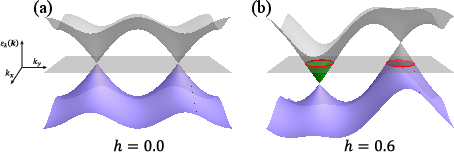
Figure 1: Schematic diagrams of energy bands for (a) h=0 and (b) h=0.6, illustrating the role of the energy shift k⋅p0 in displacing the Dirac points energetically.
Calculating Interband Longitudinal Optical Conductivities
Within linear response, the real part of the interband LOC k⋅p1 is derived in closed form. Critical to the analysis is the mapping from incident photon frequency k⋅p2 to direct transitions between valence/conduction bands, weighted by matrix elements set by the TB current operators.
For arbitrary chemical potential k⋅p3 and direction, the allowed transitions are fully characterized by solving for Fermi wave vectors along different directions and mapping the set of critical photon energies at which the onset or termination of absorption occurs. This leads to a robust characterization of the angular anisotropy inherent in tilted and shifted Dirac systems.
Critical Frequencies in Interband Optical Conductivities
A main advance is the identification and analytic classification of four distinct types of critical frequencies dictating features in the LOCs:
- Conventional Critical Frequencies (k⋅p4 or k⋅p5): Onset frequencies associated with interband transitions at the Fermi surface minima/maxima in the k⋅p6-direction (splitting in the presence of tilt).
- Partner Frequencies (k⋅p7): Frequencies associated with extremal transitions along orthogonal directions (e.g., k⋅p8), present only in the TB model due to full-zone nonlinearity and absent in linearized k⋅p9 theory.
- Sharp-Peak Frequency (k⋅p0): A robust frequency associated with van Hove singularities at high-symmetry points in the Brillouin zone, producing a pronounced peak.
- Cutoff Frequency (k⋅p1): The highest allowed interband transition frequency, set by the maximal energy span between lowest and highest band energies in the zone.
These analytic results are obtained either by explicit extremization (Lagrange multiplier method) or by symmetry analysis of the underlying band structure.
Numerical Analysis and Phase Dependence
Concrete numerical calculations across untilted (k⋅p2), under-tilted (k⋅p3), and shifted (k⋅p4) regimes validate and illustrate these analytic results:
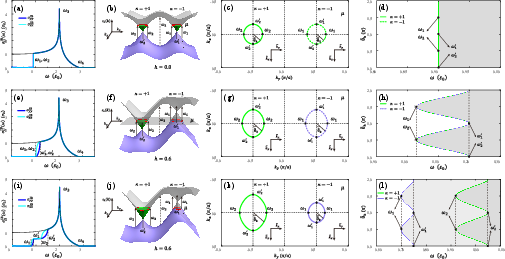
Figure 2: For untilted Dirac bands, panels show (a,e,i) interband LOCs, (b,f,j) interband optical transitions, (c,g,k) Fermi surfaces, and (d,h,l) the lower boundaries of incident photon frequency k⋅p5 for arbitrary wave-vector direction. Partner and robust frequencies are marked.
Notably, the conventional and partner frequencies become nondegenerate and split with the introduction of chemical doping (k⋅p6) and/or energy shifting (k⋅p7), generating strong and tunable anisotropy in the LOCs. The sharp-peak (k⋅p8) and cutoff frequency (k⋅p9) remain invariant to t0, t1, and t2, reflecting their geometric origin.
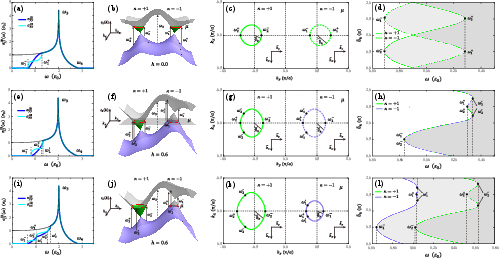
Figure 3: For under-tilted Dirac bands (t3), the splitting of critical frequencies with tilt and the robust location of partner, sharp-peak, and cutoff frequencies are evident.
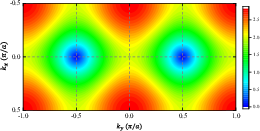
Figure 4: Density plot of the interband optical transition, explicitly revealing the locations of the sharp-peak frequency t4 (van Hove singularities at high-symmetry points) and the maximal cutoff t5 arising from Brillouin zone boundaries.
Comparison with Linearized t6 Theory
A direct quantitative and qualitative comparison with linearized t7 models demonstrates the necessity of the TB approach:
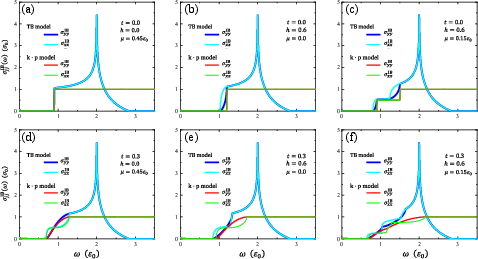
Figure 5: Side-by-side comparison of LOCs in the TB and linearized t8 models. Only the TB model captures the partner, sharp-peak, and cutoff frequencies and their associated features; the t9 result exhibits step-like behavior missing higher-frequency structures.
Above the highest conventional (or partner) frequency, the LOCs computed in the TB model depart sharply from the step-like, unbounded behavior of the ky0 model, strongly demonstrating the importance of zone-boundary and lattice effects.
Implications and Future Directions
From an experimental perspective, these results provide guidance for identifying tilt-induced anisotropy and new critical frequencies in THz and infrared spectroscopy of 2D Dirac materials. Identification of partner and robust frequencies could discriminate between single-particle theories and reveal the true role of zone-boundary physics in candidate materials. Notably, the TB framework is amenable to extensions featuring gaps, warping, and lattice anisotropy, which are essential for accurate modeling of real systems such as gapped monolayer TMDs and higher-order topological insulators.
Theoretical implications include the necessity of full-zone models for accurate calculation of observables sensitive to transitions away from the Dirac point, reconsideration of widely-used ky1 approximations, and the potential for novel optoelectronic functionality arising from sharp-peak and cutoff features as actionable photonic resonances. The analysis generalizes directly to anisotropic and spin-orbit coupled Dirac/Weyl materials.
Conclusion
The TB analysis presented provides a definitive classification and understanding of all critical frequencies and corresponding structures in the interband LOCs of tilted 2D Dirac bands. By systematically comparing with linearized theory, the study reveals not only new qualitative effects (partner, sharp-peak, cutoff frequencies) but also lays out analytic tools and formulas for broader application. These results strengthen the theoretical foundation for interpreting optical experiments in Dirac materials under tilt and energy shifting, and open pathways for future studies on more complex lattice-driven and symmetry-breaking effects.

