- The paper develops pion valence PDFs using the LCQM, fitting wave function parameters through χ² minimization against experimental data.
- It applies DGLAP evolution at LO/NLO/NNLO, comparing the evolved distributions with Drell-Yan, DIS, and HERA structure function data.
- The study reveals that only 39% of the pion's momentum is carried by valence quarks at high scales, underscoring significant gluon and sea-quark contributions.
Pion Parton Distribution Functions in the Light-Cone Quark Model and Experimental Constraints
Introduction and Motivation
This paper presents a comprehensive analysis of pion parton distribution functions (PDFs) using the light-cone quark model (LCQM), incorporating both theoretical derivation and systematic comparison to modern experimental constraints. The pion, as the lightest pseudoscalar meson and a pseudo-Goldstone boson, holds essential information on chiral symmetry breaking and the dynamical generation of hadron mass in QCD. Understanding its internal structure, encoded in PDFs, is imperative for precision hadron physics.
The authors focus on constructing pion valence PDFs at a non-perturbative scale via quark-quark correlation functions in the LCQM, then evolve these distributions to experimental scales via perturbative DGLAP evolution. The study includes precise comparisons to Drell-Yan and DIS data, calculation of the F2π structure function at NLO, predictions for future facilities, and differential Drell-Yan cross sections for various experimental configurations.
The Light-Cone Quark Model Framework
The LCQM describes the pion as a relativistic, gauge-invariant system of quark-antiquark pairs. This model leverages the light-front Fock-state decomposition, retaining only the dominant qqˉ (valence) configuration and omitting explicit gluon and sea-quark Fock components at the initial scale. The total light-front wave function is factorized into momentum and spin components, using the Brodsky-Huang-Lepage ansatz for the radial wave function and a vertex-derived (or equivalently, Melosh-rotated) spin structure for the pseudoscalar pion.
Construction and Evolution of Pion PDFs
The valence PDF f(x) is derived from quark-quark correlators on the light front with Wilson lines set to unity. The model assumes isospin symmetry with degenerate up and down constituent quark masses. Notably, the authors fit wave function parameters to reproduce physical pion observables, including the decay constant.
The initial (model-scale) valence PDF exhibits a broad, symmetric distribution reflecting the equal momentum sharing between the quark and antiquark:
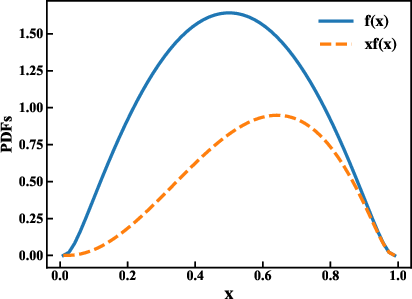
Figure 1: The unpolarized pion parton distribution function f(x) and the momentum-weighted distribution xf(x) obtained within the LCQM at the model scale.
The momentum-weighted distribution, xf(x), peaks around x≈0.5, consistent with expectation for a symmetric two-body system.
To achieve phenomenological relevance, the PDFs are evolved using DGLAP equations implemented via HOPPET at LO/NLO/NNLO. The initial LCQM scale μ0=0.6±0.1~GeV is determined by χ2 minimization against modified FNAL-E-0615 Drell-Yan data.
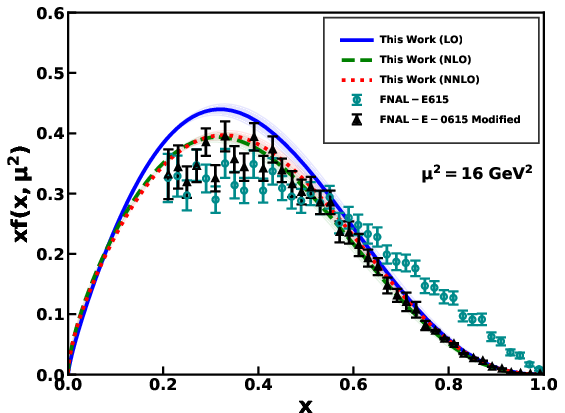
Figure 2: The evolved quark PDF xf(x) as a function of qqˉ0 for the pion compared to FNAL-E-0615 experimental data.
The evolved PDFs (including generated gluon and sea distributions) are systematically compared with global analysis results (e.g., JAM, xFitter, GRV, MAP), showing robust qualitative agreement up to high evolution scales, particularly at NNLO where the best qqˉ1/dof is achieved.
Mellin Moments and Momentum Sum Rules
The model correctly reproduces PDF normalization and momentum sum rules at the initial scale, with valence quarks carrying unity total charge. Computed Mellin moments (up to qqˉ2) decrease rapidly, with higher moments consistent with lattice QCD and phenomenological extractions. At high scales (qqˉ3~GeVqqˉ4), only qqˉ539% of the pion's momentum resides in valence quarks; gluon and sea components, generated through QCD evolution, dominate at small qqˉ6.
Structure Function qqˉ7: Comparison with HERA Data
The NLO calculation for qqˉ8 allows direct comparison with leading-neutron electroproduction data from ZEUS and H1 at DESY-HERA across a broad kinematic span.
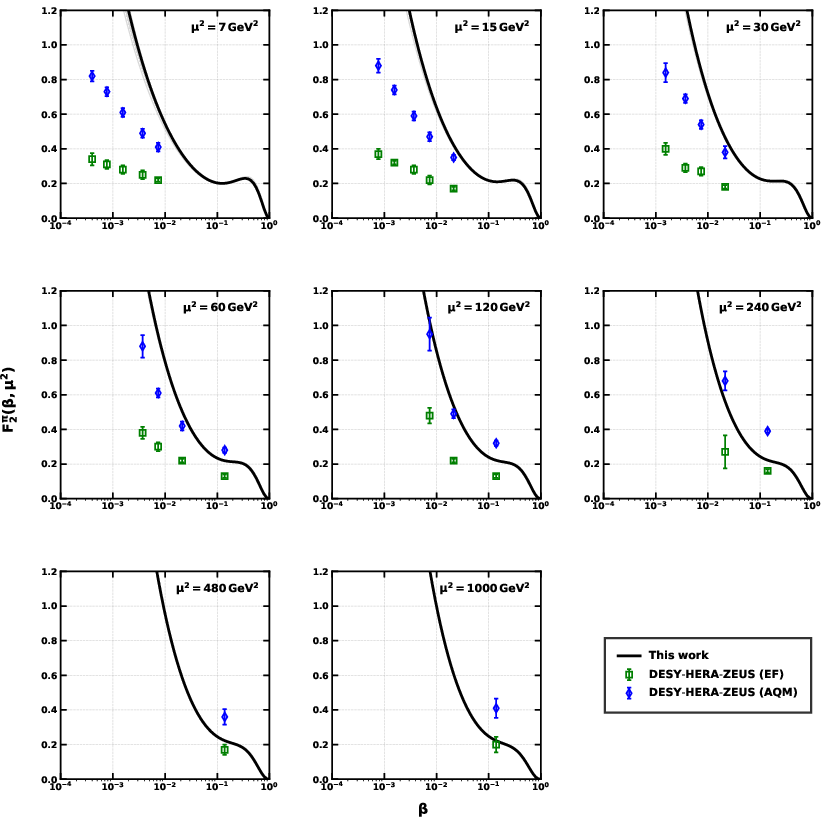
Figure 3: qqˉ9 for the pion as a function of f(x)0 at fixed experimental values of f(x)1, compared to ZEUS data.
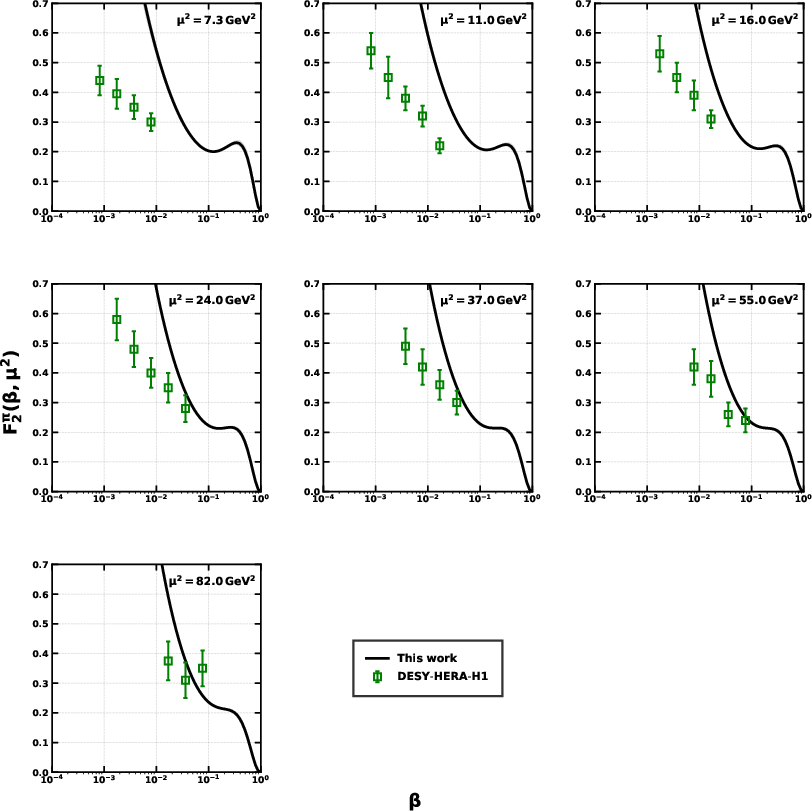
Figure 4: f(x)2 for the pion as a function of f(x)3 across various scales, compared to H1 data.
At low scales, the model overestimates some H1 points, but aligns well with ZEUS effective flux (EF) results at high scales (f(x)4~GeVf(x)5), and matches the overall trend and normalization. The structure function decompositions indicate that sea and gluon contributions grow with scale, becoming dominant at small f(x)6.
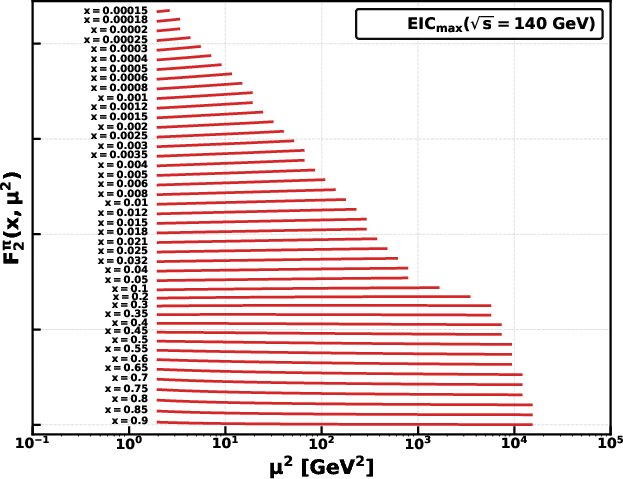
Figure 5: The pion structure function f(x)7 at varying scales and f(x)8, relevant for predictions at EIC kinematics.
This evolution is critical for precision predictions at upcoming EIC facilities, where small-f(x)9 dynamics are probed.
Drell-Yan Cross Sections and Global Data Comparison
Using the model's PDFs (evolved to experimental scales), the authors compute Drell-Yan cross sections for multiple experiments with nuclear targets, including FNAL-E-0615 and the latest COMPASS results. The nuclear PDFs (primarily nCTEQ15) are selected for target consistency.
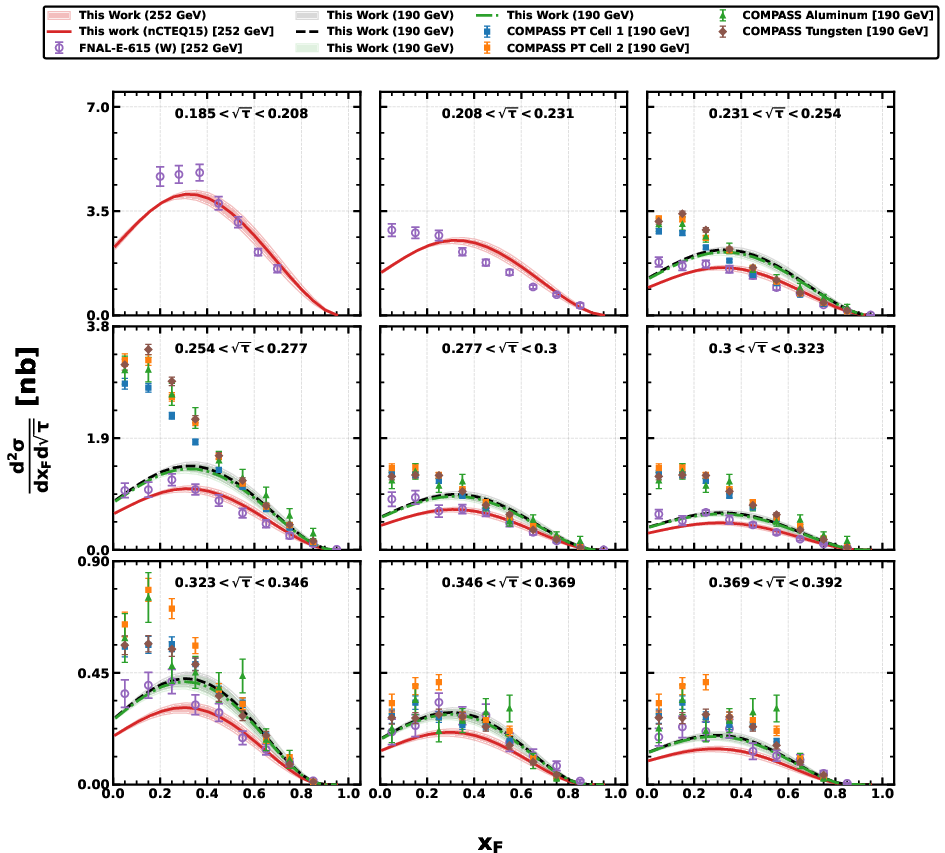
Figure 6: The pion induced Drell-Yan cross-section f(x)0 compared to experimental data from FNAL-E-0615 and COMPASS-II.
The theoretical cross sections exhibit good overall agreement with experimental measurements over a range of kinematics, energies, and nuclei, including distributions differential in f(x)1 and f(x)2. Minor discrepancies at large f(x)3 or high f(x)4 can be attributed to inherent model limitations (valence truncation, nuclear effects) and possible higher-twist contributions not captured here.
Implications and Outlook
This work demonstrates that a two-body LCQM with minimal parameterization, combined with rigorous DGLAP evolution and systematic fitting, can yield pion PDFs and associated observables (like f(x)5 and Drell-Yan cross sections) consistent with modern experimental and theoretical constraints. The model’s extension to NLO/NNLO evolution and explicit calculation of observable structure functions provides a valuable cross-check on the non-perturbative input and the treatment of uncertainties.
Notable numerical outputs:
- Initial LCQM scale, f(x)6 GeV, yields f(x)7/dof f(x)8 for NNLO fits to E-0615 data.
- Only 39% of the pion's momentum is carried by valence quarks at f(x)9~GeVxf(x)0 (evolved), reflecting substantial radiative generation of gluon and sea components.
- The agreement with HERA and COMPASS structure function and cross section data substantiates the validity of the LCQM as a nonperturbative input.
The claim that the sea-quark distribution falls more smoothly (compared to theoretical extractions) and that the gluon carries more momentum than some global fits at high scales is emphasized, highlighting the need for higher Fock-state contributions and improved constraints.
From a theoretical perspective, the methodology affirms the utility of combining light-front models with QCD evolution, but also exposes the persistent uncertainties connected to the lack of direct pion targets and the strong model dependence at very low and high xf(x)1.
Conclusions
This paper offers a technically robust and phenomenologically comprehensive study of pion parton structure. The deployment of LCQM as an initial condition, validated by extensive comparison to experiment via DGLAP evolution, opens avenues for improved nonperturbative modeling and direct predictions for future EIC and Drell-Yan facilities. The remaining discrepancies in gluon and sea-quark distributions at high scale underscore the critical importance of new experimental data and systematic inclusion of higher Fock components in nonperturbative pion structure analyses.