- The paper derives an analytic kinetic uncertainty relation (KUR) for the time-integrated quantum jump count in collectively dissipative many-body systems.
- It utilizes a mean-field approximation and maps quantum trajectories to cMPS, revealing separable classical and quantum contributions that scale as 1/N.
- Monte Carlo simulations across stationary, critical, and BTC phases validate the analytic bounds, demonstrating enhanced precision in collective dynamics.
Kinetic Uncertainty Relation in Collective Dissipative Quantum Many-Body Systems
Introduction
The paper "Kinetic Uncertainty Relation in Collective Dissipative Quantum Many-Body Systems" (2604.05747) addresses the formulation and analysis of kinetic uncertainty relations (KURs) in open quantum systems composed of N interacting spin-$1/2$ particles subject to collective dissipation. Unlike previous work, which was largely constrained to single-body quantum models, this study rigorously extends the KUR framework to regimes where collective many-body correlations and dissipative mechanisms play a central role, with a particular focus on settings relevant for boundary time crystals (BTCs).
Theoretical Framework and Model
The system under scrutiny consists of an ensemble of N collectively dissipating spins, driven coherently and interacting via a common Markovian environment. This archetypal setup is described by a Lindblad master equation for the system’s density matrix, utilizing collective spin operators and a jump operator S− capturing the collective decay channel. Both dynamical and thermodynamical properties are characterized via continuous quantum measurement, with individual stochastic quantum jump trajectories providing access to photon-counting statistics.
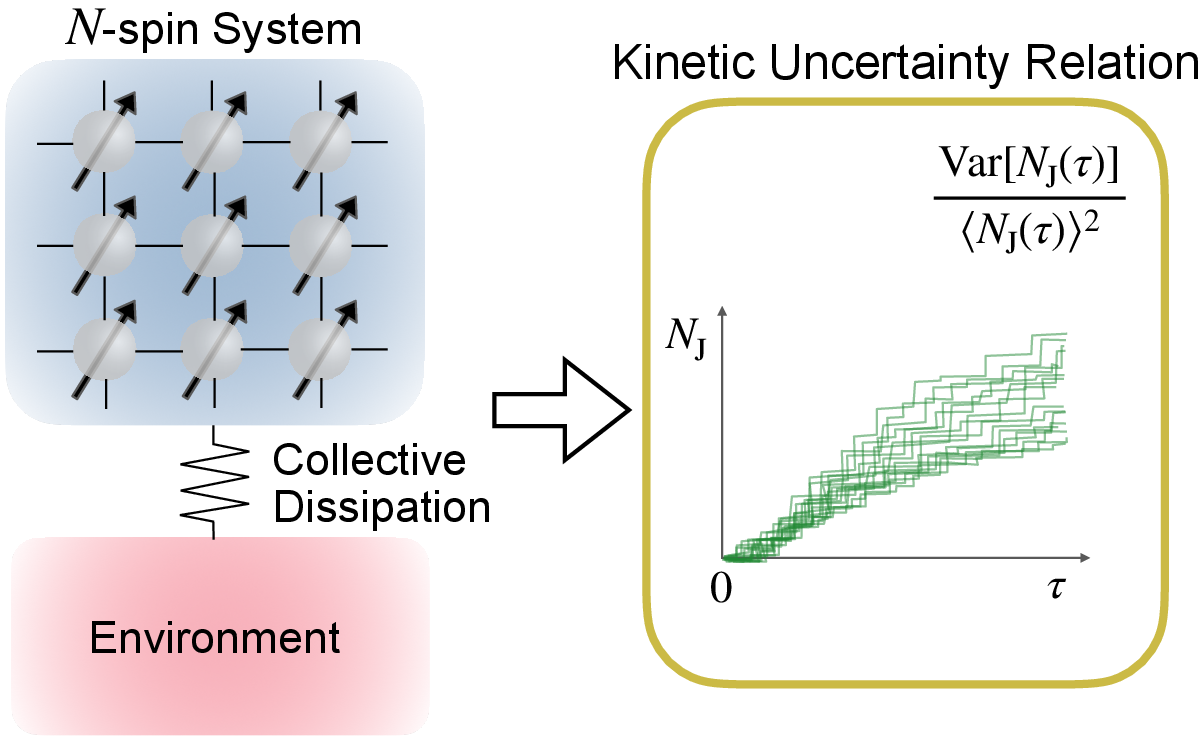
Figure 1: Schematic of the kinetic uncertainty relation for an N-spin collective dissipative system, the prototype for boundary time crystals. Measurement yields quantum jump trajectories; NJ(τ) is the integrated jump count.
Employing a mean-field approximation, the authors derive compact evolution equations for the spin magnetizations in the thermodynamic limit (N→∞), enabling tractable analytic handling of phase transitions and collective phenomena.
Derivation of the Quantum Kinetic Uncertainty Relation
The main technical result is an explicit KUR for the relative fluctuation of the time-integrated quantum jump count, NJ(τ), over an observation time τ. Mapping quantum trajectory ensembles onto continuous Matrix Product States (cMPS), the authors use quantum estimation theory and the quantum Cramér-Rao bound to obtain
⟨NJ(τ)⟩2Var[NJ(τ)]≥Bmb(τ)1
where $1/2$0 is the analytically derived many-body quantum dynamical activity. This bound is physically transparent, depending only on mean-field magnetization trajectories and parameters $1/2$1, $1/2$2, and $1/2$3. It can be further bounded above by a closed-form expression, facilitating deeper physical insight.
Physical Insights and Scaling
The bound $1/2$4 separates into classical and quantum coherent components. The first term (classical) scales with the rate of quantum jumps due to collective dissipation, while the second (quantum) encodes enhanced fluctuations arising from coherent driving. Notably, both terms manifest an explicit global $1/2$5 factor, establishing that the achievable fluctuation suppression—a proxy for precision—scales as $1/2$6. This cooperative precision enhancement is inaccessible in single-body systems and becomes most pronounced near macroscopic collective phenomena.
Numerical Validation Across Dynamical Phases
Monte Carlo simulations of quantum jump trajectories, compared to theoretical bounds, are performed across stationary, critical, and BTC dynamical regimes. The results confirm that:
- The analytically predicted lower bound strictly constrains the observed relative fluctuation for all times and parameters.
- The $1/2$7 suppression of relative fluctuations is clearly evident, endorsing the collective enhancement scenario.
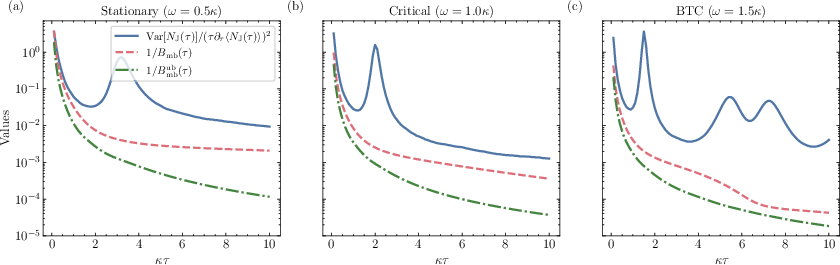
Figure 2: Temporal evolution of the relative fluctuation and theoretical bounds for $1/2$8, demonstrating tightness and phase dependence across stationary, critical, and BTC phases.
At the critical point, the actual precision is maximized, whereas the analytic bound indicates the BTC phase offers the highest ultimate precision. In all phases, the gap between the simulated precision and the theoretical minimum is attributable to the information loss inherent in a fixed unraveling (photon counts) versus the optimal (possibly phase-sensitive) measurement accessible in quantum estimation theory.
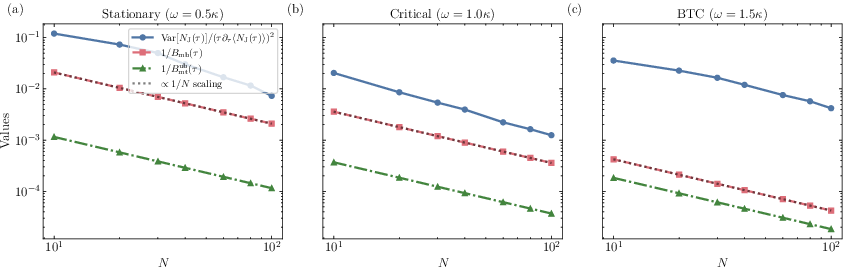
Figure 3: System-size scaling of precision bounds and numerical results at fixed $1/2$9: both analytic and numeric values exhibit robust N0 scaling in all dynamical phases.
Implications and Outlook
The established many-body quantum KUR provides a foundation for assessing precision limits in collectively coupled open quantum systems. The analytic accessibility facilitates both theoretical study and experimental benchmarking in large-N1 platforms, such as cold atomic gases and spin ensembles. The results are particularly relevant for applications in quantum metrology (e.g., precision timekeeping with quantum clocks, dissipative sensing architectures) and quantum energy devices (e.g., quantum batteries), where harnessing collective effects is essential for overcoming classical limitations.
The separation between the classical and quantum components of the bound clarifies the mechanisms underpinning metrological enhancement and the circumstances under which optimal performance requires measurement schemes that access coherent, phase-sensitive aspects of the system.
Future research may systematically address:
- Optimal measurement protocols saturating the quantum KUR in BTC and other nontrivial phases.
- Extensions to include spatial correlations, disorder, or non-Markovian reservoirs.
- Application to other macroscopic nonequilibrium phases in driven open systems.
Conclusion
This work rigorously extends the kinetic uncertainty relation to collective dissipative quantum many-body systems by deriving analytic bounds that are physically interpretable and scalable. Numerical results corroborate the theoretical framework, establishing collective suppression of fluctuations and quantifying the achievable gains in precision via cooperative quantum dynamics. The findings inform both the analysis and design of scalable quantum devices operating far from equilibrium, especially where collective effects and open-system dynamics are central.