- The paper introduces Robust Turbo-DDCM, a diffusion-based codec modification that decouples error propagation by encoding each atom index independently.
- The methodology leverages the RCC framework to tolerate bit-flip errors, maintaining high image fidelity even at BERs up to 10⁻³.
- Empirical results on Kodak24 and DIV2K demonstrate reduced decoder failures and graceful degradation compared to classical and neural codecs.
Robustness of Diffusion-Based Image Compression to Bit-Flip Errors
Introduction
This paper systematically investigates the robustness of modern diffusion-based image compression codecs—in particular, those grounded in the Reverse Channel Coding (RCC) framework—to bit-flip errors in the compressed bitstream (2604.05743). The primary contributions are twofold: an empirical comparison demonstrating substantially enhanced error-tolerance relative to classical and neural learned codecs, and the introduction of Robust Turbo-DDCM, a protocol modification to further increase resilience to bit corruption with a minor rate--distortion--perception penalty.
The authors' analysis is motivated by practical limitations in communication and storage systems, where bit-flip errors are common due to noisy channels, hardware faults, and malicious interference. The traditional pipeline of compression followed by explicit error-correcting codes (ECC) introduces computational and rate overheads. The critical question addressed is whether the structural inductive biases and generative aspects of diffusion-based compression models confer inherent robustness to such errors, potentially obviating the need for strong external error protection.
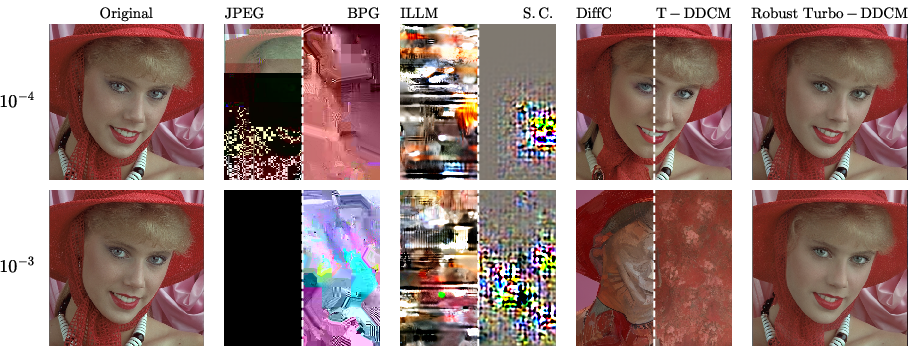
Figure 1: The qualitative effect of increasing bit-flip probability on image reconstructions across codecs, highlighting abrupt failures in classical and neural models against sustained fidelity in RCC-based and robust diffusion compressors.
Background: Diffusion-Based Image Compression and Bit-Flip Vulnerabilities
Conventional codecs (e.g., JPEG, BPG) rely on fixed transforms, quantization, and variable-length entropy coding, making them highly brittle to bitstream corruption. Neural codecs, employing VAEs, autoencoders, or GANs, improve rate-distortion and perceptual quality but remain vulnerable, especially when entropy coding is used, as a single error in entropy-coded streams can cause catastrophic loss of synchronization and un-decodable bitstreams.
Recent generative approaches, including those using diffusion models, allow for both end-to-end learned and zero-shot image compression by leveraging strong priors over the natural image distribution. The RCC paradigm, instantiated in methods like DDCM, Turbo-DDCM, and DiffC, encodes an image as a sequence of discrete indices or sparse coefficients that deterministically steer an iterative denoising (reverse diffusion) process. This indirect representation, which encodes control signals rather than data directly, can hypothetically tolerate localized errors by virtue of the generative process' trajectory stability.
Methodology and Robust Turbo-DDCM
Turbo-DDCM extends DDCM by allowing more efficient sparse approximations of the generative noise at each reverse diffusion step, transmitting the indices of a subset of codebook atoms and associated quantized coefficients. The naively optimal protocol encodes the atom subset as a single lexicographic index for bit-efficiency. However, this results in extreme sensitivity: a single corrupted bit can drastically change the atom selection, amplifying error in the reconstructed noise and hence in the decompressed image.
Robust Turbo-DDCM is introduced to address this vulnerability. It encodes each atom index independently, so bit-flips impact only individual atom selections rather than the entire subset. This design increases the number of bits required (since independent encoding is less compact than a joint lexicographic index), thereby slightly reducing rate-distortion-perception efficiency. The empirical results demonstrate, however, that this redundancy yields dramatically increased robustness and is an attractive rate-robustness operating point for practical deployments.
Experimental Results
Evaluations are conducted on the Kodak24 and DIV2K datasets, with metrics covering distortion (PSNR, LPIPS), perception (FID), and decoder failure rate (fraction of un-decodable/corrupted files). The analysis considers error rates ranging from 10−6 to 10−1, modeling bit-flips via a binary symmetric channel.
Figure 2 quantitatively demonstrates that Robust Turbo-DDCM, as well as other RCC-based diffusion compressors, maintain high image fidelity (PSNR, LPIPS) and low FID scores over multiple orders of magnitude greater bit error rates, while classical, entropy-coded, and standard neural codecs exhibit abrupt breakdowns—often becoming entirely undecodable—even at modest BER (∼ 10−4 to 10−3).
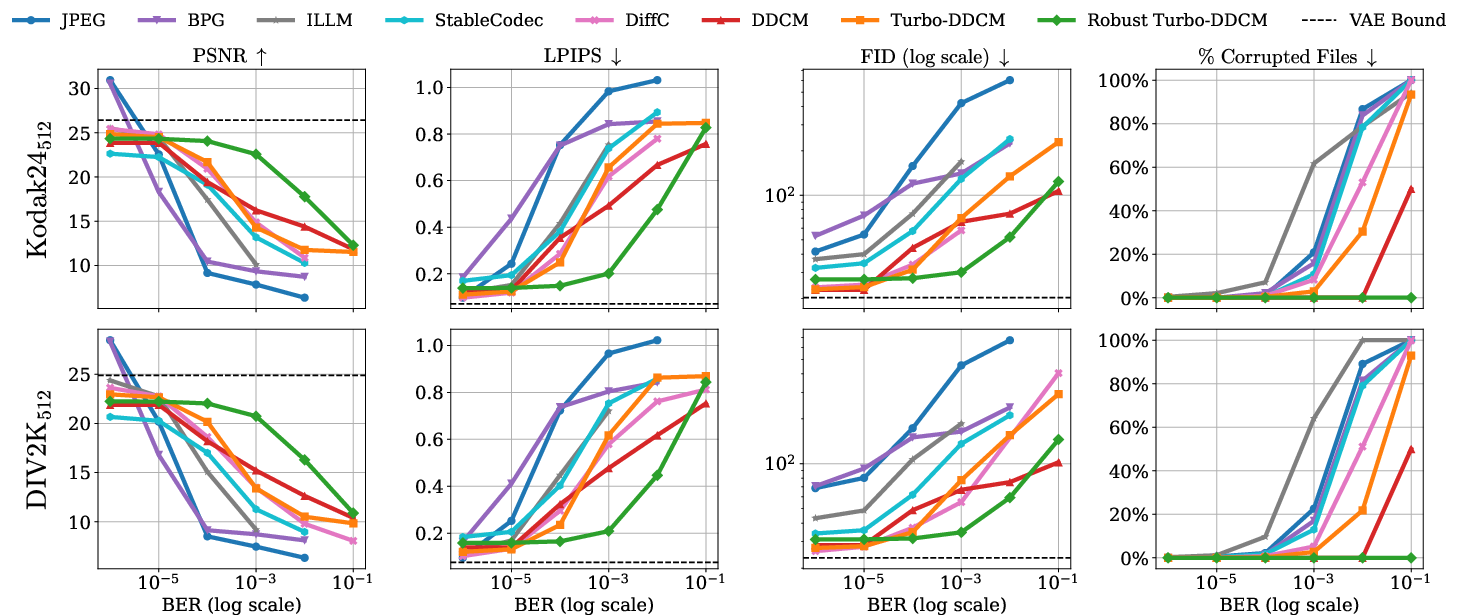
Figure 2: RCC-based diffusion compressors outperform traditional codecs by a considerable margin on all robustness metrics over increasing bit error rate.
Even among diffusion/RCC codecs, Robust Turbo-DDCM displays near-immunity to bit errors up to at least BER =10−3. At this level, all non-RCC (including entropy-coded) systems report >80% corruption, rapidly increasing FID, and PSNR collapse, while robust diffusion compression remains functional and visually faithful.
Figure 3 further unpacks the rate-distortion-perception trade-off. The improved error-tolerance of Robust Turbo-DDCM is paid for in a higher bits-per-pixel rate and a slight decrease in perceptual/distortion optimality, but the trade-off curve remains compelling for most practical noisy-channel scenarios.
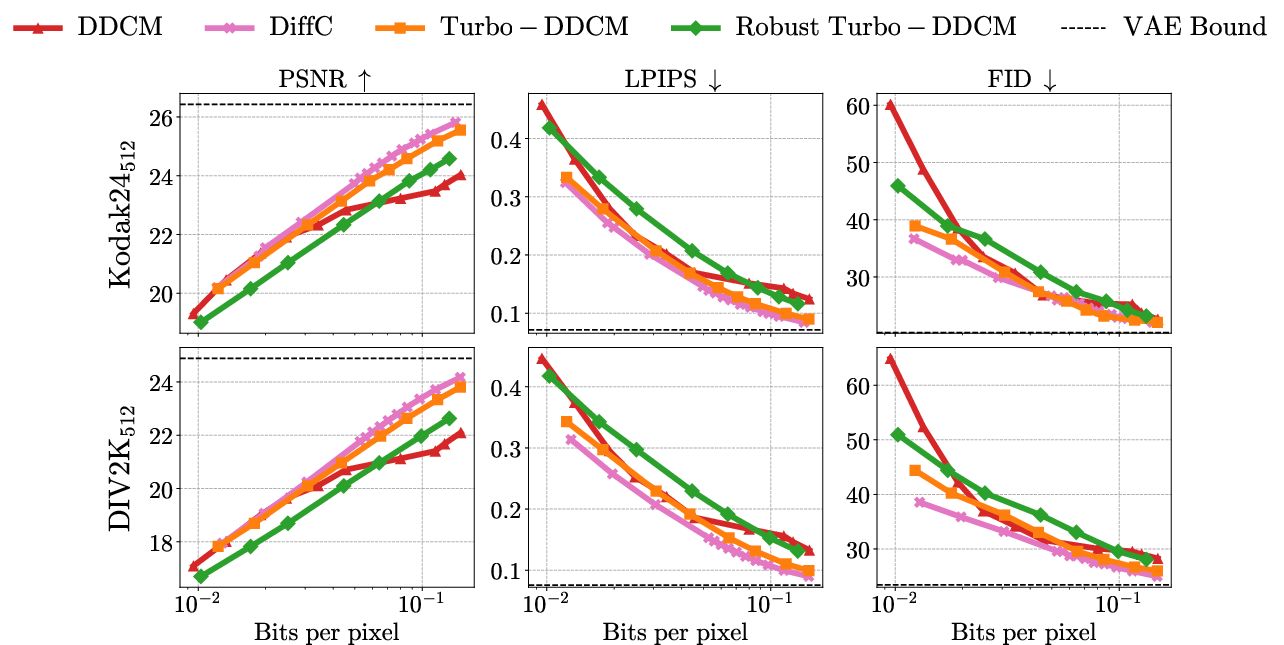
Figure 3: The enhanced robustness of Robust Turbo-DDCM is achieved at the price of increased bit-rate and a slight decrease in rate-distortion-perception optimality.
Figures 4 and 5 provide qualitative evidence at BERs 10−4 and 10−3. Competing codecs exhibit severe artifacting or total failure, while Robust Turbo-DDCM reconstructions remain highly coherent and perceptually close to the original.
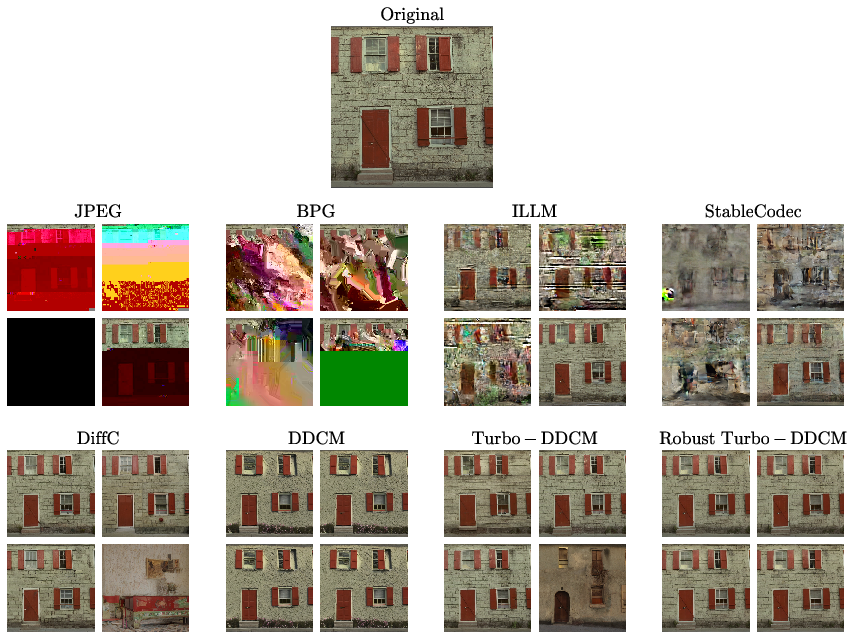
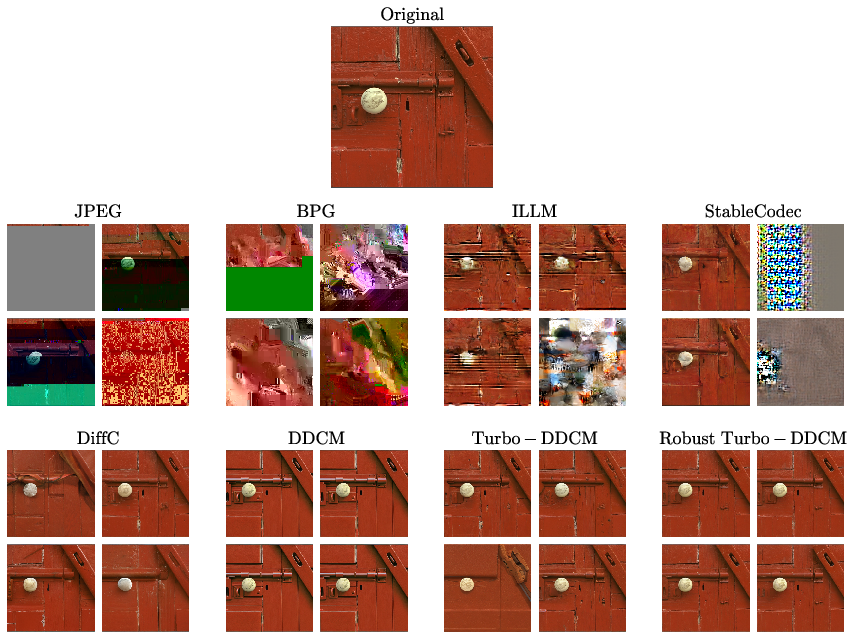
Figure 4: Visual inspection at BER =10−4—only RCC-based compressors (last three columns) preserve structure and semantics.
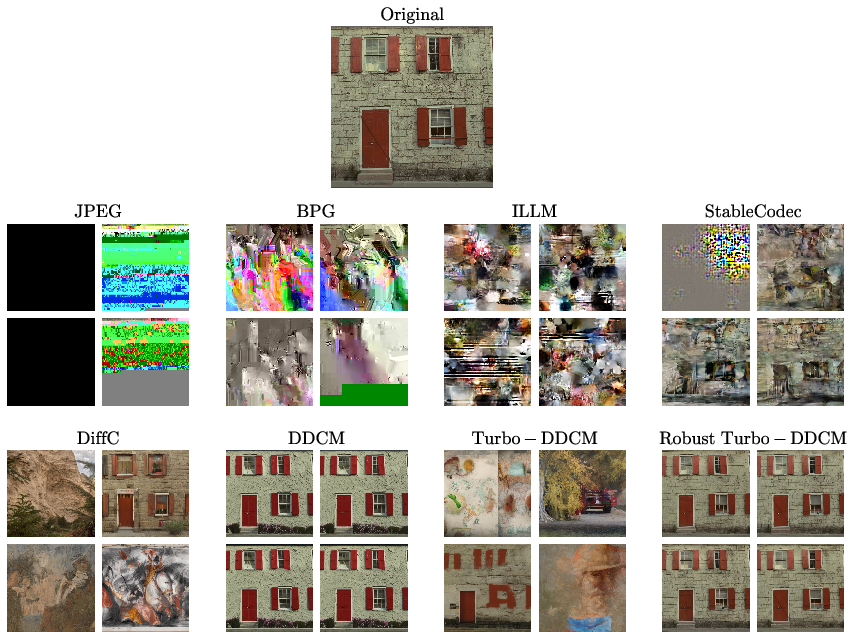
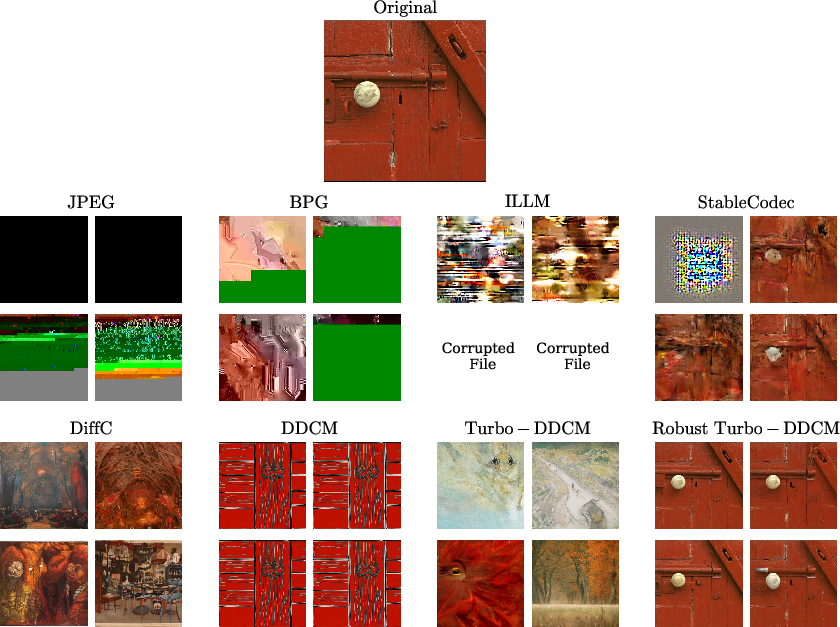
Figure 5: At BER 10−10, all but Robust Turbo-DDCM fail catastrophically, illustrating extreme resilience through robust index protocol design.
Practical and Theoretical Implications
The central claim—RCC-based diffusion compressors, especially Robust Turbo-DDCM, achieve orders of magnitude greater bit-flip error tolerance compared to classical and neural codecs at fixed bit-rates—is strongly, numerically substantiated. These results suggest a paradigm shift: in sufficiently noisy environments, relying on the inherent robustness of generative, RCC-based compressors can enable reduced or even eliminated ECC redundancy, as the coded images themselves degrade gracefully.
From a theoretical perspective, the findings highlight how indirect, generative coding in the compressed domain can fundamentally reshape the error-propagation dynamics relative to fixed transform and entropy-coded representations. The distinction between robust encoding protocols that limit the impact scope of any single bit error and "fragile" protocols is demonstrated to be critical in practice.
For future AI systems, especially in lossy, resource-constrained or adversarial environments, generative RCC-based compression with robust index encoding offers a promising method for resilient perceptual communication. Open directions include extending analysis to burst errors, hybridizing with lightweight ECC, and exploring similar robustification strategies for other generative compression paradigms.
Conclusion
The study provides compelling evidence that diffusion-based image compression methods, particularly those using robust RCC-based protocols, possess intrinsic resilience to bit-flip errors, outperforming both classical and contemporary neural compressors by a wide margin. The Robust Turbo-DDCM approach achieves the best overall robustness, suggesting that explicit ECC overhead can be reduced in many settings, and that protocol-level design is crucial in leveraging the generative model's trajectory stability. These insights open new avenues for robust-by-design, generative lossy compression systems optimized for real-world noisy environments.

