- The paper demonstrates that RI-CC2, with analytical gradients and NACVs, accurately reproduces ultrafast population transfer dynamics in pyrazine, quantitatively matching experimental conversion times.
- The study employs both a reduced-dimensional vibronic coupling model and full-dimensional on-the-fly TSH simulations, enhanced by a DANN model, to capture coherent excited state dynamics.
- The work highlights the critical roles of the Q8a and Q9a vibrational modes and the dark A1u state in mediating nonadiabatic coupling, offering a scalable pathway for simulating complex photochemistry.
Benchmarking RI-CC2 for Ultrafast Excited-State Dynamics: The Case of Pyrazine
Introduction
This paper presents a rigorous evaluation of the resolution-of-identity CC2 (RI-CC2) method for simulating ultrafast excited-state dynamics, benchmarking with the prototypical nonadiabatic photochemistry of pyrazine. The authors implement analytical gradients and nonadiabatic coupling vectors (NACVs) for RI-CC2 in Q-Chem and construct both a reduced-dimensionality vibronic coupling (VC) model and full-dimensional, on-the-fly trajectory surface hopping (TSH) simulations. A diabatic artificial neural network (DANN) model is introduced to accelerate ab initio dynamics. The study addresses critical open questions in pyrazine photophysics, notably the role of the dark A1u state and the vibrational modes that drive the coherent population transfer.
Methodology Overview
The paper leverages two complementary approaches for nonadiabatic dynamics:
- Vibronic Coupling Model (VC): A reduced-dimensionality model incorporating the three lowest excited states (B2u, A1u, B3u) and selected vibrational modes, parameterized via RI-CC2 electronic structure data. Exact quantum dynamics is performed using MPSQD, complemented by TSH simulations.
- Full-dimensional On-the-fly TSH Simulations: Implementation of analytical forces and NACVs at the RI-CC2/cc-pVDZ level. TSH is performed using the SHARC package, with machine-learned DANN force fields trained on RI-CC2 data to enable the propagation of hundreds of trajectories out to ∼200 fs.
The authors address the challenge of diabatization for non-Hermitian coupled-cluster wavefunctions by diagonalizing a symmetrized transition dipole matrix constructed from left and right transition moments, extending the oscillator strength–based protocol.
Potential Energy Surface Landscape and Absorption
RI-CC2 predicts the correct topology of diabatic potential energy surfaces (PES) for the three relevant excited states along major tuning modes (Q6a, Q1, Q9a, Q8a). The B2u/A1u conical intersections (CIs) occur near the Franck-Condon region, favoring ultrafast population transfer post-excitation, while the B2u0 CI—crucial for mediating quantum beats—appears along both B2u1 and B2u2.
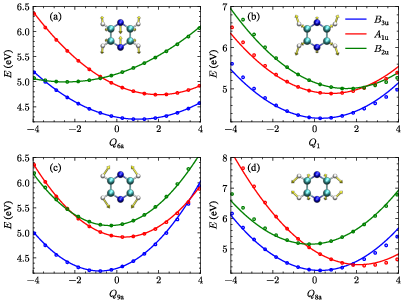
Figure 1: Potential energy surfaces along the four most significant tuning modes, illustrating RI-CC2's capacity to characterize crossings and CIs pertinent to pyrazine internal conversion dynamics.
Absorption spectra computed with RI-CC2, including static disorder, reproduce experimental molar absorptivities and bandwidths for B2u3 and B2u4, with a systematic B2u50.3 eV blueshift. This overestimation is consistent with prior findings for single-reference CC2 methods.
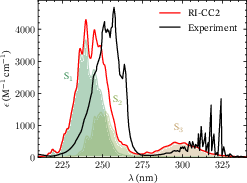
Figure 2: Calculated absorption spectrum (RI-CC2) and experiment for pyrazine, decomposed into state contributions.
Nonadiabatic Dynamical Simulations
VC Model Quantum Dynamics and Surface Hopping
Exact quantum and TSH simulations of the VC model reveal rapid population transfer from the initial B2u6 to both B2u7 and B2u8 in the first 10 fs. However, due to the stronger coupling via B2u9, population favors A1u0. Coherent population oscillations between A1u1 and A1u2 emerge, with oscillation frequencies correlated to the evolution of the A1u3 and—newly observed—A1u4 modes.
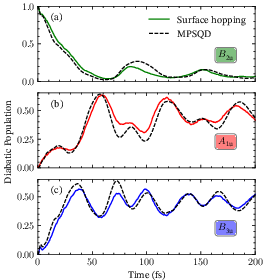
Figure 3: Time evolution of diabatic populations evidencing the transfer and coherence between key excited states in the VC model.
Full-Dimensional Ab Initio TSH Dynamics with DANN
Machine-learned DANN-accelerated TSH trajectories confirm the active participation of the dark A1u5 state in ultrafast relaxation following A1u6 excitation. The decay time of A1u7 population (26 fs) quantitatively matches the experimental value (A1u8 fs). Coherent population exchange between A1u9 and B3u0 is found to be modulated by both B3u1 and B3u2 motions.
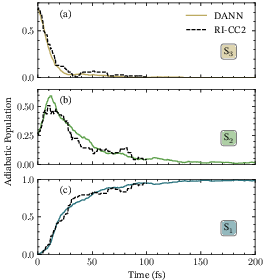
Figure 4: Time evolution of adiabatic populations in on-the-fly TSH simulations, emphasizing complete transfer into the lowest excited state.
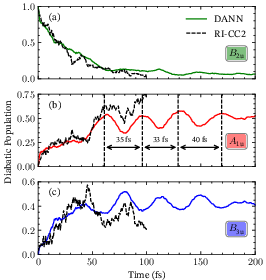
Figure 5: Time evolution of the diabatic populations in full TSH simulations, aligning with VC model trends but with suppressed B3u3 recurrences.
Analysis of nuclear density dynamics confirms that both B3u4 and B3u5 undergo coherent oscillations in phase with B3u6 population transfer, indicating their joint role in mediating this nonadiabatic process. In contrast to some experimental interpretations emphasizing B3u7, the present data highlight the substantial activity of B3u8, a mode previously underappreciated.
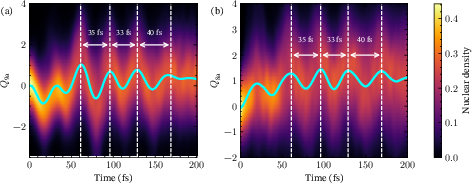
Figure 6: Nuclear density projected onto B3u9, showing periodic recrossing of the CI region concurrent with coherent electronic dynamics.
Implications and Future Directions
This work establishes that RI-CC2, with analytical gradients and NACVs, provides a balanced description of excited-state PESs and nonadiabatic couplings for organic chromophores in regions far from the ground state—even in challenging ultrafast scenarios. The ability of RI-CC2 to reproduce experimental internal conversion times and coherent vibronic effects matches the best reported for higher-level multireference methods but at substantially reduced cost and with improved scalability, supported further by stochastic sRI-CC2 implementations (2604.05734).
The high-quality dataset generated—comprising energies, gradients, and NACVs—is made openly available and constitutes a valuable resource for training next-generation machine-learned PESs and coupling models. The demonstration that DANN models can deliver RI-CC2-level accuracy for nonadiabatic dynamics, at orders-of-magnitude reduced cost, points to a paradigm shift for simulating large chromophores and complex condensed-phase environments.
On the theoretical side, the findings reinforce the necessity to explicitly consider nonadiabatic coupling between all relevant states—including spectroscopically dark n∼0 manifolds—and to accurately resolve the key tuning and coupling modes. The stochastic sRI-CC2 and new surface hopping methodologies (e.g., Floquet-FSSH for periodically driven systems) open pathways to simulate nonadiabatic, field-driven dynamics in much larger molecular assemblies.
Conclusions
This benchmark study demonstrates that RI-CC2, when applied with analytical gradients, NACVs, and DANN-accelerated dynamics, is reliable and robust for simulating ultrafast nonadiabatic processes in organic chromophores. For pyrazine, the method quantitatively recovers experimental internal conversion times and reveals that both ∼1 and ∼2 modes, along with the dark ∼3 state, play vital roles in the observed coherent population dynamics. These results promote RI-CC2 (and its stochastic variant) as practical tools for excited-state photochemistry in large systems, bridging the quantum/classical divide in nonadiabatic molecular simulation.

