- The paper proposes a novel CVT-MOME method that leverages learned chemical embeddings to partition chemical space more effectively than traditional grids.
- It employs ChemBERTa-2 with UMAP projection to create 100 chemically meaningful centroids, yielding statistically higher median hypervolumes and better archive occupancy.
- The study demonstrates that embedding-driven archives enhance both objective performance and chemical diversity, offering a new paradigm for molecular NLO design.
Embedding-Based Centroidal Voronoi Tessellation Archives for Multi-Objective Quality Diversity in Molecular NLO Design
Introduction
The discovery of nonlinear optical (NLO) molecules for photonic devices, such as electro-optic modulators, hinges on navigating massive, chemically constrained search spaces to balance competing property objectives. Traditional multi-objective optimization methods reveal trade-offs but often lack sufficient pressure for diversity, especially when dealing with vast numbers of infeasible molecular combinations. Multi-Objective MAP-Elites (MOME) addresses this by partitioning chemical space into discrete niches (“cells”), but its efficacy is limited by the choice of archive structure—standard grids based on atomic counts do not reflect the true topology or density of chemically feasible molecules.
This work replaces grid-based MOME with Centroidal Voronoi Tessellation (CVT) archives, using chemical embedding vectors derived from ChemBERTa-2 Multi-Task Regression (MTR) projected by UMAP. By allocating niches where real molecules cluster in chemical similarity space, the method enhances archive usage, objective performance, and chemical exploration. Assessment focuses on a four-objective NLO molecular optimization problem, combining β/γ ratio, HOMO-LUMO gap, linear polarizability, and per-atom energy as a stability proxy.
Methods
The CVT-MOME approach leverages learned chemical embeddings to define behavior descriptors for quality diversity (QD) archives. Molecules are represented by canonical SMILES strings, mutated using a set of graph-based operators ensuring chemical validity. Property evaluation is performed ab initio via the PySCF HF/3-21G quantum chemistry protocol.
In grid-based MOME, two measures—heavy-atom and bond count—define a 20×20 archive grid. However, the vast majority of these bins are unoccupied in practice, as many structural combinations are chemically impossible. To address this, CVT-MOME utilizes ChemBERTa-2 MTR to generate 768-dimensional chemical fingerprints for molecules, capturing contextual physicochemical information. These high-D representations are reduced via UMAP (to 10 dimensions) using a manifold learned from 10,000 random molecules, positioning centroids via k-means clustering.
Each CVT cell (100 in this work) maintains a local Pareto set corresponding to distinct chemical subspaces. Binning is performed by assigning each new molecule to its nearest centroid. This embedding-centric approach ensures that all niches represent chemically meaningful and accessible regions rather than arbitrary, potentially vacant, grid slices.
Experimental Setup
MOME and CVT-MOME archives are initialized with 50 random accessible molecules and iteratively evolved over 1,800 mutation cycles. Standard NSGA-II is included as a non-QD multiobjective baseline. The four-objective optimization encompasses:
- β/γ ratio: Enhance second-order NLO activity relative to third-order.
- Linear polarizability (α): Confine to 100≤α≤500 a.u.
- HOMO-LUMO gap (ΔE): Target 2≤ΔE≤4 eV for visible-range transparency.
- Per-heavy-atom energy: Minimize total Hartree-Fock energy per atom; models excessive instability or calculation failures are excluded.
Molecules exceeding physically relevant bounds for these properties (e.g., outside the Kuzyk limit for hyperpolarizabilities) are removed before archive assignment, ensuring only physically plausible structures contribute to evaluation metrics.
Results
In terms of median global hypervolume—a Pareto quality scalarization—CVT-MOME achieves a superior trajectory throughout the course of search relative to both conventional MOME and NSGA-II. By the end of evolution, CVT-MOME's median normalized hypervolume is $0.0273$, compared to MOME ($0.0095$) and NSGA-II (20×200). These gains are statistically significant and consistent across random seeds, as evidenced by non-parametric tests. Notably, CVT-MOME's inter-run variance is reduced, reflecting enhanced reproducibility arising from embedding-driven, rather than grid-driven, niche allocation.
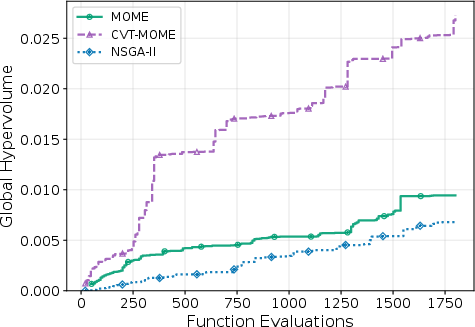
Figure 1: Median global hypervolume across function evaluations (20 runs each). CVT-MOME consistently achieves the highest median hypervolume throughout evolution.
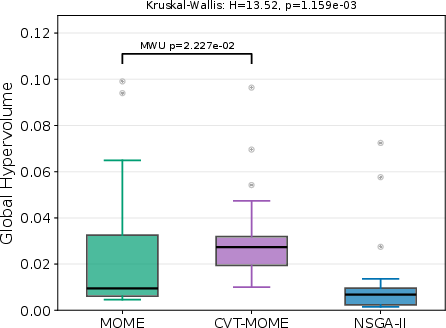
Figure 2: Box-and-whisker plots of final global hypervolume across 20 runs per algorithm.
Archive Occupancy and Multiobjective Quality-Diversity
While MOME populates a greater fraction of bins in the grid archive when analyzed structurally, CVT-MOME occupies 91 of its 100 centroids, compared to just 52/100 for MOME and 21/100 for NSGA-II. Moreover, when the chemical embedding archive is rebinned back into the grid for comparison, CVT-MOME demonstrates high-quality but more focused coverage, primarily reflecting clustering in densely populated chemical regions.
MOME’s metric coverage is less meaningful due to the presence of many infeasible or empty grid cells. In contrast, CVT-MOME bins, defined by clustering in the UMAP embedding, are guaranteed to host diverse, real molecules, capturing a richer spread of chemical diversity. Hypervolume-based QD (MOQD) scores confirm this: CVT-MOME achieves 20×201 in the grid (20×202 in the embedding-based archive), compared to MOME's 20×203 (20×204), while NSGA-II lags substantially behind.
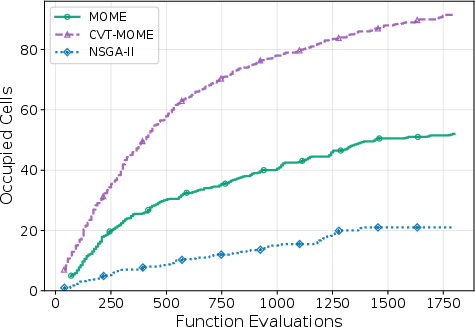
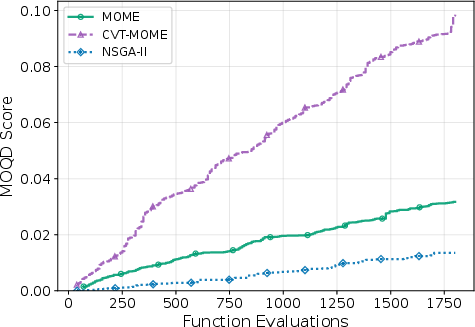
Figure 3: 20×205 (left) and 20×206 (right) demonstrate archive occupation; CVT-MOME achieves better utilization of embedding-based niches by construction.
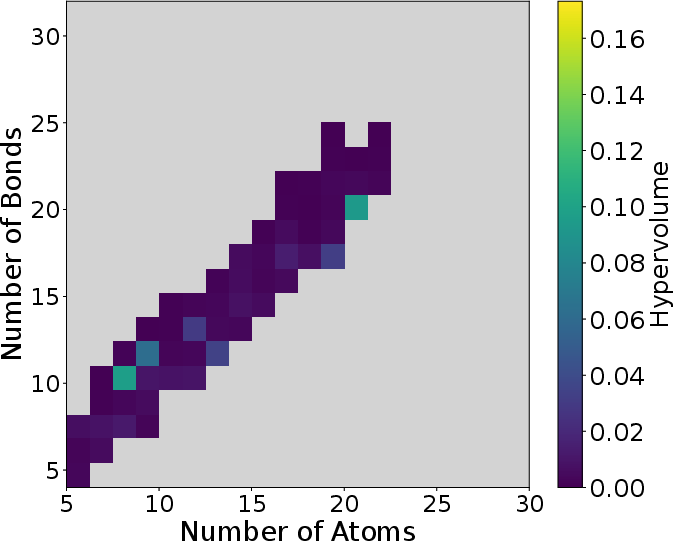
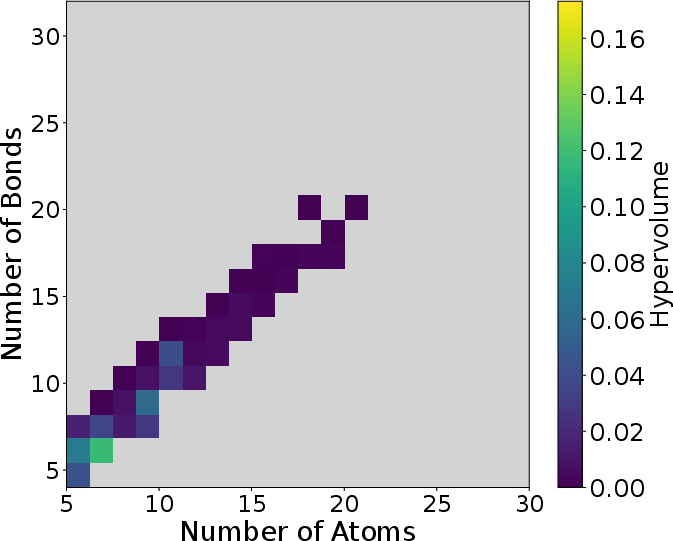
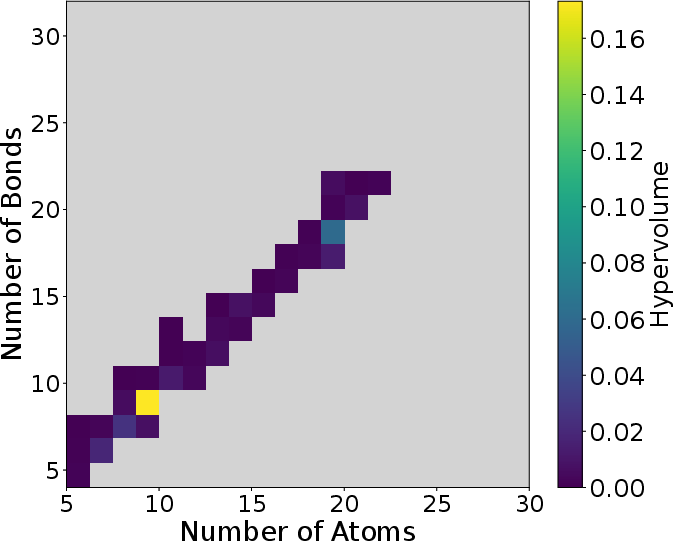
Figure 4: MOME (left), CVT-MOME (center), and NSGA-II (right) mega-archive heatmaps: CVT-MOME concentrates high-Pareto quality at discovery-rich ends of the structural manifold, while NSGA-II achieves isolated high-single-cell quality.
Trade-offs Between Diversity and Local Quality
Mega-archive heatmaps, aggregating solutions across all random seeds, reveal distinct search strategies. MOME maximizes spread across the atom/bond space but often deposits lower-quality solutions in sparsely populated bins. CVT-MOME focuses on regions of chemical space corresponding to valid, diverse molecules, with many bins hosting locally strong Pareto fronts. NSGA-II, typical for a non-QD approach, shows isolated pockets of maximum objective quality with little diversity.
Implications and Future Work
This study demonstrates that embedding-driven archives, instantiated via CVT in learned chemical space, fundamentally alter the trade-off between objective optimization and chemical diversity for molecular design. By abandoning rigid grid-based measures for learned molecular embeddings, optimization is more efficient and less constrained by arbitrary, high-dimensional metrics that do not reflect chemical reality.
Practically, this approach enables both broader and denser exploration of synthesizable chemical regions, allowing the discovery of chemically meaningful trade-offs not accessible via traditional multi-objective or QD-only methods. Theoretically, it reframes QD for molecular design as an embedding-space partitioning problem, suggesting that progress on representation learning (e.g., improved chemical foundation models or contrastive learning in property space) may further amplify the effectiveness of QD evolutionary approaches.
Future work should focus on generalizing this embedding-based archive scheme to other molecular property domains (e.g., drug-likeness, catalysis), investigating alternative embedding strategies, and combining CVT-driven QD techniques with generative models or more sophisticated multi-objective evolutionary operators. Comparative studies with graph-based or SELFIES-based representations, as well as integration with experimental design platforms, constitute promising directions for AI-driven molecular sciences.
Conclusion
Embedding-defined CVT archives, seeded by ChemBERTa-2 MTR and projected into UMAP space, surpass grid-structured MOME for multi-objective quality diversity in NLO molecular design. CVT-MOME not only yields higher global hypervolume and QD metrics but also achieves denser, more semantically coherent chemical exploration. These results establish embedding-based archives as a new paradigm for quality-diversity optimization in molecular discovery, with implications for the broader field of generative molecular AI and property optimization.

