- The paper establishes a macrotransport theory that extends classical Taylor-Aris dispersion to soft, deformable channels using a Winkler foundation model.
- It employs multiple-time-scale analysis and lubrication theory to derive effective transport equations, quantifying enhanced advection and dispersion in both steady and oscillatory flows.
- Key findings reveal that wall elasticity, contrary to rigid channel expectations, amplifies axial flow and solute spread, with significant implications for microfluidic design and biological diagnostics.
Taylor Dispersion in a Soft Axisymmetric Channel: Macrotransport Theory and Elastohydrodynamic Effects
Introduction
This paper presents a theoretical analysis of Taylor-Aris dispersion in axisymmetric channels with deformable (soft) walls, where the elasticity of the wall is modeled with a Winkler foundation. The impact of wall compliance on solutal transport is analyzed for both steady and oscillatory (pulsatile) inlet pressure conditions. The authors employ multiple-time-scale analysis to derive effective macroscopic transport equations for the cross-sectionally averaged concentration, elucidating modifications in the advection velocity and dispersion coefficient induced by the elastohydrodynamics. This work addresses a significant gap in dispersion theory—specifically, how wall elasticity fundamentally alters dispersion dynamics compared to rigid channels, with practical implications for microfluidics and potentially for biological systems.
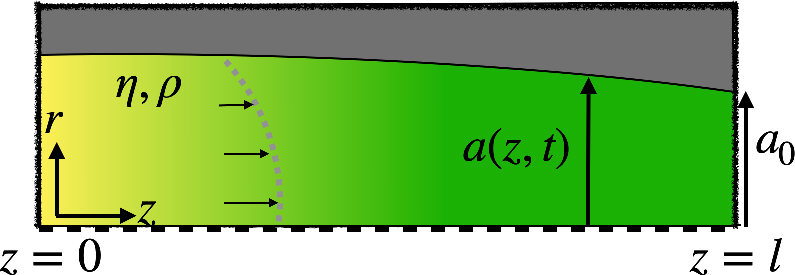
Figure 1: Schematic of the viscous flow system in an elastic, axisymmetric channel; elasticity is incorporated via a Winkler model for wall deformation under hydrodynamic pressure.
Theoretical Framework
Elastohydrodynamic Model
The channel is axisymmetric, with a fluid obeying the incompressible Navier-Stokes equations. Elastic wall deformation follows a linear Winkler relationship: the local radius a(z,t)=a0+kp(z,t) responds instantaneously to local pressure, with k quantifying wall compliance. Lubrication theory is applied under the assumption ϵ=a0/l≪1, and the problem is non-dimensionalized to reveal the relevant control parameters: Reynolds, Womersley, Strouhal, Peclet numbers, and a dimensionless compliance κ=kp0/a0.
Solute transport is governed by the advection-diffusion equation, with the critical coupling to wall motion reflected in both the velocity field (altered by elasticity) and moving boundary effects in the concentration dynamics.
Multiple-Time-Scale Analysis
A systematic multiple-time-scale expansion distinguishes between rapid radial diffusion (τ0=a02/D), advection timescales (τ1=l/U0), and long-time axial diffusion (τ2=l2/D). The method yields a macrotransport equation for the cross-sectionally averaged concentration C(0)(Z,T):
ϕ∂T∂C(0)+[Pe⟨U⟩+ϵ(Pe2αs,p+ακ)]∂Z∂C(0)=ϵ[1+Pe2γs,p]∂Z2∂2C(0)
The leading ⟨U⟩ and the coefficients k0 encompass the effects of wall compliance, location, and (for oscillatory flow) phase.
Steady Flow: Compliance-Induced Transport Enhancement
Analytical Results
In the steady-pressure regime, exact closed forms for the hydrodynamic pressure and velocity fields are obtained. The principal findings include:
- Average Flow Enhancement: Wall softness monotonically amplifies the average axial velocity, with the amplification factor increasing both with compliance and axial position. This arises from the nonlinear coupling of deformation and flow via the pressure drop.
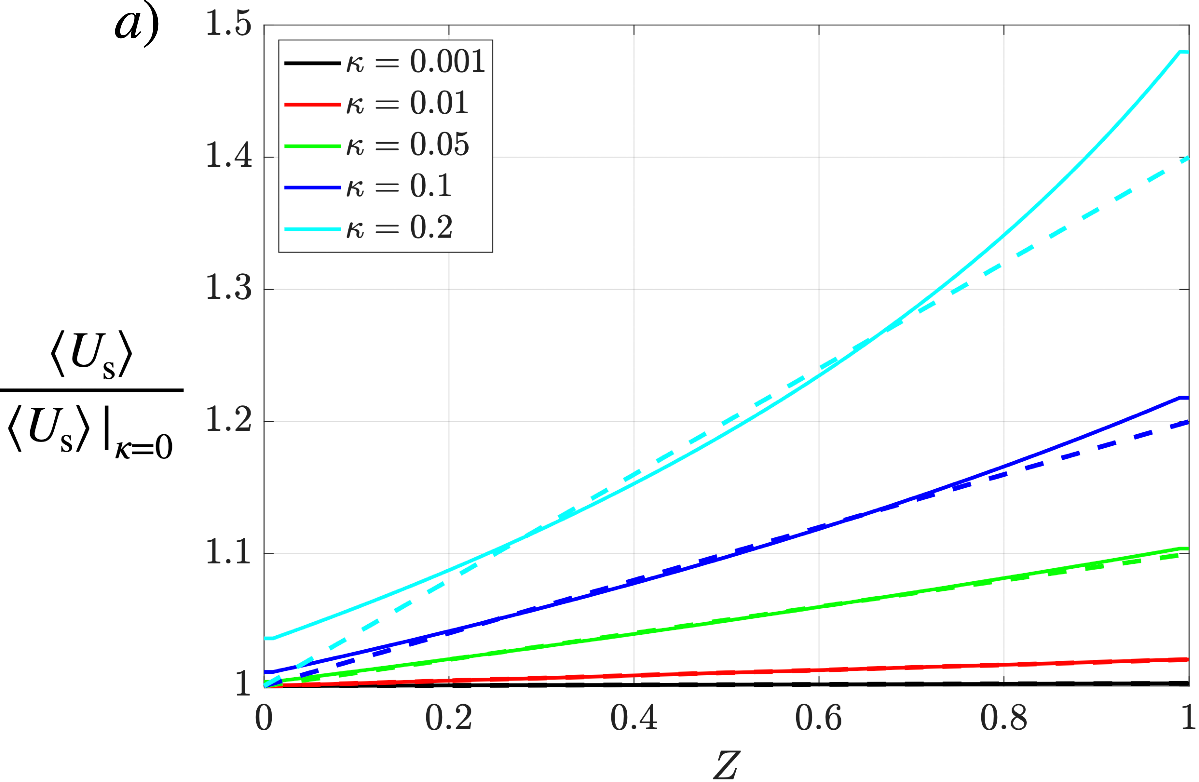
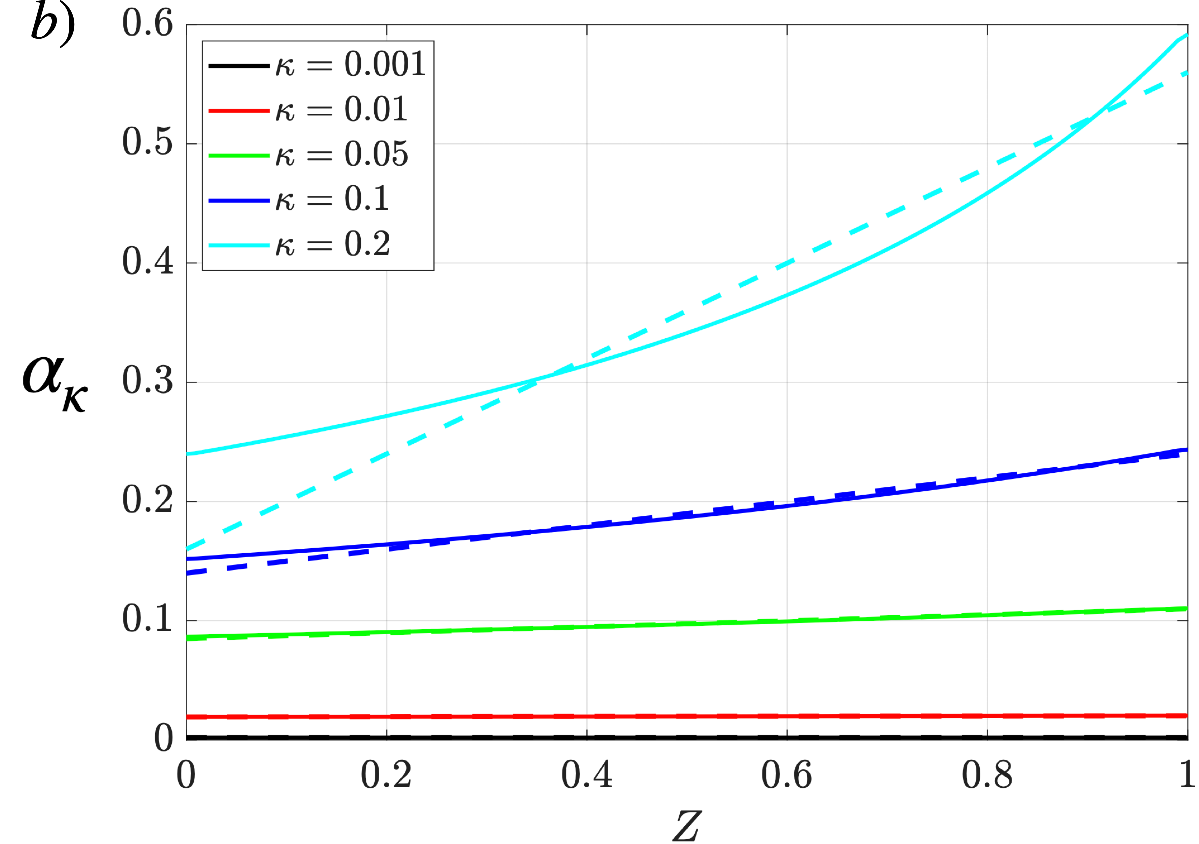
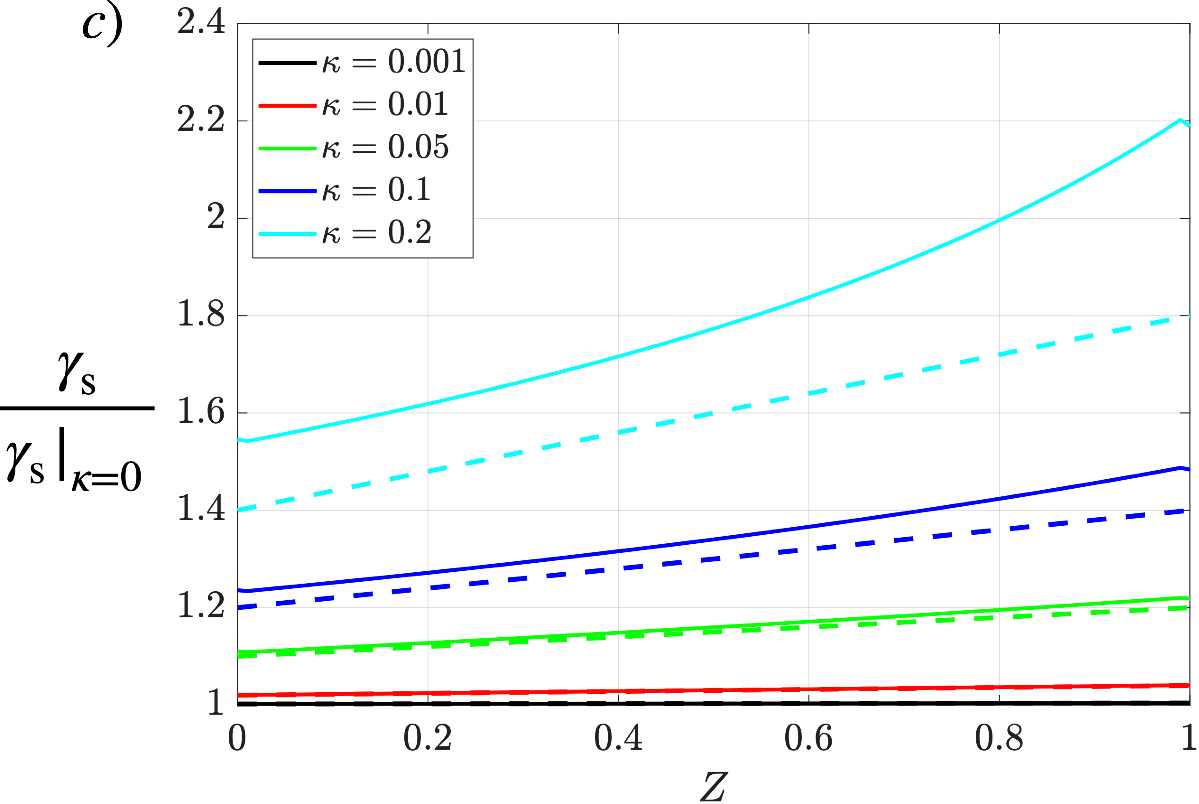
Figure 2: Dimensionless amplification of average flow and solutal advection velocity, and solutal-dispersion enhancement factor k1 as functions of channel position k2 and wall compliance k3.
- Dispersion Coefficient: The effective axial dispersion is enhanced by wall elasticity. The enhancement factor, analogous to the classical Taylor-Aris prefactor, is strictly positive and increases with both channel softness and axial coordinate.
- Non-uniformity: Both velocity and dispersion become explicitly spatially varying, reflecting localized wall deformation—contrasting with the uniform properties in rigid pipes.
- Boundary Effects: The advection velocity contains a physically significant correction term (originating from solutal no-flux at a deforming wall), which contributes an additional compliance-dependent enhancement to axial solute transport.
Contradictory Observation
A notable result is that even as effective channel radius decreases due to deformation (ostensibly reducing transport in classical rigid theory), both mean flow and dispersion increase. This reflects conservation of imposed flux through a deformable cross section and represents a deviation from rigid channel intuition.
Oscillatory Flow: Temporal and Modal Complexity
The oscillatory (pulsatile) regime introduces additional time-periodic and mode-coupling effects:
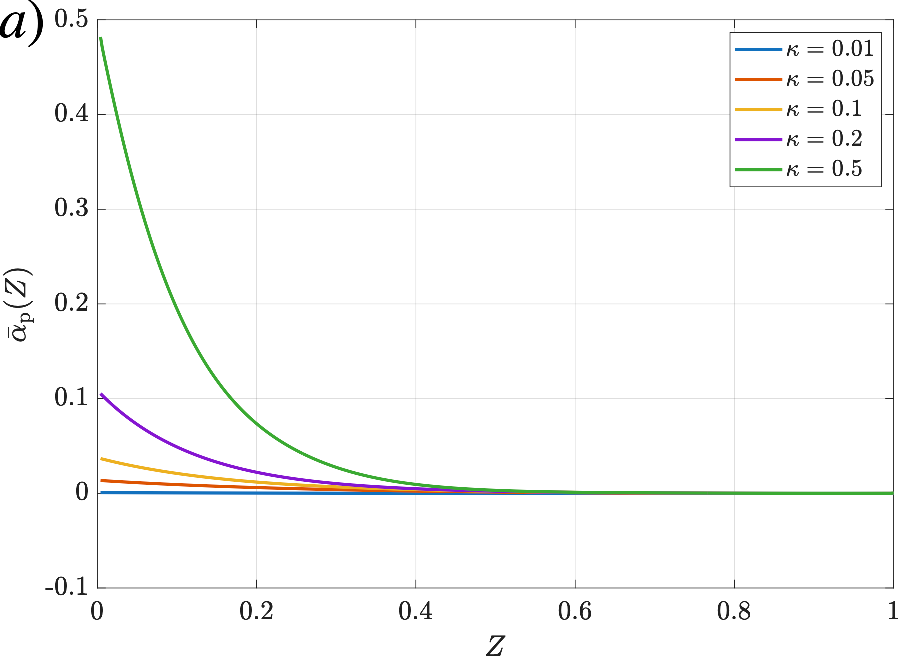
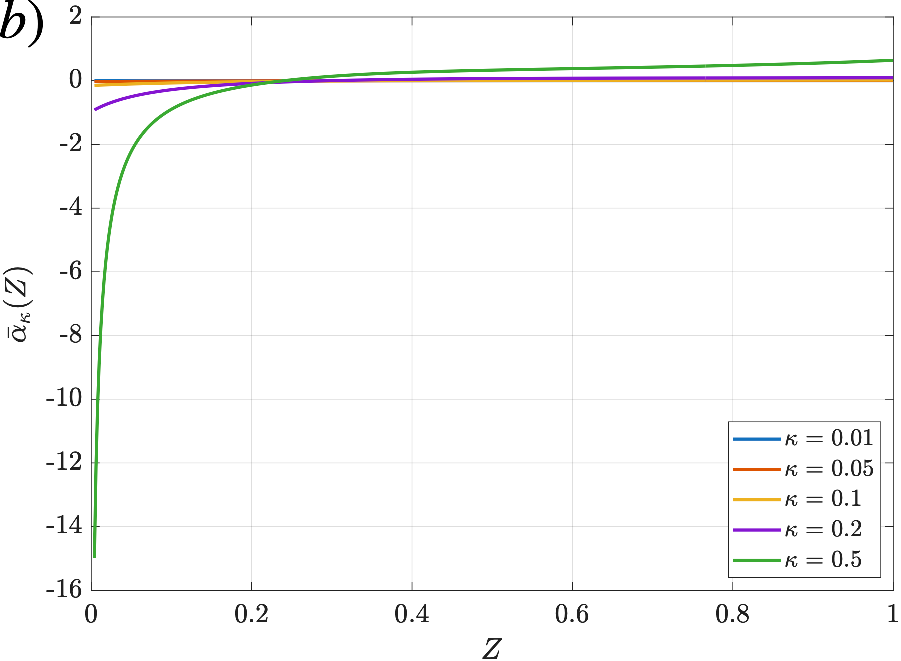
Figure 3: Numerically computed k4 and k5—parameters controlling period-averaged advection velocity—versus position k6 and wall compliance k7.
- Streaming Flows and Mode Coupling: Nonlinear coupling between elasticity and oscillatory pressure results in non-zero period-averaged pressure at k8, yielding a net streaming contribution.
- Dispersion Dynamics: Numerical evaluation of the time-dependent and period-averaged amplification factor k9 reveals an overall enhancement, but with non-uniform and temporally varying profiles. The enhancement is maximal near the inlet and can be significantly reduced near the outlet for moderate compliance.
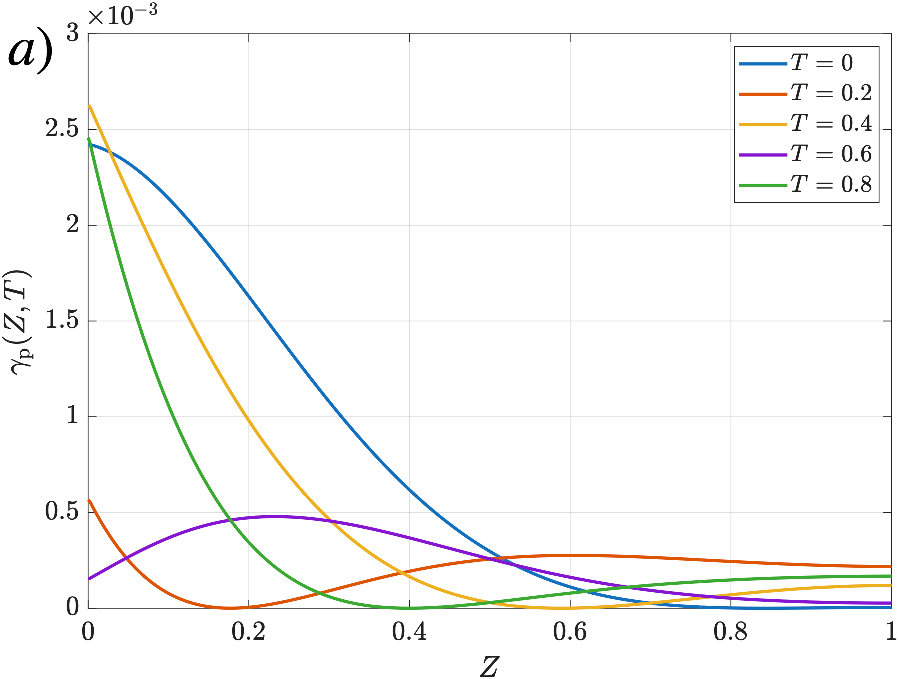
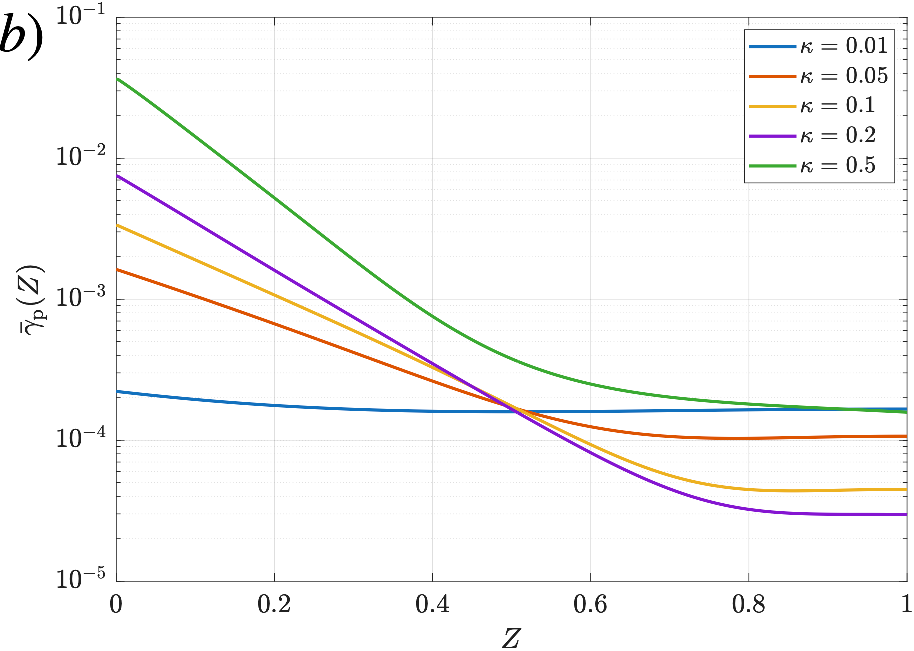
Figure 4: Time-resolved and period-averaged solutal-dispersion enhancement ϵ=a0/l≪10 as functions of ϵ=a0/l≪11, for various compliance values; the effect is strongest near the inlet and varies non-monotonically along the channel.
- Spectral Generation: The presence of wall elasticity introduces higher harmonics in the pressure and velocity fields, confirmed via perturbative analysis in the weakly compliant limit.
Solute Dispersion Profiles and Practical Implications
Numerical solutions of the macrotransport equation highlight key practical effects:
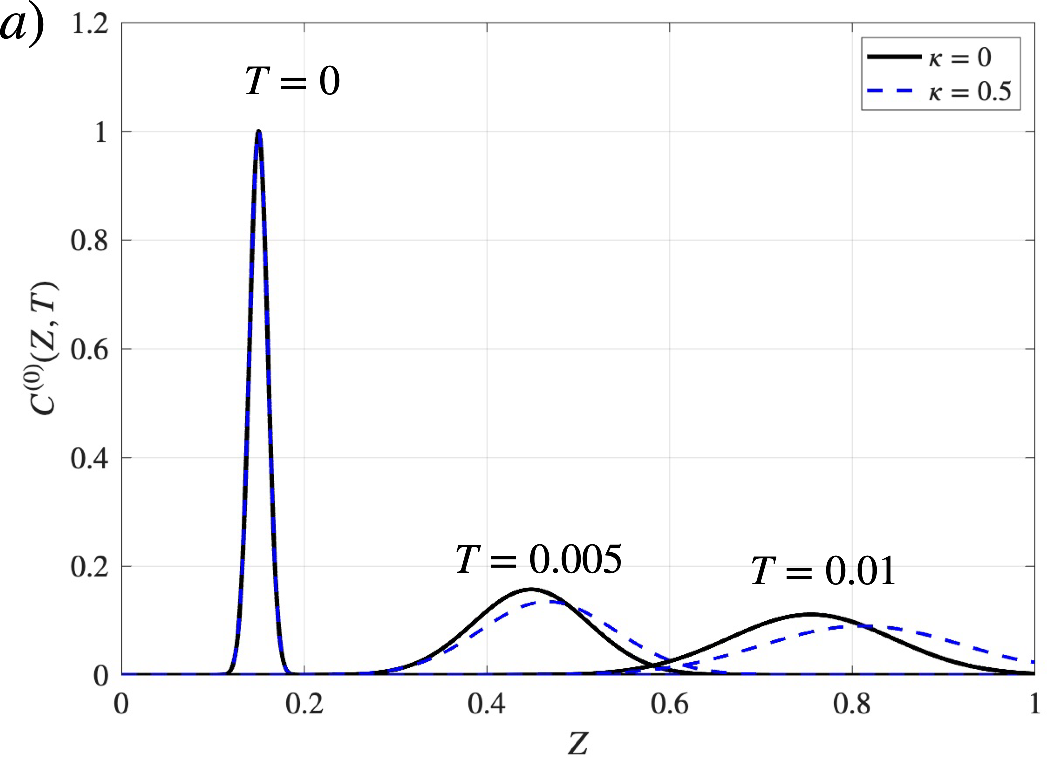
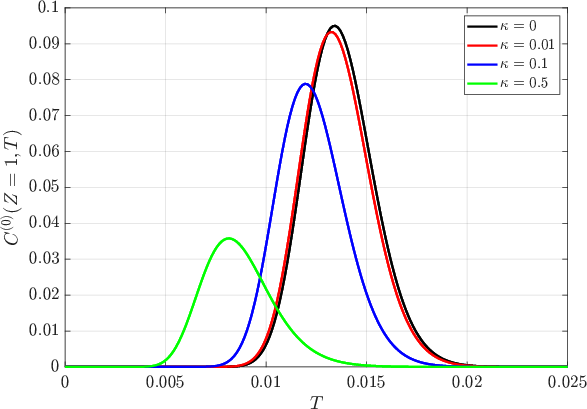
Figure 5: Evolution of dimensionless solute concentration profile ϵ=a0/l≪12 with time for different wall compliances; greater softness accelerates both the advance and spread of the solute peak.
- Enhanced Transport: Increasing compliance yields faster breakthrough and broader spreading of the solute pulse—a direct manifestation of combined advection and dispersion enhancement.
- Profile Asymmetry: Wall compliance accentuates fore-aft asymmetry in the solute breakthrough curve, with applications in inferring in situ wall mechanical properties from measured concentration histograms.
Broader Implications and Future Directions
These results have immediate implications for the design and interpretation of microfluidic systems utilizing soft materials, as well as for soft biological conduits (e.g., blood vessels). Practical consequences include:
- Non-invasive Compliance Inference: The enhanced and spatially variable solutal dispersion enables the extraction of channel compliance data from simple downstream concentration measurements.
- Biological Diagnostics: Potential for developing diagnostics of pathological vessel softening via standard tracer transport experiments.
From a theoretical perspective, this study demonstrates that classical Taylor-Aris theory is fundamentally modified by elastohydrodynamic coupling, yielding inhomogeneous and modulated transport properties that cannot be captured by rigid models.
Notable extensions include two-way coupled phenomena such as diffusio-osmosis and phoresis in soft channels, and the study of active colloidal or biological particles, where wall elasticity becomes a tunable parameter for controlling dispersion and, by extension, spatiotemporal pattern formation of transported species.
Conclusion
The paper delivers an in-depth, formal extension of Taylor-Aris dispersion theory to elastic channels, showing that wall compliance systematically enhances both advective and dispersive transport—an effect that is inherently spatially and temporally inhomogeneous in the case of non-rigid channels. These findings refine predictions for solutal transport in soft conduits and suggest new experimental strategies for inferring mechanical channel properties and controlling transport phenomena in microfluidic and biological contexts.
Reference:
"Taylor dispersion in a soft channel" (2604.05592)