- The paper introduces floating Majorana edge bands (FMEBs) emerging from anisotropy in Wilson masses, leading to momentum-separated counterpropagating Majorana modes.
- The paper employs nonequilibrium Green’s function simulations to demonstrate full and half-quantized thermal conductance plateaus as definitive experimental signatures.
- The paper establishes that FMEBs maintain robust quantized thermal transport under disorder, finite temperature, and chemical potential shifts, implying potential for topological quantum computing.
Robust Quantized Thermal Transport from Majorana Floating Edge Bands in d-Wave Superconductors
Introduction
This paper introduces and theoretically characterizes a novel class of Majorana boundary states—floating Majorana edge bands (FMEBs)—that arise in two-dimensional topological superconductors explicitly breaking time-reversal symmetry but supporting helical-like edge transport (2604.05588). Unlike conventional chiral or helical edge states, FMEBs present a pair of momentum-separated, counterpropagating Majorana modes localized on the same boundary but detached from the bulk continuum. A key physical insight is that FMEBs emerge generically from anisotropy in the Wilson mass of a Bogoliubov–de Gennes (BdG) lattice model. The work further establishes that such anisotropy is naturally realized in quantum anomalous Hall (QAH) insulators proximitized by d-wave superconductors. The authors systematically analyze resulting transport signatures via nonequilibrium Green’s function (NEGF) calculations, establishing robust, quantized thermal conductance plateaus as unique experimental fingerprints of the FMEB phase.
Minimal Model and Topological Characterization
The emergence of FMEBs is elucidated starting from a minimal two-band BdG lattice Hamiltonian on a square lattice. The model features tunable anisotropic Wilson masses along the x and y directions. With isotropic masses (Bx=By), the system is a chiral topological superconductor with Chern number N=1 supporting a single chiral Majorana edge mode, as expected from the bulk-boundary correspondence.
Introducing Wilson-mass anisotropy (Bx=By) induces a topological transition: the bulk Chern number drops to zero, yet a floating edge band (FMEB) persists in specific ribbon geometries, entirely detached from both bulk continua. The topological triviality of the bulk is thus insufficient to guarantee the absence of robust edge modes, provided orientation-selective anisotropy persists.
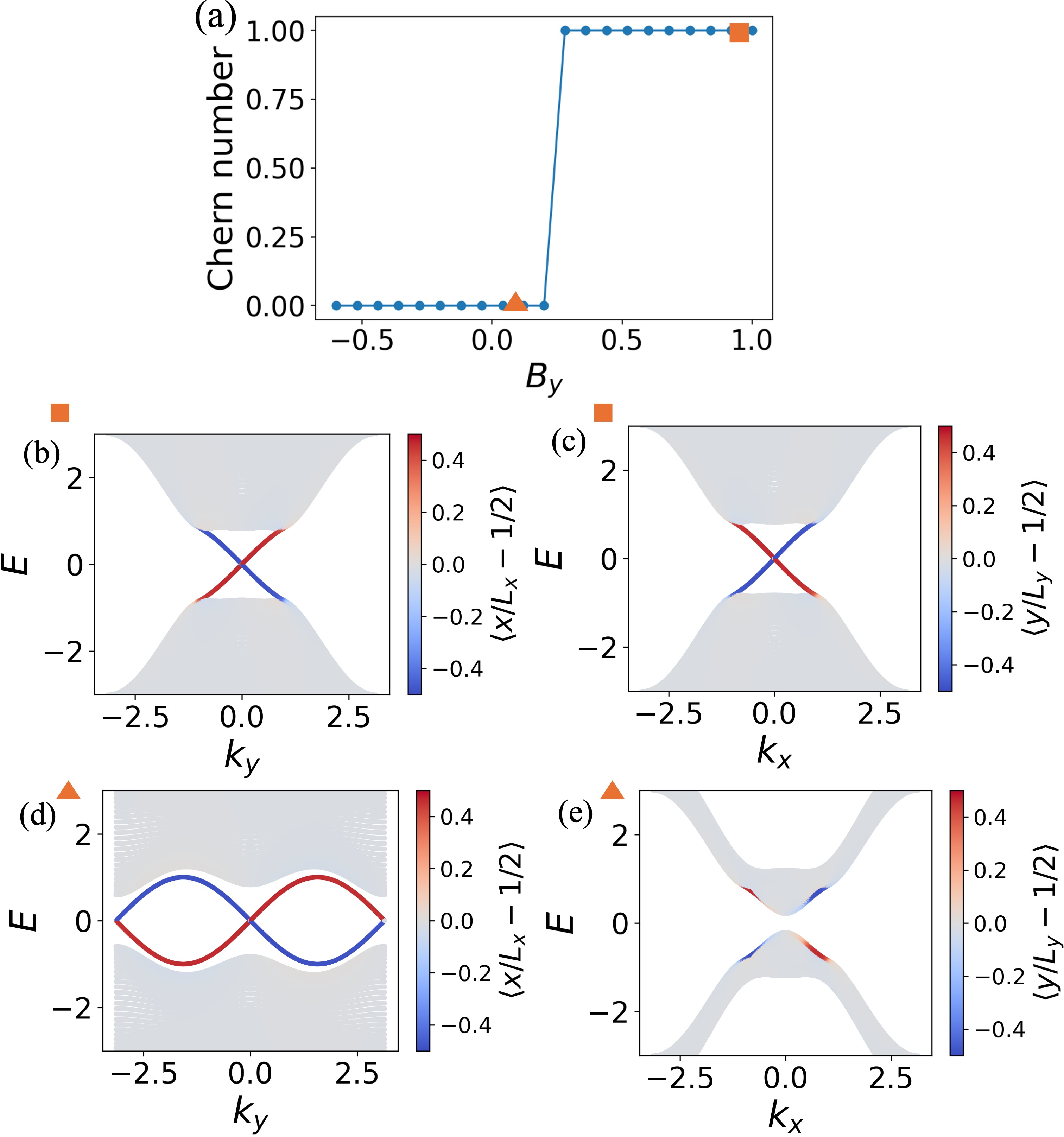
Figure 1: Bulk and edge spectra for the anisotropic BdG-QWZ model, demonstrating FMEB emergence upon increasing Wilson mass anisotropy.
The FMEBs violate conventional expectations from the bulk-boundary correspondence due to their weak-topological origin, which is diagnosed using winding numbers in quasi-1D slices of the BZ at high-symmetry momenta (see Appendix for explicit formulas and phase diagrams).
Microscopic Realization in QAH/d-Wave Superconductor Heterostructures
The paper demonstrates that the QAH/d-wave superconductor platform naturally realizes the required Wilson-mass anisotropy at the microscopic level. Within a standard QAH model proximitized by a d-wave order parameter, the d-wave pairing renormalizes the Wilson mass—in opposite directions for the two Majorana blocks derived from the BdG Hamiltonian.
Diagonalization in the Majorana basis reveals that the d0-wave pairing term modifies the effective Wilson mass for each Majorana sector as d1 (d2 for d3 and d4 for d5 for one block, vice versa for the other), automatically realizing the d6 anisotropy. Each decoupled Majorana block then supports an orientation-selective FMEB.
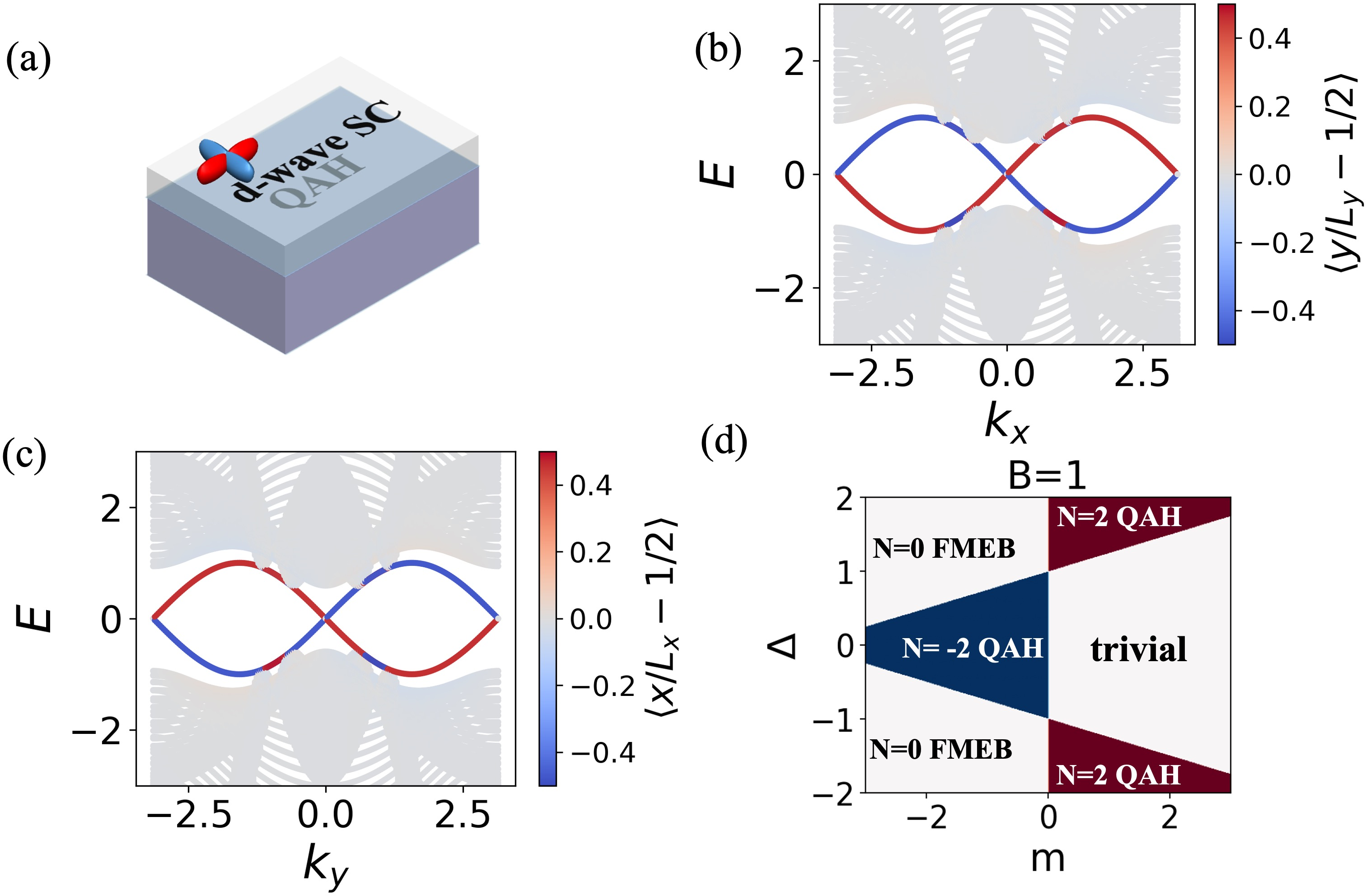
Figure 2: Edge spectra and phase diagram in a QAH/d7-wave superconductor, illustrating the robust momentum-separated counterpropagating Majorana modes of the FMEB phase despite d8.
The phase diagram in the d9 plane (QAH band inversion and x0-wave pairing amplitude), computed analytically from sign changes of high-symmetry-point masses, delineates conventional chiral QAH regimes, trivial x1 states, and "white wedge" regions where the FMEBs reside, characterized by nontrivial weak winding markers despite vanishing bulk Chern number.
Thermal Transport and Majorana Signatures
The critical experimental signature for FMEB phases is their distinctive thermal transport, evaluated through NEGF simulations in both two-terminal and four-terminal device geometries.
Two-terminal geometry: Across the QAH to FMEB transition (increasing x2-wave pairing amplitude), the total transmission remains quantized at unity, but with a qualitative shift in channel composition. In the QAH regime, transport is carried by a single chiral electron channel; in the FMEB phase, this reconstructs into two momentum-separated counterpropagating Majorana channels, each contributing one-half channel, yielding x3—a hallmark of Majorana-mediated transport.
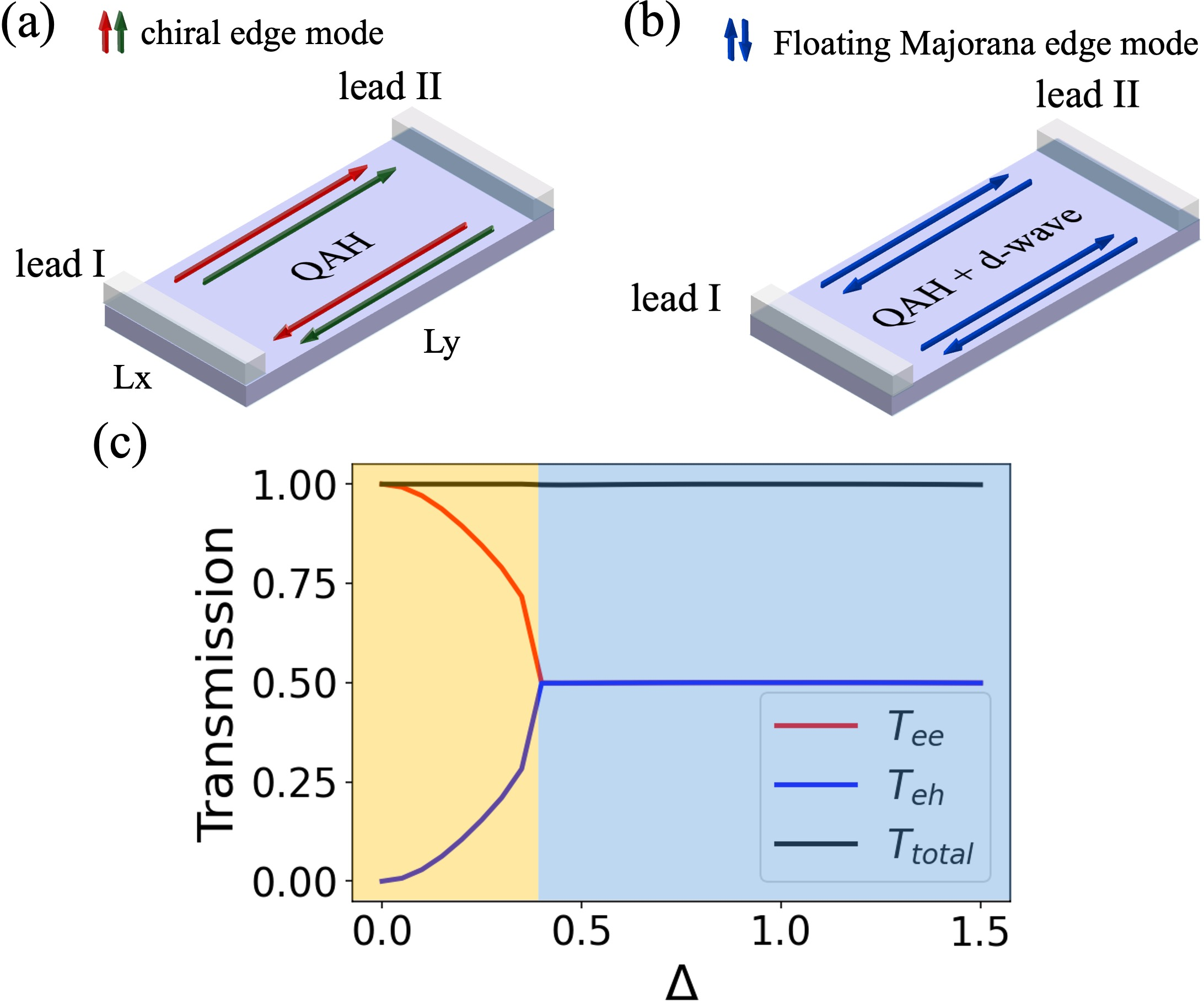
Figure 3: Transition in edge transport as x4-wave pairing is increased, reconstructing a chiral electron mode into a floating, helical-like Majorana channel, reflected in the partition of transmission coefficients.
Four-terminal geometry: To directly distinguish FMEBs from QAH phases, temperature probes couple locally to the same edge. Here, the thermal conductance transitions from a fully quantized plateau (x5) in the chiral regime to a robust half-quantized plateau (x6) in the FMEB regime—consistent with two Majorana modes per edge direction, each contributing half the normal value.
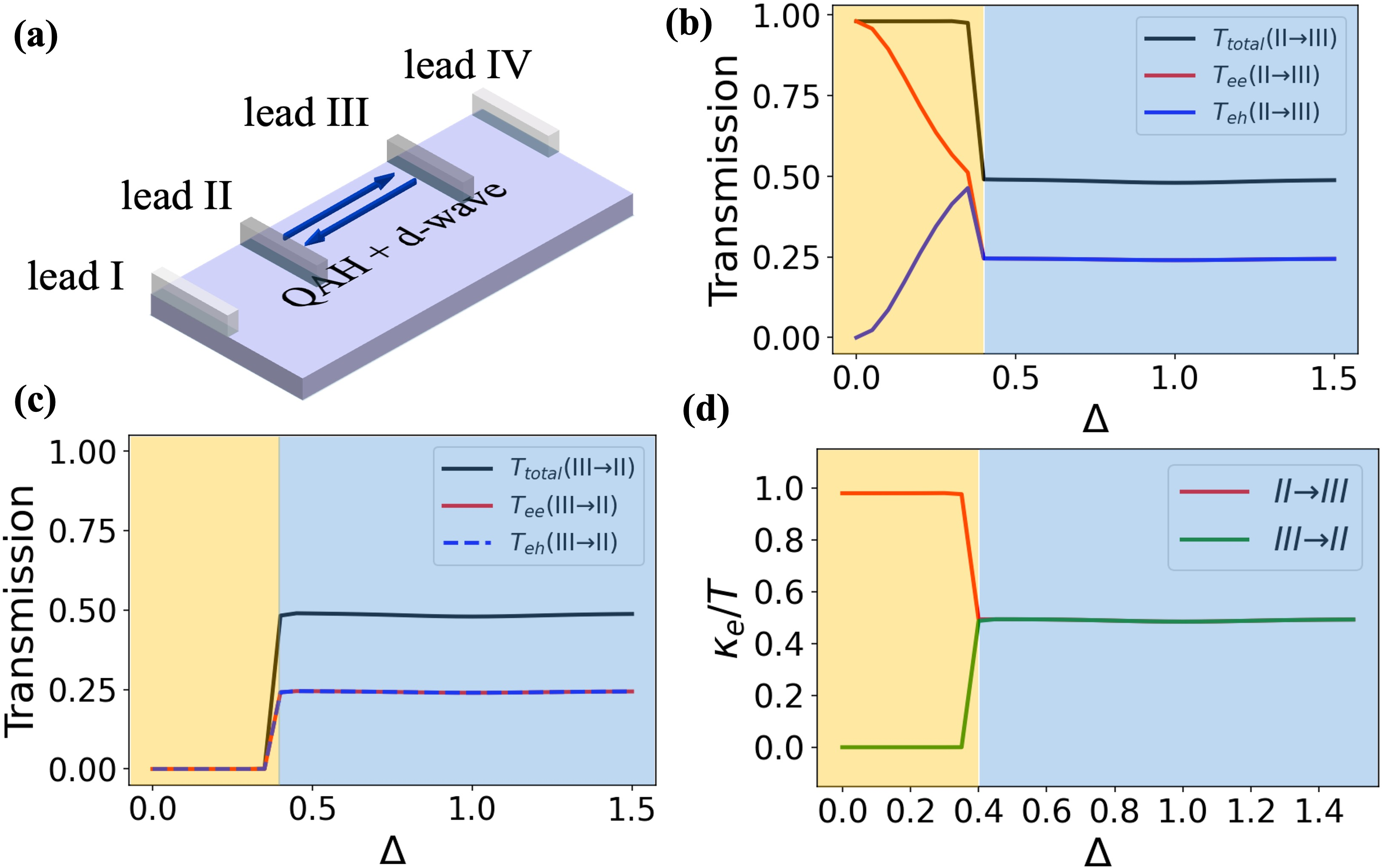
Figure 4: Four-terminal measurement reveals a robust half-quantized thermal conductance plateau in the FMEB regime, distinguishing it from the unidirectional quantized response of the QAH phase.
The bidirectionality enabled by the FMEBs, in contrast to strictly chiral QAH edge transport, provides a clear experimental handle and direct thermal conductance quantization as a measurable bulk-robust signature.
Robustness to Disorder, Temperature, and Chemical Potential
The FMEB quantized thermal transport is systematically shown to be resilient against multiple experimental imperfections:
- Long-range disorder: Quantized thermal conductance remains stable up to disorder strengths x7 (normalized units), due to the substantial momentum separation of the edge modes, which suppresses large-momentum backscattering.
- Finite temperature: The Landauer–Büttiker integral for thermal conductance reveals negligible temperature dependence as long as the system remains within the bulk gap, due to a wide, flat transmission plateau near zero energy.
- Finite chemical potential: FMEBs persist under sizable chemical potential shifts, maintaining edge localization and quantized thermal response, since the momentum separation and neutral Majorana character are only weakly perturbed even for moderate doping.
Notably, the FMEB thermal response is less fragile to time-reversal-symmetry (TRS) breaking disorder than conventional helical Majorana phases, but susceptible to strong potential disorder that enables intervalley scattering.
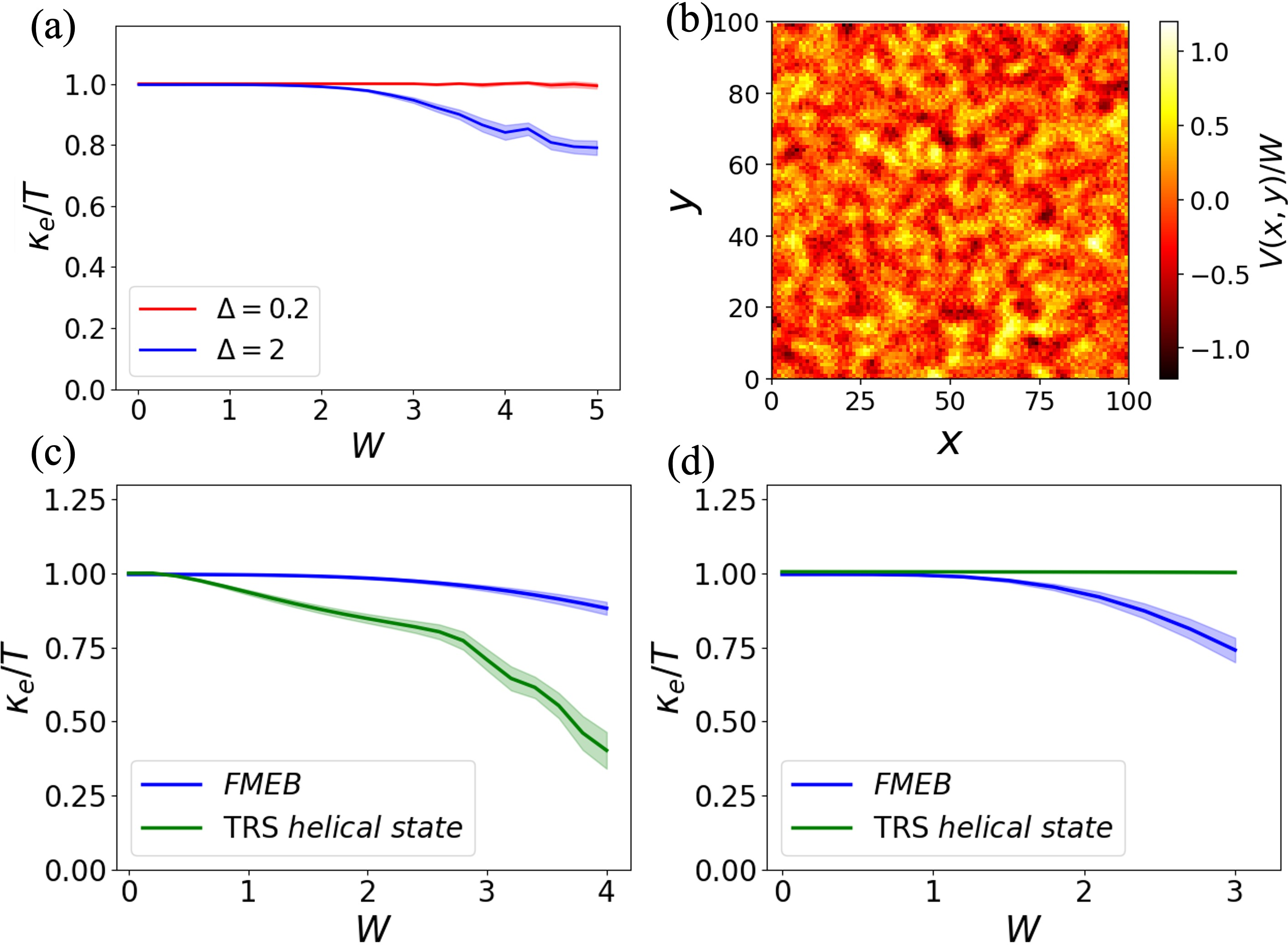
Figure 5: Quantized thermal conductance in the FMEB regime is robust to long-range disorder, distinguishing it from TRS helical Majorana edge states and conventional QAH phases.
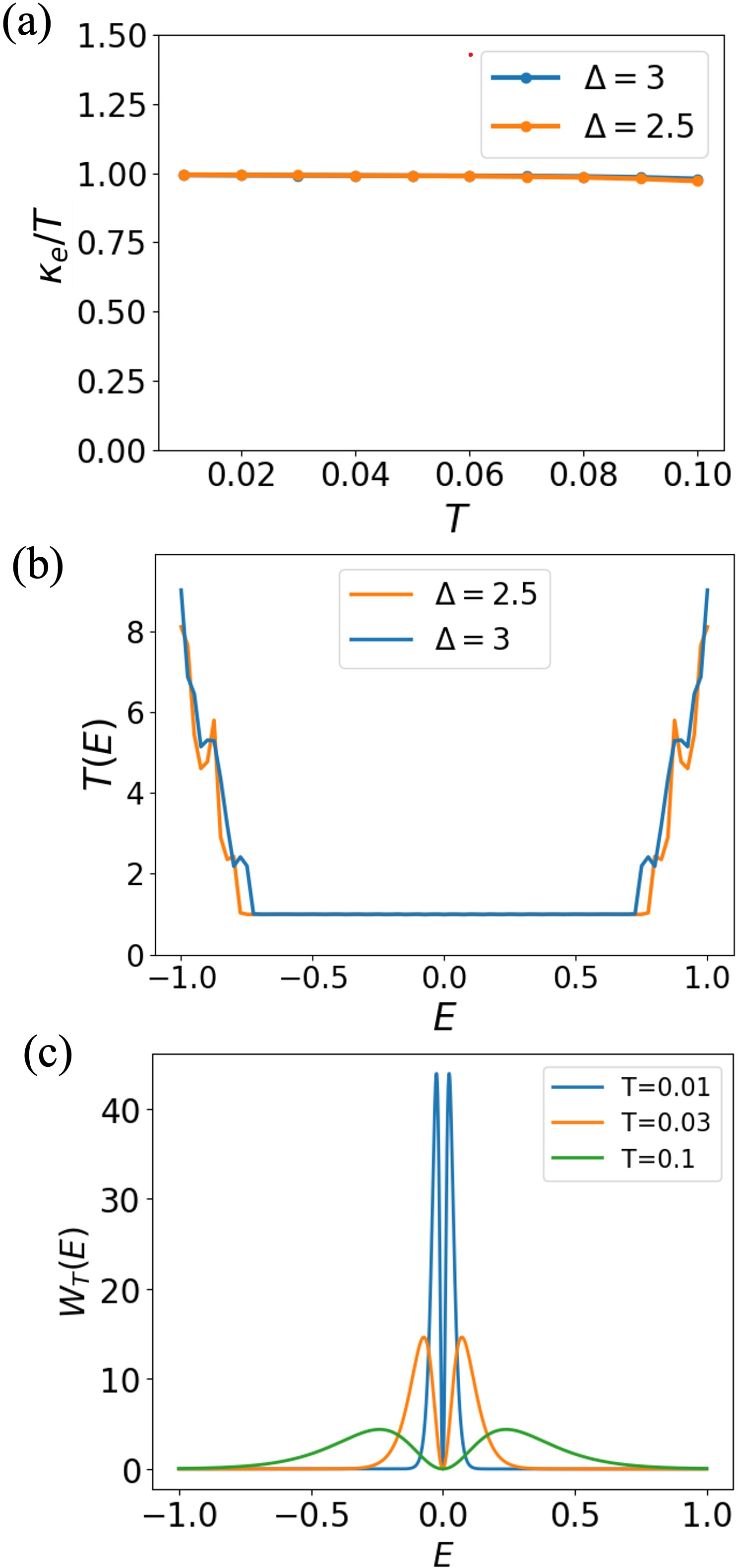
Figure 6: FMEB thermal conductance shows negligible temperature dependence owing to a broad transmission plateau inside the bulk gap.
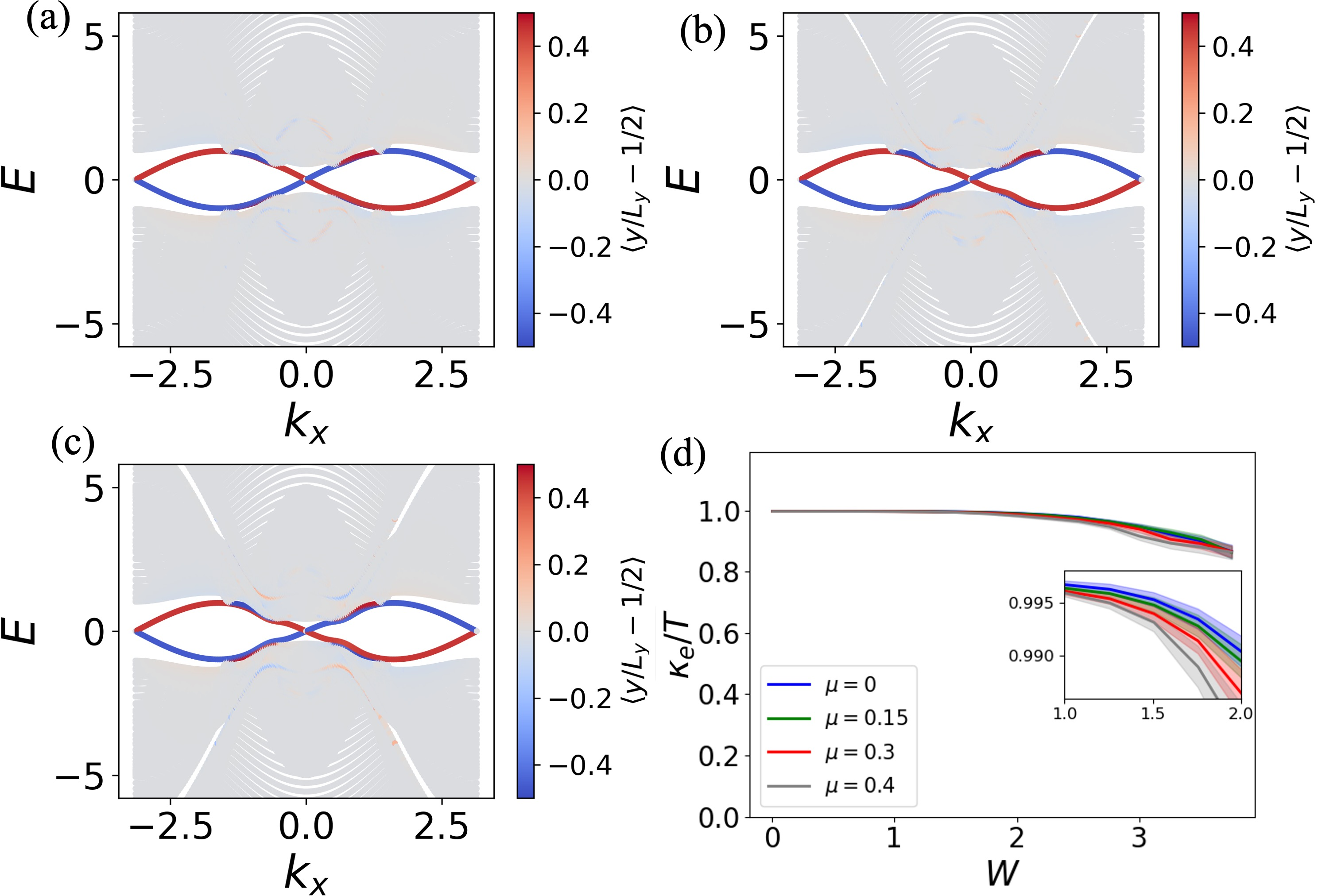
Figure 7: Counterpropagating Majorana edge modes of the FMEB persist under finite chemical potential, with minimal degradation of quantized thermal conductance under disorder.
Topological Diagnostics
The weak-topological character of FMEBs is rigorously established via block-resolved winding numbers calculated for high-symmetry quasi-one-dimensional cuts. The FMEB phase is characterized by nontrivial winding x8—in contrast to trivial regimes where both vanish. This secondary invariant distinguishes FMEBs from both trivial gapped and standard chiral/higher Chern phases, solidifying their classification as weak topological superconductors with robust, detached edge transport.
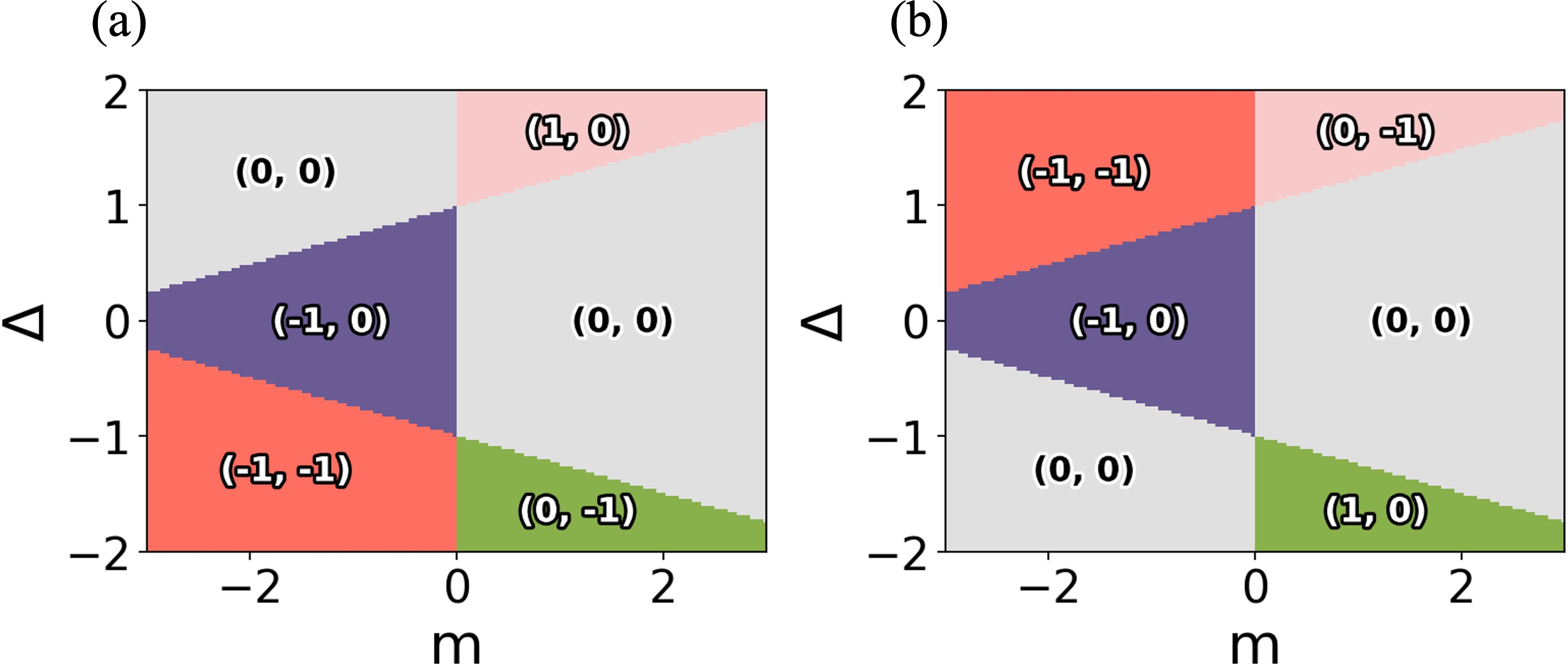
Figure 8: Phase diagrams of winding numbers for the two Majorana blocks, demarcating FMEB regimes from topologically trivial x9 phases.
Implications and Future Directions
The theoretical demonstration of FMEBs as helical-like Majorana boundary modes without requisite time-reversal symmetry establishes a new transport regime fundamentally differing from conventional chiral or helical Majorana frameworks. The direct manifestation as robust half-quantized thermal conductance implies feasible experimental detection, especially in QAH/y0-wave superconducting heterostructures leveraging currently accessible material combinations—e.g., magnetically doped y1 or intrinsic MnBiy2Tey3 TIs interfaced with cuprate superconductors.
Practically, these findings bear implications for the engineering of non-Abelian modes, fault-tolerant quantum computation, and the broader classification of weak-topological phenomena in superconducting systems. Future work may focus on disorder-engineering, the interplay with interface symmetry and electronic correlations, or extension to crystalline, altermagnetic, or higher-order topological platforms.
Conclusion
This work defines a new paradigm for Majorana boundary physics in 2D superconductors—Majorana floating edge bands—originating from microscopic anisotropy in Wilson masses implemented in QAH/y4-wave heterostructures. The FMEB phase supports robust, momentum-separated, counterpropagating Majorana edge modes with experimentally accessible, quantized and half-quantized thermal conductance plateaus. The quantization persists under finite temperature, chemical potential, and substantial disorder, marking FMEBs as an actionable target for both future theoretical analysis and experimental realization in topological quantum systems (2604.05588).