- The paper introduces a coupled chemo-mechanical framework that integrates fully kinetic hydrogen transport with a ductile phase-field fracture model to capture hydrogen embrittlement.
- The methodology employs a staggered solution algorithm that simulates ductile-to-brittle transitions and surface cracking patterns validated against experimental results.
- Simulations highlight how varying strain rates and hydrogen pressures influence fracture toughness, aiding in predictive alloy design and service-life forecasting.
A Coupled Fully Kinetic Hydrogen Transport and Ductile Phase-Field Fracture Framework for Modeling Hydrogen Embrittlement
Introduction
This work presents a comprehensive chemo-mechanical modeling framework for hydrogen embrittlement (HE), integrating a fully kinetic hydrogen transport model with a geometric phase-field fracture formalism. The methodology specifically resolves the kinetic interaction between solute hydrogen, evolving dislocation density, and ductile failure in metals—an essential advance for capturing experimentally observed embrittlement morphologies such as surface cracking and ductile-to-brittle transitions under varying mechanical and environmental conditions.
The framework employs a staggered solution algorithm in the open-source PHIMATS code, ensuring robust inter-physics coupling. Each sub-problem (mechanics, hydrogen transport, and phase-field fracture) is solved sequentially within each time increment, passing coupling information through field variables. A schematic of this algorithm clarifies the modular interdependencies among variables required for self-consistent chemo-mechanical evolution.
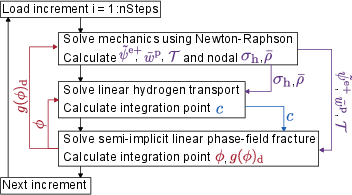
Figure 1: Schematic of the staggered solution scheme implemented in PHIMATS for the chemo-mechanical problem. Arrows indicate variables for inter-physics coupling.
The fracture process utilizes a geometric phase-field framework where the evolution of a scalar order parameter ϕ represents the damage state. Damage propagates when the crack driving force H overcomes a regularized resistance, with H defined modularly to incorporate both elastic and plastic dissipation. Crucially, the model introduces a hyperbolic tangent scaling of plastic work by stress triaxiality, enforcing plastic contributions only in tensile states to phenomenologically represent void-driven ductile damage and avoid the non-isochoric complexity of GTN-like models.
Fully Kinetic Hydrogen Transport
Hydrogen diffusion is modeled with a fully kinetic approach that includes gradients in hydrostatic stress and normalized dislocation density as driving forces. The classic lattice/dislocation trap mechanism is transcended by formulating hydrogen transport as a function of mobile species and evolving microstructure, using a closed-form evolution for dislocation density from Kocks-Mecking-Estrin theory. This enables representation of time-dependent phenomena such as pipe diffusion and the localization of hydrogen near dislocation-rich regions, which are demonstrated to be critical for realistic embrittlement prediction.
Model Verification: Ductile Damage Behavior
The proposed ductile phase-field driving force is first validated against established benchmark problems in the absence of hydrogen. Simulations of notched round bars and double-notched specimens reproduce canonical ductile morphologies including central crack initiation and cup-and-cone fracture, as well as complex crack coalescence patterns, demonstrating the versatility of the formulation for ductile damage without mesh sensitivity.
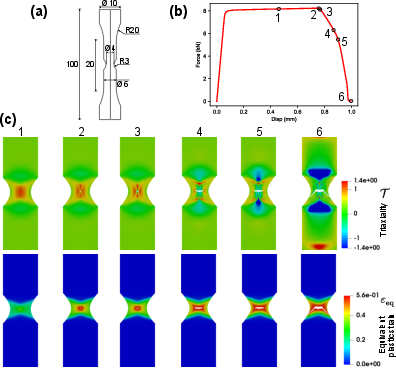
Figure 2: (a) Geometry and dimensions of the notched round bar specimen. (b) Load-displacement curve. (c) The triaxiality T and equivalent plastic strain εeq fields showing crack evolution.
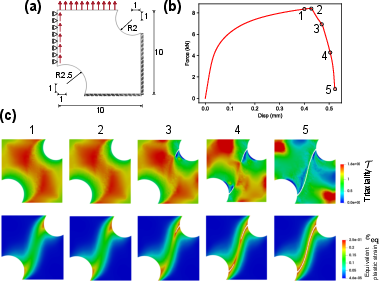
Figure 3: (a) Geometry and boundary conditions of the double-notched specimen. (b) Force-displacement response. (c) The triaxiality T and equivalent plastic strain εeq fields at different loading stages.
Hydrogen Embrittlement Phenomenology
Hydrogen Pressure and Damage Initiation
Simulations of tensile tests on smooth round bars under varying hydrogen gas pressures reveal a direct correlation between increasing hydrogen exposure and surface-near initiation of damage, as well as a transition from core-initiated failure to multiple circumferential surface cracking consistent with experimental observations on pipeline steels.
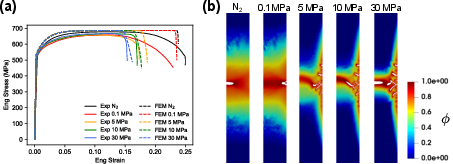
Figure 4: The effect of surface hydrogen pressure on the tensile behavior of X80 steel: (a) The stress-strain curves compared to experimental data. (b) The damage field at failure showing the transition from central localization to surface cracking with increasing hydrogen pressure.
Analysis of the hydrogen concentration fields and corresponding mechanical quantities demonstrates that the near-surface "skin effect"—characterized by a steep surface-to-core concentration gradient—arises from the interplay between boundary-driven hydrogen ingress, stress- and dislocation-enhanced trapping, and plastic strain localization along the gauge.
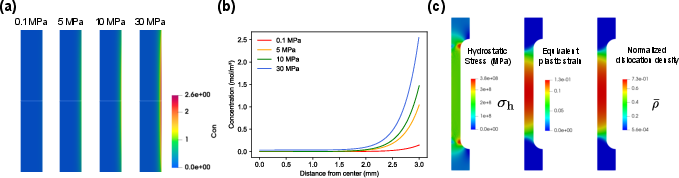
Figure 5: (a) Spatial distribution of hydrogen concentration at ε=0.102 and varying pressures. (b) Radial midsection profiles. (c) Contour plots of hydrostatic stress, equivalent plastic strain, and normalized dislocation density.
Microstructural Evolution and Surface Cracking
Detailed temporal evolution studies at fixed pressure show the nucleation and growth of multiple circumferential cracks in the near-surface region, with 3D reconstructions matching the experimental topologies observed in necking regions of hydrogen-charged specimens.
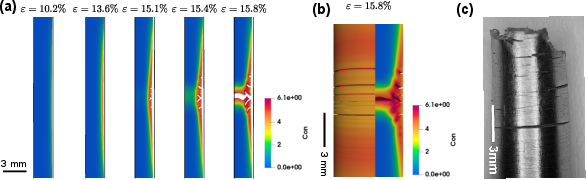
Figure 6: (a) Simulated hydrogen concentration field evolution and multiple surface crack nucleation for the 30 MPa case. (b) 3D rotational extrusion at ε=15.8%. (c) Agreement with experimental observations of surface cracking patterns in API X80 steel.
Strain Rate Effects and Kinetic Competition
Systematic variation of applied strain rate at fixed hydrogen pressure elucidates the kinetic competition inherent in hydrogen embrittlement. At higher rates, limited diffusion leads to surface localization of hydrogen and circumferential crack dominance. At extremely low rates, homogeneous degradation and bulk-like failure typical of hydrogen-free specimens reemerge.
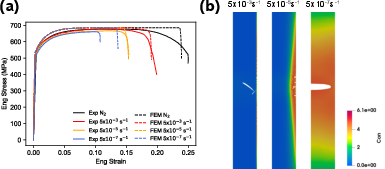
Figure 7: (a) Effect of strain-rate on tensile strength at 30 MPa hydrogen pressure with experimental comparisons. (b) Contours of hydrogen concentration and corresponding damage for different strain rates.
The model quantitatively captures the experimentally reported drop in ductility with increasing hydrogen exposure and the transition in failure morphology as a function of both mechanical loading rate and environmental conditions.
Fracture Toughness: J-Resistance Curves in Hydrogen
The framework is further benchmarked against compact tension (CT) fracture toughness tests under varying hydrogen exposures. The model tracks the crack extension and the evolution of the plastic zone, reproducing J-resistance curves that exhibit a strong, monotonic reduction in fracture toughness with increased hydrogen contamination. The transition from ductile tearing to brittle crack propagation, as well as the localization of plastic strain along the crack path, are quantitatively consistent with empirical findings.
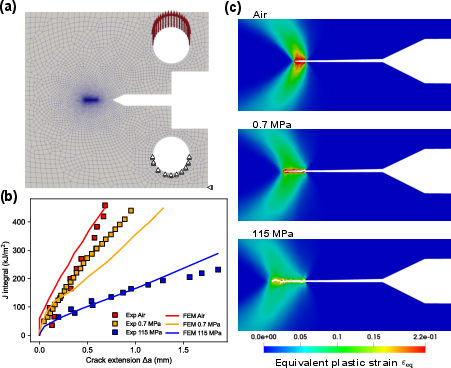
Figure 8: (a) Compact tension specimen finite element setup. (b) J-resistance curves for different hydrogen exposures compared to experiment. (c) Field results of equivalent plastic strain illustrating embrittled crack propagation and fracture process zone morphology.
Theoretical and Practical Implications
The integration of kinetic hydrogen transport with phase-field ductile fracture provides an advanced platform for interpreting and predicting HE in structural metals. The explicit link between evolving dislocation density, stress state, and hydrogen-induced embrittlement offers a mechanistic rationale for morphologies observed under practical service conditions. The model advances beyond previous approaches by enabling mesh-independent simulation of multiple fracture phenomena, incorporating rate effects, and avoiding phenomenological artifacts associated with pre-defined crack paths or equilibrium trapping formulations.
The ability to calibrate and validate this framework against diverse mechanical tests—tension, rate sensitivity, and fracture toughness—paves the way for predictive alloy design and service-life forecasting of materials exposed to hydrogen, such as pipeline steels and pressure vessels in hydrogen economy infrastructure.
On a theoretical level, the modular phase-field formalism, enriched with triaxiality- and dislocation-dependent kinetic transport, provides a baseline for future multiphysics coupling, such as with microstructure evolution, corrosion, or environmental-assisted fatigue. The efficient numerical implementation in PHIMATS and alignment with open scientific codes anticipates further adoption in the computational materials science community.
Conclusion
A coupled chemo-mechanical modeling platform for hydrogen embrittlement has been rigorously developed and validated, establishing a direct and efficient representation of hydrogen-dislocation-void interactions in ductile metals. The framework's capacity for simultaneous capture of ductile, brittle, and mixed-mode failure as a function of loading rate, hydrogen exposure, and microstructural state is demonstrated across multiple standard mechanical and fracture protocols. This paradigm extends predictive capabilities for HE and supplies theoretical scaffolding for future integration of additional microstructural or environmental fields.