- The paper introduces analytic solutions for hairy planar black holes and solitons using a potential reconstruction technique in Einstein-scalar gravity.
- It derives closed-form expressions for thermodynamic potentials via holographic renormalization, verifying local stability through specific heat analysis.
- The study reveals that scalar hair shifts the critical temperature in phase transitions, offering insights for holographic QCD and confinement models.
Phase Transitions in Primary Hair Planar Black Holes and Solitons
Analytic Hairy Solutions in Einstein-Scalar Gravity
The paper "Phase Transitions in Primary Hair Planar Black Holes and Solitons" (2604.05538) systematically constructs a new analytic class of solutions in the Einstein-scalar gravity system with planar symmetry and asymptotically AdS boundary conditions, admitting regular primary scalar hair in arbitrary space-time dimensions. The framework employs a potential reconstruction technique: by parametrizing the metric with a scale function A(z), the authors derive exact planar black hole and soliton metrics, alongside their regular scalar field profiles. Notably, for A(z)=−azn, where n=1,2 are studied in detail, the solutions capture a range of holographically motivated spacetimes relevant for bottom-up QCD models.
The primary hair here is an independent continuous parameter controlling the scalar field amplitude, with the construction ensuring that both the curvature invariants and scalar field remain regular throughout the exterior region, and all solutions (including solitons) are free of additional singularities. In the a→0 limit, the solutions smoothly reduce to standard, non-hairy (planar Schwarzschild-AdS and AdS soliton) geometries.
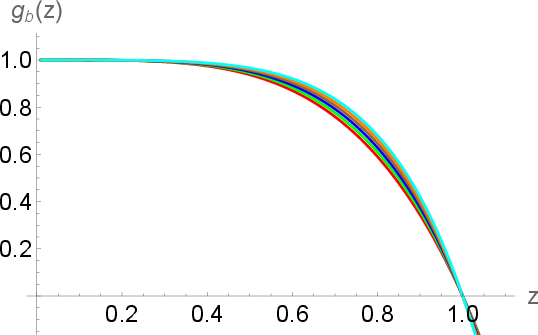
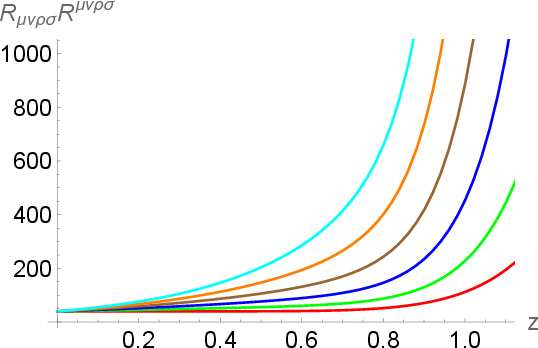
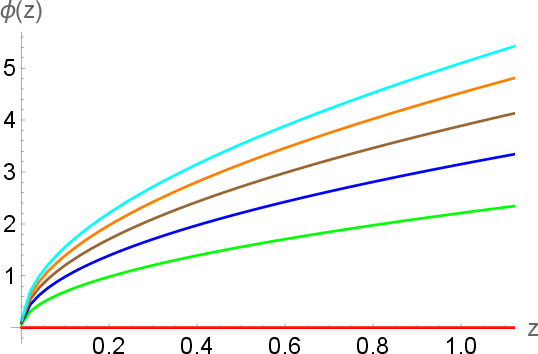
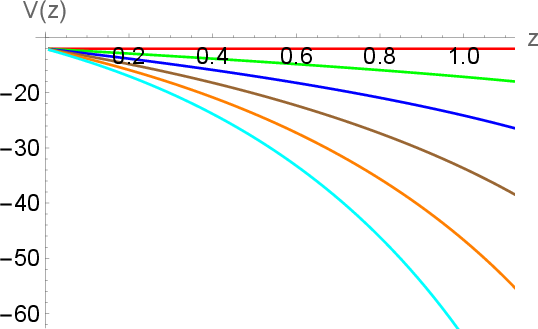
Figure 1: The behavior of gb(z) and RμνρσRμνρσ, showing the metric regularity and controlled curvature for various hair strengths.
Thermodynamics, Holographic Renormalization, and Stability
The paper provides closed analytic formulas for thermodynamic potentials, masses, entropies, and stress tensors by explicit holographic renormalization, extending the counterterm formalism to the hairy primary scalar context. These calculations are performed for both the black hole and soliton branches, and the expected relations (e.g., Gibbs free energy F=M−TS and the relation between free energy and pressure) are verified. In all cases, the parameters relevant for finite temperature ensemble are fixed by regularity and matching of Euclidean time and compact spatial cycles at the boundary.
Local stability of the black holes is assessed via the positivity of the specific heat; as the entropy-temperature curves for all black holes with both A(z)=−az and A(z)=−az2 forms are monotonic in large black hole branches, specific heat remains positive and these branches are locally stable.
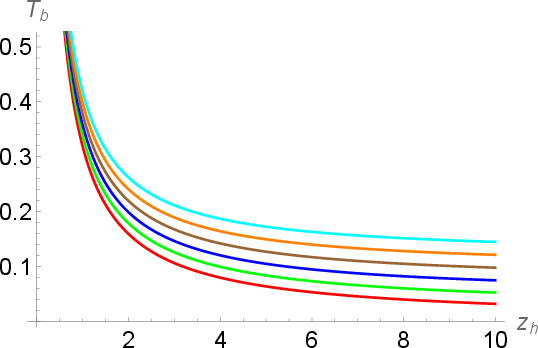
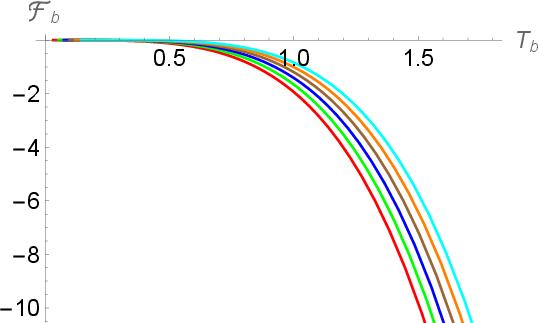
Figure 2: Hawking temperature as a function of horizon radius; the temperature profiles confirm monotonic and non-monotonic regimes, depending on hair strength and choice of A(z).
Phase Structure and Hair-Induced Modifications
A systematic analysis of phase transitions is provided by comparing the Gibbs free energies of the competing hairy black hole and soliton solutions. The periodicities of the Euclidean time (A(z)=−azn0) and compact spatial (A(z)=−azn1) cycles are matched at the boundary, and the dominant phase is determined by the sign of A(z)=−azn2. The main findings are as follows:
- Existence of a first-order transition: The transition between the two dominant phases occurs at A(z)=−azn3. For A(z)=−azn4, the soliton is dominant; for A(z)=−azn5, the black hole is. This boundary coincides with the location where free energies of the two solutions cross.
- Influence of Primary Hair: The critical temperature A(z)=−azn6 for the transition increases as the scalar hair parameter A(z)=−azn7 grows, for all forms of A(z)=−azn8, dimensions A(z)=−azn9, and for both n=1,20 and n=1,21 cases. Thus, scalar hair broadens the temperature domain in which the soliton (confining) phase dominates.
- Multiple Black Hole Branches: For n=1,22, two branches appear for a fixed temperature; only the large branch is stable. For n=1,23, only one stable branch exists. The hairy soliton similarly can have multiple branches as a function of its tip location n=1,24, but only the smallest n=1,25 branch is relevant thermodynamically.
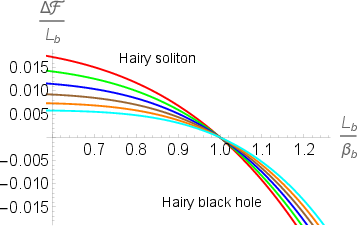
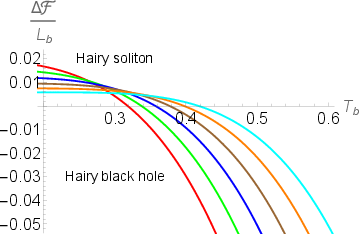
Figure 3: The free energy difference n=1,26 plotted against the periodicity ratio n=1,27, demonstrating the sharp sign change and dominance transition at n=1,28.
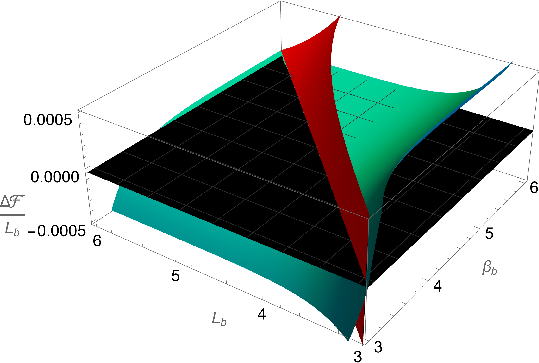
Figure 4: Temperature dependence of the free energy difference, highlighting the shift of critical temperature with increasing hair parameter.
Implications for Holography and QCD Modeling
The analytic hairy soliton backgrounds constructed serve as compelling gravitational duals for the confined phase in bottom-up AdS/QCD frameworks. The dependence of the phase transition temperature on the scalar hair strength—interpreted as a dual RG parameter—shows that scalar sector deformations can be used to tune the deconfinement transition. The regularity of the solutions and the absence of curvature singularities position these as robust geometric backgrounds for computing further observables such as spectral and transport properties of the dual field theory.
Furthermore, the results rigorously verify the Horowitz-Myers conjecture (the soliton as the ground state) in the presence of primary hair, guaranteeing that, even with nontrivial scalar dressing, the soliton solution retains lowest energy relative to black holes.
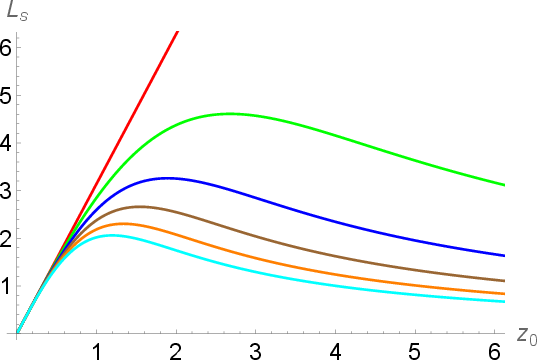
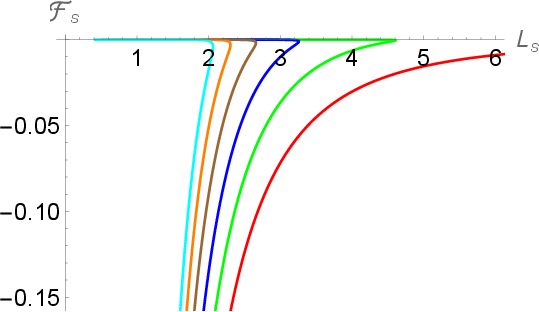
Figure 5: The spatial period n=1,29 as a function of a→00 for several hair parameter values, demonstrating structure of admissible solitons and their thermodynamic branches.
Conclusion
This work precisely characterizes how primary scalar hair alters the phase diagram of planar AdS black holes and solitons. By providing analytic, regular, and physically motivated hairy solutions in arbitrary dimension, it enables controlled studies of confinement/deconfinement-like transitions in holographic contexts and direct model-building in AdS/QCD. The dependencies of the transition temperature and stability regime on the hair parameter suggest further directions in exploring charge, rotation, and external field effects in these regular backgrounds. The construction of primary hairy solitons stands as a technically accomplished result, providing canonical ground states for future analytic and numerical studies aimed at decoding strongly coupled dynamics via holography.

