Measurement of charged-particle production in $\sqrt{s_\text{NN}}=9.62$ TeV proton-oxygen collisions as a probe of cosmic-ray air showers with the ATLAS detector
Published 7 Apr 2026 in hep-ex | (2604.05512v1)
Abstract: This Letter presents a measurement of prompt charged-particle production in proton-oxygen interactions at $\sqrt{s_\text{NN}}=9.62$ TeV center-of-mass energy with the ATLAS detector, corresponding to 634 $μ$b${-1}$ of integrated luminosity. A total of 246 million selected events have at least one track with transverse momentum $p_\text{T}> 500$ MeV and pseudorapidity $|η|<2.5$. The measured fiducial proton-oxygen cross section is $σ\text{fid.}{p\text{O}}=396 \pm 6~(\text{exp.}) \pm 9~(\text{lumi.})~\text{mb}$ and the extrapolated inelastic proton-air cross section is $σ{p+\text{air}}\text{inel.} = 406 \pm 6~(\text{exp.}) \pm 9~(\text{lumi.}) \pm 28~(\text{th.})~\text{mb}$. Measurements of charged-particle multiplicity, $p_\text{T}$, and $η$ distributions are an order-of-magnitude more precise than differences between hadronic-interaction models. These results enable improved modeling of cosmic-ray air showers, which is important for astroparticle physics.
The paper provides the first collider-based measurement of prompt charged-particle production in pO collisions at 9.62 TeV using the ATLAS detector.
It details precise cross-section and differential multiplicity results, revealing significant tensions with common hadronic interaction models.
The study’s findings demand immediate retuning of simulation models to reduce systematic uncertainties in cosmic-ray air-shower predictions.
Measurement of Charged-Particle Production in sNN=9.62 TeV pO Collisions as a Probe of Cosmic-Ray Air Showers with the ATLAS Detector
Introduction
The study reports the first collider-based measurement of prompt charged-particle production in pO collisions at sNN=9.62 TeV using the ATLAS detector. This work targets the hadronic interaction regime pertinent to the initial stages of cosmic-ray air showers, addressing major systematic uncertainties that affect the determination of the mass composition and energy spectrum of PeV-scale cosmic rays. Existing LHC measurements have been limited to pp and heavy-ion (PbPb, XeXe, OO, NeNe) systems, which lack close correspondence to the nitrogen-oxygen composition of the atmosphere; thus, pO results deliver a crucial constraint for hadronic interaction models underpinning air-shower simulations.
Experimental Methodology
Approximately 634~μb−1 of data were collected with the 16O and proton LHC beams at 3.4 and 6.8 TeV/nucleon, respectively, with an average pileup of 0.025. Events were triggered via the TRT L1 Fast-OR system and required at least one reconstructed track with pT>500 MeV and p0 satisfying stringent track-quality selections. The total dataset comprises 246 million events and 5.11 billion tracks.
Comprehensive corrections and systematic evaluation are applied to background subtraction (secondaries, strange baryons, fake tracks, cosmic rays, beam backgrounds), trigger and vertex efficiencies (via ZDC reference triggers and data-driven methods), and track-reconstruction performance (using HIJING and Angantyr-based simulation with additional corrections for passive material and IBL inefficiencies). Bayesian unfolding is performed to recover charged-particle multiplicities and p1-spectra.
Cross-Section Results
The fiducial cross section in the region with at least one primary charged particle (p2 MeV, p3) is determined to be:
p4
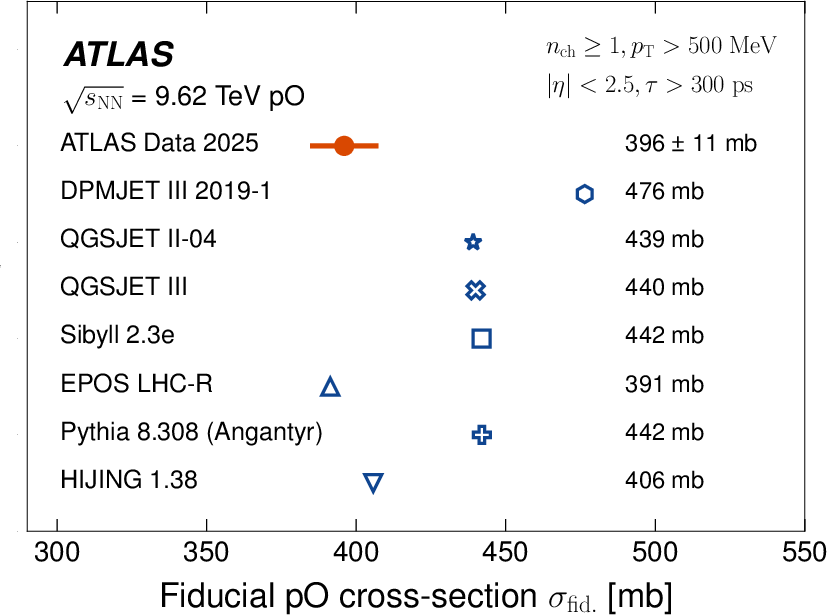
Figure 1: Comparison of the ATLAS fiducial p5O cross-section measurement (filled marker) with model predictions (open markers) for HIJING, Angantyr, EPOS, DPMJET, QGSJET, and Sibyll.
This measurement is consistent within uncertainties with EPOS and HIJING but is lower by at least three standard deviations compared with DPMJET III, Pythia 8 Angantyr, QGSJET (II-04, III), and Sibyll 2.3e, indicating significant tension with the generator models frequently used in cosmic-ray air-shower simulations.
Extrapolation to the full inelastic cross section yields:
p6
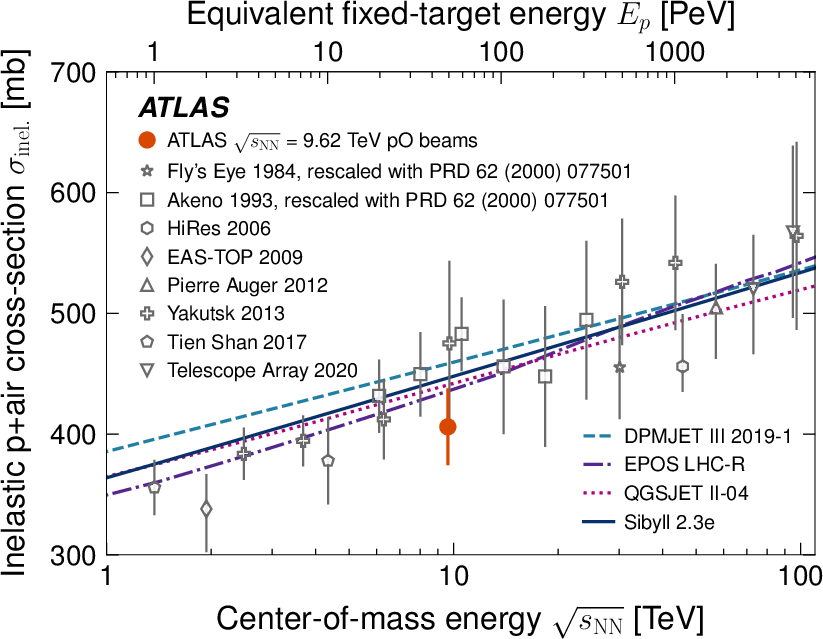
Using MC-based ratios to account for the nitrogen and oxygen composition of air, the inelastic p7+air cross section is inferred:
p8
This value aligns with rescaled noncollider measurements from Akeno and Yakutsk at similar energies and constrains hadronic model spread to within p9.
Charged-Particle Distributions and Multiplicities
Detailed differential distributions of charged-particle multiplicity, p0, mean p1 vs. p2, and p3 have been measured with precision far exceeding the model variations. The following features are highlighted:
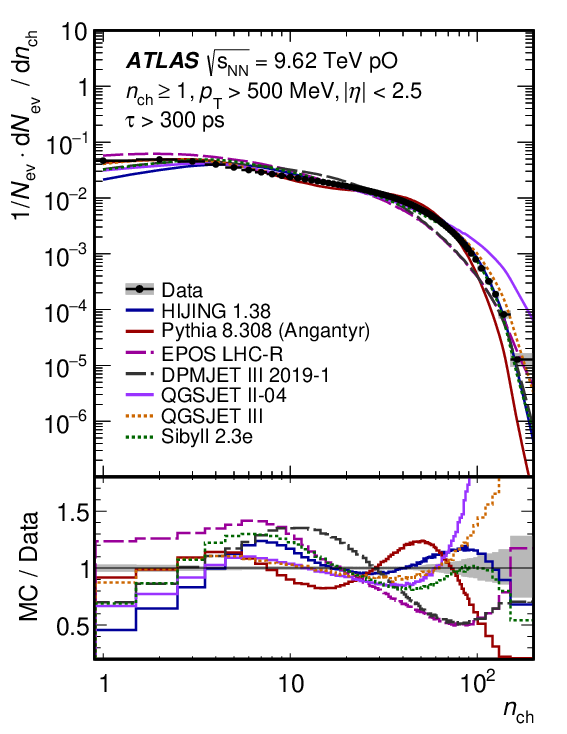
Multiplicity Distribution: Model-to-data discrepancies reach a factor of two at low p4 and over an order of magnitude for p5. Angantyr and QGSJET III match the tails up to p6, but deviate at higher multiplicity, while DPMJET and EPOS approach the data within 30% at the highest multiplicities.
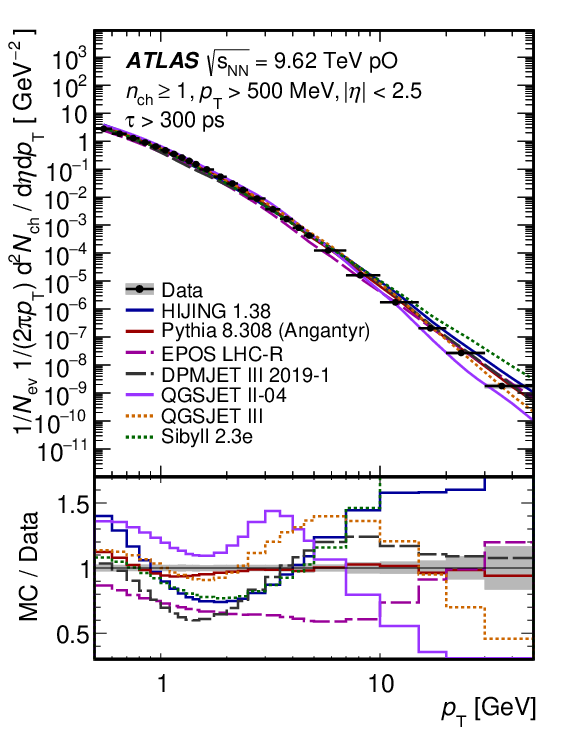
p7 Spectrum: Uncertainties increase from 2.5% at low p8 to 17% above 20 GeV, while model predictions differ by 40% up to an order of magnitude at the high end. Angantyr tracks the spectrum within 12%.
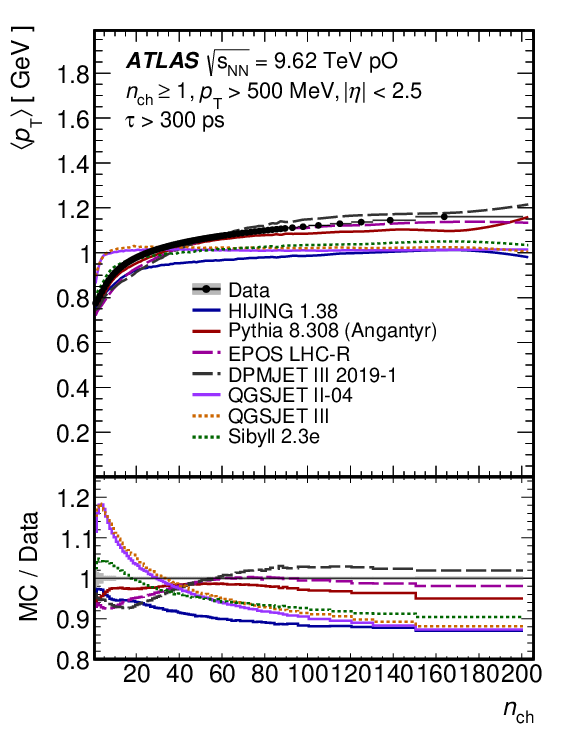
Mean p9 vs. sNN=9.620: Data uncertainties remain sNN=9.621 for sNN=9.622, which is notably lower than the 10–25% model spread. The shape is generally better described by Angantyr, DPMJET, and EPOS for sNN=9.623.
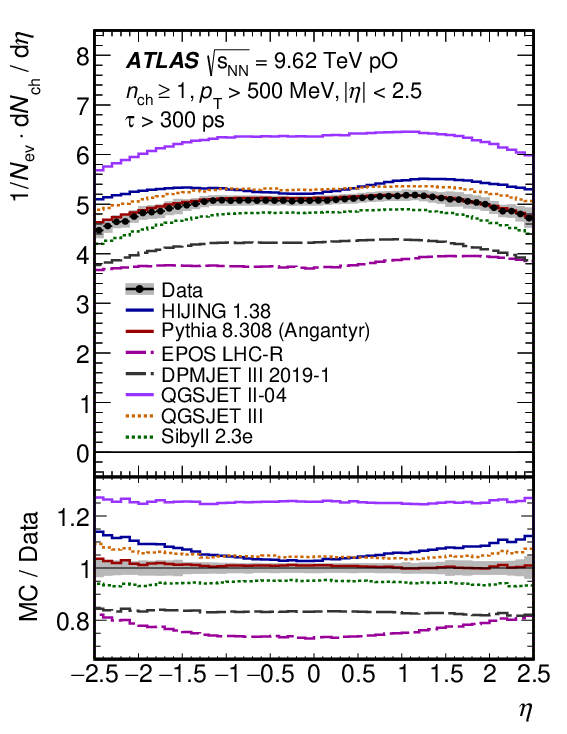
sNN=9.624 Distribution: Data are significantly flatter than most model predictions. The particle density is measured as sNN=9.625 at sNN=9.626, decreasing to sNN=9.627 at sNN=9.628.
Figure 2: Unfolded primary charged-particle distributions in the ATLAS sNN=9.629O dataset, shown with generator-level model comparisons. Subpanels display multiplicity (pp0), pp1, mean pp2 vs pp3, and pp4 spectra.
The measurement precision is typically an order of magnitude superior to the generator-spread, decisively discriminating between hadronic model implementations.
Implications for Hadronic Modeling and Astroparticle Physics
These results directly test phenomenological models at the energies encountered in the first, particle-producing interactions of PeV cosmic rays in the atmosphere. The demonstrated tension with all major models except EPOS/HIJING necessitates retuning of DPMJET, QGSJET (II, III), Sibyll, and Angantyr to reduce systematic uncertainties in cosmic-ray mass-composition inferences.
Improvement in multiplicity and kinematic modeling is critical for air-shower observables such as pp5 and muon production, which are the leading systematic for the mass composition at the knee and ankle of the cosmic-ray spectrum.
On the theoretical side, the measurements underscore the limitations of existing nonperturbative QCD models, especially in baryon and strangeness production. Discrepancies at high multiplicity and for the pp6 tail may be indicative of collective effects or insufficient treatment of diffractive and multi-parton interactions.
Future Prospects
Immediate directions include the implementation of these data as mandatory constraints in the tuning of hadronic MC generators, with the anticipated reduction of systematic uncertainties in air-shower modeling for cosmic-ray experiments (e.g., Auger, Telescope Array, LHAASO). Moreover, differential measurements—strangeness fraction, (anti)baryon enhancement, forward particle production—could further break degeneracies in model parameters and clarify the origin of remaining discrepancies.
Additional LHC runs with other light-ion projectiles (e.g., pp7N, pp8Ar) and expanded forward instrumentation (e.g., FASER, SND@LHC) will supplement this dataset and enable more comprehensive model validation.
Conclusion
The ATLAS measurement of charged-particle production in pp9O collisions at p0 TeV provides the first collider-quality reference for hadronic interactions matching the atmospheric target relevant to cosmic-ray shower initiation. The fiducial and inelastic cross sections display significant discrepancies with most current hadronic interaction models, and the charged-particle spectra are measured with significantly higher accuracy than the model differences. These findings demand immediate integration into astroparticle physics simulations, with direct consequences for primary mass composition and the interpretation of cosmic-ray observatory data.