- The paper introduces the Phase-Fidelity-Aware Truncated Quantum Fourier Transform (PFA-TQFT), optimizing QFT for NISQ devices by aligning truncation depth with hardware limits.
- PFA-TQFT reduces gate count from O(m²) to O(m log m) by omitting gates with negligible phase contribution, effectively leveraging NISQ noise constraints.
- This framework identifies a 'fidelity cliff,' highlighting conditions where the truncated method outperforms traditional QFT under realistic NISQ noise settings.
Phase-Fidelity-Aware Truncated QFT: A Hardware-Calibrated Paradigm for NISQ-Optimal Quantum Phase Estimation
Problem Motivation and Prior Constraints
Quantum Phase Estimation (QPE) is foundational to several quantum algorithms, including quantum simulation, Shor's algorithm, and the Harrow-Hassidim-Lloyd (HHL) algorithm. The canonical QFT used in QPE requires O(m2) two-qubit controlled-phase gates for m control qubits, directly conflicting with the circuit depth and error rates tolerated by contemporary NISQ devices. While prior work, beginning with Coppersmith's truncation of small-angle rotations [quant-ph/0201067], Barenco et al. [Phys. Rev. A 54, 139], and more recent analytical advances [quant-ph/0403071, (Häner et al., 2018)], established that controlled-phase rotations below a threshold can be omitted, these works lack:
- Closed-form bounds for truncation-induced distributional phase error under realistic (noisy) hardware assumptions,
- A device-calibrated, analytically optimal truncation depth,
- An analysis accounting for the interplay (and possible synergy) between truncation and noise—specifically, conditions under which aggressive truncation can outperform the full QFT under NISQ noise.
The present work addresses all three and provides a framework for optimal QFT truncation targeted to hardware characteristics.
PFA-TQFT Framework: Construct and Theoretical Guarantees
The authors introduce the Phase-Fidelity-Aware Truncated QFT (PFA-TQFT), explicitly parameterized by a truncation depth d derived from the two-qubit gate fidelity ε2q of a given hardware platform. Controlled-phase gates Rk with rotation angles θk<2π/2d are omitted, and d is chosen such that their omission incurs phase errors no greater than that of a noisy gate implementation.
The main structural and analytical results can be summarized as follows:
- Definition: For an m-qubit QFT, the PFA-TQFT applies only those controlled-phase gates with k≤d, where d=⌊log2(2π/ε2q)⌋.
- Error Bound: The total variation distance (TVD) between the output distributions of the full and truncated QFT satisfies m0 for all eigenphases m1 and all m2 (Theorem 1).
- Resource Scaling: The gate count reduces from m3 to m4, i.e., for m5, the scaling is m6.
- Hardware Calibration: The optimal truncation depth m7 is platform-specific. For instance, with m8 for IBM Eagle, m9 yields a d0 gate-count reduction at d1.
- Fidelity Cliff and Success Probability: There exists a sharp "fidelity cliff" at d2, below which performance collapses and above which the success probability saturates to the full QFT.
This hardware-calibrated truncation criterion is both analytically motivated and operationally simple, involving only a one-line formula derived from device-specific error rates.
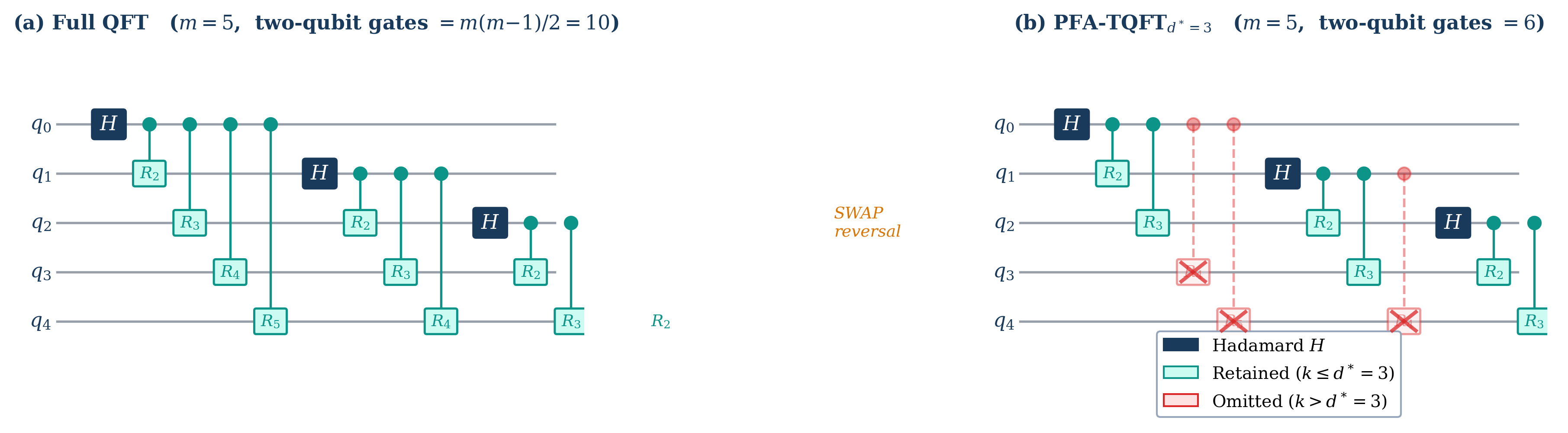
Figure 1: Gate-level comparison between a full QFT and PFA-TQFT (d3) for d4; PFA-TQFT omits four small-angle gates, yielding significant gate reduction even for modest system sizes.
Numerical and Analytical Validation
Distributional and Fidelity Analysis
The TVD bound is benchmarked against Monte Carlo simulations across a range of d5 and d6. The theoretical bound matches the empirical maxima within a constant factor. The relation between truncation depth, system size, TVD, and phase estimation failure probability is quantitatively validated.
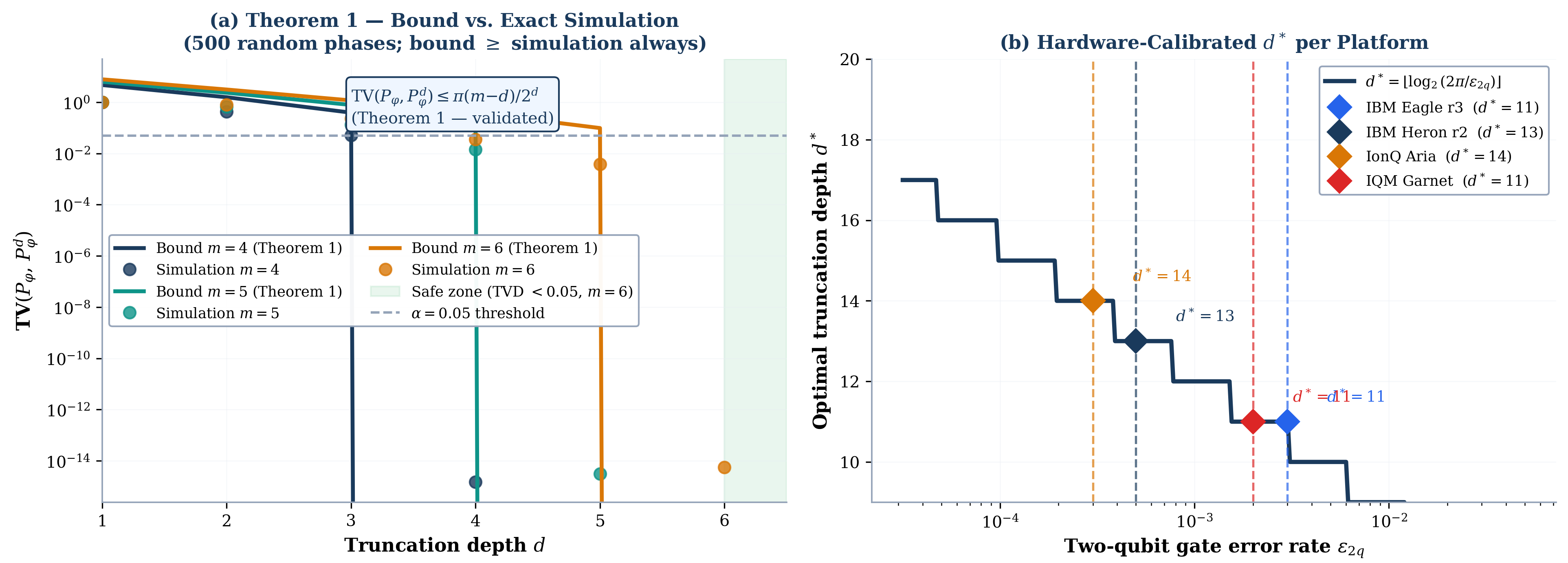
Figure 2: (a) TVD error bound versus truncation depth d7 across several d8; theoretical curves and empirical simulations agree. (b) Hardware-calibrated d9 as a function of two-qubit gate error, with demarcations for specific platforms.
A "fidelity cliff" arises as the truncation depth is reduced below ε2q0: phase estimation accuracy drops precipitously, while beyond this threshold accuracy plateaus.
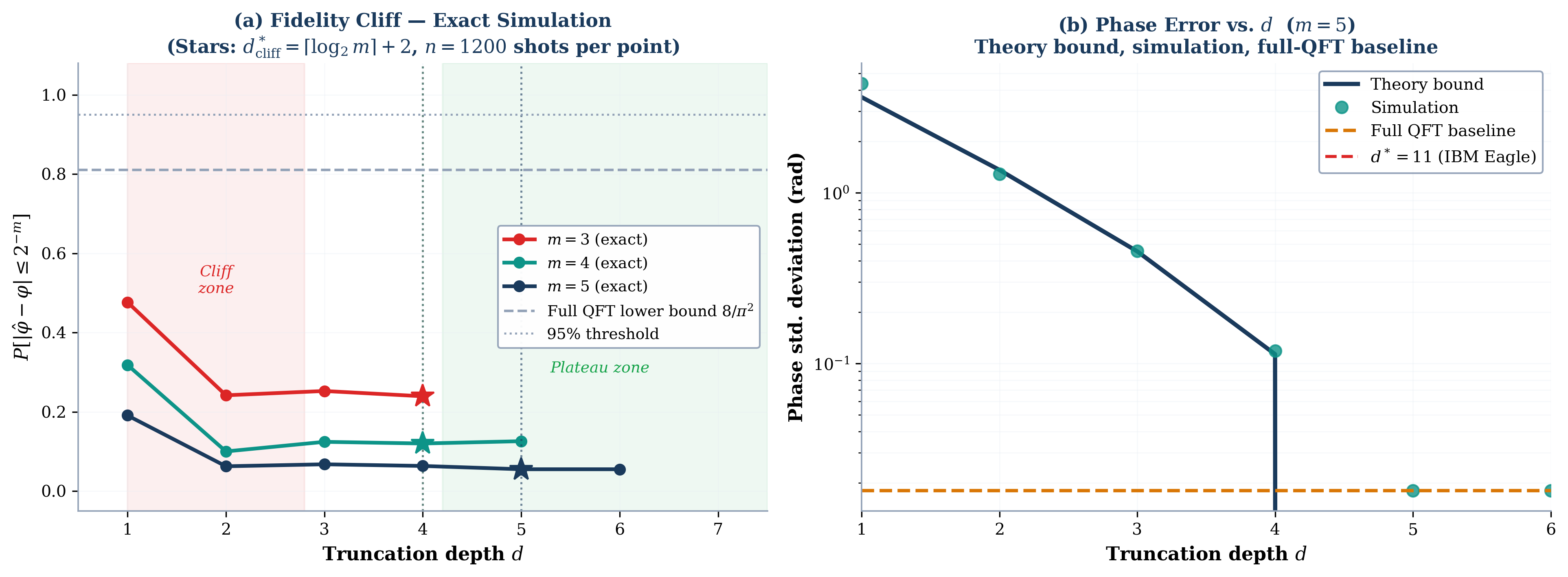
Figure 3: (a) Success probability for accurate phase estimation as a function of truncation depth ε2q1, revealing a sharp transition ("cliff") near ε2q2.
Resource Efficiency
PFA-TQFT delivers substantial two-qubit gate reduction while keeping the approximation-induced error within the hardware's inherent noise floor:
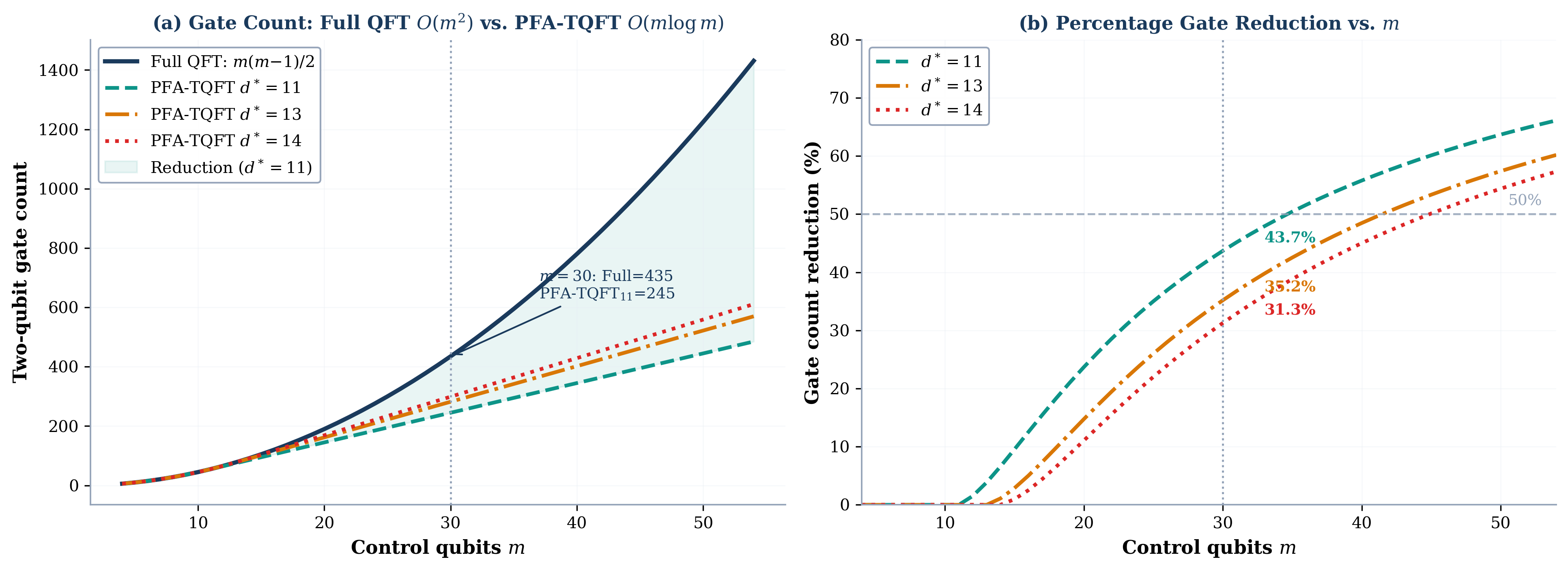
Figure 4: (a) Gate count scaling with ε2q3 for full QFT and PFA-TQFT at different truncation depths; (b) Percent reduction in gate count increases with system size.
For IBM Eagle r3, Heron r2, IonQ Aria, and IQM Garnet, a single calibration line produces the device-optimal ε2q4, as shown empirically and in tabulated results.
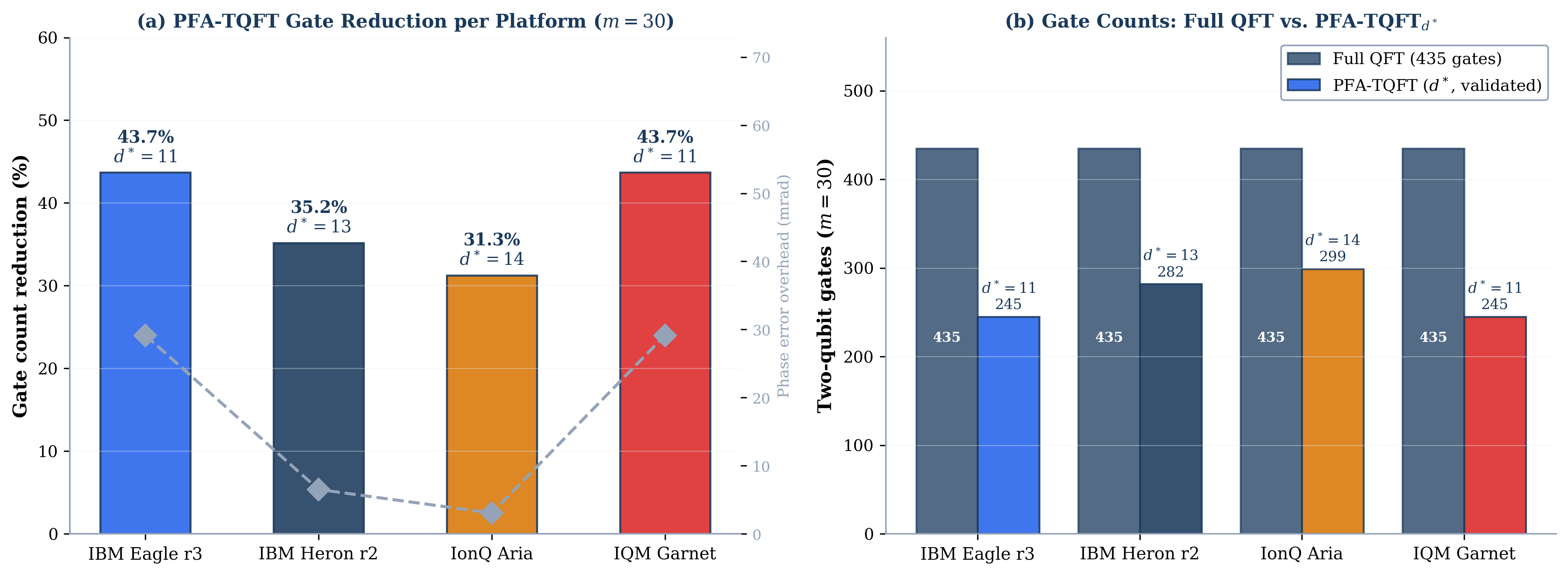
Figure 5: (a) Percentage gate count reduction and phase error overhead per platform at ε2q5. (b) Comparison of absolute gate counts for full QFT versus PFA-TQFT across platforms.
Noise-Truncation Synergy
A central and perhaps counterintuitive result is that—in the presence of realistic NISQ noise—PFA-TQFT can outperform even the full QFT in estimation accuracy. For sufficiently large ε2q6 (e.g., ε2q7 as seen on certain NISQ devices), the noise accumulated by the additional omitted gates in the full QFT exceeds the approximation error from PFA-TQFT truncation. This regime is quantitatively characterized both by RMSE on the 1D transverse-field Ising model and by analytic crossover thresholds.
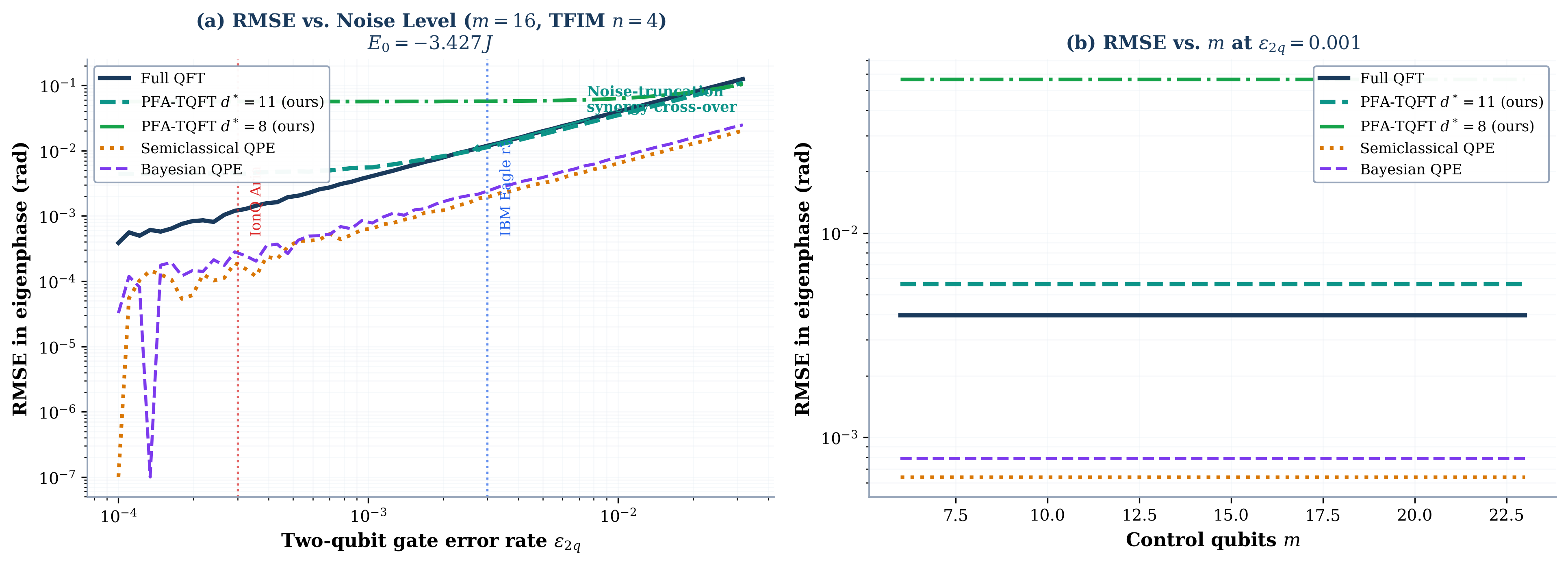
Figure 6: (a) RMSE in QPE for the TFIM as a function of ε2q8. PFA-TQFT (ε2q9) outperforms full QFT at high error rates, marking the practical advantage of noise-truncation synergy. (b) Scaling with Rk0 at fixed noise rate.
Comparison with Alternative QPE Implementations
PFA-TQFT is compared to semiclassical, Bayesian, and iterative QPE methods. Unlike these, it is a single-shot, feedback-free approach with explicit hardware-aware error bounds. While semiclassical or iterative QPE can further reduce quantum resources, they require extensive classical feedback and are not directly compatible with certain applications (e.g., those demanding low-latency quantum-to-quantum processing).
Implications and Future Research Directions
Practical Impacts
- QPE-based applications: By transforming the QFT subroutine from an Rk1 to an Rk2 component, PFA-TQFT directly extends the viable use of QPE (and thus, quantum simulation, ground state energy estimation, and more) to larger problem sizes on NISQ hardware.
- Compiler Design: The PFA-TQFT criterion is straightforward to incorporate into quantum circuit compilers (Qiskit, Cirq, tket), enabling automatic truncation optimally tuned to device characterizations.
- Quantum Algorithm Engineering: In HHL and Shor's algorithm, where QPE has traditionally been a depth bottleneck, PFA-TQFT reduces required gates by more than an order of magnitude, matching hardware noise limits.
Theoretical Implications
The closed-form TVD bound rigorously links circuit approximation to distributional error in phase estimation, not merely global fidelity or operator norm, and does so under a practically relevant noise model.
The observed noise-truncation synergy demonstrates that, under decoherence-dominated regimes, intentional circuit approximation can become an error-mitigation strategy—a paradigm shift from the traditional fault-tolerance view.
Future Directions
- Adaptive per-qubit truncation in response to spatially varying error rates across devices.
- Extensions to structured noise models (Pauli, amplitude damping, crosstalk).
- Integration with error mitigation frameworks (e.g., zero-noise extrapolation).
- Experimental demonstrations on cloud-accessible IBM and IonQ systems.
- Full integration into quantum software stacks for turn-key, hardware-aware QFT truncation.
Conclusion
PFA-TQFT provides a robust, hardware-calibrated approximate QFT variant that is theoretically well-founded and operationally simple. By ensuring that circuit complexity aligns with the error budget of practical NISQ hardware, this approach makes QPE-based quantum algorithms tractable at scales otherwise inaccessible. The synergy between approximation and hardware-induced noise further refines the role of compilation in the NISQ era, establishing truncation not only as a compromise but as a principled optimization.
References: (2604.05456), [quant-ph/0201067], [quant-ph/0403071], (Häner et al., 2018), [PhysRevA.54.139].

