MEC: Machine-Learning-Assisted Generalized Entropy Calibration for Semi-Supervised Mean Estimation
Published 7 Apr 2026 in stat.ML and cs.LG | (2604.05446v1)
Abstract: Obtaining high-quality labels is costly, whereas unlabeled covariates are often abundant, motivating semi-supervised inference methods with reliable uncertainty quantification. Prediction-powered inference (PPI) leverages a machine-learning predictor trained on a small labeled sample to improve efficiency, but it can lose efficiency under model misspecification and suffer from coverage distortions due to label reuse. We introduce Machine-Learning-Assisted Generalized Entropy Calibration (MEC), a cross-fitted, calibration-weighted variant of PPI. MEC improves efficiency by reweighting labeled samples to better align with the target population, using a principled calibration framework based on Bregman projections. This yields robustness to affine transformations of the predictor and relaxes requirements for validity by replacing conditions on raw prediction error with weaker projection-error conditions. As a result, MEC attains the semiparametric efficiency bound under weaker assumptions than existing PPI variants. Across simulations and a real-data application, MEC achieves near-nominal coverage and tighter confidence intervals than CF-PPI and vanilla PPI.
The paper introduces MEC, a novel estimator that employs entropy-based calibration to improve bias correction and efficiency over traditional PPI methods.
It formulates calibration as a constrained convex optimization using Bregman divergence, yielding robust weights and semiparametric efficiency.
Empirical and theoretical results demonstrate MEC's superior performance in generating valid confidence intervals, especially with scarce labeled data.
Machine-Learning-Assisted Generalized Entropy Calibration for Semi-Supervised Mean Estimation
Problem Setting and Prior Work
The research problem addresses semisupervised mean estimation when labeled responses are scarce and covariate data is abundant—a pervasive issue in scientific and industrial applications with expensive labeling but plentiful features. The standard setup assumes access to two disjoint i.i.d samples: a large unlabeled covariate set and a much smaller labeled set. The task is to estimate the population mean of the response variable, with quantifiable statistical uncertainty.
Prediction-powered inference (PPI) has recently emerged as a powerful paradigm for leveraging flexible ML predictors trained on labeled data to impute outcomes on unlabeled data, then correcting for predictor bias using the labeled sample. However, practical PPI estimation is subject to two fundamental limitations:
Label reuse: using the same labeled instances for both model fitting and bias correction can induce overfitting, rendering variance estimation and coverage invalid.
Efficiency shortfall: the classical PPI estimator achieves the semiparametric efficiency bound only for oracle predictors, and otherwise may exhibit substantial variance inflation.
Various extensions have addressed these issues. PPI++ optimally tunes the convex combination of plug-in and bias-corrected terms for improved efficiency, while cross-fitted PPI (CF–PPI) employs sample splitting to mitigate label reuse. These methods mark progress toward efficient, valid semisupervised inference, yet they still rely on relatively strong assumptions concerning prediction error and model alignment.
The MEC Estimator: Formulation and Algorithmic Details
This work introduces Machine-Learning-Assisted Generalized Entropy Calibration (MEC), which generalizes the PPI framework by principled entropy-based calibration of the residual correction term via Bregman projections. Under MEC, the classical plug-in plus correction structure of PPI is maintained but the residual term is computed using labeled samples with optimized calibration weights, rather than uniform weights.
Let the labeled set S contain n indices and the unlabeled set contain N≫n. MEC solves a constrained convex optimization problem,
ω=argminω∈(0,∞)nDG(ω∥d)
subject to two calibration constraints: j∈S∑ωj=N,j∈S∑ωjm(−)(Xj)=i=1∑Nm(−)(Xi)
where d are baseline design weights (dj=N/n), DG is a separable Bregman divergence, and m(−) is an out-of-fold ML predictor constructed via K-fold sample splitting.
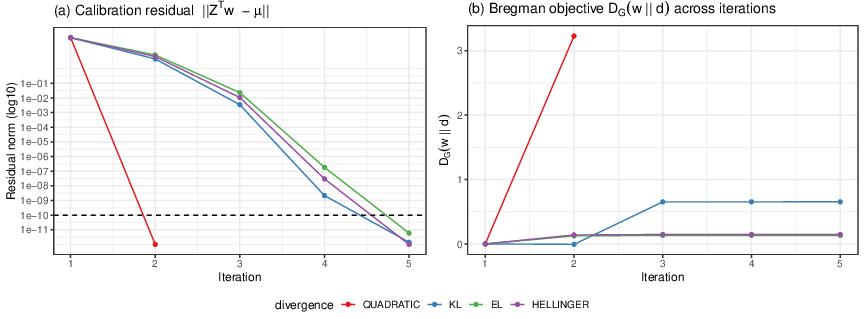
The solution admits both primal (projection) and dual (regression) representations, and the optimization is efficiently solved by Newton-Raphson in the low-dimensional dual (calibration) space, yielding highly stable weights.
The resulting MEC estimator for the population mean is given by
n0
where the weights n1 incorporate calibration via an intercept and the ML predictor.
Figure 1: Iteration procedure of dual Newton solver on a single realization of the synthetic data, demonstrating rapid and stable convergence of the calibration weight optimization.
Statistical Properties and Theoretical Guarantees
Theoretical analysis reveals that MEC enjoys several key properties:
Affine robustness: MEC is invariant to affine transformations of the ML predictor, ensuring misspecification-induced variance inflation is minimized to only the component of the true regression function orthogonal to the span of n2.
Weaker consistency conditions: MEC replaces n3 convergence requirements on the raw prediction error (as in CF–PPI) with weaker projection-error conditions, i.e., consistency and asymptotic normality require only the projection of the truth onto the calibration subspace to converge.
Semiparametric efficiency: when the true regression function is in the span of n4, MEC attains the semiparametric efficiency bound.
The dual form of the estimator admits an analytic decomposition as a generalized regression estimator (GREG), which justifies optimal variance estimation and forms the basis for Wald-type confidence intervals.
Empirical Results and Numerical Performance
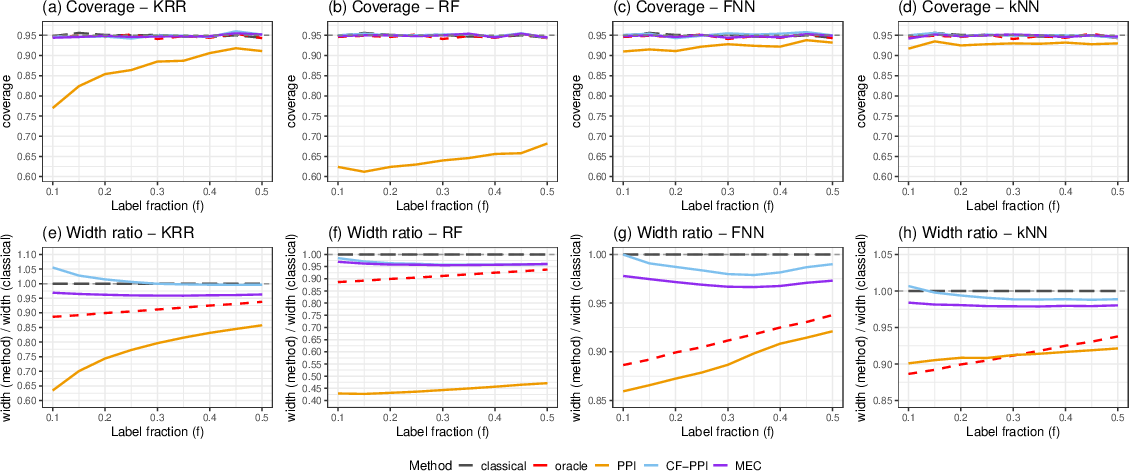
Extensive simulations compare MEC, CF–PPI, and vanilla PPI over a range of predictors (KRR, RF, FNN, kNN), label fractions, dimensions, and distributional regimes. The primary metrics are empirical coverage of 95% confidence intervals and the interval width ratio relative to classical label-only inference.
MEC consistently achieves near-nominal coverage across all label fractions and settings, and attains the narrowest valid confidence intervals among the compared methods. Notably, efficiency improvements relative to CF–PPI and vanilla PPI are most pronounced at small label fractions and under moderate prediction error/misspecification. Vanilla PPI tends to undercover and CF–PPI may suffer width inflation when predictors are misaligned or n5 is small. MEC's performance is robust to the choice of Bregman generator.
Figure 2: Coverage and width ratios of 95% confidence intervals across label fractions for various ML predictors, demonstrating MEC's consistent near-nominal coverage and efficiency.
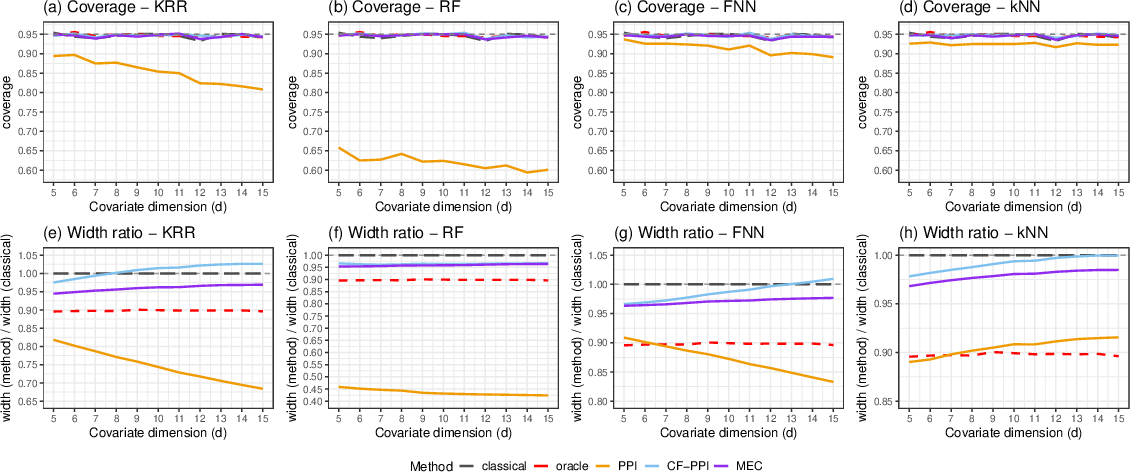
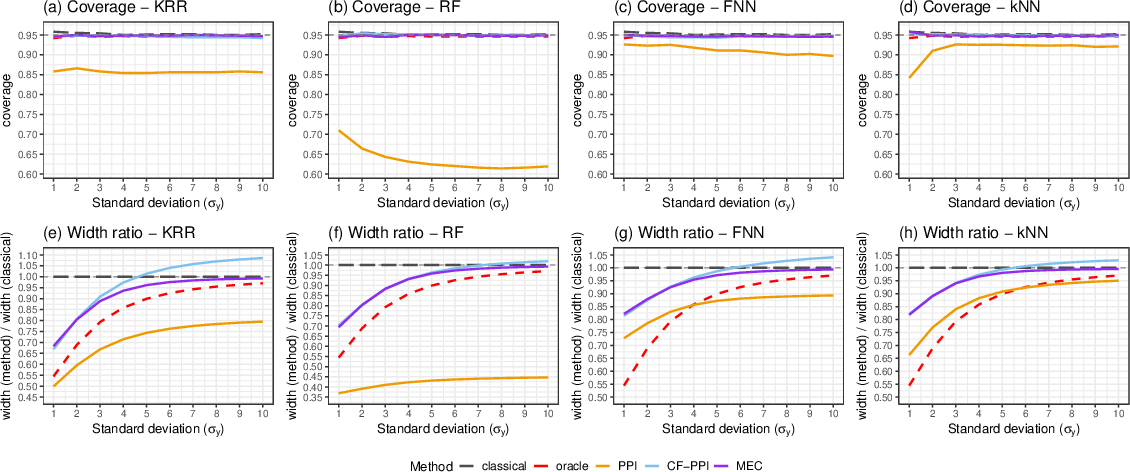
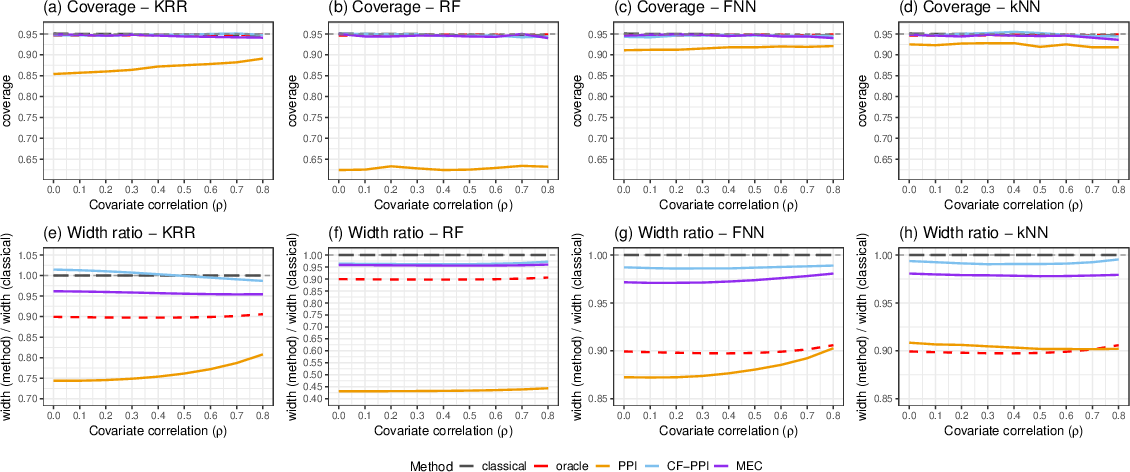
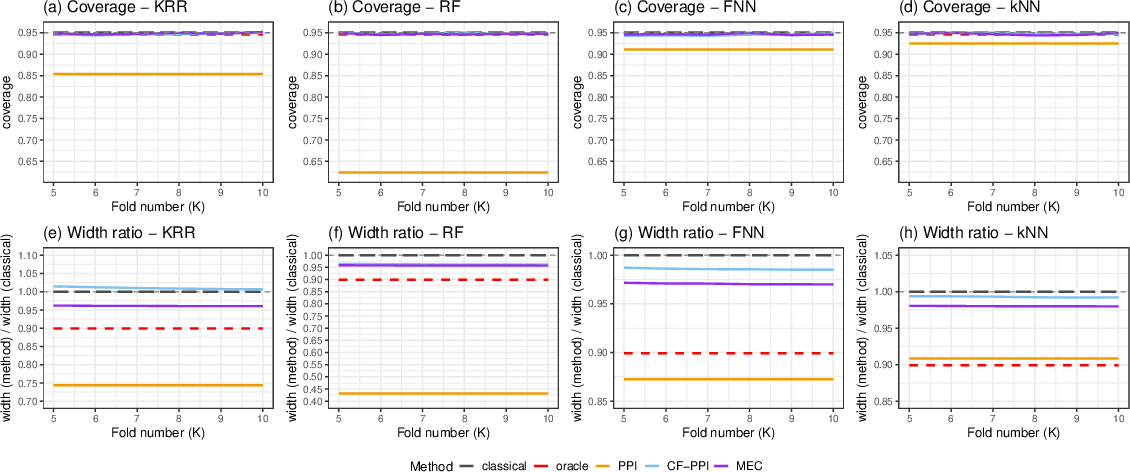
Further diagnostic and sensitivity analyses show that MEC results are robust to changes in covariate dimension, noise level, fold number, and covariate correlation.
Figure 3: Effect of covariate dimension n6 on coverage and width ratios, demonstrating invariant performance of MEC to increasing dimension.
Figure 4: Effect of response noise standard deviation n7 on the performance metrics of the estimators.
Figure 5: Influence of covariate correlation n8 on coverage and width, with MEC maintaining stability.
Figure 6: Sensitivity to the number of sample-splitting folds n9 for calibration.
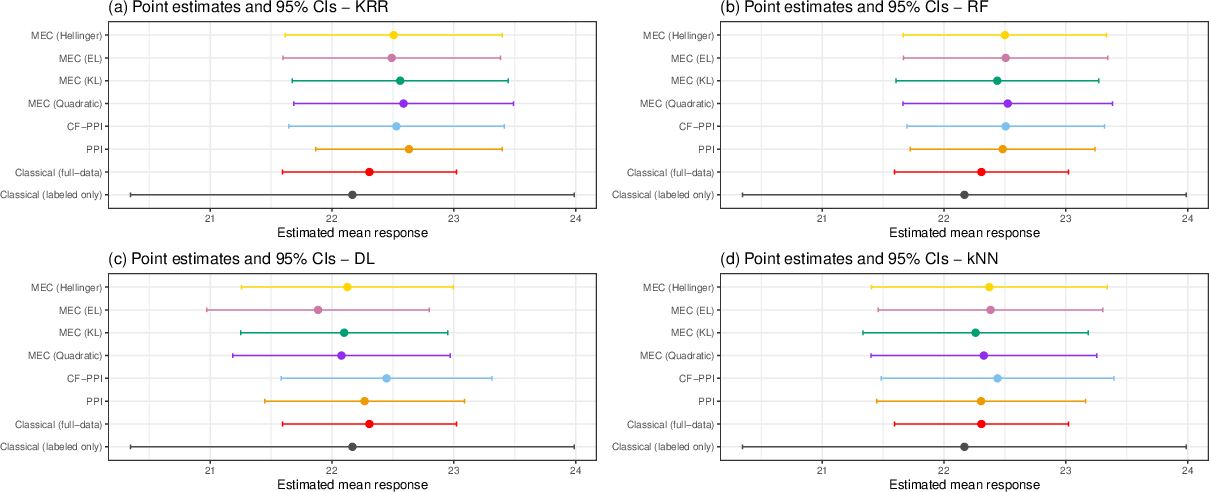
A real-data application (Energy Efficiency dataset) further corroborates the empirical findings.
Figure 7: Point estimates and 95% confidence intervals in real data, aligned scenario, across multiple learners and methods.
Practical and Theoretical Implications
The methodology provides a substantial advancement for semi-supervised inference in the absence of strong modeling assumptions or well-specified predictors. By integrating flexible ML predictions into a robust, entropy-calibrated framework, MEC enables inferentially valid and efficient mean estimation even in finite samples, relaxing stringent conditions typically required for semiparametric efficiency.
Practically, the approach offers a scalable, computationally simple alternative for practitioners, since the calibration weights are always optimally constructed in a 2D space regardless of covariate dimension or sample size. The theory suggests that MEC generalizes and subsumes PPI++: both are asymptotically equivalent for quadratic generators, but MEC allows for broader entropy classes.
Looking forward, the paper highlights extensions to more general semi- and nonparametric targets (such as average treatment effects), as well as integration into the broader landscape of orthogonal statistical learning and calibration-style estimators for survey and missing data problems. The methodological innovations in weight calibration and projection error relaxation are expected to influence the design of future robust inference pipelines in ML-augmented statistics.
Conclusion
MEC establishes a theoretically principled and practically robust method for semi-supervised mean estimation that leverages modern ML predictors while mitigating their misspecification through entropy-based calibration. It delivers near-nominal coverage and sharper confidence intervals across a wide operational regime, requiring only minimal regularity and projection conditions on the predictors. The approach unifies and extends existing lines of work on PPI, calibration, and efficient survey inference, offering a flexible toolset for future developments in uncertainty-aware machine-learning-integrated analysis.