- The paper demonstrates that engineered dissipative coupling transforms decoherence into a resource for inducing robust multiphoton interference in anti-PT symmetric systems.
- The study employs non-Hermitian Hamiltonian modeling and Lindblad master equations to reveal tunable high-order photon correlations with interference visibility as high as 94%.
- The experimental validation on a TFLN nanophotonic chip confirms that reservoir engineering and dark state protection offer new avenues for scalable, noise-resilient quantum state engineering.
Decoherence-Induced Multiphoton Interference: A Comprehensive Analysis
Introduction
Decoherence is traditionally considered antithetical to quantum information processing due to its propensity to degrade quantum coherence and entanglement, often undermining quantum advantage. However, recent advances in the engineering of open quantum systems have reframed this perspective: dissipation, when judiciously controlled, can enable robust state preparation and entanglement mechanisms inaccessible in closed, Hermitian quantum systems. The paper "Decoherence-induced Multiphoton Interference" (2604.05422) investigates this paradigm through the lens of non-Hermitian, anti-parity-time (anti-PT) symmetric photonic systems, demonstrating experimentally—on a thin-film lithium niobate (TFLN) nanophotonic platform—that shared reservoir-induced dissipative coupling can generate coherent multiphoton quantum states and controllable quantum interference among up to four photons.
This work presents both a formal theoretical framework and systematic experimental validation, revealing the emergence and tunability of multiphoton correlations generated and protected by decoherence. The implications extend to non-Hermitian quantum optics, reservoir engineering, and practical quantum photonic technologies.
Theoretical Framework
The central device comprises a triple-waveguide PPLN structure integrated on TFLN (Figure 1). Two outer waveguides (a and b) support SPDC, producing non-degenerate signal-idler photon pairs, while a central, highly lossy waveguide (c) acts as a common reservoir, facilitating dissipative (rather than unitary, coherent) coupling between a and b. The loss channel is engineered with a chromium strip deposited on the central waveguide, enabling controllable non-Hermitian dynamics.
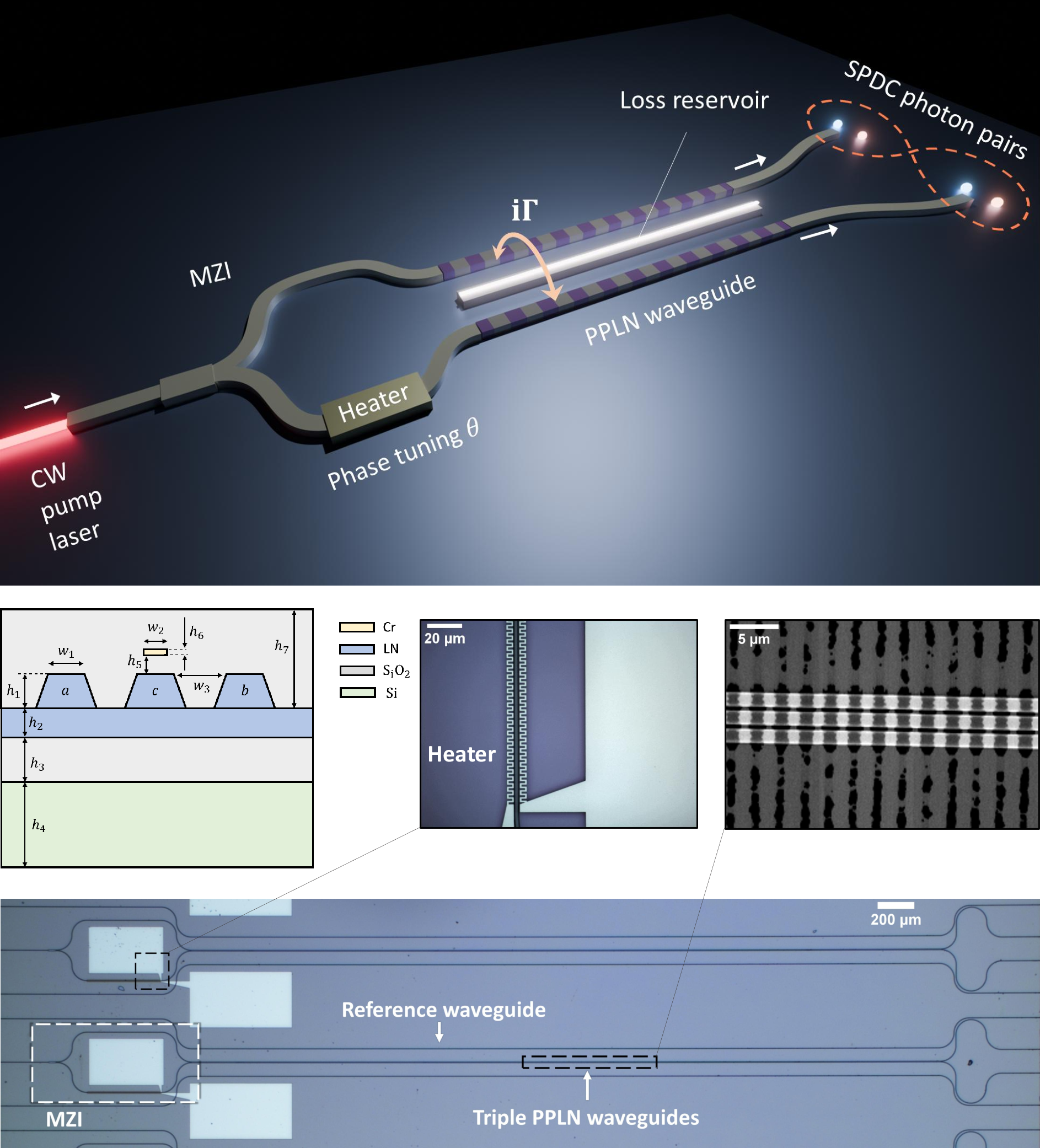
Figure 1: Schematic, cross-section, and microscope images of the anti-PT system on TFLN with integrated control and loss engineering.
A Mach-Zehnder interferometer (MZI) with a thermo-optic heater tailors the phase θ between pumps driving the SPDC in a and b, permitting phase-tuning of multiphoton interference.
The system is formally described by the Hamiltonian
H=HNL+HL,
where HNL encompasses SPDC in waveguides a and b, and HL describes linear coupling to the lossy mode c. The adiabatic elimination of the rapid reservoir c (γ≫∣κ∣) yields an effective non-Hermitian Hamiltonian over just a and b:
HL′=−iΓμ∑(aμ†aμ+aμ†bμ+bμ†aμ+bμ†bμ),
where Γ=∣κ∣2/γ denotes the dissipative coupling rate. Crucially, HL′ is anti-PT symmetric, characterized by the anti-commutation {PT,HL′}=0.
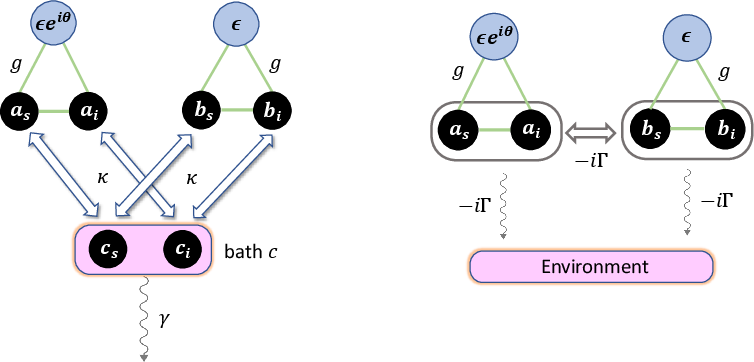
Figure 2: Full system Hamiltonian coupled to a lossy auxiliary mode and adiabatically eliminated two-mode effective anti-PT picture.
Dissipative coupling mediates quantum interference between a and b via collective loss—a hallmark of reservoir engineering in open quantum systems. The phase θ modulates the interference pattern through controllable SPDC amplitudes.
Master Equation and Role of Quantum Jumps
Quantum evolutions are analyzed via Lindblad master equations, which, unlike the non-Hermitian Schrödinger equation, explicitly account for quantum jumps induced by continuous environmental monitoring:
H=HNL+HL,0
This dissipator gives rise to decoherence-free subspaces (DFS) and underpins the noise-resilience of engineered dark modes—state components decoupled from loss due to symmetry.
Multiphoton Correlation Metrics
The study utilizes both the standard H=HNL+HL,1 correlation functions and constructs nontrivial normalized ratios H=HNL+HL,2 to distinguish genuine multiphoton interference from statistical coincidences, a necessary step given the possibility of high-order accidental background correlations in SPDC.
Numerical Results
Solving the effective models for realistic parameters, the paper demonstrates strong divergences between dissipative (anti-PT) and conventional coherent (Hermitian) coupling. For instance, Figure 3 shows that mean photon number and four-photon correlation H=HNL+HL,3 grow monotonically with propagation in the anti-PT case, unimpeded by phase mismatches; by contrast, the Hermitian system exhibits oscillatory and phase-sensitive interference, which can suppress multiphoton correlations.
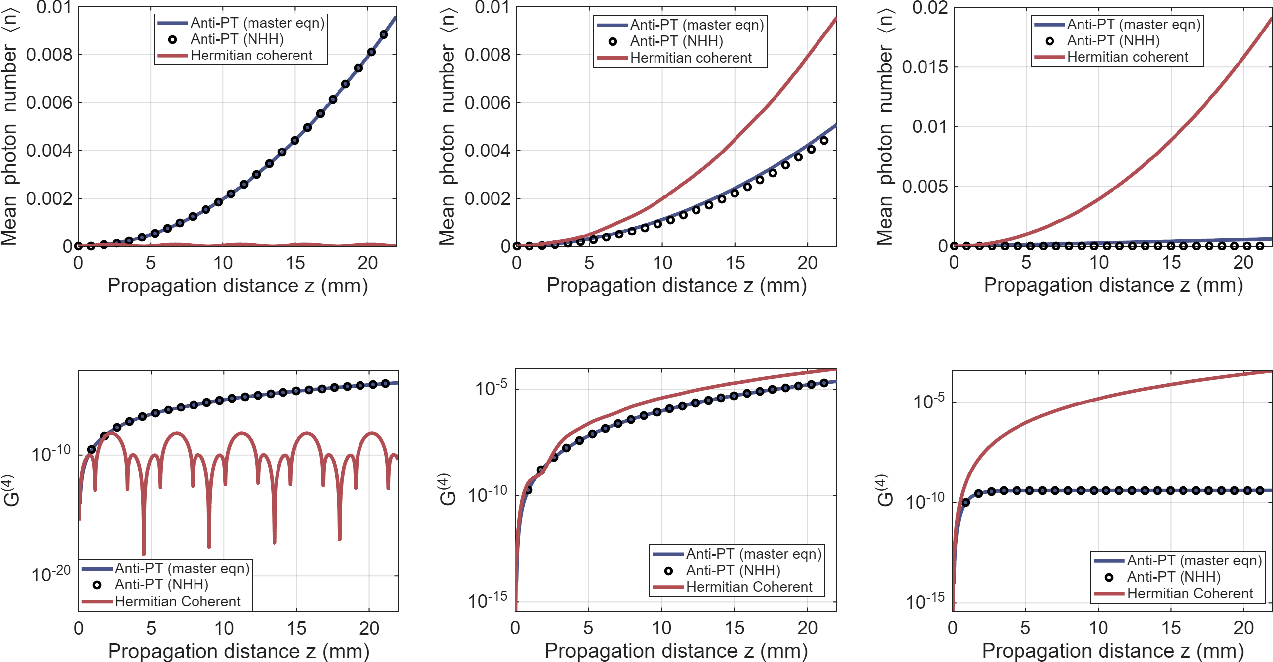
Figure 3: Simulated mean photon number and four-photon correlation evolution for different pump phases in anti-PT vs. Hermitian systems.
Importantly, the monotonic and robust build-up of high-order correlations in anti-PT devices is a direct consequence of reservoir-induced dark state protection and collective dissipation, which purifies the state into the DFS. Quantum jumps, neglected in the non-Hermitian Schrödinger dynamics, are necessary for accurately computing all normalization-sensitive observables such as H=HNL+HL,4.
In bright/dark supermode basis, only bright modes are lossy, while dark modes are immune, yielding robust multiphoton coherence resistant to disorder and decoherence. This property is critical for DFS-based quantum information schemes.
Experimental Implementation
A nanophotonic TFLN chip is fabricated following precise e-beam lithography and periodic poling protocols. The SPDC process and phase control are characterized by SHG and SPDC measurements at cryogenic detector sensitivity, with well-calibrated and independently measured coupling and loss rates.
The experimental setup is shown in Figure 4.
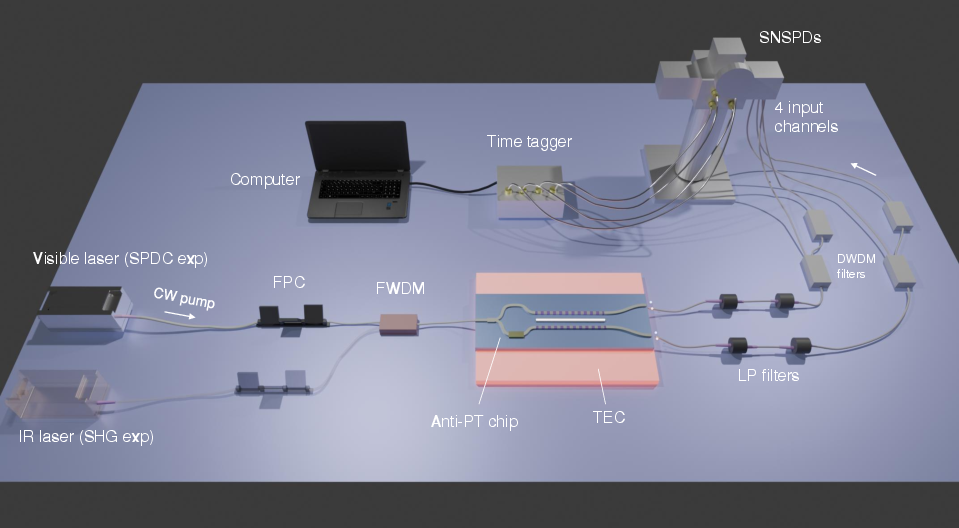
Figure 4: Experimental arrangement for SHG/SPDC characterization and multiphoton correlation measurements.
Experimental Multiphoton Correlation Results
Four-Photon Correlations
Experimentally, time-tagged four-fold coincidence counts are accumulated for various pump phase differences (Figure 5a), and H=HNL+HL,5 is extracted. The anti-PT device yields highly tunable four-photon correlations, with visibility H=HNL+HL,6, matching theoretical expectations. The Hermitian reference exhibits nearly independent channels (H=HNL+HL,7) and regions of four-photon suppression due to destructive interference.
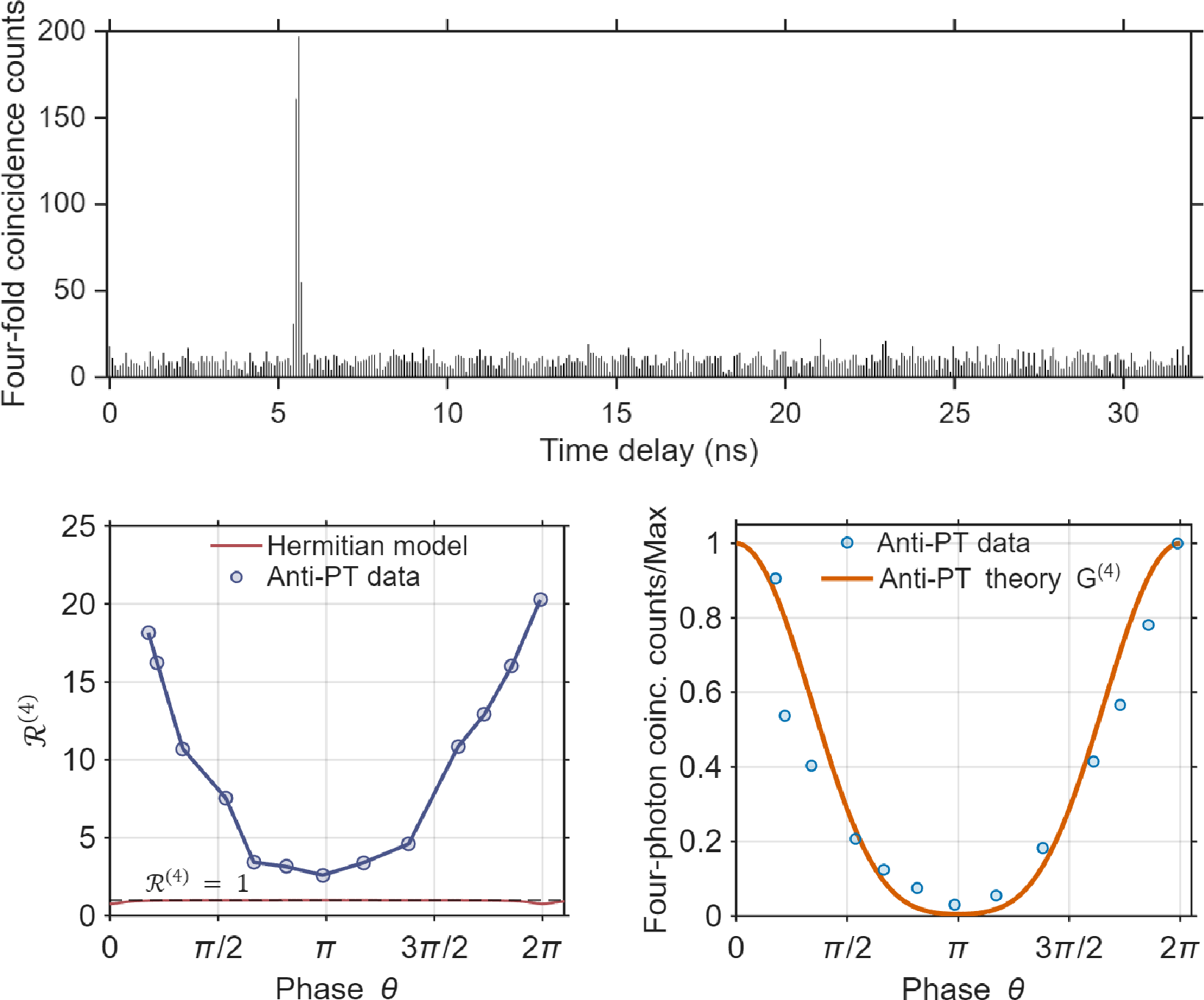
Figure 5: Four-photon (a) histogram, (b) inter-pair correlation H=HNL+HL,8 and (c) phase dependence of four-photon coincidences.
Three-Photon and Two-Photon Correlations
Three-photon coincidences (Figure 6) and two-photon coincidences (Figure 7) exhibit strong phase-dependence in the anti-PT system, confirming the selective bright/dark-state nature of dissipative coupling. Notably, intra-waveguide two-photon correlations are insensitive to phase, while inter-waveguide correlations are strongly phase-tunable—mirroring the theoretical predictions for dark-mode-protected state channels.
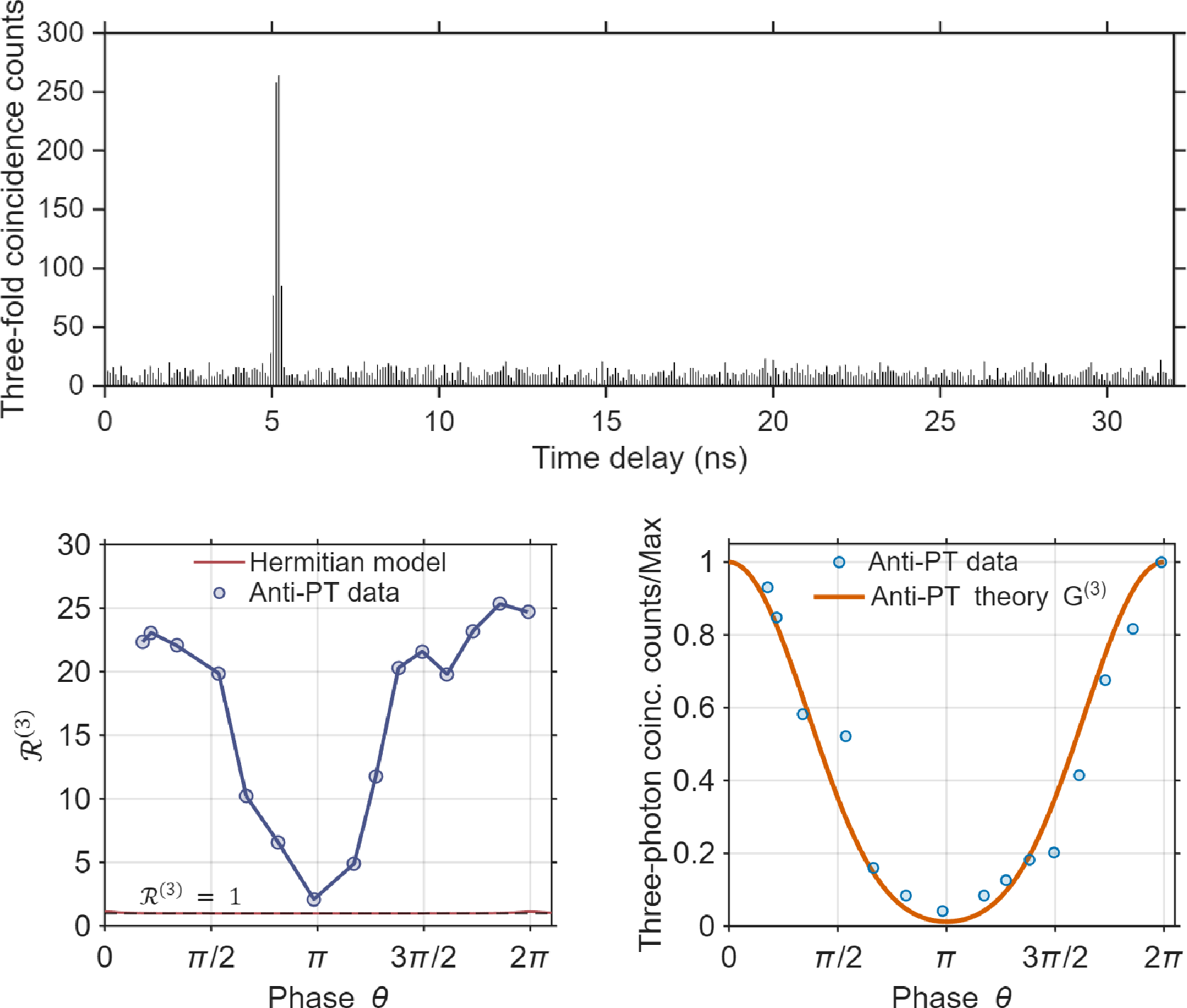
Figure 6: Three-photon correlation histograms and phase dependence of H=HNL+HL,9 and HNL0.
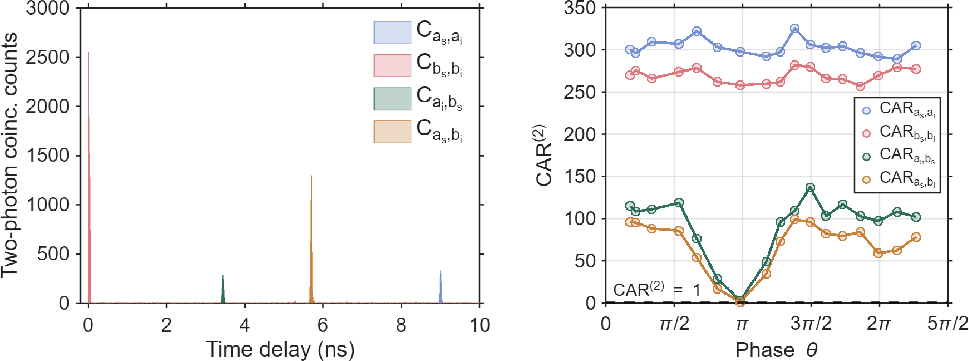
Figure 7: Two-photon delay histograms and phase dependence of intra- and inter-waveguide coincidence-to-accidental ratios.
Implications and Outlook
Theoretical Significance
This work pushes non-Hermitian quantum optics beyond two-photon PT/anti-PT phenomena, directly probing decoherence-enabled multiphoton interference at the second quantization level. It demonstrates the capacity of engineered loss channels to serve as quantum resources, contradicting the traditional view of decoherence as purely deleterious. The anti-PT symmetry enables deterministic noise-robust state engineering, with the DFS providing inherent protection from environmental noise and disorder—a substantial advantage for scalable quantum photonic technologies.
Practical Applications and Future Directions
Reservoir-engineered anti-PT platforms on TFLN are promising for modular, integrated, and room-temperature-compatible quantum light sources with tunable high-order correlations. The demonstrated phase control and high visibility in multiphoton interference point toward practical architectures for quantum information tasks—especially where robustness to disorder and loss are required (e.g., DFS quantum memories, entangled multiphoton sources for boson sampling, quantum metrology, and sensing).
Future research is likely to explore (i) scalability to even higher photon numbers leveraging the DFS protection, (ii) topological effects and exceptional point engineering in non-Hermitian quantum networks, (iii) integration with active feedforward and classical control, and (iv) dynamic reservoir engineering in time-varying or programmable nanophotonic networks.
Conclusion
By leveraging anti-PT symmetry and engineered dissipative coupling, "Decoherence-induced Multiphoton Interference" demonstrates robust, controllable multiphoton quantum interference arising from decoherence itself, not in spite of it. The experimental validation on a TFLN nanophotonic chip establishes a new paradigm for quantum state engineering and paves the way for reservoir- and DFS-based quantum technologies. This research substantiates dissipation as an enabling resource for advanced quantum photonics, fundamentally expanding the operational landscape for quantum information science.