- The paper proposes that topological quantum critical points are governed by a shadowing mechanism enforcing strict anomaly constraints tied to adjacent gapped phases.
- It employs a U(1) Chern-Simons gauge theory with massless Dirac fermions, introducing an exactly marginal, non-local gauge interaction on a conformal manifold.
- The study derives universal topological signatures and highlights experimental implications for moiré graphene systems, enabling tunable critical behavior.
Introduction and Conceptual Framework
This work develops a formalism for topological quantum critical points (tQCPs) residing between non-invertible chiral topological orders in (2+1) dimensions. Unlike conventional quantum critical points, governed by local order parameters in the Landau-Ginzburg-Wilson paradigm, tQCPs interpolate between intrinsically topologically ordered, gapped phases characterized by distinct modular data and chiral central charges. The central proposal is that these tQCPs are described by scale-invariant quantum field theories (QFTs) which do not appear as isolated fixed points but rather populate a non-compact conformal manifold. The essential organizing principle introduced is "topological shadowing": the IR critical theory's field content and parameters are sharply constrained by the topological data—specifically, chiral central charges and anyon braiding statistics—of the adjoining gapped phases.
The core effective theory is a U(1) Chern-Simons gauge theory at level k coupled to Nf flavors of massless Dirac fermions, explicitly incorporating a non-local quadratic structure for the gauge sector. This non-locality arises naturally, either by integrating out kinematically decoupled Dirac fermions or as a boundary effect from a (3+1)-D bulk with a topological θ-term.
Topological Shadowing, Anomaly Constraints, and Field Content
A distinguishing feature of the studied tQCPs is the rigid constraint that the integral data (Chern-Simons level k and fermion flavor number Nf) are not free parameters; they are determined by the anomaly matching between the topological data of the neighboring phases. For two phases with chiral central charges c1 and (2+1)0 (with (2+1)1), and assuming the gauge charge (2+1)2 (generalization to fractional charges is presented), the allowed field theory parameters are fixed as:
(2+1)3
This originates from a careful analysis of how integrating out fermions alters the Chern-Simons level via the parity anomaly, which also guarantees gauge invariance even in the presence of half-integer (2+1)4. This is a strict UV-IR matching reminiscent of 't Hooft anomaly conditions, but here the matching is enforced at the level of modular topological data rather than symmetry-protected data, establishing a conceptually novel instance of topological constraint—a "shadow" of bulk phase topology on the critical theory.
The Effective Theory and Its Key Non-Local Structure
The minimal extended effective field theory (eEFT) at the transition is specified as:
(2+1)5
with the momentum-space projector (2+1)6. The non-local term, linear in (2+1)7, is exactly marginal in the IR and contrasts with the standard Maxwell term, which becomes irrelevant at low energies. The parameter (2+1)8 can be interpreted as stemming from integrating out bands with different effective velocities (in condensed matter scenarios) or as a boundary "shadow" of higher-dimensional bulk topology.
A central technical result is the explicit demonstration that, up to two-loop order, the beta functions for both the Chern-Simons level (2+1)9 and the non-local gauge coupling U(1)0 vanish exactly:
U(1)1
This is established via a diagrammatic RG analysis, evaluating the relevant photon self-energies and employing integration-by-parts reductions for two-loop integrals.
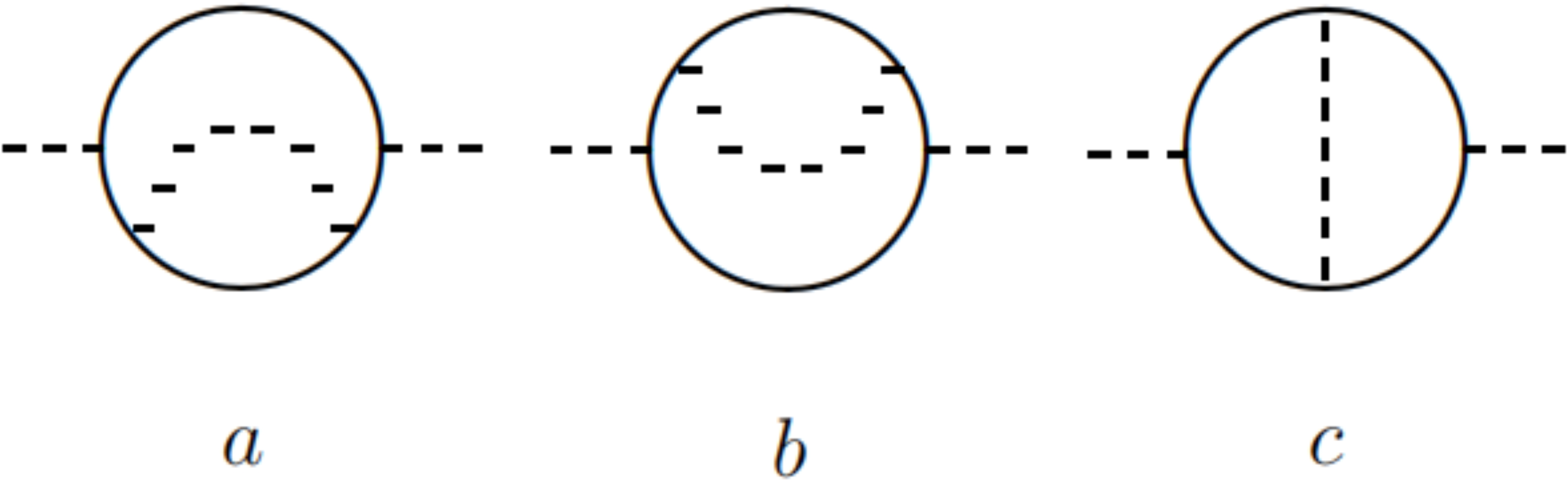
Figure 1: Two-loop diagrams of photon self-energy, essential for the RG analysis, with solid lines as fermion propagators and dashed lines as gauge propagators.
This result marks the presence of a non-trivial, non-compact manifold of fixed points—a conformal manifold parameterized by U(1)2—which is realized without any need for supersymmetry. This is a remarkable U(1)3D parallel to the conformal lines of the U(1)4D Luttinger liquid, but within a distinctly topological gauge theory context.
The manifold is not trivial: the fermion anomalous dimension,
U(1)5
is a continuously variable, strictly nonzero function along the manifold, showing that these are genuine interacting CFTs (not free points at different couplings).
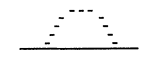
Figure 2: One-loop diagrams of fermion self-energy contributing to the continuously varying anomalous dimension U(1)6.
Universal Topological Signature and Non-Local Observables
To diagnose the topological content, the expectation value and commutators of Wilson loop operators are computed in closed form. While the presence of U(1)7 induces a continuous renormalization of local observables (such as the statistical angle extracted from the VEV of a Wilson loop), the algebra of Wilson loops winding on nontrivial cycles (e.g., torus cycles) is robust and entirely controlled by U(1)8, and thus by the adjacent phase topologies:
U(1)9
A striking universal relation between the topological braiding data at the critical point and those in the adjacent phases is derived:
k0
where k1. This algebra is completely insensitive to the local, non-universal dynamics along the conformal manifold and is dictated solely by the global topological "shadow".
Physical Implications, Experimental Scenarios, and Holography
The structure of the eEFT and its non-local properties allow for direct applicability to experimentally relevant systems. For instance, transitions between different fractional Chern insulator states in moiré graphene platforms are anticipated to realize this physics, with k2 tunable via the presence or hybridization strength of extra bands crossing the Fermi level. Critical exponents—such as k3—can, in principle, be continuously tuned by such material parameters, while topological observables (modular commutators of Wilson loops) remain unchanged.
Furthermore, the non-local gauge structure is justified holographically: the boundary of a k4D Maxwell theory with a k5-term naturally induces the observed non-local quadratic gauge field term and provides further intuition as to its exact marginality.
Comparison to Other Critical Phenomena
In contrast to standard SPT quantum criticality, where the universality class is determined by relative changes in topological invariants and the dynamics is generally uniquely specified, the tQCPs examined here can host an entire manifold of scale-invariant theories within each universality class defined by k6. This considerably enlarges the space of critical behaviors accessible in topological systems.
Conclusion
This paper advances the theoretical understanding of quantum phase transitions between topologically ordered phases by formulating a general framework for topologically shadowed quantum criticality. It demonstrates that non-invertible topological data impose strict anomaly constraints on the allowed IR critical theories, leading to a non-compact conformal manifold of interacting fixed points in k7 dimensions, characterized by exactly marginal non-local gauge interactions without supersymmetry. While local critical exponents vary, universal topological operator algebra remains topologically protected. The work points to experimental implications for moiré systems and highlights a deep holographic connection between higher-dimensional topology and k8D conformal manifolds, suggesting routes for future research on the global structure and dynamics at topological phase transitions and the emergent role of conformal manifolds in strongly correlated quantum matter.
(2604.05391)