- The paper introduces a determinant mapping from Toeplitz-plus-Hankel to Hankel determinants, enabling precise extraction of oscillatory corrections and hard-edge crossover behavior.
- It derives explicit closed-form expressions for Rényi entanglement amplitude and phase through Riemann–Hilbert asymptotics, confirming universal power-law scaling.
- The study extends symmetry resolution by analyzing U(1) sector decomposition, revealing a halved Gaussian width and equipartition offset with experimental relevance.
Entanglement in the Open XX Chain: Rényi Oscillations, Hard-Edge Crossover, and Symmetry Resolution
Introduction and Context
This paper provides a comprehensive analysis of Rényi entanglement entropies in the open XX spin-21 chain. It focuses on the subleading structure beyond the universal CFT logarithm, including explicit oscillatory corrections, hard-edge crossovers near the band edges, and the role of U(1) symmetries in entanglement resolution. The approach leverages a reduction from Toeplitz-plus-Hankel determinants to Hankel determinants with positive weights, enabling the application of Riemann–Hilbert steepest-descent techniques for extracting large-size asymptotics. This formalism yields explicit, closed-form expressions for the oscillatory amplitude and phase, pinpoints the behavior near the spectral boundaries, and systematically addresses the symmetry-resolved decomposition of entanglement.
Determinant Mapping and Asymptotic Expansion
The reduced density matrix of a block in the ground state of the open XX chain is encoded in the eigenvalues of a Toeplitz-plus-Hankel correlation matrix. Classical Fisher–Hartwig approaches face ambiguity in such cases due to multiple possible representations. The paper circumvents this by employing the Deift–Its–Krasovsky even-symbol identity, mapping the Toeplitz-plus-Hankel determinant to a Hankel determinant with a single internal Fisher–Hartwig-type jump on the interval [−1,1] and Jacobi edge singularities. This mapping enables direct connection to the Riemann–Hilbert asymptotics for orthogonal polynomials with jump discontinuities.
The entropy is then represented as an integral over spectral parameters, with all nontrivial dependence transferred to the Hankel weight's jump and edges. The asymptotic expansion takes the form
Sα(ℓ)=121(1+α1)lnℓ+Cα(OBC)(kF)+Aα(OBC)(kF)ℓ−1/αcos(2kFℓ+φα(kF))+O(ℓ−min(1,2/α)),
where Aα(OBC)(kF) and φα(kF) are specified in closed form via an explicit evaluation of the Szegő function for the jump-symbol.
Rényi Oscillations: Amplitude, Phase, and Geometric Factorization
The leading 2kF oscillation, originating from the Fisher–Hartwig jump, is characterized by an amplitude scaling as ℓ−1/α. Explicit expressions for the amplitude and phase are derived:
Aα(OBC)(kF)=Gα(2sinkF)−1/α∣D(eikF)∣−2/α,φα(kF)=2απ−α1argD(eikF),
where Gα is a combination of Barnes U(1)0-functions and U(1)1 is a regularized Szegő function value.
For intervals detached from the boundary, the oscillatory amplitude factorizes numerically as the product of the boundary amplitude and a universal geometry-dependent function U(1)2, with U(1)3 being the appropriate conformal cross-ratio. This supports a leading approximation in which geometry effects and filling/oscillation scale separate.
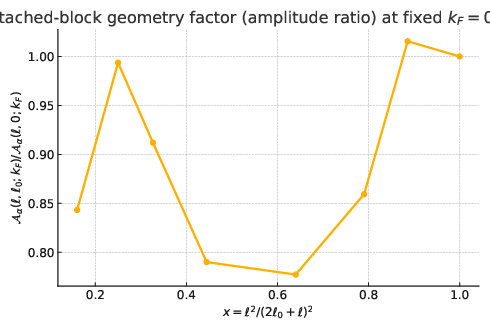
Figure 2: Detached block amplitude ratio U(1)4 versus the cross-ratio U(1)5 for U(1)6, demonstrating geometric factorization.
Hard-Edge Crossover in Scaling Variable U(1)7
A central result is the identification of a single-variable scaling form for the entanglement near the band edge,
U(1)8
which controls the transition from edge to bulk entanglement behavior. The leading logarithm is U(1)9, organizing all filling dependence into the scaling variable and achieving a sharp data collapse for all block sizes and fillings. In this scaling regime, the boundary oscillatory envelope obeys universal power laws,
[−1,1]0
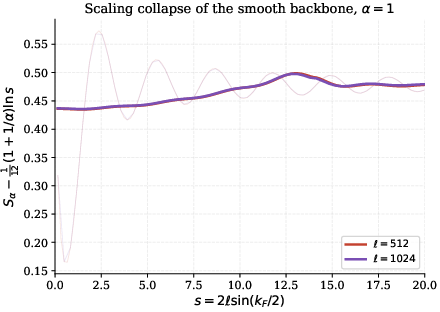
Figure 4: Scaling collapse of the smooth backbone [−1,1]1 for [−1,1]2, confirming that [−1,1]3 is the natural scaling variable for the entropy.
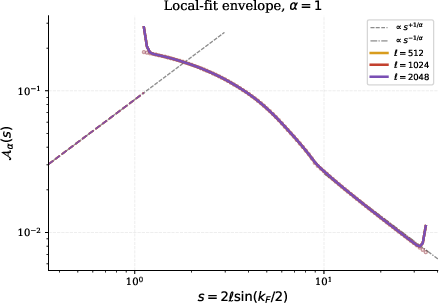
Figure 1: Oscillation envelope [−1,1]4 for [−1,1]5 extracted by demodulation, showing robust adherence to the predicted [−1,1]6 scaling laws.
This universal behavior persists for all Rényi indices with only amplitude renormalization. At the left and right band edges, the same crossover applies with [−1,1]7. The paper provides extensive numerical evidence supporting these universal exponents across block sizes and Rényi index choices.
Symmetry-Resolved Entanglement and Equipartition Offset
The determinant approach extends to the charged moments [−1,1]8 required to resolve the entanglement into [−1,1]9 symmetry sectors. The small-Sα(ℓ)=121(1+α1)lnℓ+Cα(OBC)(kF)+Aα(OBC)(kF)ℓ−1/αcos(2kFℓ+φα(kF))+O(ℓ−min(1,2/α)),0 behavior is Gaussian, with a width halved relative to the periodic chain,
Sα(ℓ)=121(1+α1)lnℓ+Cα(OBC)(kF)+Aα(OBC)(kF)ℓ−1/αcos(2kFℓ+φα(kF))+O(ℓ−min(1,2/α)),1
where Sα(ℓ)=121(1+α1)lnℓ+Cα(OBC)(kF)+Aα(OBC)(kF)ℓ−1/αcos(2kFℓ+φα(kF))+O(ℓ−min(1,2/α)),2 is the Luttinger parameter (unity for XX chain). This produces the universal OBC equipartition offset
Sα(ℓ)=121(1+α1)lnℓ+Cα(OBC)(kF)+Aα(OBC)(kF)ℓ−1/αcos(2kFℓ+φα(kF))+O(ℓ−min(1,2/α)),3
and the predicted sector weights become Gaussian, centered on the mean charge.
Charged moment numerics confirm the correct asymptotic behavior of the curvature at Sα(ℓ)=121(1+α1)lnℓ+Cα(OBC)(kF)+Aα(OBC)(kF)ℓ−1/αcos(2kFℓ+φα(kF))+O(ℓ−min(1,2/α)),4 and reveal oscillary amplitude growth with nonzero flux, demonstrating oscillatory corrections not captured by a simple Gaussian suppression.
Sector-Resolved Oscillations: Structure and Limitations
Sector-resolved entanglement reveals the survival of parity oscillations within symmetry sectors. The paper conjectures a scaling structure in which the neutral oscillatory envelope is multiplied by a Gaussian suppression in the difference Sα(ℓ)=121(1+α1)lnℓ+Cα(OBC)(kF)+Aα(OBC)(kF)ℓ−1/αcos(2kFℓ+φα(kF))+O(ℓ−min(1,2/α)),5, but dedicated analysis and numerics indicate that the charged oscillatory amplitude carries explicit, nontrivial dependence on the flux variable Sα(ℓ)=121(1+α1)lnℓ+Cα(OBC)(kF)+Aα(OBC)(kF)ℓ−1/αcos(2kFℓ+φα(kF))+O(ℓ−min(1,2/α)),6—not reducible to neutral entanglement by a simple convolution. Thus, formulas for the sector-resolved oscillation amplitude are only approximations and a full analytic study requires a uniform-in-Sα(ℓ)=121(1+α1)lnℓ+Cα(OBC)(kF)+Aα(OBC)(kF)ℓ−1/αcos(2kFℓ+φα(kF))+O(ℓ−min(1,2/α)),7 treatment of the charged Hankel determinant.
Vanishing of Entanglement Asymmetry at Equilibrium
For equilibrium states with global Sα(ℓ)=121(1+α1)lnℓ+Cα(OBC)(kF)+Aα(OBC)(kF)ℓ−1/αcos(2kFℓ+φα(kF))+O(ℓ−min(1,2/α)),8 symmetry, the entanglement asymmetry (difference of the entropy between the reduced state and its Sα(ℓ)=121(1+α1)lnℓ+Cα(OBC)(kF)+Aα(OBC)(kF)ℓ−1/αcos(2kFℓ+φα(kF))+O(ℓ−min(1,2/α)),9-dephased version) vanishes identically for all system sizes, Rényi indices, and fillings, since the reduced density matrix commutes with the charge operator. This aligns with general symmetry principles and previous results.
Experimental Implications
The analysis provides testable predictions for cold-atom and solid-state emulators of the open XX chain. The scaling collapse in the smooth part and the power-law structure of oscillation envelopes are both accessible via measurement of block entropies for varying sizes and fillings. Symmetry-resolved quantities can be accessed with contemporary randomized measurement protocols or post-selection on quantum gas microscope platforms.
Conclusion
This work establishes a determinant-based asymptotic framework for entanglement and symmetry resolution in the open XX chain, providing closed-form amplitude/phase expressions, universal crossover functions, and robust finite-size evidence supporting the derived scaling laws. The methods overcome ambiguities present in earlier Toeplitz-plus-Hankel analyses and yield greater tractability for both theoretical and numerical study. Proposed future directions include a full analytic account of charged hard-edge asymptotics, extension to dynamical protocols (e.g., post-quench scenarios), symmetry-resolved negativities, and non-Abelian symmetry settings.
Summary
- The determinant mapping and Riemann–Hilbert techniques give full analytic control over OBC entanglement oscillations and hard-edge crossovers.
- The oscillation envelope scales universally as Aα(OBC)(kF)0, with explicit amplitude/phase given in terms of the Szegő function.
- Symmetry resolution recovers the halved Gaussian width/equipartition offset and predicts a more intricate structure for the oscillatory corrections in sectors.
- The approach opens a path for precise entanglement diagnostics in diverse interacting and nonequilibrium quantum systems.