- The paper demonstrates that CSRO increases the mean hydrogen solution energy in CoNiV, reducing the number of deep binding sites and overall hydrogen uptake.
- It employs a machine-learning interatomic potential validated against DFT to accurately simulate atomic forces and energies across diverse local environments.
- The study shows that while hydrogen segregates to dislocation cores, the trapping energies remain moderate, suggesting CSRO engineering can mitigate hydrogen embrittlement.
Chemical Short-Range Order and Hydrogen Interactions in CoNiV Alloys: An Atomistic Perspective
Introduction
Concentrated alloys, including medium- and high-entropy alloys such as equiatomic CoNiV, are frequently observed to possess significant chemical short-range order (CSRO) that affects their structural and mechanical responses. Understanding the coupling between CSRO and hydrogen–defect interactions is essential to unravel the atomistic origins of hydrogen embrittlement resistance in these alloys. The paper presents a comprehensive atomistic study using a machine-learning interatomic potential (MLIP), specifically developed and validated for the Co–Ni–V–H system, to elucidate the role of CSRO in regulating hydrogen energetics and hydrogen–dislocation interactions in CoNiV.
Development and Validation of Machine-Learned Interatomic Potential
A database of density functional theory (DFT) calculations was constructed to encompass diverse chemical and local environments, including random and CSRO configurations and hydrogen-bearing structures. The MLIP was trained within the moment tensor potential (MTP) framework and rigorously validated against both energies and atomic forces, achieving RMSE values of 4.52 meV/atom (energy) and 141.98 meV/Å (forces) against an independent validation set. Validation of elementary properties, such as lattice parameters, elastic constants, and hydrogen solution/binding energies, demonstrated close agreement with both experimental and high-accuracy DFT references, confirming the suitability of the potential for the present simulations.
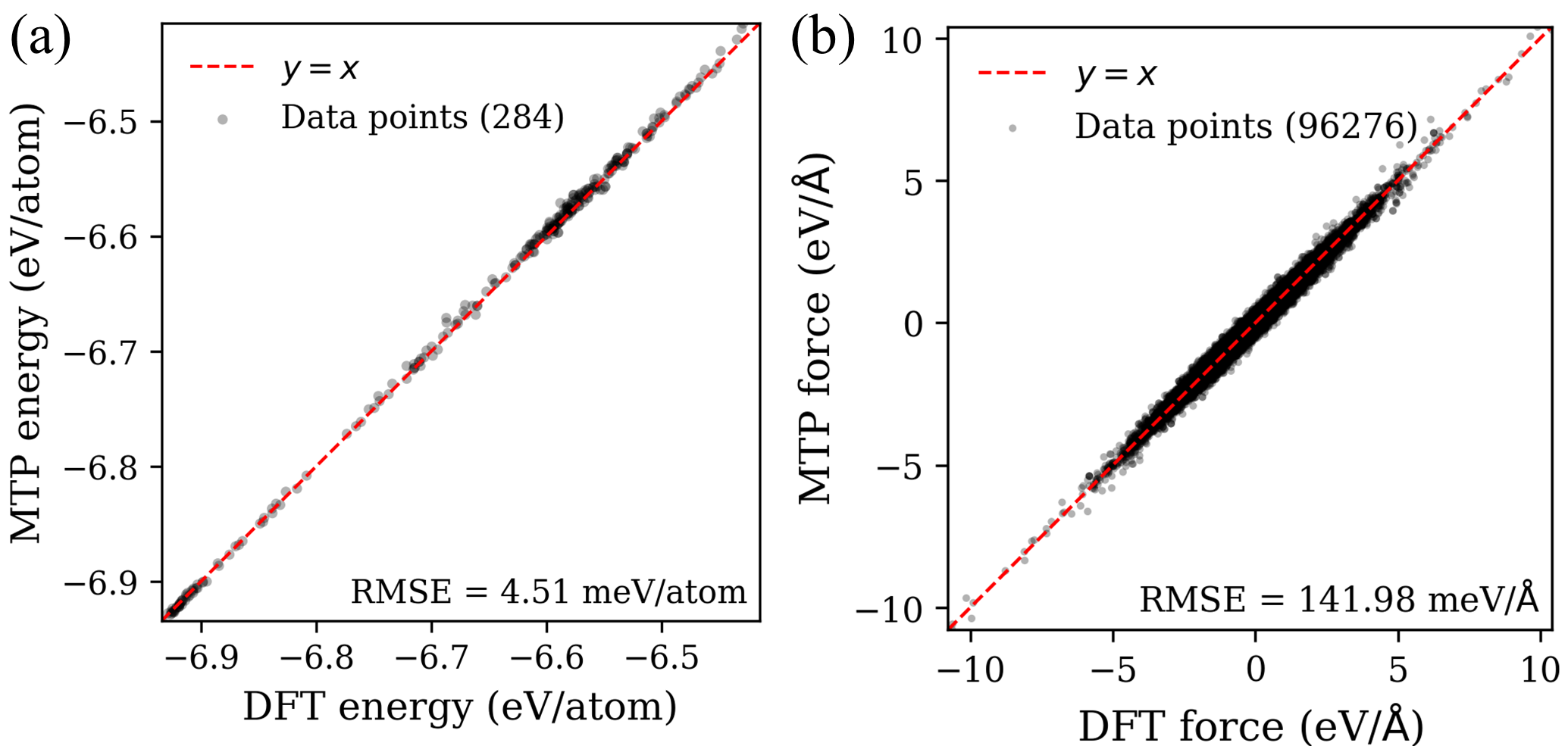
Figure 1: MLIP achieves reliable accuracy in predicting both total energies and atomic forces, benchmarked against DFT data for a representative validation set.
Chemical Short-Range Order in CoNiV: Thermodynamic and Structural Features
Hybrid Monte Carlo/molecular dynamics (MCMD) simulations employing the developed MLIP confirmed pronounced V-centered CSRO in equiatomic CoNiV across 300–1000 K, as reflected by strongly negative Warren–Cowley SRO parameters for Ni–V and Co–V pairs and strong V–V avoidance. The SRO parameters showed minimal temperature dependence and remained robust even upon introducing dilute hydrogen (1 at.%), with negligible influence on ordering tendencies. These results are consistent with prior neutron and electron diffuse scattering experiments and first-principles predictions, establishing that CSRO is energetically stabilized by size mismatch and electronic effects (V being an early transition metal).
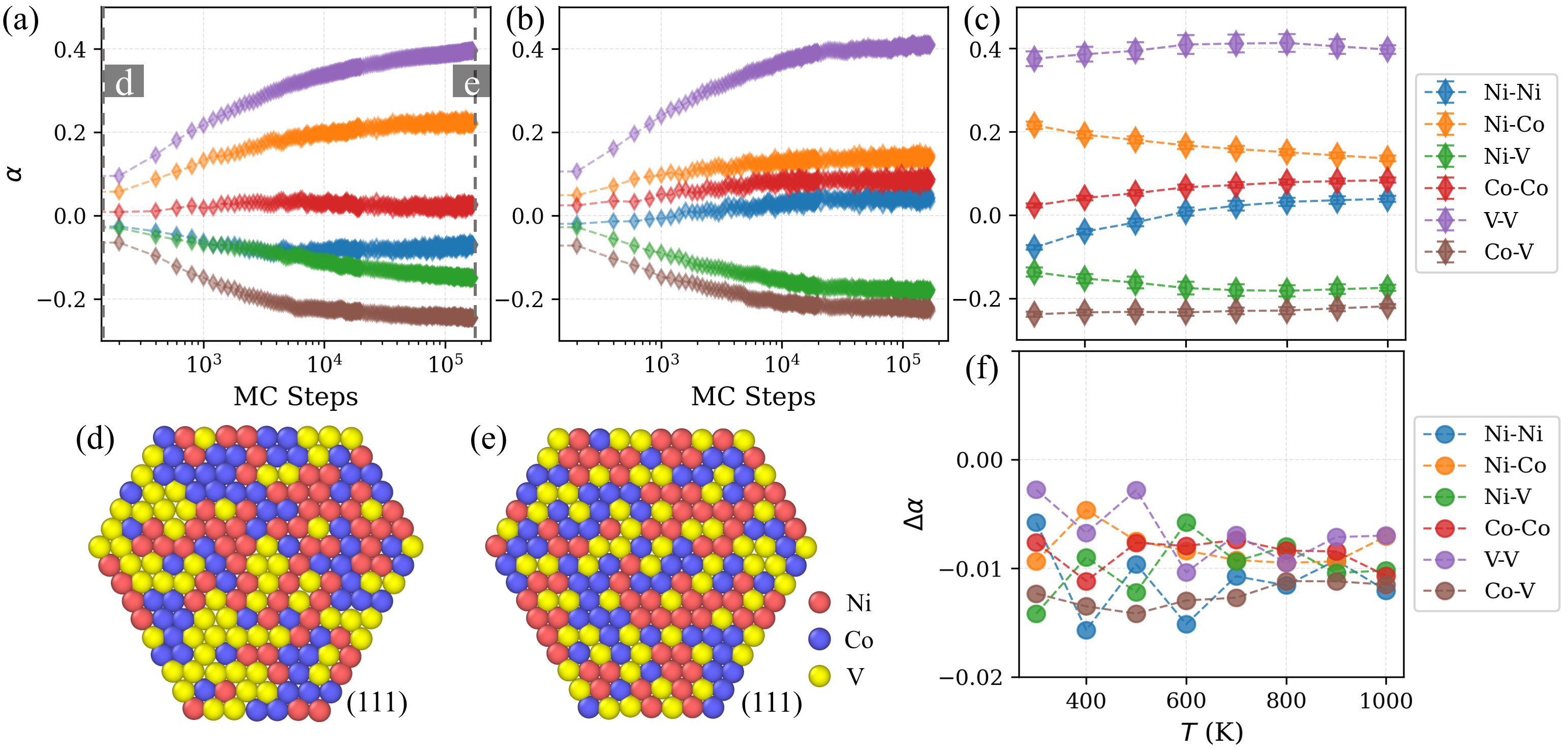
Figure 2: V-centered CSRO is manifested by persistent negative Warren–Cowley parameters for heteroatomic pairs and strong suppression of V–V correlations; dilute H does not affect the underlying chemical order.
CSRO Modulates Bulk Hydrogen Solution Thermodynamics
Systematic sampling of octahedral interstitial sites in both chemically random and CSRO configurations revealed that CSRO elevates the mean hydrogen solution energy and suppresses the fraction of deep binding sites that promote strong H uptake. Specifically, the average Esol increased from ~0.11 eV (random) to ~0.18 eV (CSRO), and the proportion of sites with Esol<0 (enabling spontaneous H occupation) nearly halved with ordering. Detailed mapping of solution energy as a function of the local first-nearest-neighbor composition established the primary stabilization in V-rich environments, which are rendered statistically rare by V–V avoidance in the ordered state.
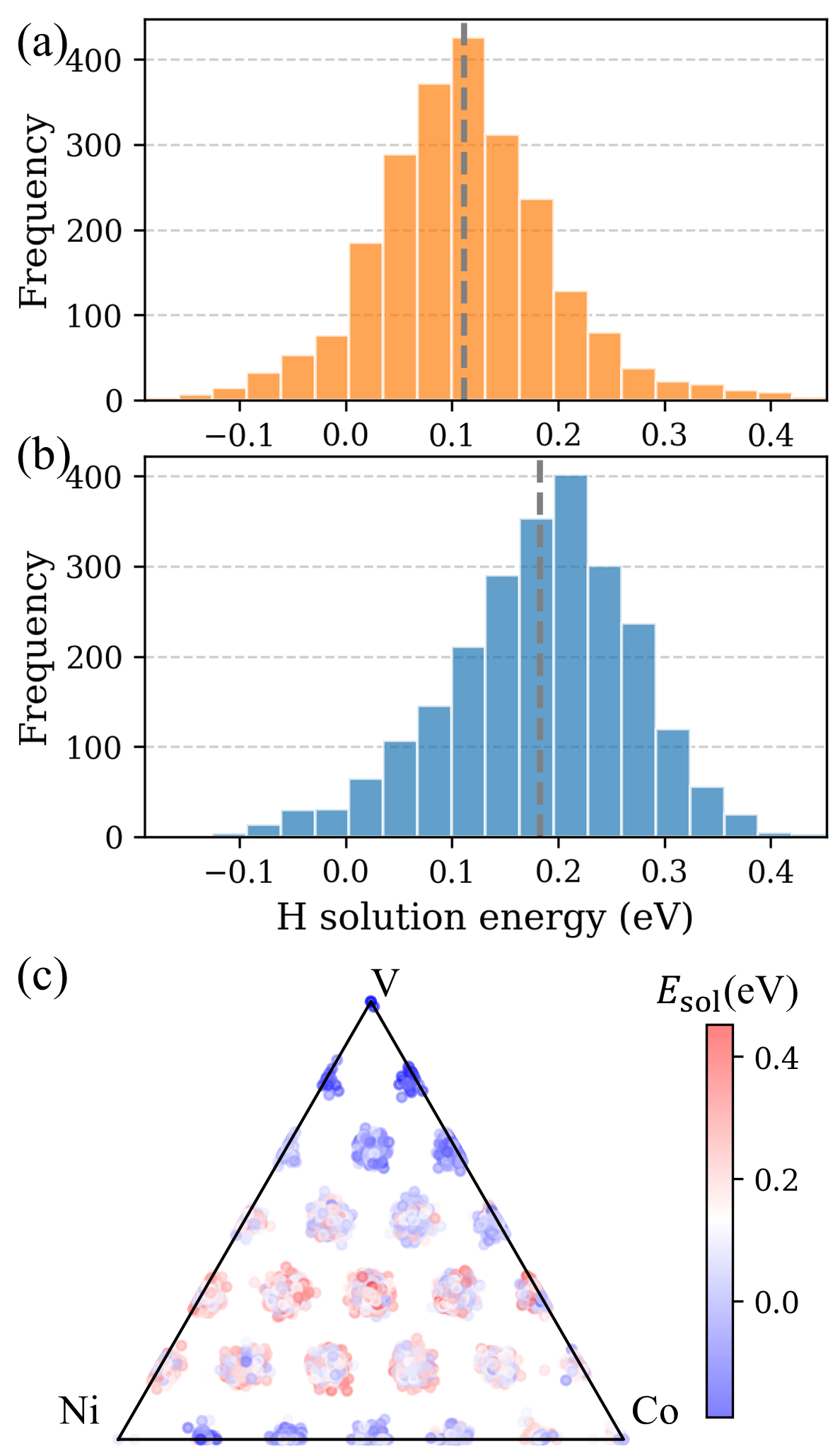
Figure 3: CSRO shifts the distribution of hydrogen solution energies to higher values and reduces the number of strongly binding sites; local V enrichment is strongly correlated with deep solution wells.
Hydrogen–Dislocation Interactions: CSRO as a Regulator
Dislocation core structures were generated for both random and CSRO CoNiV, revealing typical Shockley partial dissociation and associated hydrostatic strain fields. Mapping hydrogen solution energies in the vicinity of edge dislocation cores demonstrated that hydrogen preferentially segregates to tensile hydrostatic regions; however, absolute trapping energies remain moderate (0.03–0.06 eV) and strongly modulated by local chemical environments. CSRO increases the bulk Esol, thereby enhancing the driving force for H partitioning at dislocation cores relative to the bulk, but chemical trapping remains dominant over elastic trapping. Notably, the stacking fault region does not constitute a strong hydrogen trap, indicating that H influence on stacking fault energy is minimal at dilute concentrations.
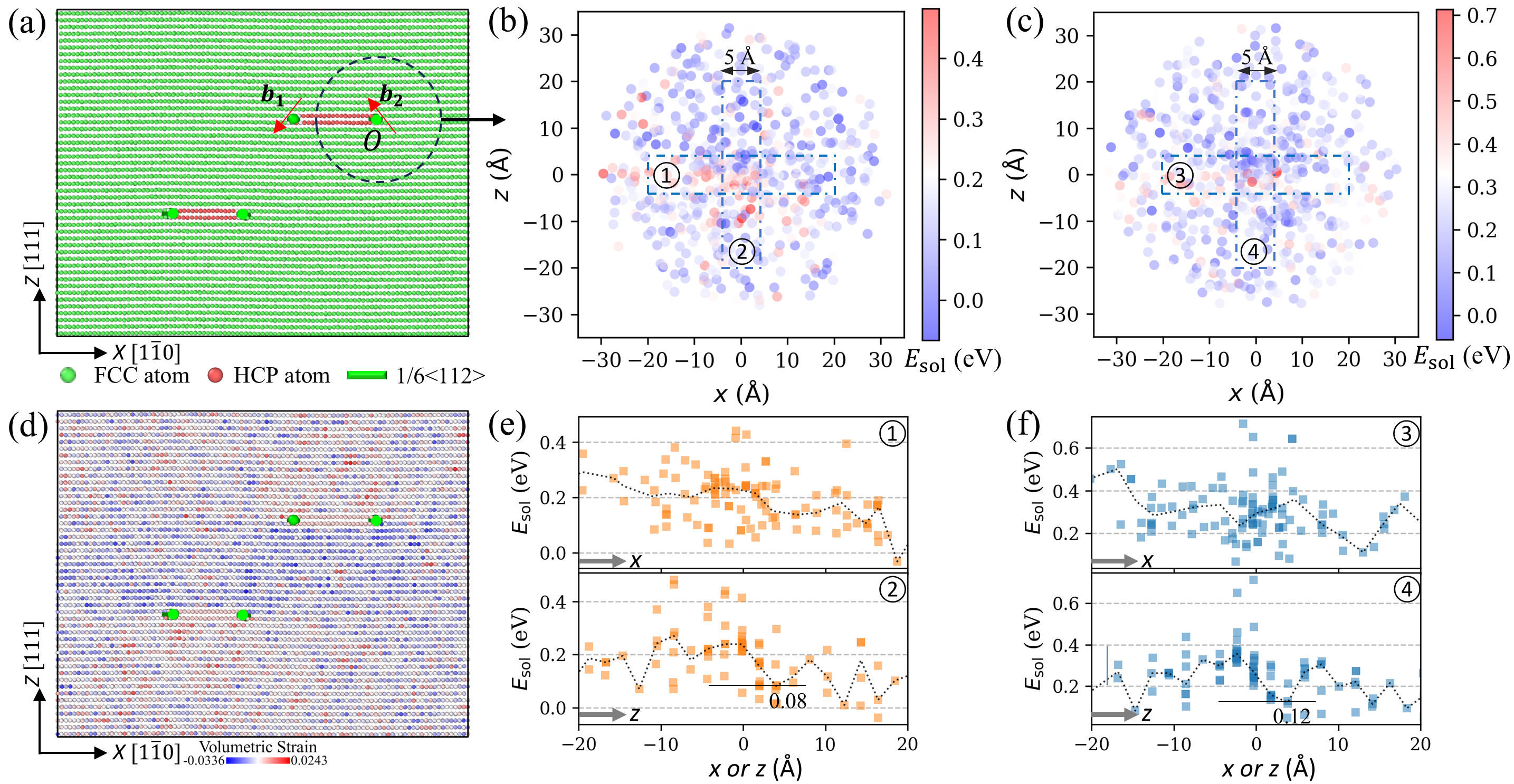
Figure 4: Hydrogen solution energies in the dislocation vicinity are modulated by both local strain and chemistry; tensile core provides slight preference for segregation, accentuated by CSRO.
Implications, Contrasts, and Perspectives
The study makes several strong, data-driven claims:
- CSRO intrinsically elevates the bulk hydrogen solution energy and reduces the density of deep trapping sites, effectively lowering the equilibrium hydrogen content in the lattice.
- The effect of hydrogen on substitutional chemical ordering is negligible at dilute concentrations.
- Although hydrogen does partition to dislocation cores, the associated trapping energies are weak and unlikely to act as deep, irreversible traps.
- The modulation of bulk hydrogen uptake by CSRO, rather than trapping at planar faults or vacancies, is posited as a key contributor to the observed resistance of CoNiV to hydrogen embrittlement.
From a theoretical perspective, the explicit quantification of bulk and defect-site hydrogen energetics as a function of chemical order provides critical insight into the thermodynamic driving forces governing hydrogen partitioning and redistribution under service environments. Practically, these results imply that process routes that enhance CSRO may provide an avenue to mitigate hydrogen embrittlement susceptibility in technologically relevant alloys. Future research directions include time-resolved modeling of hydrogen–defect kinetics, exploration of higher hydrogen chemical potentials, and explicit correlation of atomistic predictions with micromechanical property measurements.
Conclusion
The systematic development and deployment of an MLIP for the Co–Ni–V–H system enabled quantitative atomistic simulation of CSRO, hydrogen energetics, and hydrogen–defect interactions in concentrated alloys. Results unambiguously demonstrate that CSRO modulates hydrogen uptake and redistribution, primarily by raising the mean solution energy and reducing strongly binding environments, while dislocation-related trapping remains shallow and reversible. These findings advance the atomistic understanding of hydrogen tolerance in CSRO-forming alloys and underline the importance of chemical order engineering as a lever for hydrogen environment embrittlement resistance.