- The paper presents a theoretical framework defining stable points in value factorization and reveals how multiple suboptimal attractors hinder convergence.
- It introduces MRVF, an iterative algorithm that clips payoffs to destabilize inferior actions and enforces strict improvement toward the global optimum.
- Empirical results in risk-reward games, predator-prey tasks, and SMAC demonstrate MRVF’s robust performance and enhanced policy convergence.
Multi-Round Value Factorization: Stable Point Analysis and Overcoming Suboptimality in MARL
Introduction
Value decomposition via factorization has been central in cooperative Multi-Agent Reinforcement Learning (MARL) but is limited by representational constraints—especially in environments with non-monotonic payoffs, where conventional factorization schemes often converge to suboptimal policies. The paper "Breakthrough the Suboptimal Stable Point in Value-Factorization-Based Multi-Agent Reinforcement Learning" (2604.05297) presents a rigorous theoretical framework for analyzing the suboptimality of value-factorization, introduces the concept of stable points for general convergence analysis, and proposes Multi-Round Value Factorization (MRVF), a method that systematically eliminates suboptimal attractors by iteratively destabilizing inferior solutions.
Stable Point Theory for Value Factorization
The classical analyses in value-factorization (e.g., QMIX, QTRAN, QPLEX, ResQ) generally assume convergence towards global optima, disregarding the observed empirical frequency of suboptimal convergence. The authors formalize the notion of a stable point: a joint action under which the dynamical system induced by greedy action updates ceases further transitions and thus reflects algorithmic convergence. They elucidate that multiple stable points exist for typical value factorization objectives and demonstrate, both theoretically and with counter-examples, that most methods admit non-optimal stable points—fundamentally explaining suboptimal policy convergence in practice.
They employ a discrete dynamical systems view, treating the transition in the greedy joint action as a mapping governed by gradient and gradient-free components—highlighting the role of gradient discontinuities due to action-selection switches. This is a key distinction not accounted for by prior theoretical work and critical for understanding the evolution of policy trajectories.
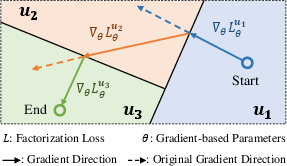
Figure 1: Gradient discontinuity occurs at greedy action transitions due to the update of gradient-free components affecting parameter gradients.
The authors show for representative algorithms:
- QMIX, WQMIX: The optimal joint action is not necessarily a stable point, and in highly non-monotonic settings, suboptimal stable points can even strictly dominate.
- QPLEX, ResQ: Even when the optimal action is stable, there exist multiple suboptimal stable points for QPLEX; ResQ's global optimum is only weakly stable—the policy may easily escape it due to lack of attraction.
- Implication: Guaranteeing the global optimum requires it to be the unique strongly stable point, which is unattainable in realistic high-dimensional joint action spaces via a single-round factorization.
Multi-Round Value Factorization (MRVF)
To address these limitations, the authors propose iterative filtering: instead of attempting the unattainable feat of making the global optimum the unique attractor in a single shot, MRVF operates across rounds. Each round redefines the optimization objective so that actions with payoffs less than the previous round's selected action are clipped—destabilizing suboptimal attractors and enforcing progress towards higher-payoff solutions.
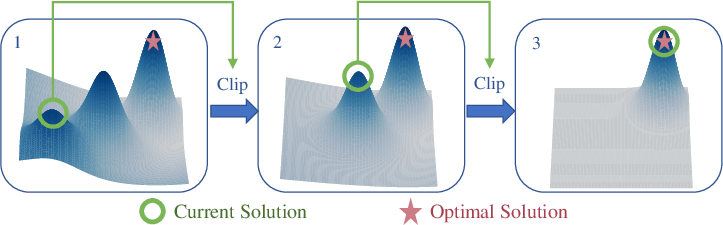
Figure 2: By clipping payoffs, MRVF suppresses suboptimal attractors, ensuring that in each round, inferior actions cannot be recurrent stable points.
The algorithmic realization is:
- Round k=1: Standard monotonic factorization on the joint action value.
- Subsequent Rounds: The loss for a candidate joint action is the clipped positive difference between its current estimated value and the previous round's best action. Only actions achieving strictly higher payoffs can remain stable points.
- Termination: The process halts when no further improvement in estimated payoff is possible.
This scheme satisfies the Strict Improvement Condition: at each iteration, unless already at the optimum, the selected action strictly improves over the previous. The authors theoretically prove convergence to the global optimum within a finite number of rounds under this condition.
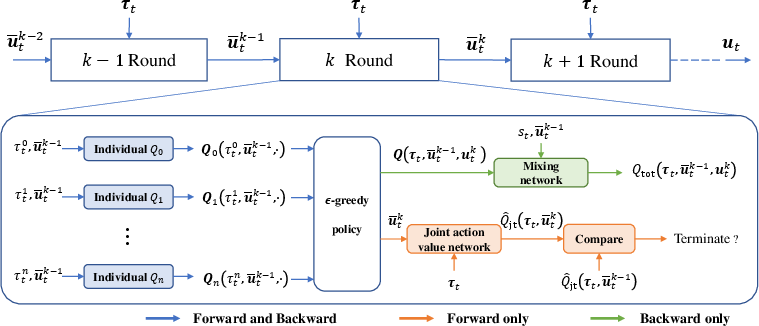
Figure 3: The MRVF framework alternates between greedy action selection and progressive solution filtering via multi-round network architectures.
Empirical Evaluation
Risk-Reward One-Step Games
In randomly generated high-dimensional risk-reward games with highly non-monotonic joint payoff tensors, MRVF consistently identifies globally optimal actions, substantially outperforming monotonic (QMIX, NA2Q) and weighted (QTRAN, WQMIX) methods. As the number of agents or action dimensionality increases (reward sparsity increases), competing methods collapse to nearly zero or negative returns; MRVF maintains high returns, though performance degrades gracefully as the combinatorial search becomes infeasible for all methods.
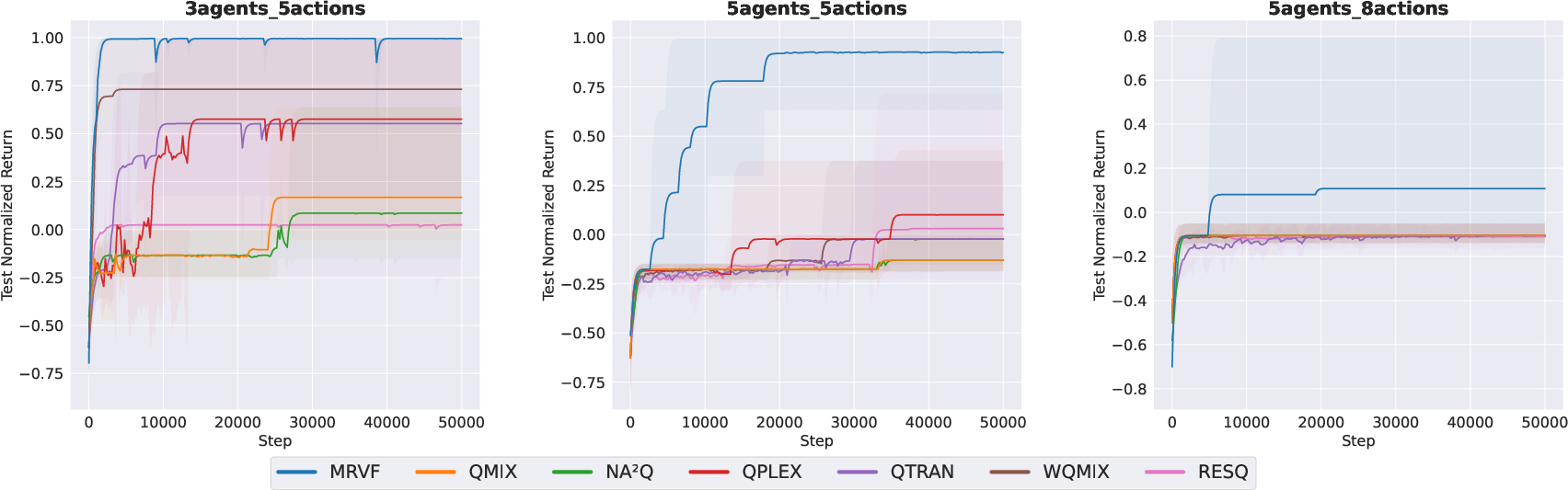
Figure 4: MRVF attains near-optimal normalized returns in risk-reward benchmarks, while baseline methods collapse due to suboptimal stable points.
Predator-Prey Coordination
On the 8-agent predator-prey task with increasing penalties for failed coordinated captures (heightened non-monotonicity), monotonic and prior factorization methods rapidly deteriorate as agents avoid risky cooperative actions due to the attractor structure. MRVF remains robust, consistently finding policies that exploit coordinated captures, achieving superior cumulative rewards across all penalty regimes.
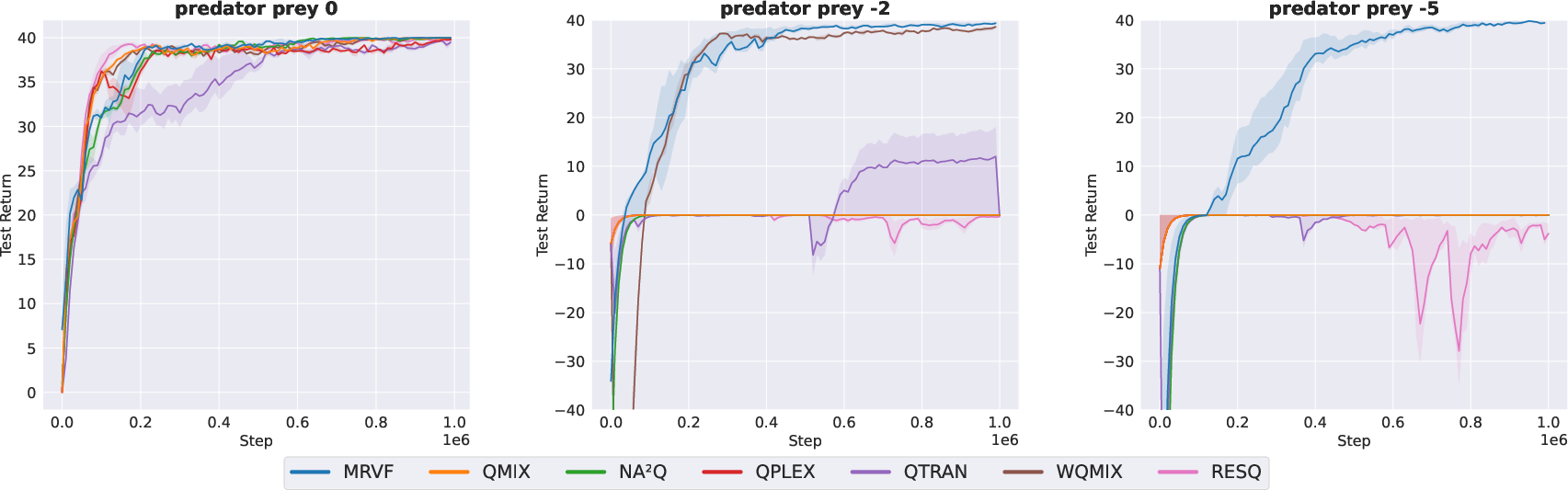
Figure 5: As punishment and non-monotonicity grow, MRVF sustains high returns, in contrast to the failure of competitive schemes.
StarCraft II Multi-Agent Challenge (SMAC)
In both monotonic (e.g., SMAC) and highly non-monotonic tasks, MRVF is at least competitive with, and often outperforms, state-of-the-art methods across all scenarios. It shows reduced variance and improved robustness—where others, like QPLEX and WQMIX, show instability and scenario sensitivity due to suboptimal convergence.
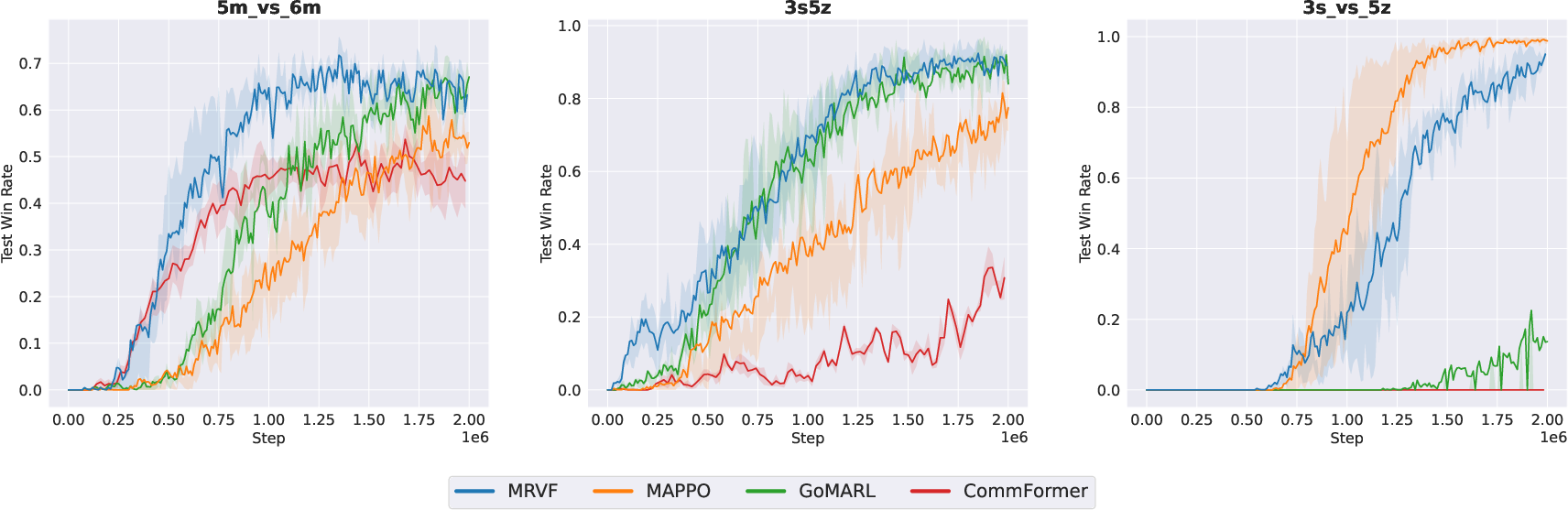
Figure 6: Test win rates on SMAC indicate MRVF’s superior consistency and final performance.
Ablation studies confirm the necessity of multi-round strict improvement: single-round or non-strict-improvement variants perform worse, especially in non-monotonic domains.
Theoretical Implications
This work establishes the stable-point paradigm as a unifying theoretical foundation for analyzing value factorization convergence. The discrete dynamical system characterization exposes the limitations of existing methods, identifies precisely when and why suboptimal attractors dominate, and informs algorithmic strategies (multi-round, strict improvement) that systematically circumvent such traps.
Furthermore, the correspondence between MRVF and multi-round communication or negotiation in MARL—which iteratively improves proposed joint actions via repeated information exchange and solution refinement—opens the door for extending these ideas to learning-based inter-agent communication, as well as policy-gradient and hybrid paradigms.
Practical Impact and Future Directions
The architecture and sampling strategies are readily compatible with existing monotonic factorization implementations and offer practical benefits for sparse-reward, non-monotonic, and complex coordination environments.
The main limitations are increased computational complexity (multiple network passes per environment step) and a potential delay in TD backup propagation. Future work may investigate more efficient surrogate architectures, progressive network expansion for round reduction, decentralized variants, or adaptive round scheduling to balance performance and computation.
Algorithmic generalization towards continuous action spaces, hierarchical decompositions, and explicit communication mechanisms are promising avenues enabled by the multi-round stable-point analysis.
Conclusion
The stable-point theoretical framework and the MRVF algorithm provide both insight and solution to the endemic problem of suboptimal convergence in value-factorization-based MARL. By explicitly characterizing the solution landscape and exploiting iterative destabilization of suboptimal modes, MRVF achieves robustness and global optimality unattainable by prior methods—a substantial advance in both MARL theory and practice.