- The paper identifies a geometry-driven quantum phase transition from a uniform condensate to nematic states via a tunable parameter θ in 1D flat band lattices.
- It employs the Gross-Pitaevskii and Bogoliubov-de Gennes methods to analyze excitation spectra, revealing vanishing sound velocity at critical transition points.
- The study demonstrates the universality of nematic ordering and its implications for flat-band superconductivity and engineered quantum materials.
Nematic Phase Transitions and Density Modulations in 1D Flat Band Condensates
Introduction and Theoretical Model
The study addresses the ground-state and excitation properties of one-dimensional Gross-Pitaevskii (GP) condensates in flat-band optical lattices. The primary focus is on orthogonal all-bands-flat (ABF) geometries, where a tunable parameter θ systematically deforms compact localized states (CLSs), directly modifying flat-band quantum geometry. The analysis is performed in the weak interaction regime, gn≪gap, ensuring that the GP nonlinearity acts perturbatively within the lowest flat-band manifold.
The two-band ABF lattice features sublattice amplitudes al and bl and supports a local transformation that detangles the original lattice basis into orthogonal CLSs, which can be directly used to minimize the interaction Hamiltonian in the presence of a finite onsite interaction g. The minimization constraint enforces the ground state to reside strictly in the lower flat band, i.e., all fl=0, where fl are the amplitudes of the upper flat band CLSs.
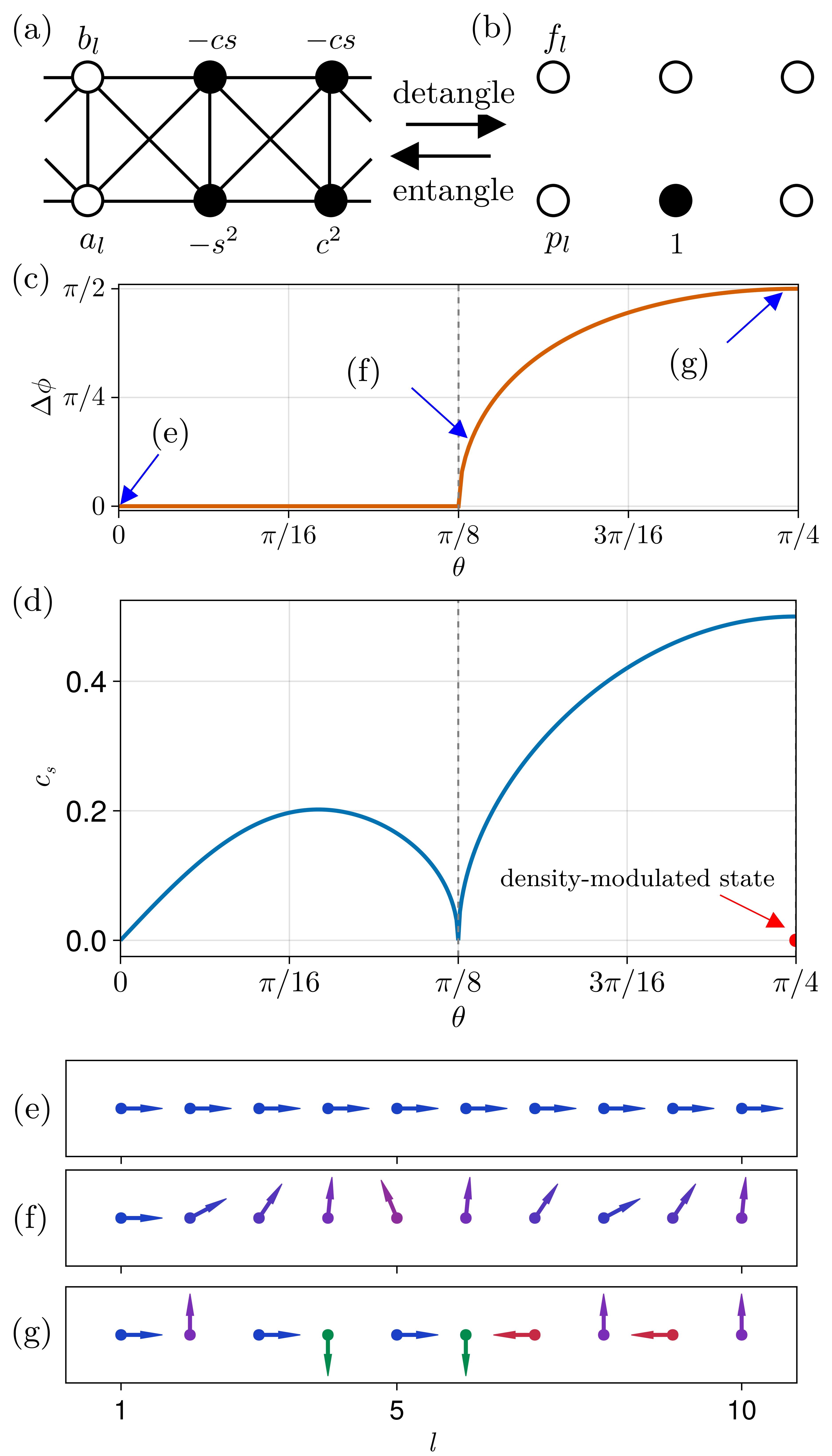
Figure 1: Summary of results for GP-ABF: tight-binding lattice structures, phase diagram, numerically obtained ground states, and computed sound velocity as functions of the flat-band geometry parameter θ.
Geometry-Driven Phase Structure and Macroscopic Nematicity
A key result is the identification of a geometry-driven quantum phase transition, dictated by the variation of θ. For 0≤θ<π/8, the ground state is a uniform condensate with zero phase difference between neighboring CLSs and preserved time-reversal symmetry. For gn≪gap0, the system transitions into an extensively degenerate nematic manifold characterized by broken time reversal symmetry and macroscopic degeneracy. Each ground state can be labeled by a sequence of Ising variables gn≪gap1 reflecting the sign of the phase difference between adjacent CLSs.
At the endpoint gn≪gap2, the CLS amplitudes become constant and an additional pair of ground states emerges. These states exhibit real-space density modulation with vanishing phase stiffness. The phase diagram (Figure 1c) showcases the abrupt change in optimal phase difference as gn≪gap3 crosses the transition, with the multiplicity of nematic ground states given by combinatorial scaling and the allowed winding numbers.
Excitations, Phase Stiffness, and Sound Velocity
The stability of the condensate phases is analyzed through the Bogoliubov-de Gennes (BdG) approach. The acoustic spectrum is parametrized by the phase stiffness gn≪gap4 and compressibility gn≪gap5, with the sound velocity gn≪gap6. Analytical expressions for gn≪gap7 show a non-analyticity at gn≪gap8, where the homogeneous condensate becomes unstable and gn≪gap9 vanishes, corresponding to the phase transition point.
In the nematic regime, all ground states share the same al0. At al1, density-modulated states display al2, signifying the absence of phase rigidity and the dominance of density fluctuations. Full BdG spectra support these analytic results and reveal that the collapse of the Goldstone mode is correlated with the transition from homogeneous to nematic (and then to density-modulated) ground states.
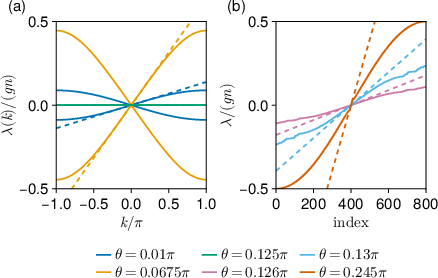
Figure 2: Full BdG spectra for ABF GP models, delineating the collapse and behavior of excitations across different flat-band geometries.
Low Temperature Statistics and Order-by-Disorder
The nematic ground-state manifold, being macroscopically degenerate, naturally raises questions about finite-T selection mechanisms. Simulated annealing, Monte Carlo sampling, and free-energy corrections are employed to probe the potential for order-by-disorder (ObD) selection. For generic values of al3 in the nematic regime, no primary ObD selection is detectable at leading order from acoustic fluctuations, as al4 is configuration-independent. However, at the endpoint al5, the density-modulated states (with al6) are favored thermally due to their softer Goldstone modes, consistent with the free energy correction al7.
Extension to Non-ABF Flat Band Lattices
To assess universality, a linearly independent flat-band geometry, the sawtooth lattice, is investigated. The GP ground-state structure is shown to permit nematicity even when only one (not all) bands are flat, provided the non-interacting constraint is respected. The sawtooth chain supports degenerate uniform-norm nematic ground states on the al8 sublattice, but density-modulated phases are generally absent due to the inhomogeneity of the corresponding CLSs.
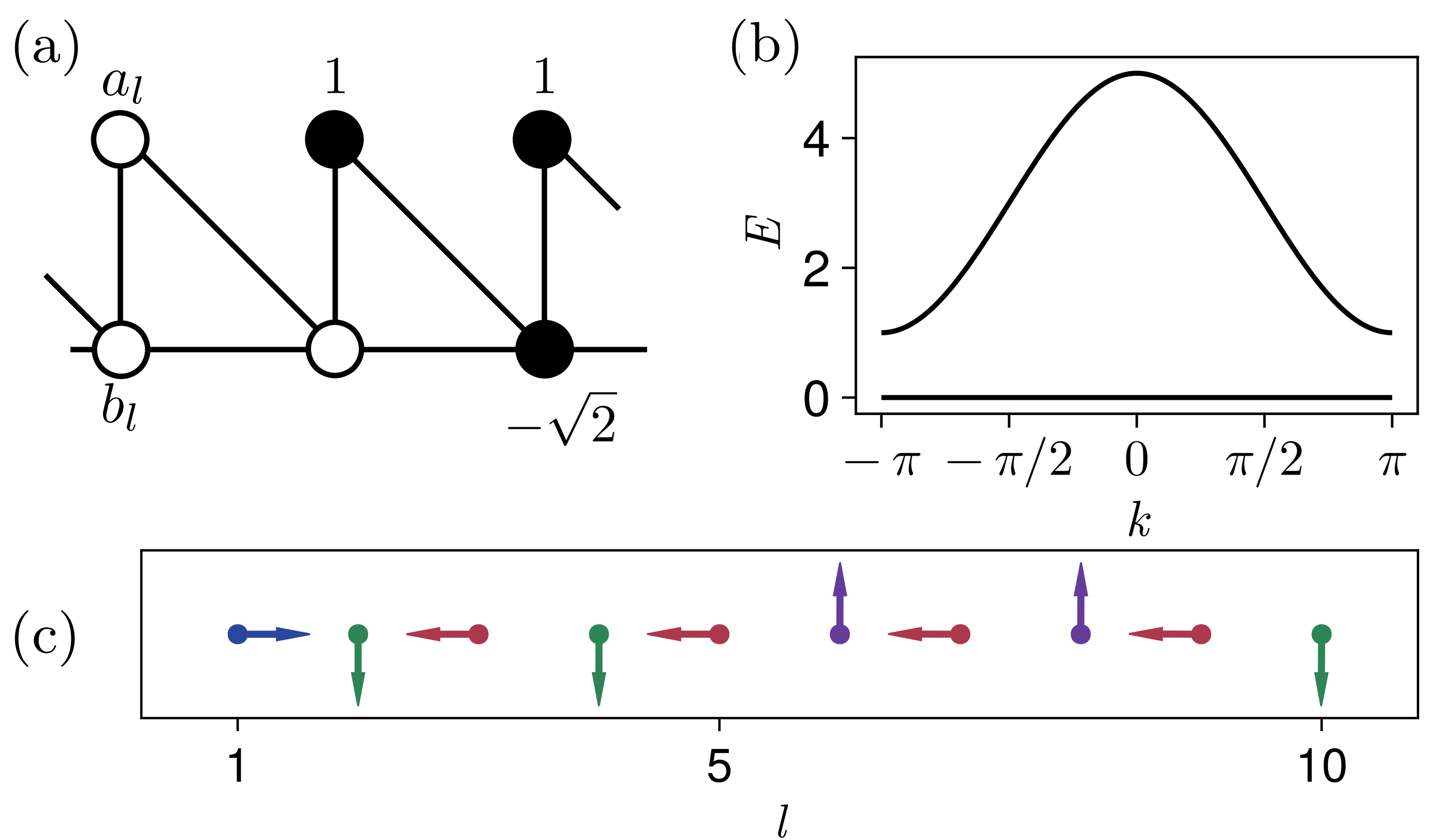
Figure 3: (a) Sawtooth chain tight-binding lattice. (b) Band structure showing flat and dispersive bands. (c) Numerically obtained nematic ground state.
Conclusion
This work provides a comprehensive characterization of the interplay between quantum geometry, GP nonlinearity, and emergent macroscopic nematicity in one-dimensional flat-band systems. The sensitivity of collective excitation spectra—specifically sound velocity—to local geometric parameters enables experimental access to the underlying phase structure, including phase transitions and the existence of alternative ground-state manifolds with vanishing stiffness.
The results clarify the robust connection between flat-band geometry and condensate degeneracy, establish the absence of leading-order ObD selection within the nematic regime, and emphasize the generalizability of nematic ordering beyond orthogonal ABF models. The findings have direct implications for flat-band superconductivity, where geometric tuning of lattices may be employed to tailor many-body phase structure and transport, and suggest avenues for engineered degeneracy and fluctuational selection in synthetic quantum materials and cold-atom experiments.
(2604.05258)