- The paper introduces a temporal extension to TabDDPM by integrating timestep embeddings and Conv1D adapters to enhance sequential coherence in sensor data synthesis.
- It demonstrates improved synthetic sequence realism and balanced class augmentation through context-aware and conditional embeddings tailored for HAR.
- Experiments on the WISDM dataset reveal statistically aligned and temporally consistent synthetic data that effectively support robust human activity recognition pipelines.
Temporal Diffusion Approaches for Human Activity Recognition: Extending TabDDPM
Motivation and Limitations of Existing Generative Models
The application of diffusion models for privacy-preserving synthetic data generation is of increasing relevance in human activity recognition (HAR), particularly with the proliferation of wearable and smartphone-based sensors. Traditional data collection for HAR, exemplified by datasets such as WISDM, is constrained by privacy, annotation costs, and domain shifts induced by sensor heterogeneity, limiting class balance and statistical diversity. Existing generative models, including GANs, VAEs, and early diffusion architectures, are stymied by weak temporal modeling, high computational cost, and limited interpretability when targeting multivariate time-series data with complex dependencies. Models like TabDDPM yield high-fidelity attribute-wise synthesis in tabular domains but fail to preserve frame-to-frame coherence, inhibiting their utility for sequential sensor synthesis essential in HAR.
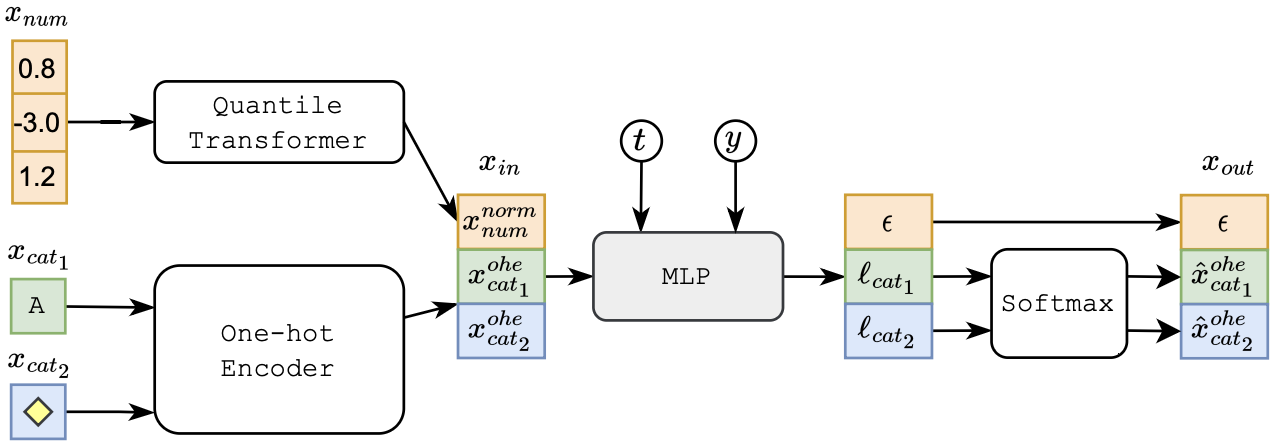
Figure 1: TabDDPM architecture for tabular data with quantile-transformed numerical and one-hot encoded categorical features.
Proposed Temporal TabDDPM: Model Architecture and Methodology
The central methodological advancement in this work is the augmentation of TabDDPM to address temporal structure via context-aware embeddings and lightweight convolutional adapters. The model reformulates sensor data as windowed sequences, augmenting the original TabDDPM’s preprocessing pipeline with:
- Timestep Embeddings: Each denoising phase is associated with a learnable time embedding, permitting the network to model nonstationary dynamics across the sequence.
- Conditional Embeddings: Activity label and auxiliary context (e.g., user ID) are embedded, enabling explicit control of behaviorally distinct trajectories and supporting class-conditioned synthesis.
- Observation Masks: A binary mask representing missing and observed values is concatenated, enhancing robustness to data gaps and uneven sampling paradigms typical in heterogeneous sensor streams.
Critically, the backbone denoising architecture is interleaved with Conv1D-based temporal adapters, facilitating local modeling of inter-timestep relationships at O(T) computational complexity absent in the original TabDDPM, but avoiding the quadratic cost of self-attention-driven architectures. This design targets realistic sequence synthesis under resource constraints, integrating local temporal information while retaining inference efficiency and simplicity.
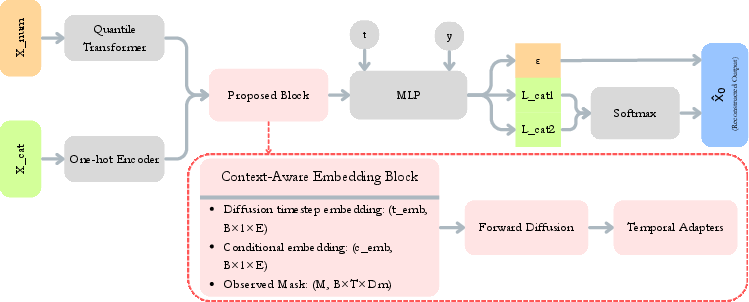
Figure 2: Proposed Temporal TabDDPM architecture with context-aware embeddings and temporal adapters.
Experimental Setup and Data Processing
The model is evaluated using the WISDM dataset, which provides triaxial accelerometer data across six distinct activities, sampled at 20 Hz. Data from five users are preprocessed into windows of 100 samples with a 50% overlap, ensuring both class stratification and sequence continuity for model training and evaluation. Attribute normalization uses quantile transformation; categorical activity labels are integer encoded. The observation mask enables robust sequence modeling in the presence of missingness. The network leverages the AdamW optimizer, gradient clipping, and a cosine annealed learning schedule over 1000 diffusion steps.
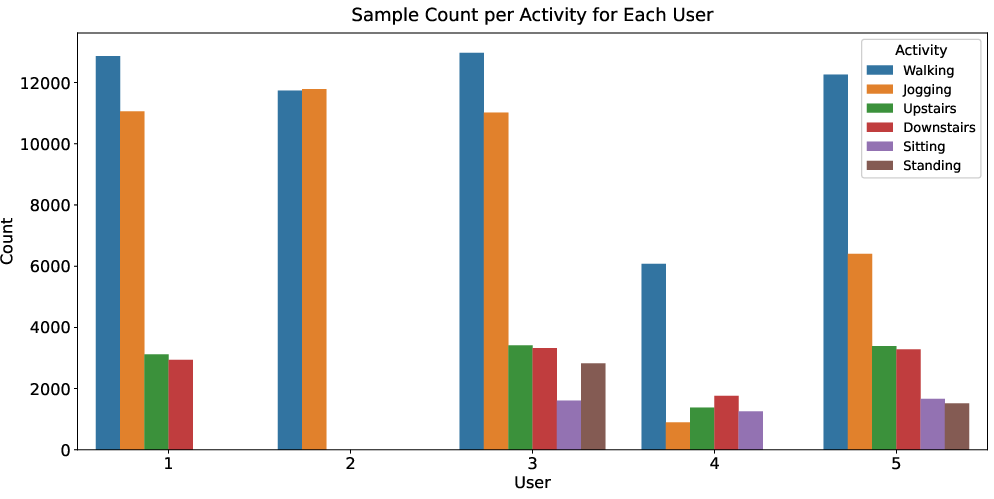
Figure 3: Activity distribution across the five selected users.
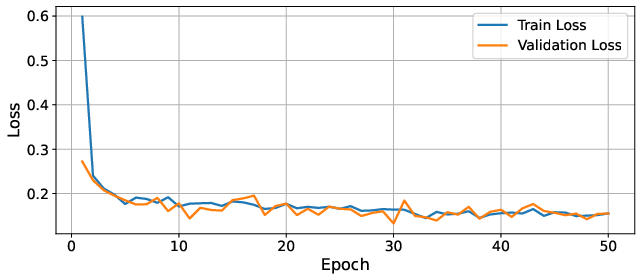
Figure 4: Training and validation loss over 50 epochs.
Synthetic Sequence Quality: Statistical and Temporal Evaluation
Synthetic data generated by the Temporal TabDDPM demonstrate close alignment with real sensor distributions, validated through comparative feature histograms and time-series plots. In contrast to both interpolation-based methods (e.g., SMOTE) and the static original TabDDPM, the proposed approach yields smoother, temporally coherent sequences that closely match the dynamics of target activities.
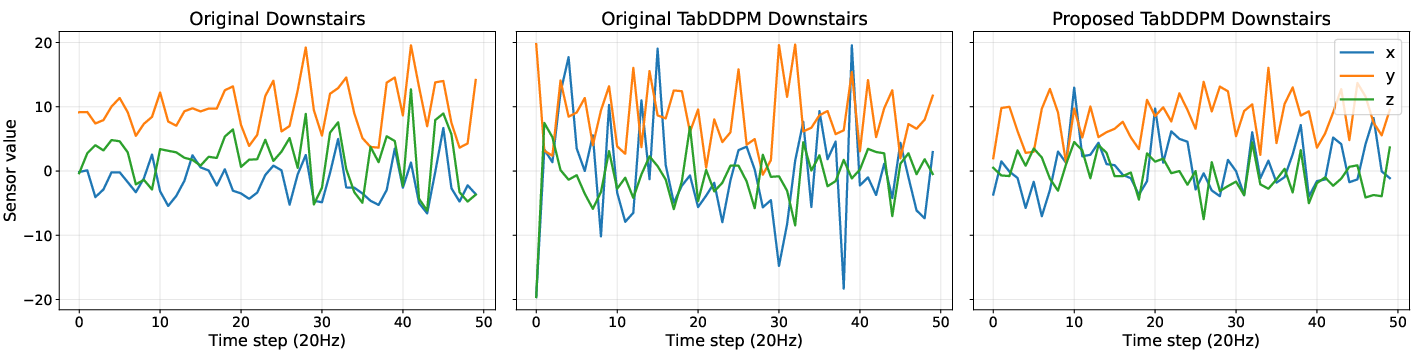
Figure 5: Comparison of real and synthetic accelerometer sequences for the Downstairs activity.
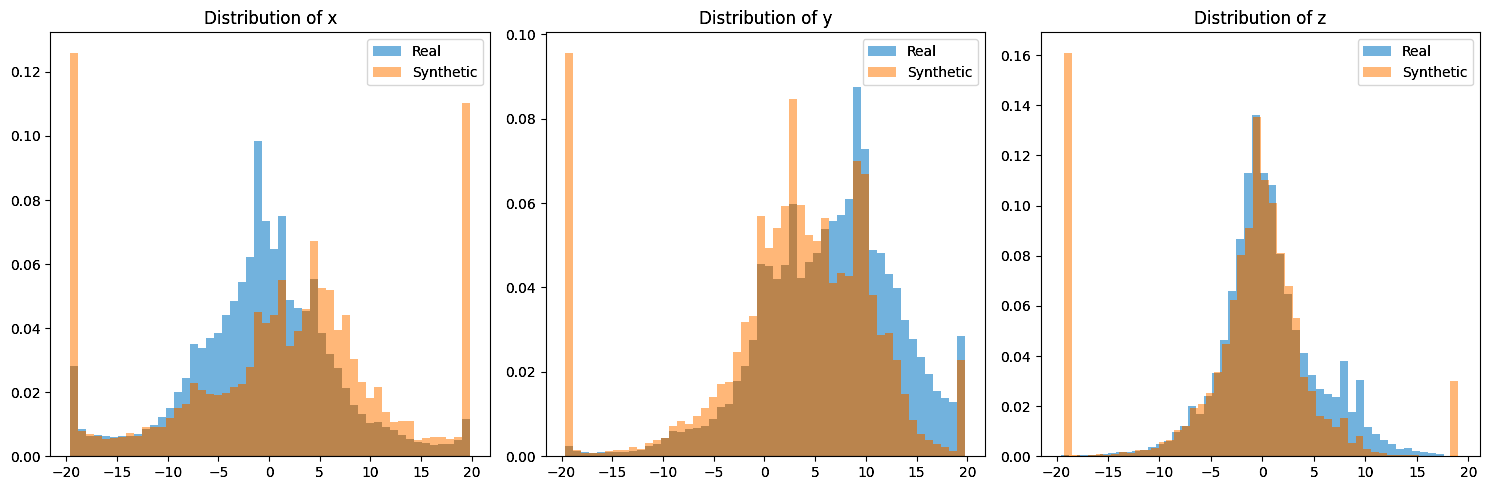
Figure 6: Distribution comparison of accelerometer features (x, y, z) between real and synthetic data.
Class Imbalance Correction and Downstream Classification
The temporal extension to TabDDPM delivers balanced data augmentation for minority activities. Synthetic data is used to upsample underrepresented classes in the training set, with the augmented datasets evaluated using Random Forest classifiers on a held-out test partition. The macro F1-score (0.64) and accuracy (0.71) attained by Temporal TabDDPM closely mirror those achieved with SMOTE and the non-augmented baseline, with meaningful precision/recall improvements for static activity classes (e.g., Sitting and Standing).
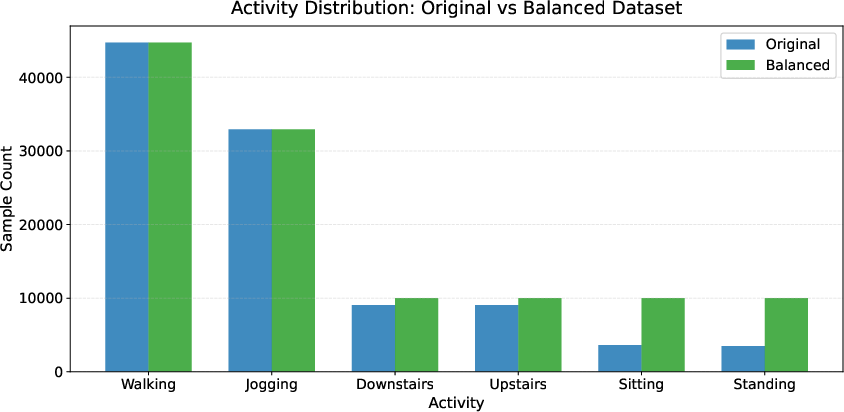
Figure 7: Class distribution before and after augmentation.
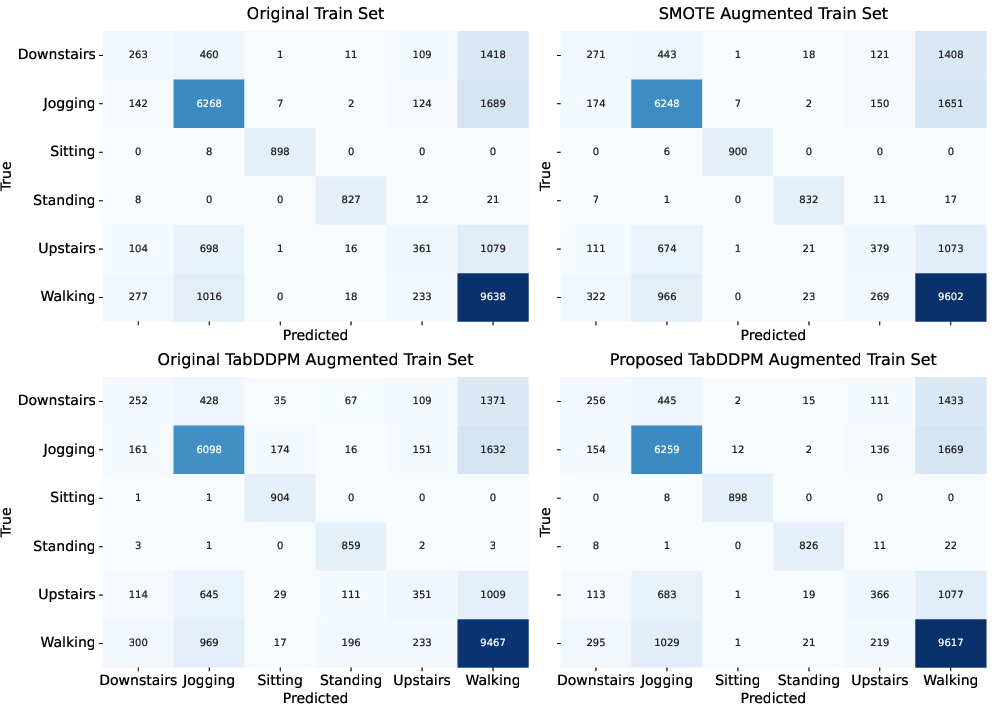
Figure 8: Confusion matrices for Random Forest classifiers trained on (a) Original, (b) SMOTE augmented, (c) Original TabDDPM, and (d) Proposed TabDDPM datasets.
Temporal Structure: Bigram and ACF Validation
Temporal consistency is quantitatively assessed via bigram transition matrices and autocorrelation functions (ACFs). Temporal TabDDPM accurately reconstructs the sharp, localized transition patterns of real sequences, a capability lacking in both vanilla TabDDPM and SMOTE. Furthermore, the method preserves activity-specific temporal dependencies: dynamic classes (Upstairs, Downstairs) retain short-range decay and nonstationarity, while static classes (Sitting, Standing) show low autocorrelation with mild periodicities reflecting natural micro-movements.
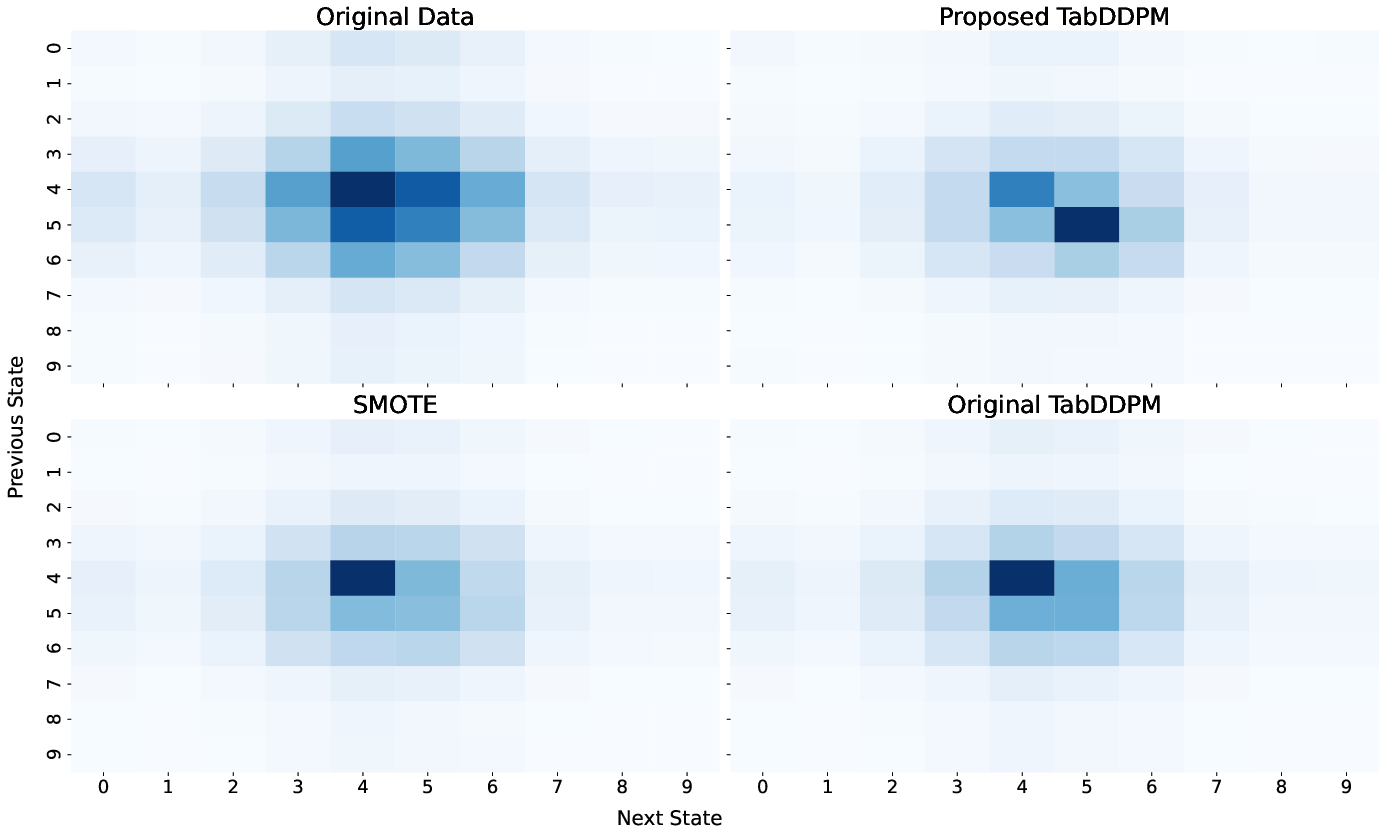
Figure 9: Bigram transition matrices for the X-axis showing short-range temporal transitions for (a) Original data, (b) Proposed TabDDPM, (c) SMOTE, and (d) Original TabDDPM.
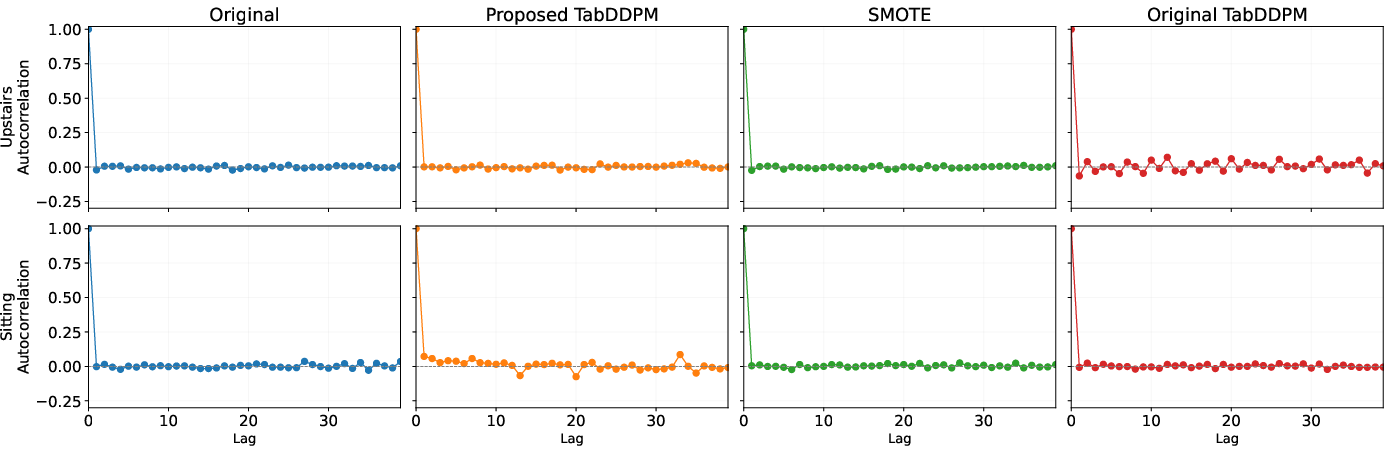
Figure 10: Autocorrelation functions (ACF) for Sitting and Upstairs activities on the Z-axis, comparing temporal dependence across methods.
Implications, Limitations, and Future Directions
The explicit introduction of temporal adapters and activity-conditional embeddings into diffusion-based tabular frameworks is validated as a powerful mechanism for enhancing the statistical and temporal fidelity of synthetic sensor data. While downstream classification gains are modest on WISDM due to short-sequence, high-variance classes and the limitations of static classifiers, the sequence-level realism and stochastics captured by the model strongly support its application to more advanced HAR pipelines—particularly those employing sequence models capable of leveraging richer temporal dynamics (e.g., LSTM, CNN, Transformer-based HAR architectures).
Principal limitations center around sole benchmarking on WISDM, precluding robust generalization claims to more complex multimodal sensor arrays. The current design is also limited to short windowed segments. Future extensions will address longer sequence modeling, integration of multi-sensor modalities, and explorations into transformer-based temporal diffusion, providing enhanced expressiveness and cross-domain generality.
Conclusion
The work provides conclusive evidence that equipping diffusion-based tabular generators with lightweight yet expressive temporal and context-aware components substantially improves their capacity to synthesize realistic and temporally coherent time-series data for HAR. The resulting model achieves competitive discriminative performance while outperforming in temporal structure and diversity, underlining the practical utility for privacy-preserving augmentation, robust minority class synthesis, and as a foundational generative mechanism for modern sequential modeling tasks in sensor analytics.
(2604.05257)

