- The paper establishes quantum precision limits in optical pulse ranging by deriving quantum Cramér-Rao bounds using an effective Hamiltonian approach.
- It demonstrates that minimizing temporal pulse width provides greater uncertainty reduction than intensity squeezing, especially under photon loss.
- The findings indicate that quantum advantages are confined to low-loss, controlled scenarios, emphasizing advanced pulse shaping and mode engineering.
Quantum Noise and Fundamental Limits in Optical Pulse Ranging
Introduction
This work analyzes the precision limits of distance measurements using quantum optical pulses, particularly frequency combs, within the context of light-based ranging (LiDAR) in dispersive media. The study leverages an effective Hamiltonian approach to derive the quantum Cramér-Rao bounds (QCRBs) for estimation tasks involving both the distance and nuisance parameters related to the ambient environment. The principal focus is on assessing the impact of intensity squeezing and temporal pulse shaping on achievable precision, with an explicit comparison to the classical (shot noise) limit. The analysis elucidates the modal dependencies of the QCRB and identifies the precise operational scenarios where quantum advantage could manifest.
Quantum Estimation Framework for Pulse Ranging
The ranging modality studied employs optical frequency combs, exploiting their ultrashort pulses and phase stability. The phase acquired by the comb upon propagation encodes the length L, group delay, and group-velocity dispersion due to atmospheric conditions, introducing a multiparameter estimation scenario. The QCRB is evaluated via the quantum Fisher information matrix, incorporating both intrinsic quantum fluctuations (through photon number variances) and modal structure (e.g., pulse duration, kurtosis, and asymmetry).
The estimation scenario distinguishes between optimal detection (knowing all nuisance parameters) and the realistic, generally suboptimal, multiparameter regime. Homodyne detection with shaped local oscillators is discussed as the practical modality for achieving mode-selective sensitivity, with precision ultimately limited by the QCRB when nuisance parameters are present.
Impact of Mode Structure and Quantum Fluctuations
The analysis uses displaced squeezed vacuum states to model quantum states of the pulses, characterizing average photon number N and photon number variance Δ2N, and explores the influence of second and fourth spectral moments (μ2, β) on the QCRB for L.
Key findings demonstrate that squeezing (increasing Δ2N) offers only moderate improvement over shot noise in the minimum attainable uncertainty. The strongest reduction in uncertainty is achieved by minimizing temporal pulse width, enhancing the time-of-flight contribution relative to phase estimation. Modal features such as high kurtosis (e.g., hyperbolic secant spectra) present slight advantages by redistributing the spectral weight, but the effect is secondary compared to pulse duration and quantum noise manipulation.
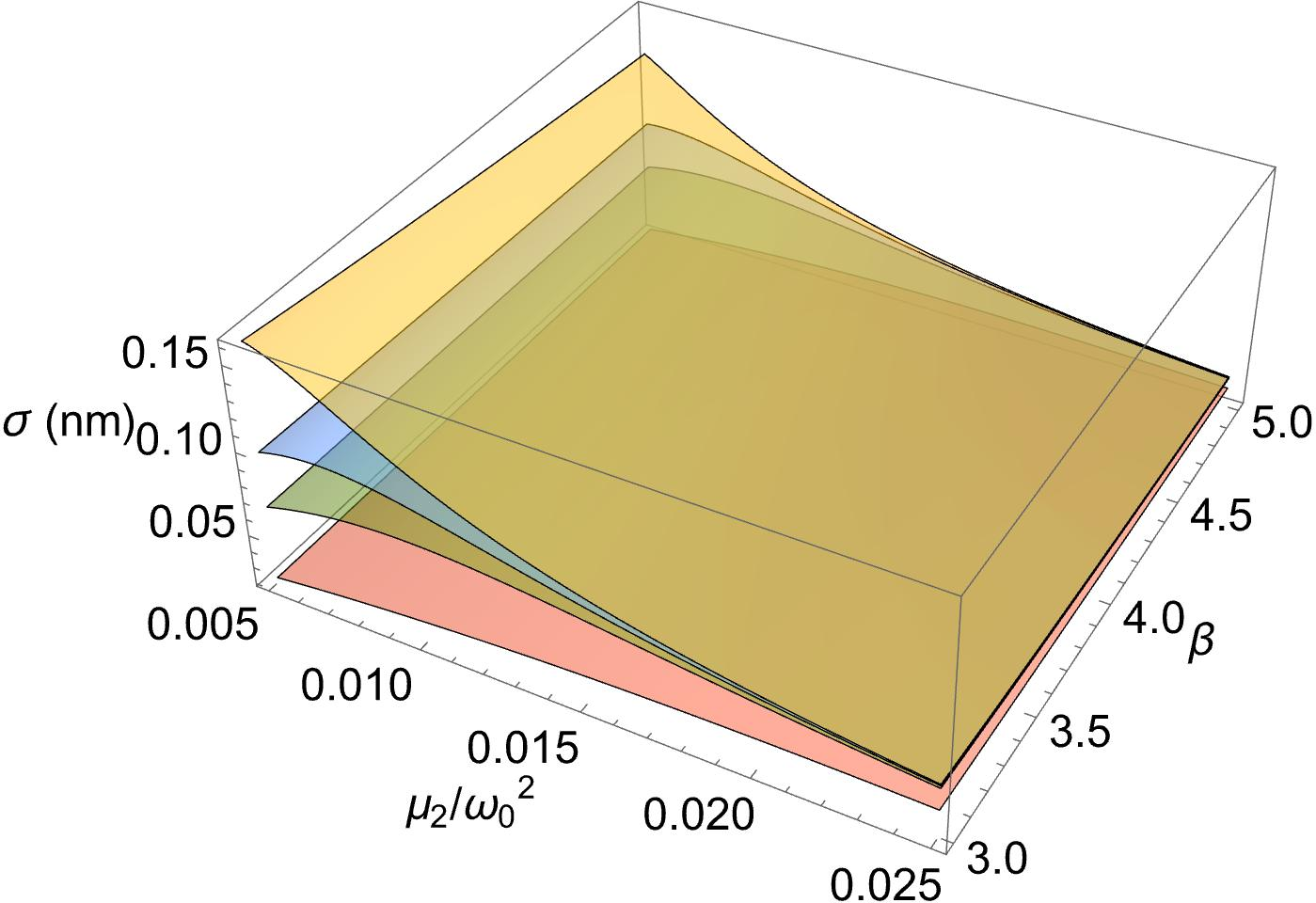
Figure 1: Uncertainty σ of the retrieved value of L as a function of spectral second moment μ2 and kurtosis N0 for N1 photons and varying degrees of intensity noise (anti-squeezing).
Asymmetric Pulse Spectra and Modal Dependence
Pulse asymmetry (quantified by a skewness parameter N2) is analyzed using a skewed-normal spectral model. The precision bound, normalized to the Gaussian spectrum, shows limited sensitivity to moderate asymmetry, reflecting the robustness of the ranging protocol to spectral skew for realistic parameter regimes. At low to moderate squeezing, asymmetry can slightly degrade performance, while at higher squeezing, modest improvement relative to the symmetric case is observed.
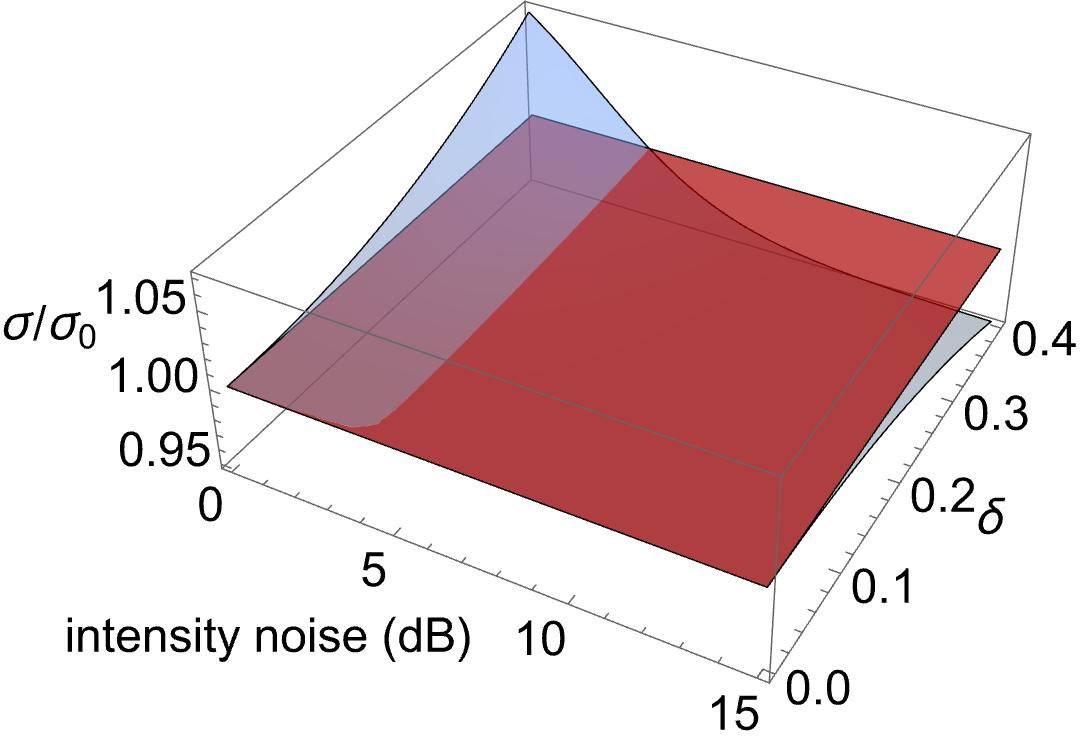
Figure 2: Uncertainty N3 in N4 as a function of intensity squeezing and asymmetry parameter N5, normalized to the Gaussian case, at fixed N6.
Losses and Practical Considerations
The paper systematically quantifies the impact of photon loss, modeled as transmission N7, on the QCRB and the photon number variance. The analysis shows unequivocally that the quantum enhancement provided by squeezing becomes negligible at moderate loss levels, even though N8 may still differ from the shot noise case. When transmission is low, the precision converges to the shot noise limit, regardless of initial quantum enhancements.
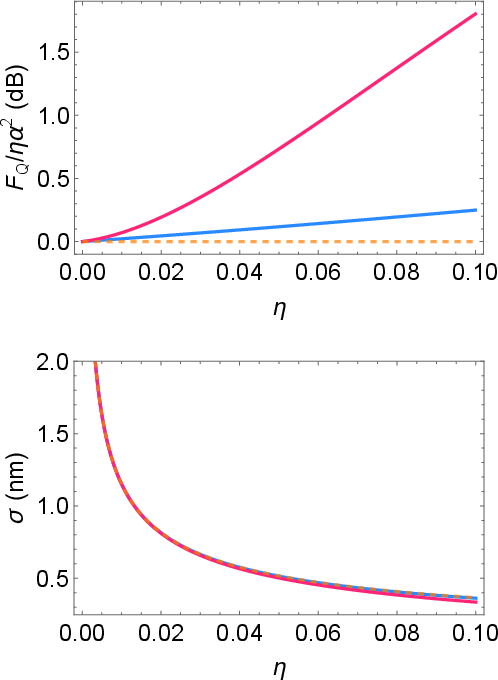
Figure 3: (Upper) Quantum Fisher information N9 versus channel transmittance Δ2N0; (Lower) uncertainty Δ2N1 in Δ2N2, both for different levels of initial squeezing and compared to the shot noise reference.
Theoretical and Practical Implications
The findings establish that in dual-mode quantum optical ranging—combining pulsed and phase-sensitive protocols—the possibility for substantial quantum enhancement via squeezing is fundamentally constrained. The multiparameter structure, inclusion of dispersion, and spectral-temporal properties of the comb dictate the limits more profoundly than quantum fluctuations alone. Thus, in realistic high-loss or long-range scenarios (e.g., satellite geodesy, open-air LiDAR), squeezing yields little to no operational advantage over classical strategies.
In contrast, opportunities for quantum enhancement exist in short-to-intermediate range settings, where loss is minimized and finer temporal pulse control is technically feasible. Examples include controlled-environment metrology or autonomous navigation for ground vehicles, where atmospheric variations and attenuation are less severe.
Conclusion
This study rigorously delineates the quantum precision bounds for distance estimation using optical pulses, clarifying that the practical advantage of quantum resources such as intensity squeezing is marginal outside of highly controlled, low-loss domains. The work effectively benchmarks the attainable performance and highlights the predominant importance of temporal pulse engineering and system-level losses. Future efforts may prioritize advanced mode engineering and loss mitigation, or shift focus to application domains where quantum enhancements in estimation are not rendered negligible by realistic imperfections.
(2604.05107)