Quantum Algorithms for Heterogeneous PDEs: The Neutron Diffusion Eigenvalue Problem
Published 6 Apr 2026 in quant-ph and math.AP | (2604.05098v1)
Abstract: We develop a hybrid classical-quantum algorithm to solve a type of linear reaction-diffusion equation, the neutron diffusion (generalized) k-eigenvalue problem that establishes nuclear criticality. The algorithm handles an equation with piecewise constant coefficients, describing a problem in a heterogeneous medium. We apply uniform finite elements and show that the quantum algorithm provides significant polynomial end-to-end speedup over its classical counterparts. This speedup leverages recent advances in quantum linear systems -- fast inversion and quantum preconditioning -- and uses Hamiltonian simulation as a subroutine. Our results suggest that quantum algorithms may provide speedups for heterogeneous PDEs, though the extent of this advantage over the fastest classical algorithm depends on the effectiveness of other classical approaches such as nonuniform or adaptive meshing for a given problem instance.
The paper demonstrates rigorous quantum speedups for solving the neutron diffusion eigenvalue problem in highly heterogeneous media.
It introduces a hybrid quantum-classical framework using block-encoding and BPX-type quantum preconditioning to handle poor solution regularity.
Numerical results validate that classical FEM complexity significantly degrades in heterogeneous settings, underlining the practical impact of the quantum approach.
Quantum Algorithms for Heterogeneous PDEs: The Neutron Diffusion Eigenvalue Problem
Introduction
The paper "Quantum Algorithms for Heterogeneous PDEs: The Neutron Diffusion Eigenvalue Problem" (2604.05098) presents a detailed study of quantum algorithms for solving elliptic PDE eigenvalue problems in highly heterogeneous media, with a focus on the neutron diffusion k-eigenvalue problem. The authors rigorously analyze the end-to-end complexity of quantum finite element methods (FEM) for this problem class, incorporating the effects of solution regularity and material heterogeneity. Strong polynomial speedups are proven for quantum over classical algorithms in the regime of low solution regularity, precisely the case where FEM convergence is severely limited by coefficient discontinuities.
The Neutron Diffusion Eigenvalue Problem in Heterogeneous Media
The k-eigenvalue neutron diffusion equation considered is
(−∇⋅(D(x)∇)+Σa(x))ϕ(x)=k1νΣf(x)ϕ(x),
on a unit cube with Dirichlet boundaries. Here, D(x), Σa(x), and νΣf(x) are piecewise constant, modeling a reactor core comprised of multiple materials (fuel, moderators, etc.). The principal eigenvalue kmax determines system criticality, and must be computed to high accuracy for reactor design/analysis.
Classical and Quantum Complexity: The Role of Regularity
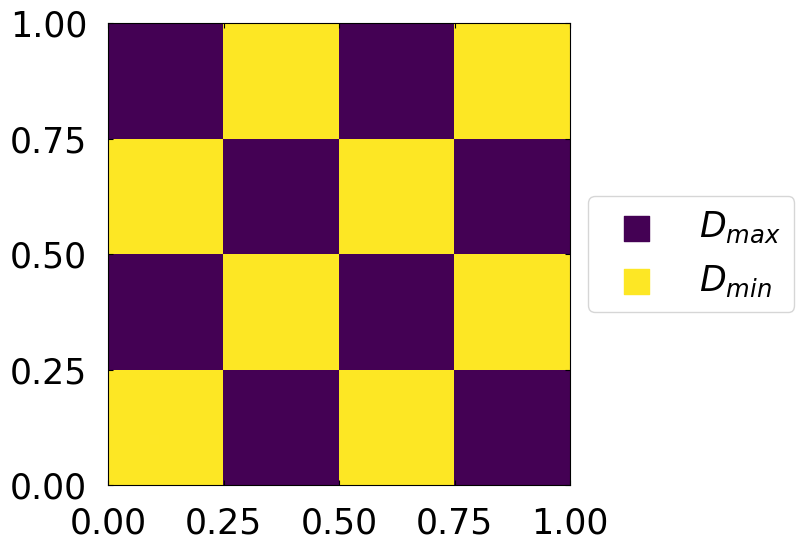
In classical FEM, the required mesh resolution for a given accuracy is dictated by the Sobolev regularity of the PDE solution. For heterogeneous coefficients (i.e., across material interfaces), the solution regularity can be very low and convergence exponents are severely reduced. This effect is particularly acute in checkerboard or strongly layered configurations. The minimal regularity parameter γ=Dmin/Dmax quantifies this degradation, and for realistic contrasts leads to mesh complexity N=Ω(ϵ−p) for large p.
The classical complexity for uniform FEM is then
k0
where k1 is spatial dimension and k2 quantifies solution regularity. Convergence rates collapse for low k3, rendering classical uniform meshing impractical for high accuracy.
Quantum linear system algorithms (QLSA), however, can in principle solve the same discretization in k4 gates, independent of k5 and k6, provided that condition number dependencies can be mitigated (see below). The authors construct a complete pipeline to achieve this.
Quantum Algorithmic Framework
The quantum algorithm follows a hybrid paradigm:
Classical Coarse-grid Solution: The principal eigenvector is computed on a coarse mesh classically.
Quantum State Preparation: The coarse-grid solution is efficiently interpolated and encoded into a quantum state on the fine grid.
Block-encoded Hamiltonian Construction: The discretized generalized eigenproblem is reduced to a Hermitian eigenproblem using symmetrization and block-encoding techniques.
Quantum Preconditioning: The BPX-type quantum preconditioner and fast inversion routines are employed to reduce the condition number dependence to k7.
Quantum Phase Estimation (QPE): The top eigenvalue is extracted via QPE, leveraging the prepared initial state.
Classical Postprocessing: The eigenvalue is measured and reported.
The quantum acceleration hinges crucially on assembling robust block-encodings for all operator components (stiffness, mass, fission, etc.) and efficiently implementing preconditioning in a piecewise-constant, potentially highly ill-conditioned regime.
Quantum Preconditioning and Block Encoding
A major technical achievement of the paper is the explicit construction of low overhead block-encodings for multilevel interpolation operators—and, crucially, for the BPX quantum preconditioner—by exploiting their tensor-product and sparse structure. The preconditioner ensures that the quantum linear system solve does not inherit the dire condition number scaling present in the heterogeneous problem, keeping overall complexity nearly optimal in k9.
Rigorous Convergence and Complexity Analysis
The authors carry out a detailed functional analysis (building on [Petzoldt2001, babuska_1991_eigenvalue_problems]) showing that:
The mesh size (−∇⋅(D(x)∇)+Σa(x))ϕ(x)=k1νΣf(x)ϕ(x),0 needed to reach error (−∇⋅(D(x)∇)+Σa(x))ϕ(x)=k1νΣf(x)ϕ(x),1 is (−∇⋅(D(x)∇)+Σa(x))ϕ(x)=k1νΣf(x)ϕ(x),2 where (−∇⋅(D(x)∇)+Σa(x))ϕ(x)=k1νΣf(x)ϕ(x),3.
The classical complexity is (−∇⋅(D(x)∇)+Σa(x))ϕ(x)=k1νΣf(x)ϕ(x),4 under uniform meshing.
The quantum complexity is (−∇⋅(D(x)∇)+Σa(x))ϕ(x)=k1νΣf(x)ϕ(x),5, with explicit dependence on the number of material regions (−∇⋅(D(x)∇)+Σa(x))ϕ(x)=k1νΣf(x)ϕ(x),6.
Figure 1: A 2D checkerboard configuration—an example of a difficult geometry where solution regularity is minimized and standard FEM convergence is dramatically slowed.
Careful technical work establishes that quantum initial state preparation (via interpolated coarse-grid eigenvectors) maintains constant overlap with the fine-grid eigenstate in the worst-case regularity setting, which is essential for success probability in QPE.
Numerical Results: Empirical Hardness of Heterogeneous Cases
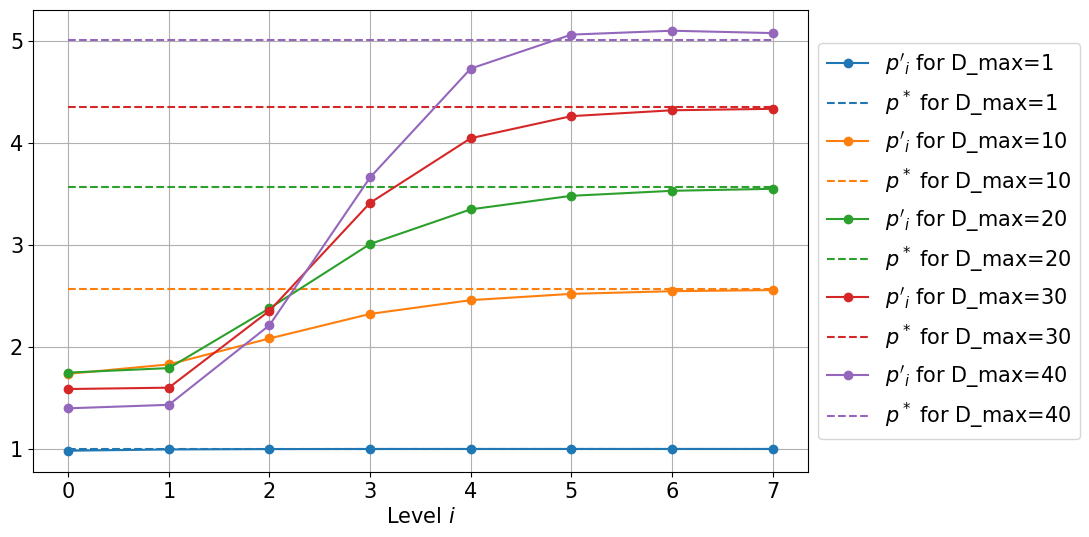
The paper provides numerical evidence, using high-contrast checkerboard patterns, that the classical uniform FEM convergence rates can be arbitrarily slow, saturating the theoretical worst-case exponents. Observed complexity scaling in these cases reaches (−∇⋅(D(x)∇)+Σa(x))ϕ(x)=k1νΣf(x)ϕ(x),7 or worse, consistent with the rigorous bounds.
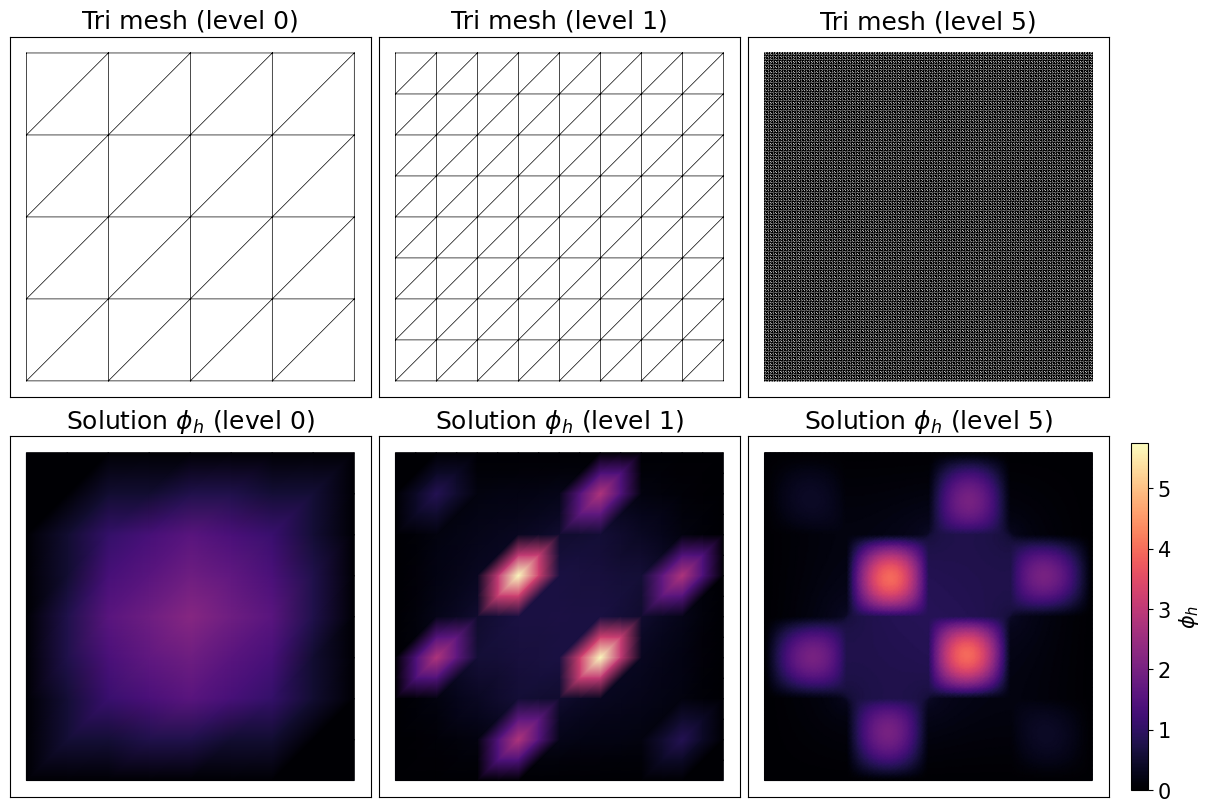
Figure 3: Demonstration of mesh refinement (top) and solution structure (bottom) for a strongly heterogeneous problem instance, highlighting the rapid increase in required mesh elements for accuracy.
Figure 2: Empirically observed scaling exponents for the classical FEM in checkerboard configurations, confirming the severe slow-down predicted by regularity analysis.
This directly supports the claim that quantum speedup in these regimes is not merely a theoretical artifact but is practically relevant for challenging heterogeneous PDEs.
Comparison with Classical and Other Quantum Solvers
The authors systematically compare their approach to both classical adaptive/non-uniform meshing and alternative quantum methods (e.g., quantum Monte Carlo, quantum walk-based solvers, and QLSA-based algorithms for constant-coefficient problems). Notably, while adaptive meshing or MC methods can, in some cases, alleviate classical complexity, for highly irregular solutions these may not outperform brute-force uniform discretization in practice. The quantum speedup is then robust.
Implications, Practical Impact, and Future Directions
This work shifts the paradigm regarding the kinds of PDE problems where quantum acceleration is most pronounced. The key insight is that quantum advantage emerges for problems where spatial heterogeneity (discontinuous or highly oscillatory coefficients) physically enforces poor solution regularity, and where classical adaptive techniques are difficult or ineffective.
Immediate implications include:
Benchmark target classes: Heterogeneous elliptic PDEs with complex interfaces constitute especially attractive targets for demonstrating quantum advantage in scientific computing.
Reactor Physics and Multipoint Transport: Direct applications include criticality analysis in nuclear engineering, reservoir simulation, and potentially materials design where high-contrast coefficients are endemic.
Quantum Multiscaling: The methods developed (including the block encoding of piecewise-constant preconditioners) can be extended to other PDEs, such as reaction-diffusion, Helmholtz, and even Maxwell and elasticity equations with spatial heterogeneity.
Theoretically, the work clarifies that quantum speedups for PDEs are not limited to extremely large spatial dimension (the “curse of dimensionality” argument), but may manifest robustly in fixed (−∇⋅(D(x)∇)+Σa(x))ϕ(x)=k1νΣf(x)ϕ(x),8 when poor regularity is present.
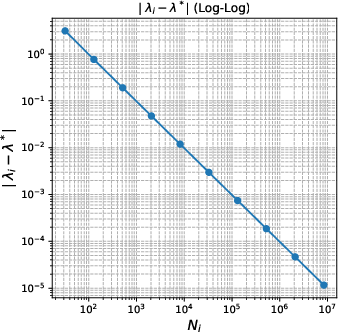
Figure 4: Log-log plot showing classical FEM error decay as a function of mesh size, illustrating the plateau in convergence rate in the heterogeneous setting.
Conclusion
The paper provides the first rigorous, end-to-end analysis of quantum finite element algorithms for strongly heterogeneous PDE eigenvalue problems, setting new technical benchmarks in block-encoding and quantum preconditioning. It demonstrates, with formal proofs and empirical data, that quantum algorithms can achieve polynomial (and in practical terms, decisive) speedups over classical solvers for neutron diffusion in complex geometries. This work forms the template for future explorations into quantum advantage for PDEs arising in scientific and engineering domains with intrinsic material heterogeneity.