- The paper provides analytic and numerical evidence that raising H₀ in early-time models generically forces higher ωb values, clashing with precise BBN deuterium constraints.
- It employs CMB angular scale scaling arguments and full Bayesian fits to demonstrate a nearly linear degeneracy between H₀ and ωb across various non-standard cosmologies.
- The results indicate that without novel mechanisms during BBN, early-time H₀ solutions are statistically disfavored once BBN likelihoods are incorporated.
A Generic ωb Tension in Early-Time Solutions to the Hubble Tension
Introduction and Motivation
The persistent ∼5σ discrepancy between the H0 value inferred from the CMB (Planck) and the direct measurement using the distance ladder (SH0ES) has motivated a vast landscape of proposals spanning modifications to cosmology at both early- and late-times. Recent efforts have explored early-universe physics (prior to recombination) involving additional relativistic degrees of freedom, scalar fields, or other mechanisms that alter the pre-recombination expansion rate, thereby reconciling the CMB-inferred and direct H0 measurements while retaining agreement with other cosmological and astrophysical datasets.
However, robust confrontation with standard Big Bang Nucleosynthesis (BBN) constraints is often less emphasized, despite their percent-level sensitivity to the cosmic baryon density ωb through precise deuterium abundance measurements. This work provides a systematic, analytic, and numerical assessment of the interplay between early-time solutions to the Hubble tension and the resulting constraints from BBN, demonstrating that increased H0 solutions tend to generically predict a baryon density in significant tension with primordial element abundance measurements.
Parametric and Numerical Scaling of H0 and ωb
The paper first presents an analytic scaling argument, relating the three principal CMB-measured angular scales---ℓA (acoustic), ℓeq (equality), and ∼5σ0 (damping)---to the core cosmological parameters, most notably ∼5σ1 and ∼5σ2. Holding the observed angular scales of the CMB fixed under increasing ∼5σ3 forces the baryon density to higher values in a generic, model-agnostic manner, with best-fit scaling exponents in the range ∼5σ4 depending on which scales dominate the fit. Detailed numeric calculation around the Planck best-fit yields ∼5σ5, confirming this robust, nearly linear degeneracy.
This parameter degeneracy is empirically validated in a variety of non-minimal early-universe models, including Early Dark Energy (EDE), Wess-Zumino Dark Radiation (WZDR), Stepped Partially Acoustic Dark Matter (SPartAcous), and cosmologies with primordial magnetic fields. When these models are fit to CMB, BAO, and supernova data (excluding BBN), the posteriors for ∼5σ6 and ∼5σ7 invariably trace this degeneracy direction.
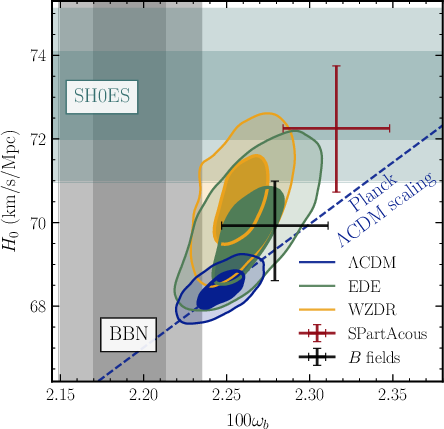
Figure 1: 1 and ∼5σ8 contours in the ∼5σ9–H00 plane for H01CDM and representative early-time solutions, all fit without BBN likelihoods; the tight BBN constraint is shown in gray, and the degeneracy slope is highlighted by the dashed line.
Notably, in the absence of BBN, the allowed H02 values in early-time models are consistently higher than the standard BBN-preferred value, with differences often exceeding current BBN uncertainties.
BBN Constraints and the Deuterium Bottleneck
BBN, through precise measurements of primordial deuterium, exerts a stringent constraint on H03, with the predicted deuterium-to-hydrogen ratio scaling steeply with the baryon-to-photon ratio: H04. Thus, even small excursions in H05 from the canonical H06CDM-baryon density produce significant shifts in the predicted D/H, leading to tensions with precision measurements now at the H07 level.
Notably, most early-time H08 resolution models were constructed not to alter the baryon content directly and were designed so that their effects manifest after nucleosynthesis or have negligible impact during BBN. Nonetheless, the CMB-inferred degeneracy forces them into conflict with BBN—imposing a high-H09 solution is demonstrably "toxic to BBN," as the phenomenological degeneracy pushes H00 to values inconsistent with observed primordial deuterium.
Model Analysis with and without BBN Likelihoods
The numerical section re-analyzes two representative models: WZDR (extra dark radiation from late-time species) and the H01 EDE scenario. Full Bayesian fits are conducted using Planck, BAO, Pantheon, and SH0ES data, both with and without the inclusion of a full BBN likelihood (which incorporates the latest D/H and He abundances, with theoretical and nuclear rate uncertainties propagated).
When the BBN likelihood is omitted, high H02 and correspondingly high H03 posteriors are favored, achieving overlap with the SH0ES determination of H04. However, inclusion of the BBN likelihood sharply truncates the posterior region, capping both H05 and H06 to values in better agreement with H07CDM but unable to reach the SH0ES value, and resulting in global fits that are not statistically preferred over the minimal model.
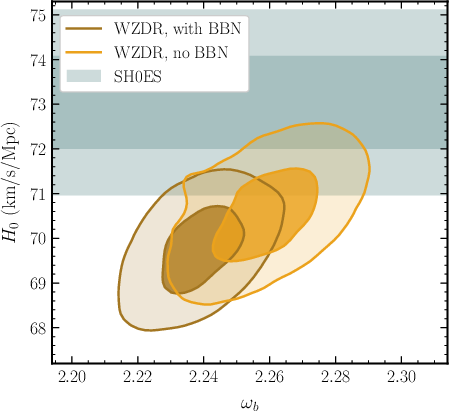
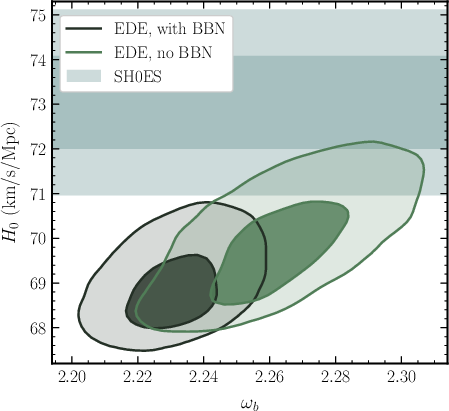
Figure 2: Posterior contours in H08 and H09 for WZDR (top) and EDE (bottom), showing the impact of including BBN (darker) vs. excluding BBN (lighter); ωb0 is strongly limited when BBN is incorporated, never achieving the SH0ES central value.
Further, full model-dependent corner plots reveal that adding BBN likelihood not only penalizes high values of ωb1 and ωb2, but also correspondingly suppresses the populations of non-minimal new parameters (e.g., ωb3 for WZDR, ωb4 for EDE), with preference reverting towards the standard cosmology.
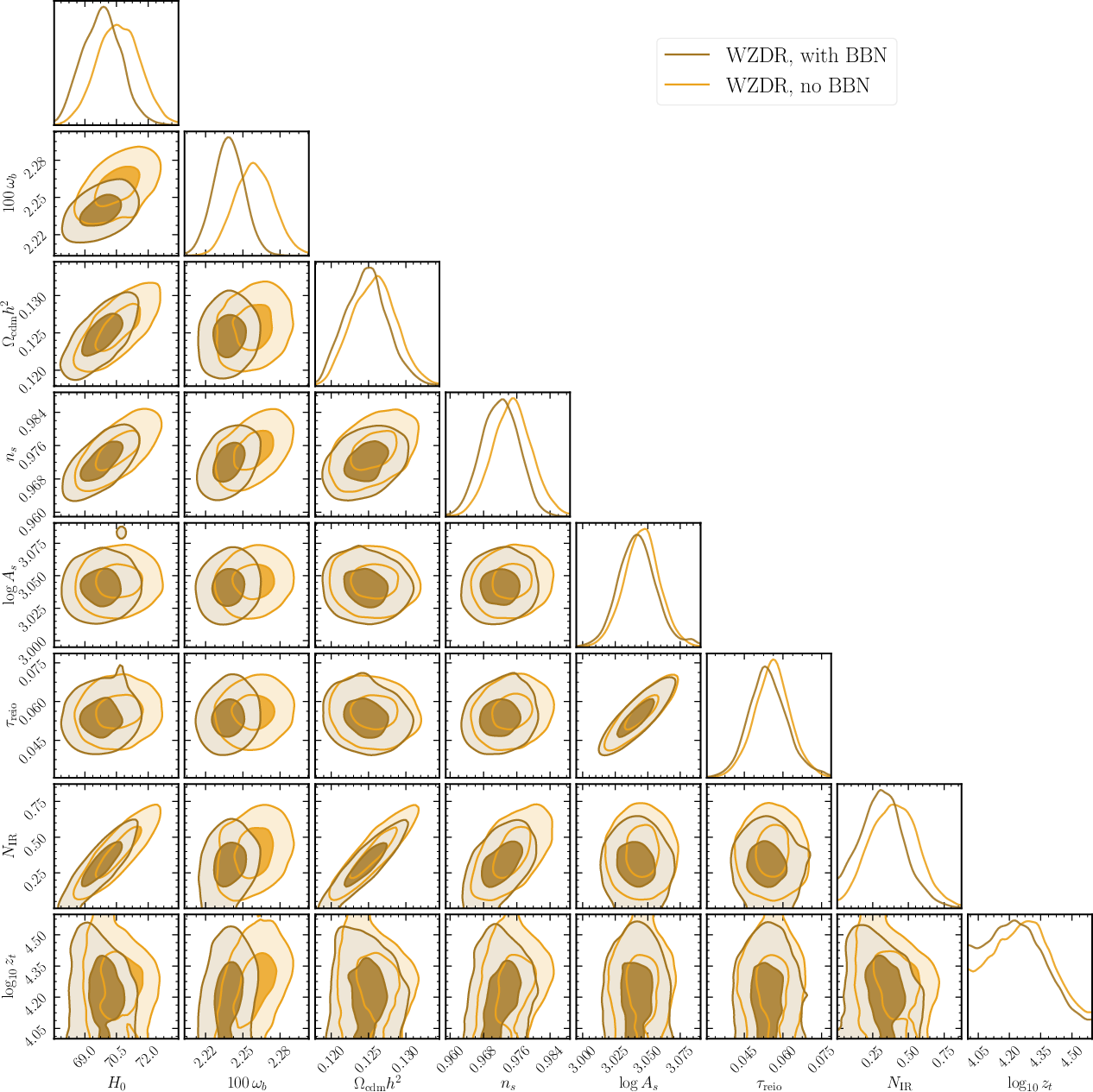
Figure 3: The effect of including a BBN likelihood in WZDR cosmology, with significant restriction of parameter space along ωb5 and related axes.
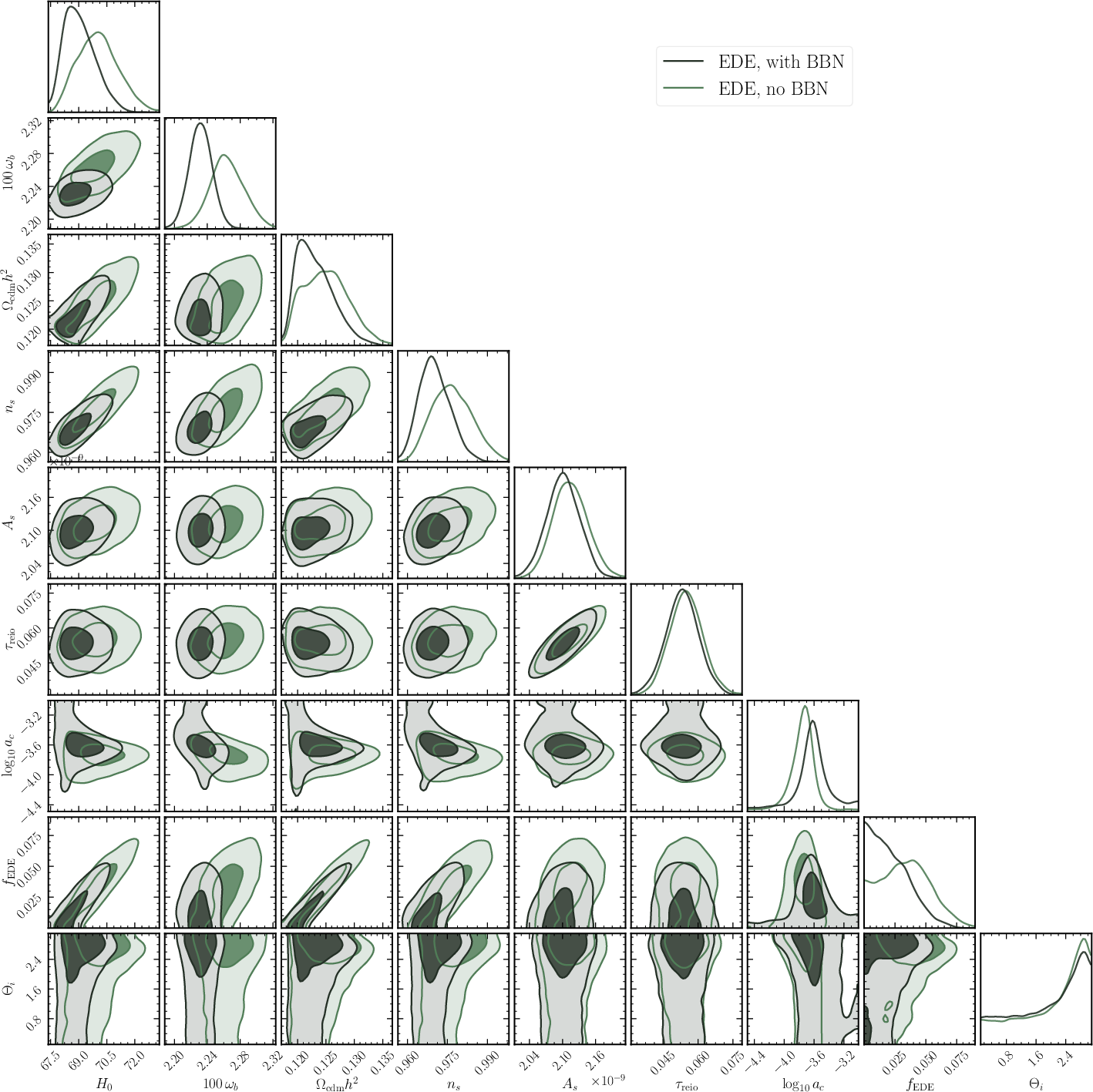
Figure 4: Impact of BBN likelihood in EDE cosmology, showing the contraction of allowed regions in ωb6 and related parameters as well as on ωb7–ωb8.
Numerical Model Comparison and Global Fit
Tabulated minimum ωb9 and AIC (Akaike information criterion) values show that neither the WZDR nor the EDE model are preferred over H00CDM when BBN is added. This holds even when one allows for substantial freedom in the new model parameters and when the nuclear prediction for deuterium is varied across different theoretical networks. Both models successfully alleviate the Hubble tension with BBN excluded but lose this advantage—on both statistical and physical grounds—when BBN is considered.
Implications and Outlook
These results delineate a robust theoretical obstruction: in the absence of new mechanisms operating during BBN or highly non-standard primordial nuclear physics, any early-universe solution that attempts to raise H01 via pre-recombination physics will face a generic tension with independently inferred baryon densities from primordial element abundances.
Potential remaining loopholes (such as increasing H02 at late BBN epochs to tweak deuterium without perturbing helium) are constrained by current and anticipated high-precision helium measurements, further shrinking viable parameter space. Nontrivial new sectors or modifications that thermalize before or during BBN, possibly with finely engineered H03 and baryon-to-photon evolution histories, are required to reconcile all datasets.
On the practical front, these findings underscore that all future phenomenological and/or model-building efforts targeting the Hubble tension via high-H04 early-universe physics must explicitly and quantitatively address the baryon density-BBN constraints, not merely fit CMB and low-H05 data. Theoretical development should focus on models where the rescaling of the baryon-to-photon ratio is mitigated or compensated without running afoul of other probes. Late-time solutions to the Hubble tension are also increasingly constrained by other datasets, as recent studies have shown, leaving the solution space severely narrowed.
Conclusion
This work provides analytic and numerical evidence that early-time solutions to the Hubble tension generically induce an upward shift in the CMB-inferred baryon density, putting these models in tension with percent-level primordial deuterium measurements from BBN. When a full BBN likelihood is incorporated, representative early-time models (EDE, WZDR) lose their ability to reconcile Planck and SH0ES H06 values and perform no better than H07CDM in global fits. Any definitive cosmological resolution of the Hubble tension must simultaneously address these BBN constraints; the search for such models will likely require genuinely novel mechanisms engaging both early and late universe observables.