- The paper demonstrates that interpulse photon counts closely follow a Skellam distribution, validating its statistical adoption over Gaussian models.
- The study reveals significant excess variance in the main pulse, suggesting additional short-lived emission events distinct from standard Poisson behavior.
- Methodology entails high-precision NICER data analysis with background subtraction and phase-resolved modeling to discern subtle pulsar emission features.
Photon-Count Statistics of Crab X-ray Pulses: Skellam Behavior and Excess Variance in the Main Pulse
Introduction and Context
This study presents a statistical characterization of the photon-count distributions of X-ray pulses from the Crab pulsar (PSR B0531+21), using 78.8 ks of high-precision NICER data. The Crab's emission structure consists of a main pulse (MP), interpulse (IP), and bridge emission, observed across the electromagnetic spectrum. Its brightness enables investigation of single-pulse statistics in the X-ray regime, a regime typically dominated by low-count data. Detailed statistical analysis of this rich data set allows differentiation in the stochastic behavior of the MP and IP and stringent testing of assumptions typically made in high-energy photon-counting analyses.
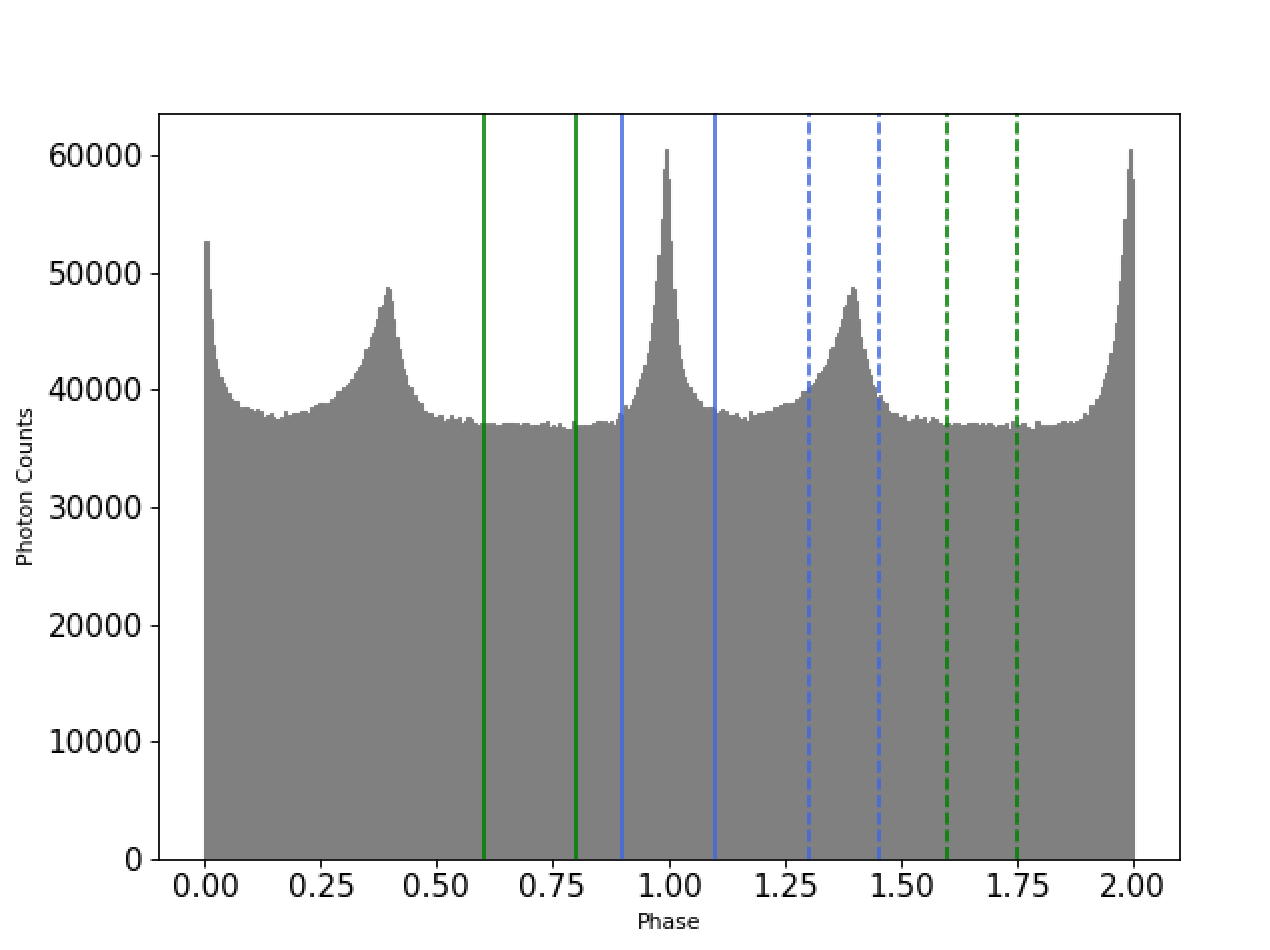
Figure 1: Example Crab pulse profile (NICER X-ray data). Green: off-pulse windows; blue: on-pulse windows. MP (solid), IP (dashed); bridge emission spans these components.
Observational Methods and Data Processing
The dataset comprises over 2 million Crab X-ray pulses. Pulsar phases were determined via barycentric corrections and Jodrell Bank Crab ephemeris, utilizing the PINT and HEASOFT pipelines. Photon counts for the MP and IP were extracted from well-defined on-pulse and off-pulse phase windows, with background subtraction performed to isolate the pulsed emission component. The full distribution for each pulse phase component was then constructed for subsequent statistical modeling.
Statistical Modeling: Skellam vs. Gaussian Frameworks
Photon counts in the on-pulse and off-pulse windows originate from statistically independent Poissonian processes. The difference of these, which quantifies the net pulsed signal after background subtraction, should be described by a Skellam distribution for sufficiently high mean counts and for phase windows allowing negative counts. This is a theoretically rigorous alternative to Gaussian or ad hoc Poisson approximations often applied in X-ray astronomy.
Goodness-of-fit was evaluated via reduced χ2, Akaike information criterion (AIC), and Bayesian information criterion (BIC), enabling direct model comparison.
Results: Distributional Distinctions Between Main Pulse and Interpulse
Interpulse Photon-Count Statistics
The single-pulse photon-count distribution for the IP aligns excellently with Skellam expectations. The reduced χ2 for Skellam is 1.037, compared to 1.716 for the Gaussian, with delta AIC and BIC >30, indicating decisive statistical preference for the Skellam framework. The residuals normalized by the expected uncertainty show no significant phase- or count-dependent structure.
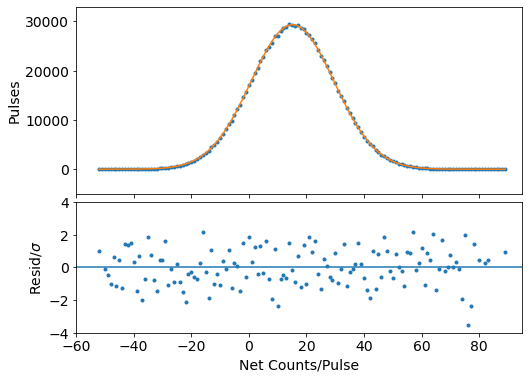
Figure 2: The single-pulse photon-count distribution for the IP (blue: data, orange: Skellam model). Bottom: normalized residuals.
Main Pulse Photon-Count Statistics and High-Variance Events
The MP is well described by a Skellam distribution compared to a Gaussian (reduced χ2=1.57 versus 2.37), but the fit is not statistically sufficient given the high precision. Normalized residuals for the MP display significant outliers in the high-count tail. This indicates the presence of excess variance not captured by a pure Poissonian subtraction model, a feature that is completely absent in the IP.
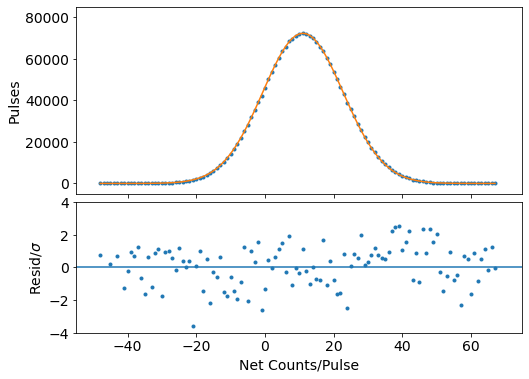
Figure 3: The single-pulse photon-count distribution for the MP (blue: data, orange: Skellam fit) and corresponding residuals, illustrating excess events at high counts.
Summing photon counts over two successive main pulses, however, largely eliminates the excess variance and yields a reduced χ2 consistent with 1.006. No significant short-lag autocorrelation—indicative of pulse-to-pulse “memory” or correlated processes—was detected in the MP data (lag-1 autocorrelation consistent with zero at <0.0034, 95% confidence). Summing over multiple rotations averages out the rare high-variance events responsible for the excess variance.
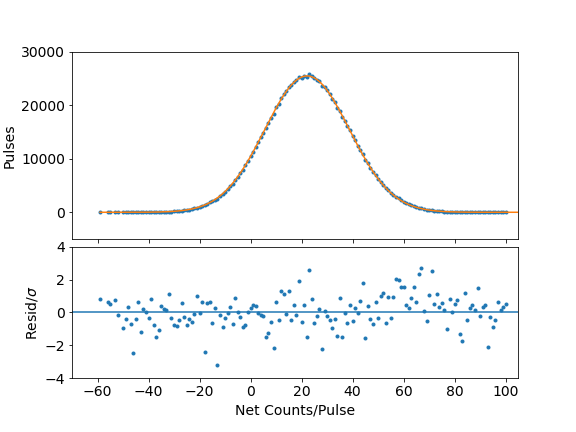
Figure 4: Two-pulse photon-count distribution for the MP and Skellam model fit. Excess variance is averaged out when counts are summed across successive pulses.
Figure 5: Two-pulse photon-count distribution for the IP demonstrates continued strong agreement with the Skellam model under aggregation.
Pulse Window Dependence
Analysis of the MP phase window subdivided into leading and trailing halves indicates that excess variance is localized predominantly to the trailing MP. However, low-count regimes in these narrower windows reduce the diagnostic reliability of χ2-based tests. When window widths are reduced, both MP and IP show apparent increased scatter relative to Skellam, but this is ascribed to the expected breakdown of Gaussian approximations and the increased influence of Poisson discreteness.
Physical Interpretation and Theoretical Implications
The observed differential behavior between the MP and IP photon-count statistics highlights distinct stochastic processes. The IP is consistent with a purely Poissonian model, supporting emission scenarios where net emission is deterministic and background-subtracted differences follow Skellam statistics. In contrast, the MP exhibits a significant population of high-count outliers, a property not attributable to giant radio pulses (GRPs), which are too infrequent and of insufficient magnitude to produce the observed excess variance. Rather, the results suggest the presence of additional short-lived or localized emission phenomena affecting the MP.
Absence of detectable pulse-to-pulse correlation implies these phenomena are not due to processes with rotational timescale memory, setting constraints on models involving intrinsic magnetospheric variability, unmodeled photon pileup, or rare microphysical events.
The paper advocates for Skellam-based statistical modeling as the rigorous choice for differenced Poisson photon-count problems in X-ray and high-energy astrophysics, especially in high-statistics regimes. This approach is directly extensible to timing and variability studies of other bright X-ray pulsars or Poissonian sources.
Conclusions
This work demonstrates that the interpulse emission from the Crab pulsar in X-rays is described with high fidelity by the Skellam distribution, validating this formalism for photon-count-differencing analyses in pulsar astrophysics. The main pulse, although statistically closer to Skellam than Gaussian modeling, exhibits significant excess variance due to rare, high-count events, the origin of which is not explained by present knowledge of GRPs or persistent memory processes. These findings provide quantitative distributional constraints for theoretical models of pulsar magnetospheric emission and have methodological implications for future ensemble timing and variability analyses in high-energy astrophysics.
Future developments will require targeted searches for microphysical or plasma instabilities underlying these rare events and broader deployment of Skellam-based models in astrophysical data reduction pipelines (2604.05050).