- The paper introduces a branch representation that reduces the number of integration variables to (3L-3) at L loops, independent of external kinematics.
- It employs intersection theory in the LP parametrization to recursively construct dual bases for efficient extraction of reduction coefficients.
- Numerical results reveal up to a 38-fold runtime improvement over traditional methods, highlighting its potential in high-order amplitude computations.
Efficient Feynman Integral Reduction via Branch Representation and Intersection Theory
Introduction
Feynman integral reduction is a pivotal step in high-order calculations in perturbative quantum field theory. Traditionally, this is accomplished via Integration-By-Parts (IBP) identities, with algorithms such as Laporta's and packages like FIRE, Reduze, LiteRed, and Kira forming the computational backbone. However, for multi-loop and multi-leg processes, the complexity—measured by the size and number of linear systems—renders IBP methodologies a computational bottleneck, especially in the context of contemporary collider physics. Intersection theory has emerged as a promising alternative, recasting reduction in terms of bilinear pairings in twisted cohomology. Despite theoretical elegance, practical adoption has been hindered by high-dimensional intersection number computations, which scale with the number of propagators and quickly become intractable.
The paper "Feynman integral reduction with intersection theory made simple" (2604.05025) introduces a substantial simplification: exploiting the redundancy in the quadratic structure of propagators, the so-called branch representation is used to minimize the variable count for intersection number evaluation to (3L−3) at L loops—regardless of the number of external legs or propagators. The implications are a drastic reduction in computational requirements and practical runtimes.
Theoretical Framework and Branch Representation
Intersection theory-based reduction proceeds by expressing Feynman integrals as generalized hypergeometric functions in the Lee-Pomeransky (LP) parametrization. Integrals are treated as elements of the twisted cohomology group Hn, with reduction coefficients extracted from the intersection numbers between bra- and ket-vectors in dual bases. The complexity arises from the recursive evaluation of n-variable intersection numbers, where n is typically the number of Feynman parameters (and thus propagators).
The branch representation, as furthered in this work, groups propagators sharing the same quadratic form into "branches," with internal lines assigned to their respective branches (Figure 1).
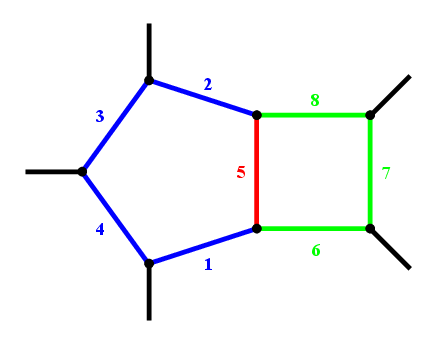
Figure 1: A two-loop diagram illustrating the branch structure; internal lines of the same color belong to the same branch.
The central result is that the number of branches, B, satisfies B≤3L−3 for L≥2 in general, which is independent of external kinematics. Using suitable variable transformations, integration proceeds first over (N−B) internal parameters (fixed-branch integrals; FBI), and then recursively over the B branch variables. This layered decomposition means intersection number computations are only required for the branch variables themselves, as the coefficients for the inner layers can be determined "almost for free" from the FBI reductions.
Construction of Dual Bases and Recursive Implementation
The method leverages flexibility in the choice of ket-basis: explicit functional forms are unnecessary so long as the reduction is operational. Master FBIs at the bottom inner layer are taken as an orthonormal bra-basis, and higher-layer ket-basis vectors are recursively constructed as polynomials of the branch variables multiplied by inner-layer kets.
A technical subtlety arises from so-called sub-branch integrals, where all propagators of a branch are pinched (L0). Here, special constructions ensure the correct residue information is captured, allowing recursion to proceed unimpeded even in the presence of such pinchings.
Numerical Results: Complexity and Efficiency
To quantitatively assess the benefits, the method is applied to both a two-loop three-point function with massive internal lines (Figure 2) and to the two-loop pentabox topology.
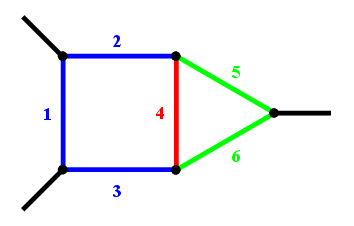
Figure 2: A two-loop three-point diagram with massive internal lines and off-shell external legs.
In the three-point example, the LP representation requires six layers of intersection numbers, whereas the branch representation reduces this to the theoretical minimum of three. Implementations using FiniteFlow and state-of-the-art polynomial division algorithms give a runtime of 285 seconds for the branch representation versus 10785 seconds for the LP representation—a factor of 38 improvement.
For the two-loop pentabox (with five off-shell external legs and massless internal lines), traditional Baikov and LP representations require 11 and 8 layers, respectively. Branch representation requires only three. The largest linear system in this approach has approximately L1 equations, with most other systems being an order of magnitude smaller. In contrast, IBP-based reduction with Kira 3 yields a system with L2 equations for similar targets. An "effective system size" L3 is introduced to compare overall computational complexity, and the branch method is shown to be more than an order of magnitude more efficient. Furthermore, the block-triangular and sparse nature of the resulting linear systems opens additional avenues for optimization, such as bringing computational scaling closer to L4.
Implications and Future Directions
This method establishes a new standard for scalable reduction algorithms in multi-loop, multi-leg kinematics. The key technical claim—intersection-theory-based reduction can always be performed with at most L5 variables at L6 loops—has direct practical implications for phenomenology, including applications in multi-boson and multi-jet production at the LHC. The reduced dimensionality is decoupled from the number of propagators or external legs, enabling tractable reduction for previously intractable problems.
Theoretically, this represents consolidation of the link between the algebraic geometry underpinning intersection theory and the analytic structure of Feynman graph integrals. Practically, it dramatically narrows the gap between intersection-theory-based and IBP-based reduction workflows, with potential to surpass the latter through further optimized block-sparse solvers, parallel implementations, and adaptation to higher-loop (three loops and beyond) topologies.
Conclusion
The branch-representation-based intersection theory framework offers an efficient, generalizable protocol for Feynman integral reduction at multiloop orders. By reducing the variable count to a practical minimum, it addresses the central bottleneck of current analytic and numeric reduction pipelines. The presented results demonstrate both immediate numerical efficiency and broad applicability, with prospects for further advances via algorithmic and software development. This method is poised to become central in multi-scale, multi-leg amplitude computations for precision collider physics and beyond.

