- The paper establishes resolution criteria in hybrid simulations to capture the ion Weibel instability, prescribing a minimum grid resolution that scales with Alfvénic Mach number.
- Systematic 1D and 2D hybrid and PIC simulations validate that under-resolving the ion scales suppresses instability growth while excessive resolution introduces non-physical whistler modes.
- The study prescribes a minimum resolution scaling law and a maximum limit of 30 cells per ion skin depth to ensure physical fidelity in modeling astrophysical shocks.
Optimal Resolution Criteria for the Ion Weibel Instability in Hybrid Simulations
Introduction
The paper "Ion Weibel Instability in the hybrid framework: the optimal resolution" (2604.05021) addresses a critical and previously unquantified issue in kinetic plasma theory: establishing resolution requirements for hybrid simulations to faithfully capture the ion Weibel instability, a key mechanism mediating dissipation and particle acceleration in high-Mach-number astrophysical shocks. Hybrid codes, in which ions are treated kinetically and electrons as a massless charge-neutralizing fluid, are central tools in modeling large-scale plasma environments such as those found at supernova remnants. However, the interplay between microinstability physics and numerical resolution has often been neglected, resulting in simulations that either under-resolve physical modes or are contaminated by numerically-induced artifacts.
This work develops a linear theory for the ion Weibel instability in the massless-electron (hybrid) limit, validates this framework through systematic one- and two-dimensional hybrid and PIC simulations, and prescribes both necessary and maximum spatial resolution as explicit functions of Alfvénic Mach number. These results are essential for accurate modeling of shock transition regions, particle injection, and acceleration processes in astrophysical and laboratory plasmas.
Linear Theory and Resolution Criteria
The theoretical analysis considers counterstreaming ion beams in the presence of a perpendicular background magnetic field. The hybrid model assumes electrons are a charge-neutralizing fluid with negligible inertia. The linear dispersion relation is analytically derived, and distinctions between the hybrid and full kinetic electron regimes are highlighted, especially regarding electron screening.
The framework demonstrates that, in weakly magnetized regimes, the ion Weibel instability’s fastest-growing mode has a wavelength that decreases with increasing Mach number. For hybrid models, neglecting electron mass is well-motivated only when the instability evolves faster than the ion gyroperiod but much more slowly than the electron gyroperiod. The theoretical spectrum yields key scaling laws for the dominant wavenumber:
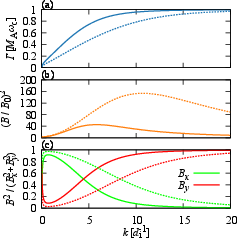
Figure 1: Linear theory for MA=30 and MA=100, with growth rates, saturation, and polarization for the Weibel instability.
A precise fit (kpeak∝MA0.51) to the fastest-growing wavenumber is found, establishing the minimum resolution requirement as:
Nmin=9(30MA)0.51
where N is the number of grid cells per ion skin depth di. The required number of resolution elements thus grows sublinearly with Mach number. For instance, MA=100 demands N≈17, while MA=30 is consistent with N=10.
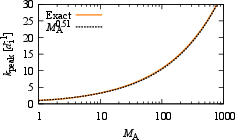
Figure 2: Dependence of peak mode wavenumber on MA=1000; orange denotes the linear theory, black the best fit MA=1001 scaling.
Polarization analysis reveals that the MA=1002 and MA=1003 nature of filamentary fluctuations also depends sensitively on resolution, with clear cross-over points for each Mach regime.
Limitations: Maximum Resolution and Whistler Mode Contamination
A pivotal insight of the analysis is that excessive spatial resolution in hybrid models introduces small-scale whistler modes that do not correspond to physical plasma behavior. The massless electron assumption causes an artificial divergence in whistler phase velocity at high wavenumbers, leading to numerically unstable or nonphysical solutions, in contrast to full kinetic models with finite electron mass.
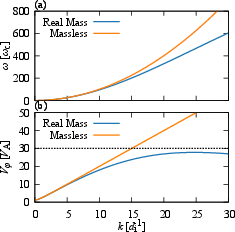
Figure 3: Dispersion relation and phase velocity of whistler modes in hybrid and full kinetic models. Massless electrons cause artificial high phase velocities at short wavelengths.
This necessitates a practical maximum resolution in hybrid simulations, identified as MA=1004 cells per MA=1005, independent of MA=1006, to avoid unphysical small-scale whistler excitation. Therefore, for a given Mach number:
MA=1007
Beyond MA=1008, no physically meaningful spatial resolution exists within hybrid models, and fully kinetic treatments become necessary.
Validation with 1D and 2D Simulations
Extensive 1D and 2D hybrid and PIC simulations using the dHybridR code corroborate the theoretical predictions. In the 1D case, for MA=1009, a resolution of kpeak∝MA0.510 accurately resolves the dominant kpeak∝MA0.511-mode; under-resolving (kpeak∝MA0.512) suppresses growth rates, shifts spectral power, and distorts magnetic field polarization.
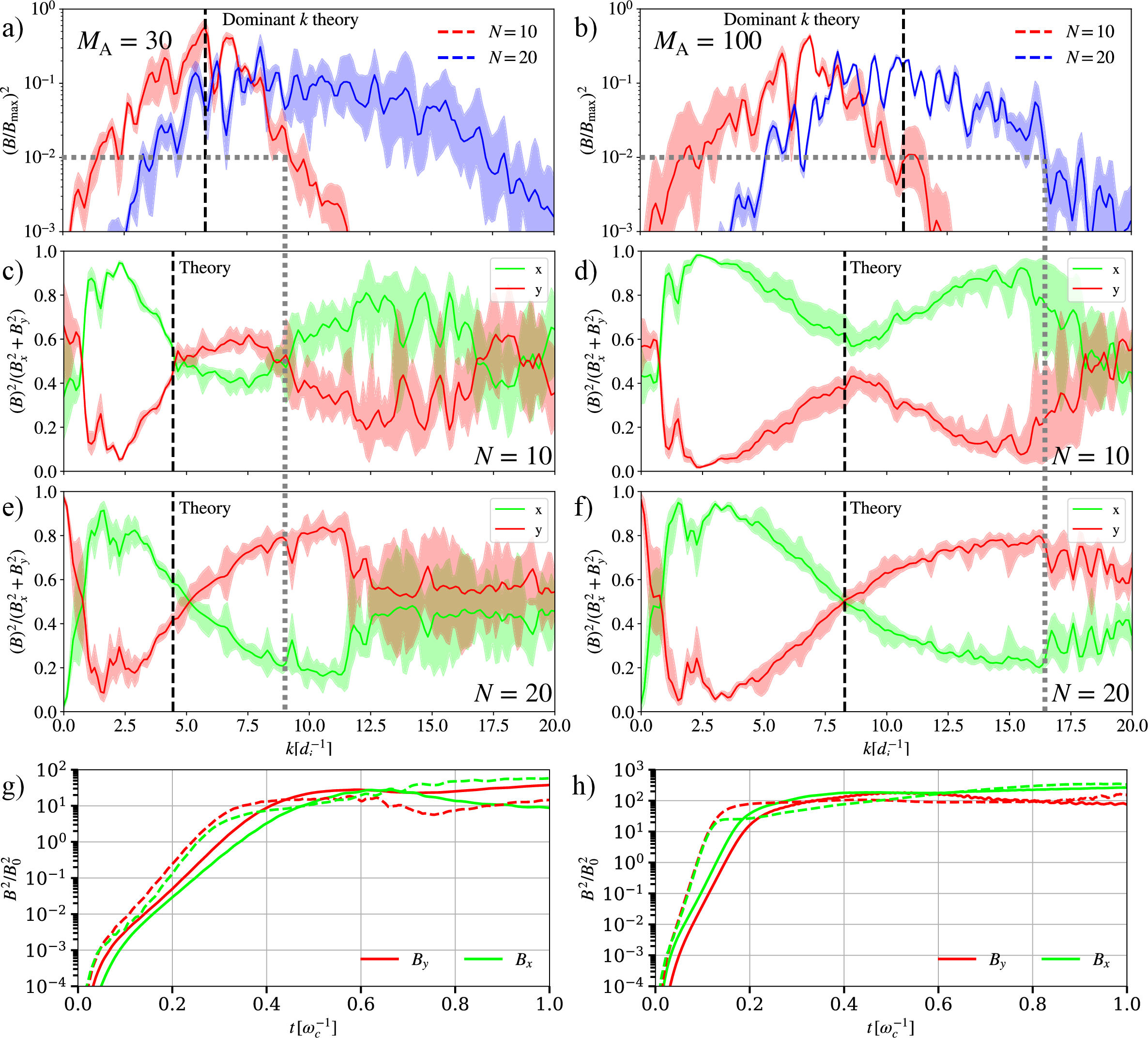
Figure 4: 1D hybrid simulation results showing power spectra and polarization for kpeak∝MA0.513 and kpeak∝MA0.514. Convergence is reached as predicted by theory.
For kpeak∝MA0.515, kpeak∝MA0.516 is sufficient, with accurate agreement in growth, saturation, and polarization characteristics with the theoretical model.
2D simulations further demonstrate that, for kpeak∝MA0.517, hybrid results match the full PIC solutions at ion scales, while kpeak∝MA0.518 exhibits spurious small-scale and oblique fluctuations incompatible with accurate modeling.
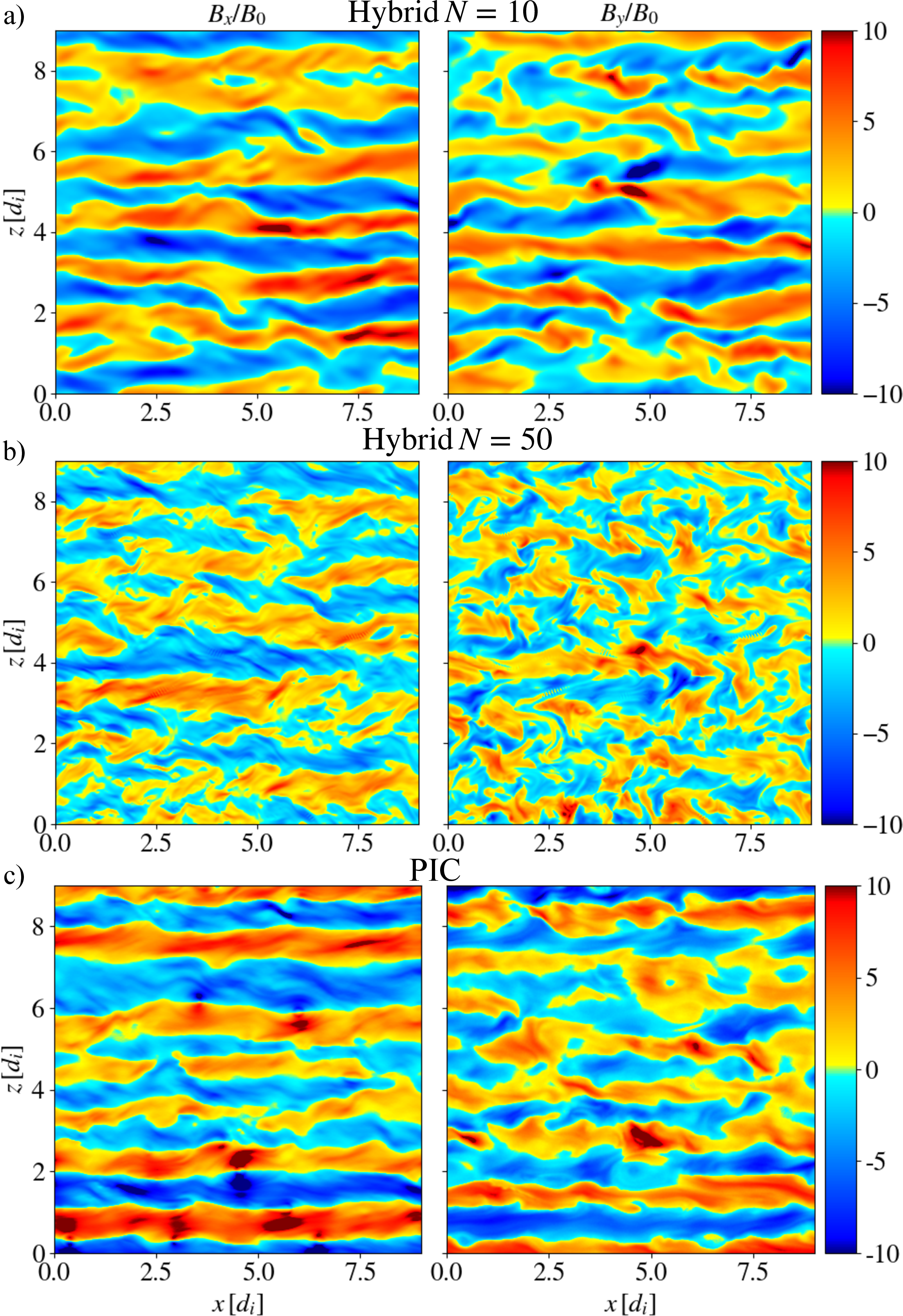
Figure 5: 2D hybrid and full PIC results for kpeak∝MA0.519. Hybrid at optimal (Nmin=9(30MA)0.510) and excessive (Nmin=9(30MA)0.511) resolutions compared to PIC with realistic mass ratio.
Implications and Future Directions
The implications for shock acceleration studies and plasma turbulence modeling are immediate. Simulations that under-resolve the critical scales will misrepresent the growth, saturation, and topology of Weibel-induced fields, which directly modulates particle injection, cosmic-ray acceleration, and shock reformation. Conversely, over-resolving, or using hybrid codes outside validated Mach number ranges, can contaminate transition-region structure and field statistics via artificial whistler mode power.
The practical guidelines derived here provide parameterization for future large-scale hybrid shock and beam instabilities studies, ensuring physical fidelity while maximizing computational efficiency. For higher Mach regimes or studies probing sub-ion scales, more advanced models should be adopted. Recent developments in hybrid-kinetic and extended fluid models, including finite electron mass [Munoz2018, Jain2023], and closure approaches incorporating kinetic corrections [Hunana2022, Jikei2021], may enable hybrid studies at higher Nmin=9(30MA)0.512 and offer improved fidelity for small-scale phenomena.
Conclusion
This work solidifies the theoretical and numerical foundation for simulating ion Weibel-driven field evolution in hybrid codes, explicitly quantifying both the minimum and maximum spatial resolution as a function of plasma parameters. These results establish best practices for hybrid modeling of high-Mach-number shocks, providing prescriptive boundaries that safeguard against both physical under-resolution and numerical pathology. The extension of hybrid methods through improved electron models is a promising research avenue for expanding the physically meaningful parameter space of hybrid simulations in collisionless shock and astrophysical plasma research.

