- The paper demonstrates that N6946-BH1 exhibits minimal optical signatures and weak MIR emission, supporting its classification as a failed supernova.
- It employs high-precision astrometry, DOLPHOT PSF photometry, and advanced radiative transfer modeling to differentiate failed supernovae from stellar mergers.
- The SED fitting reveals a silicate-rich dust shell with defined parameters, indicating fallback accretion onto a nascent black hole.
Disentangling Failed Supernovae: N6946-BH1, Neighboring Stellar Sources, and the Distinction from Stellar Mergers
Introduction and Scientific Motivation
The mechanisms governing the collapse of massive stars and the formation of compact remnants (NSs and BHs) remain fundamental questions in the context of stellar evolution, supernova (SN) rates, and the synthesis of gravitational wave (GW) sources. Contemporary core-collapse models predict that a significant fraction (10–30%) of stars with MZAMS≳15M⊙ will collapse directly to BHs in a so-called "failed supernova" event, characterized by minimal optical signature and transient dust-enshrouded emission. The empirical demonstration of this channel, distinct from both canonical SNe and luminous red novae (stellar mergers), must be secured through definitive progenitor/remnant studies.
N6946-BH1 has persisted as a paradigmatic candidate, exhibiting the abrupt optical disappearance of a red supergiant progenitor, weak MIR emission, and a lack of high-energy (SN-like) output. However, recent JWST observations and conflicting interpretations regarding source identification and the dust-enshrouded nature of the remnant demand rigorous reanalysis. The present study systematically revisits the JWST data with precise source localization, stellar SED fitting, advanced radiative transfer modeling, and a critical comparative analysis against known cases of stellar mergers and other failed SN candidates.
Accurate Identification of the N6946-BH1 Remnant and Nearby Stars
Due to the crowding and redundancy of NIR sources in the dense field, establishing the true remnant position and photometric properties is non-trivial. The ISIS image subtraction and DOLPHOT PSF photometry pipeline, leveraged across JWST and pre-event HST data, conclusively demonstrates a misidentification in previous analyses. The purported N6946-BH1 NIR source used by Beasor et al. (2024) aligns with a red giant neighbor (N1), not with the location of the vanished progenitor.
This realignment is visualized in the following archival and JWST data series, which establish the spatial offset and the correct remnant identification:
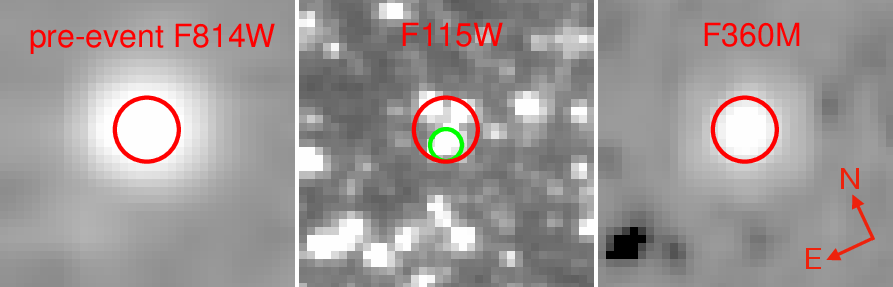
Figure 1: Multi-epoch and multi-band imaging of N6946-BH1, clarifying the pre-outburst progenitor and the remnant position relative to neighboring red giants.
A further breakdown of the NIRCam data reveals four neighboring red giants (N1–N4), none of which contribute to the MIR emission at the remnant’s site:
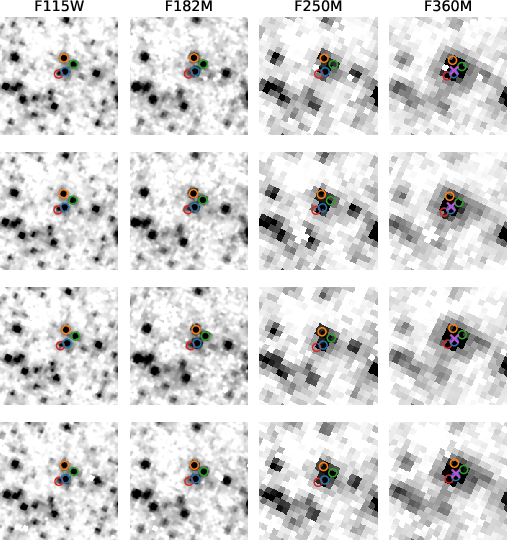
Figure 2: NIRCam multi-band cutouts marking red giants N1–N4 and the actual DOLPHOT-determined N6946-BH1 remnant position.
DUSTY modeling constrained by F115W, F182M, and F250M SEDs yields temperatures and luminosities for N1–N4 within the canonical red giant branch range, further excluding these stars as potential remnants.
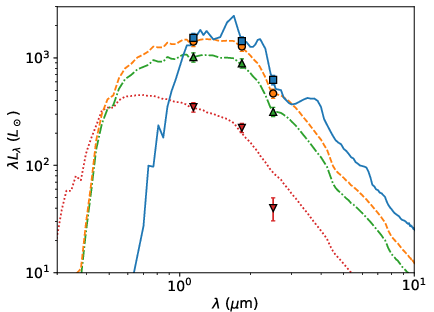
Figure 3: SED data and best-fit stellar atmosphere models for the four neighboring red giants surrounding the N6946-BH1 remnant.
SED Fitting and Dust Properties of the N6946-BH1 Remnant
The MIR SED of N6946-BH1 is reconstructed using a combination of JWST NIRCam F360M, MIRI F560W, F770W, F1000W, and F2100W data, supplemented by conservative NIR upper limits informed by N1 photometry. State-of-the-art DUSTY radiative transfer modeling robustly disfavors graphitic dust, whereas silicate-dominated dust shells with a maximum grain size of amax≈3μm and Td≈670 K yield an excellent fit, including reproducing the ∼10μm silicate absorption feature.
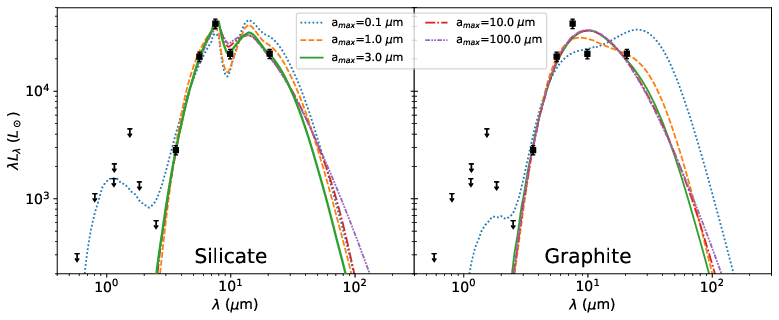
Figure 4: SED fits for silicate (left) and graphitic (right) dust shells, demonstrating that only silicate models with moderate amax can reproduce the observed MIR features.
The optimal model parameters are:
- Luminosity: log(L/L⊙)=4.73±0.03
- Visual optical depth: τV≈19
- Inner shell radius: Rin∼2.6×1015cm
- Ejecta mass (lower bound): Mej≳0.08M⊙
- Ejecta kinetic energy: Kej≳3×1045erg
The observed SED is sharply truncated blueward of amax≈3μ0m and remains undetectable in the optical, as confirmed by the continued absence of amax≈3μ1-band excess during more than a decade of LBT monitoring.
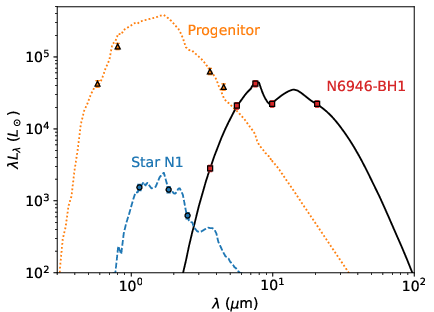
Figure 5: Comparative SEDs of the N6946-BH1 remnant, its progenitor (pre-event), and the misidentified red giant neighbor (N1).
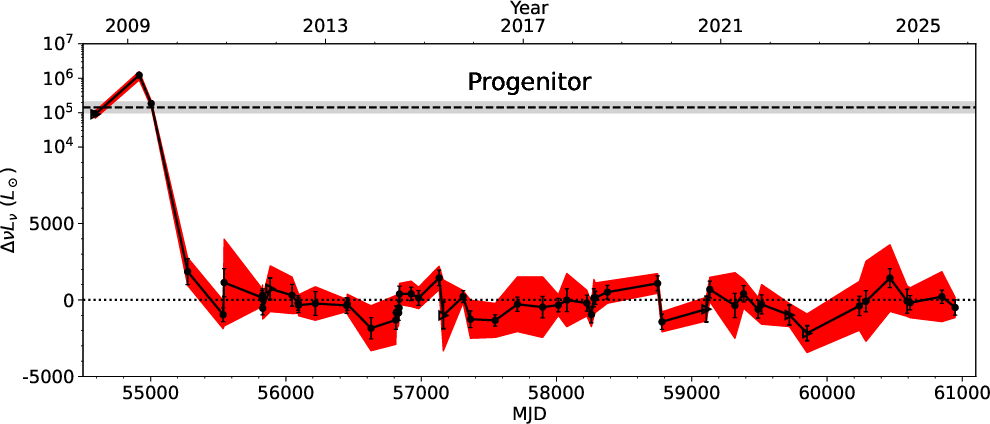
Figure 6: LBT amax≈3μ2-band light curve showing the rapid optical quenching post-outburst, with the remnant remaining below amax≈3μ3 for over a decade.
Comparative Analysis with Galactic and Extragalactic Stellar Mergers
A crucial claim of the study is the strong distinction, on both photometric and evolutionary grounds, between failed SN candidates and the class of stellar mergers (Galactic and extragalactic LRNe). Galactic merger remnants (BLG-360, V838 Mon, V1309 Sco, V4332 Sgr) are modeled with comprehensive SED fitting, establishing that their remnants are systematically 10–100 times more luminous than their pre-outburst progenitors and exhibit strong NIR/optical emission, reflecting residual over-inflation and thermal relaxation of the merged core.
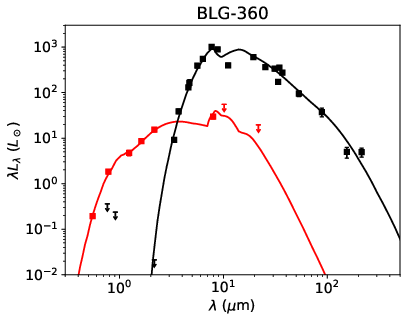
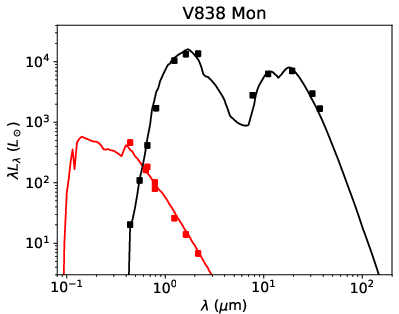
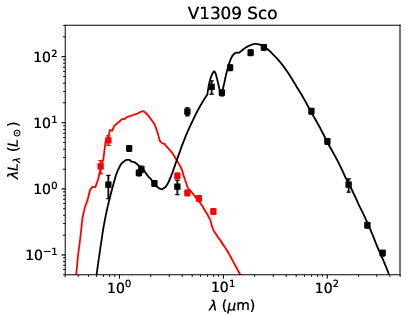
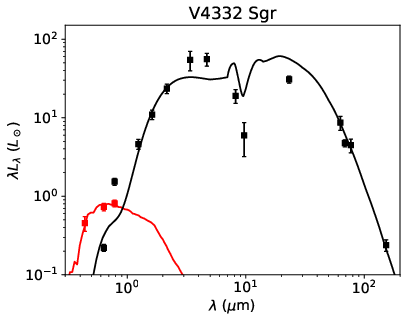
Figure 7: SED fits to the progenitors and remnants of representative Galactic stellar mergers, highlighting bolometric brightening post-outburst (details in color code).
A similar trend emerges across extragalactic LRNe, and all are contrasted against the failed SN candidates. A remnant/progenitor luminosity ratio versus progenitor luminosity diagram encapsulates the divergence: N6946-BH1 and M31-2014-DS1 are more than an order of magnitude fainter than their progenitors, in explicit contrast to stellar mergers.
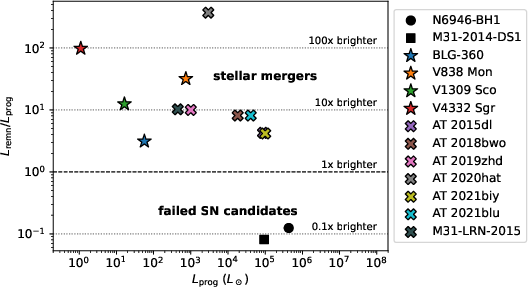
Figure 8: Remnant/progenitor luminosity ratios as a function of progenitor luminosity for failed SN candidates and stellar mergers, clearly segregating the two populations.
Implications, Robustness of the Interpretation, and Observational Predictiveness
The systematic offset in remnant/progenitor luminosity ratio between failed SN candidates and mergers is neither accounted for by orientation effects nor by dust geometry. Axisymmetric obscuration (e.g., an edge-on disk) cannot suppress amax≈3μ4 by more than a factor of amax≈3μ53 assuming isotropic dust models; the observed offset is at least a factor of amax≈3μ6–amax≈3μ7. Thus, the MIR-faint, NIR/optical-quiescent, and long-lived character of N6946-BH1 cannot be attributed to a merger event nor misinterpretation of the reprocessed SED.
From a theoretical standpoint, these observations are consistent with failed SN models in which the remnant emission is powered by fallback accretion onto a nascent BH, sharply curtailed by mass and angular momentum loss and enveloped by a moderately optically thick, silicate-rich shell.
Consequent observational predictions include:
- Absence of rebrightening at NIR/optical wavelengths, even as the remnant cools and the dust shell evolves.
- No late-time signature of re-inflated stellar atmospheres, which characterize merger remnants.
- A MIR SED dominated by silicate absorption, with low inferred amax≈3μ8 and fallback rates.
- New candidates should cluster with N6946-BH1 and M31-2014-DS1 in the remnant/progenitor luminosity ratio diagram.
Detection of further analogs by wide-field MIR surveys and continuous monitoring will refine the rate of failed SN events, contributing directly to our understanding of BH formation channels, the compact object mass function, and possible connections to GW source populations.
Conclusion
This analysis establishes unambiguous evidence for the failed SN nature of N6946-BH1 through high-precision astrometry, SED and light-curve analyses, and robust radiative transfer modeling. The remnant is both anomalously faint relative to all known merger remnants and characterized by MIR emission best explained as fallback-accretion power processed by silicate-rich circumstellar ejecta. The luminous distinction between failed SNe and mergers is now robustly quantifiable, and ongoing all-sky MIR time-domain surveys are optimally poised to expand the sample of directly identified failed SN events. The practical and theoretical implications extend from SN mechanism studies to compact-remnant and GW-source demography.
References:
- "The neighboring stars of N6946-BH1 and the observational characteristics of failed supernovae" (2604.05019)