Revisiting The Gravitational Mirroring In Presence of Compact Objects
Published 6 Apr 2026 in gr-qc and astro-ph.GA | (2604.05009v1)
Abstract: We propose a novel concept of astrophysical mirroring in the schwarzschild framework, which emerges as a direct consequence of gravitational lensing effects occurring in the immediate vicinity of extremely dense massive objects within spacetime. Through rigorous theoretical calculations and numerical ray-tracing analysis, we demonstrate that sufficiently compact astrophysical objects possess the capability to induce such extreme curvature in spacetime that the resulting gravitational field can bend light rays to extraordinary degrees, creating what we term a "reflection image" or mirror-like appearance of the source in distant regions of space. We discuss the theoretical framework as well as the observational consequences of this phenomenon.
The paper demonstrates that gravitational mirroring arises from null geodesic looping in Schwarzschild geometry, leading to spatially retraced images near compact objects.
It employs rigorous numerical ray-tracing via the RK4 algorithm and theoretical derivations to map photon trajectories and quantify deflection angles.
Results critically impact the interpretation of black hole shadows and galactic brightness by showing that high-order mirrored images can enhance observable flux.
Astrophysical Mirroring in the Vicinity of Compact Objects: Ray-Tracing and Theoretical Analysis
Introduction
This work systematically investigates the phenomenon of gravitational mirroring—here defined as the appearance of multiple, spatially retraced images due to the propagation of null geodesics in the strong-field region surrounding compact objects—within the Schwarzschild framework. The analysis advances previous treatments by unifying theoretical and numerical approaches to photon trajectory integration. Detailed ray-tracing results, supported by rigorous derivation of null geodesic equations, reveal conditions under which strongly lensed light returns to its origin, mimicking a “mirror” image at distinct spatial positions. The implications for gravitational lensing, photon ring structure, and observational feasibility at current and upcoming resolution limits are critically evaluated.
Theoretical Foundation and Null Geodesic Structure
The Schwarzschild metric, under the assumption of spherical symmetry and in natural units, provides the foundation for the null geodesic equations employed in this study. The trajectory of light in such a spacetime is governed by the nonlinear second-order differential equation
dϕ2d2u+u=3Mu2,
with u=1/r, central mass M, and ϕ the azimuthal coordinate. Numerical integration (specifically, the RK4 algorithm) is utilized due to the nonlinearity of the lensing regime at high curvature, where analytical solutions are not generally available.
A key feature of Schwarzschild geometry is the presence of the photon sphere at r=3M, where unstable circular photon orbits exist independent of the presence of an event horizon. This is distinct from the more familiar Schwarzschild (event horizon) radius at r=2M, and it is this sphere that enables pronounced non-Euclidean photon paths.
Numerical Ray Tracing and Image Formation
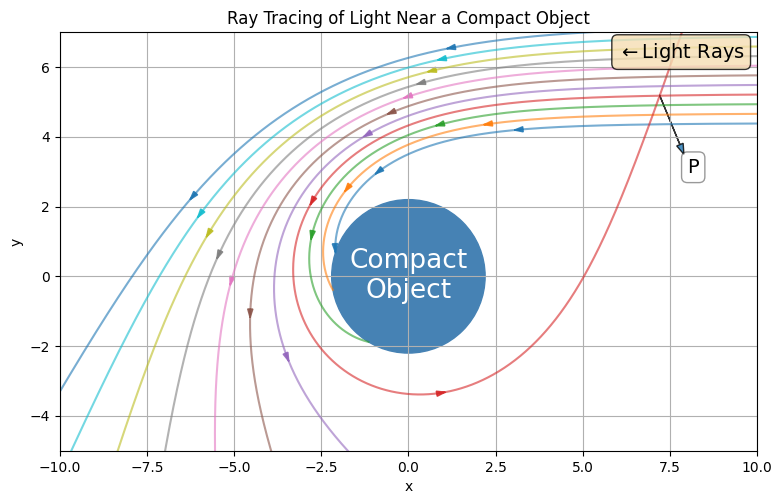
Comprehensive numerical ray-tracing confirms the existence of self-intersecting null geodesics whereby photons emitted from a point near a compact object can return to their point of origin or create spatially separated, but identical, images of that source due to extreme spacetime curvature.
Figure 1: Light is initially emitted from point P, loops around a compact object, and spatially returns to its emission point, yielding a mirror image at a remote observer location.
This process is distinct from classical gravitational lensing where the observer, lens, and source alignment forms multiple images via direct, non-looping null paths. Instead, strong-field geodesics can create one or several full loops, allowing photons to return and thus create a sequence of “mirrored” images.
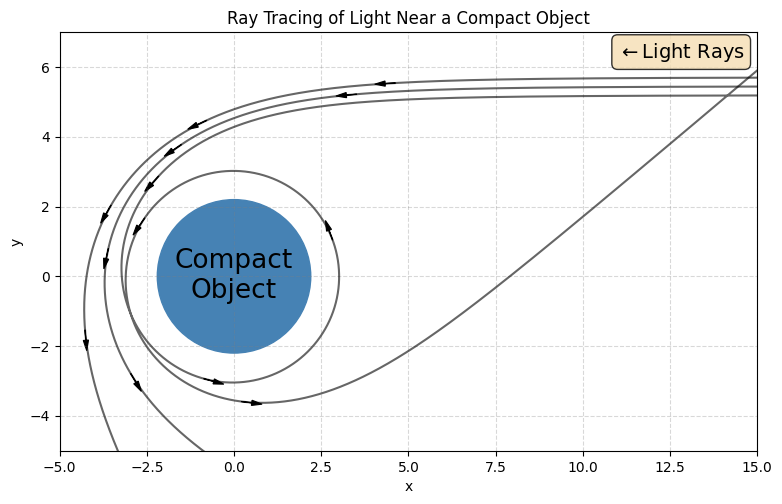
Secondary and higher-order images correspond to photon trajectories with multiple windings around the compact object before escaping to a distant observer.
Figure 2: A secondary image is generated as the photon loops twice around the lens before returning to the emission point—each successively higher-order image is created by further windings.
Such image multiplicity leads to a theoretically infinite sequence of images, each with diminished flux due to geometric path elongation and redshift effects, and with angular positions asymptotically clustering near the photon sphere. This accumulation renders separation of higher-order images infeasible with current angular resolutions, though they are essential for the formation of the photon ring and shadow morphology observed in both simulation and high-resolution astrophysical imaging.
Mathematical Characterization of Gravitational Mirroring
Deflection angles are quantized in the form α=(2k+1)π (k=0,1,2,…), where each odd multiple corresponds to photon paths that return along the direction of emission after an integer number of windings. Near the critical impact parameter bc=33M, the deflection diverges logarithmically, as expected from strong-deflection gravitational lensing theory [strong_lensing]:
α(b)≃−ln(bcb−1)+const−π.
This strongly nonlinear relation implies that the formation of spatially retraced (mirrored) images is highly sensitive to emission angle and local curvature, with only the lowest-order images contributing appreciably to observable intensity.
Distinction from Closed Timelike Curves
Although spatial projection of null geodesics exhibits closed loops, the addition of the temporal dimension converts these into non-closed, causally consistent trajectories—spiral-like paths in spacetime. Thus, this mirroring effect does not entail or suggest the existence of closed timelike curves (CTCs), and causality is preserved at the geodesic level.
Phenomenological Implications and Observational Consequences
Relevance to Black Hole Shadows and Photon Rings
The presence of mirrored and multiplicity images imparts nontrivial structure to the photon ring and shadow morphology. The rapid angular clustering near the photon sphere directly contributes to the substructure recently studied by EHT and model-based reconstructions [gralla2019, Urso2025Equatorial]. The mirror-like images are not true inverted reflections but are spatially separated, higher-order lensed images.
Impacts on Galactic Brightness Interpretation
The study posits that not all central galactic brightness can be ascribed to intrinsic mechanisms; strong-field mirroring increases the effective luminosity by redirecting both internal and external light toward observers. Consequently, analyses of galactic nuclei must account for potential flux enhancement from the cumulative effect of strong lensing by a highly compact core.
Observational Feasibility and Instrumental Constraints
Angular separation between core mirrored images and the standard photon ring is typically well below the resolving power of current VLBI arrays, including the EHT, for objects such as Sgr A*. However, future instruments with extended baselines or alternative methodologies (e.g., Bayesian inference frameworks [Tiede2025Bayesian]) may eventually discriminate or statistically infer the presence of such mirrored substructure.
Implications for Identification of Isolated Black Holes
A salient consequence is that even in the absence of foreground or background illumination, gravitational mirroring mandates a nonzero light intensity near isolated compact objects—differentiating them from perfect absorbers. Detections (or stringent non-detections) of such signatures bear directly on the classification of microlensing objects.
Frequency Shift Behavior
Analysis demonstrates that gravitational redshift and blueshift effects exactly compensate for traced-back photons, in contrast to cosmological redshift, which accumulates throughout the doubled optical path. This has implications for the interpretation of spectral evolution in the vicinity of compact lensing objects.
Broader Theoretical Implications and Generalizations
While this analysis is set within the Schwarzschild regime, the underlying mechanism extends to more general spacetimes, including the Kerr metric and scenarios with non-trivial energy-momentum structure [cramer1997, r10]. The property of null geodesic looping and image multiplicity is thus a generic prediction of general relativity in strong-field domains.
Conclusion
This investigation robustly codifies the concept of gravitational mirroring as a geometrically determined, strong-field lensing effect producing multiple, spatially retraced images—mirrored not by reflection at material surfaces, but by the non-Euclidean propagation of light in curved spacetime (2604.05009). Ray-tracing and theoretical analysis establish the conditions for, and properties of, these images, as well as clarify the distinction from CTCs. The predicted image multiplicity has direct interpretational consequences for black hole shadow science, galactic emission models, and future interferometric efforts targeting sub-photon-sphere scale imaging.
This work establishes a foundation for extending gravitational lensing studies beyond conventional weak-field and single-loop scenarios. Future directions include the exploration of mirroring effects for rotating and non-spherically symmetric spacetimes, and statistical quantification of observational prospects with next-generation VLBI infrastructure.