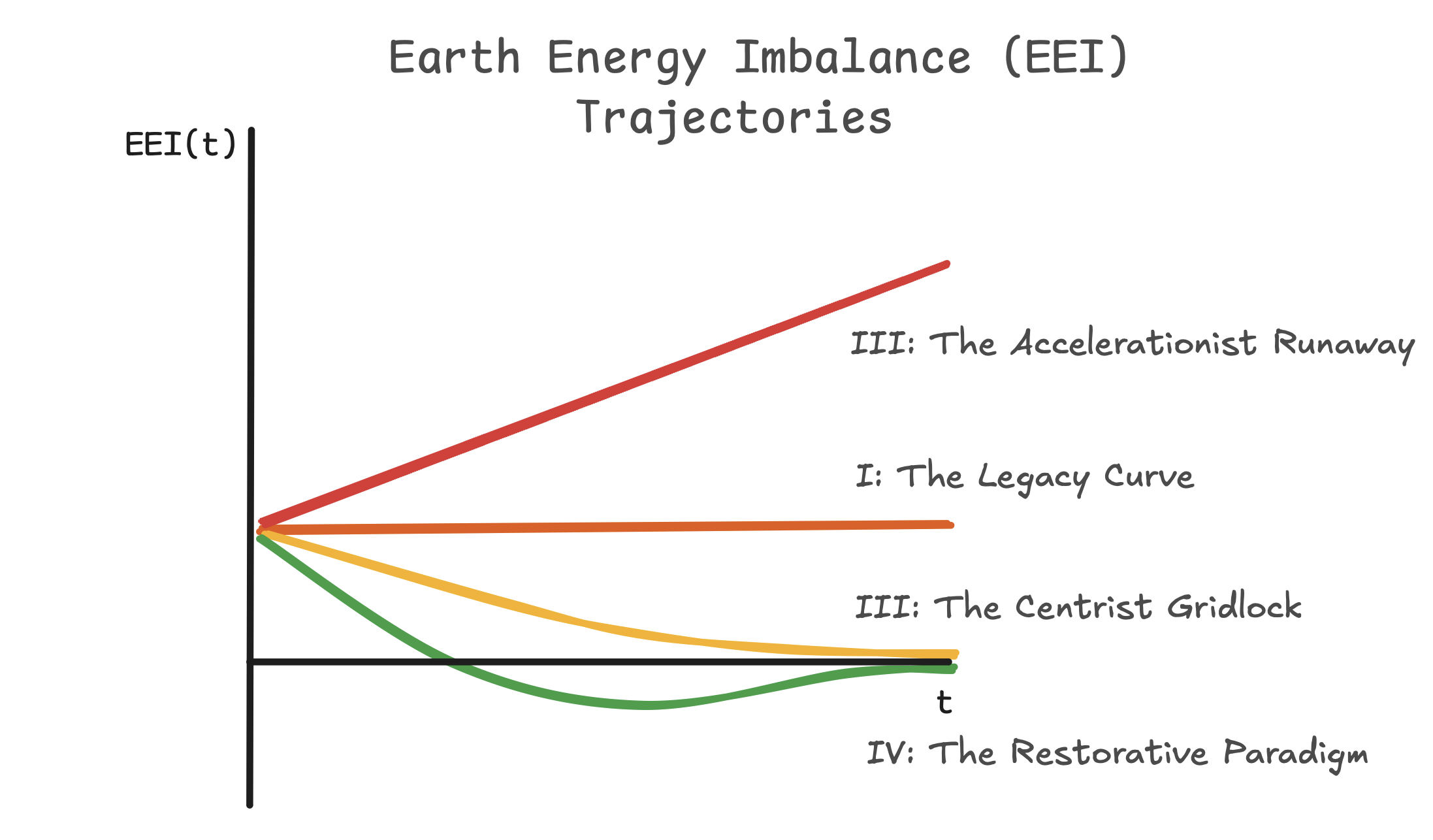
- The paper establishes AI-induced waste heat as a distinct tenth planetary boundary with a critical 6.5-year timeline before ecological tipping points are reached.
- It employs empirical climate data and thermodynamic principles, including Landauer’s limit, to model waste heat accumulation from escalating AI compute demands.
- The study outlines four civilizational trajectories, emphasizing that only coordinated AI-driven optimization can potentially reverse the trend towards catastrophic planetary heating.
The Thermodynamic Imperative of AI: The 10th Planetary Boundary and the 6.5-Year Countdown
Introduction
"The Planetary Cost of AI Acceleration, Part II: The 10th Planetary Boundary and the 6.5-Year Countdown" (2604.04956) advances a rigorous thermodynamic framing of artificial intelligence expansion within the context of planetary boundaries. The work contends that the exponential growth of AI—characterized by autonomous LLM agents and cognitive offloading—now represents a dominant, direct source of anthropogenic waste heat on a civilizational scale. By integrating physical, infrastructural, economic, and computational perspectives, the authors propose waste heat from AI as a distinct “tenth planetary boundary,” and delineate four macroscale society-trajectory scenarios based on the interplay of six critical determinants.
Cognitive Offloading as a Super-Exponential Driver
The core analysis identifies a shift in AI’s role: rather than simply automating physical labor, AI acceleration is now allowing for the massive delegation of cognitive tasks. This paradigm shift removes biological constraints from information processing, leading to month-over-month super-exponential growth in token consumption and compute demand. Unlike historical physical mechanization, cognitive offloading scales orders of magnitude faster, primarily limited by capital expansion and not by the rate of human population or physical movement.
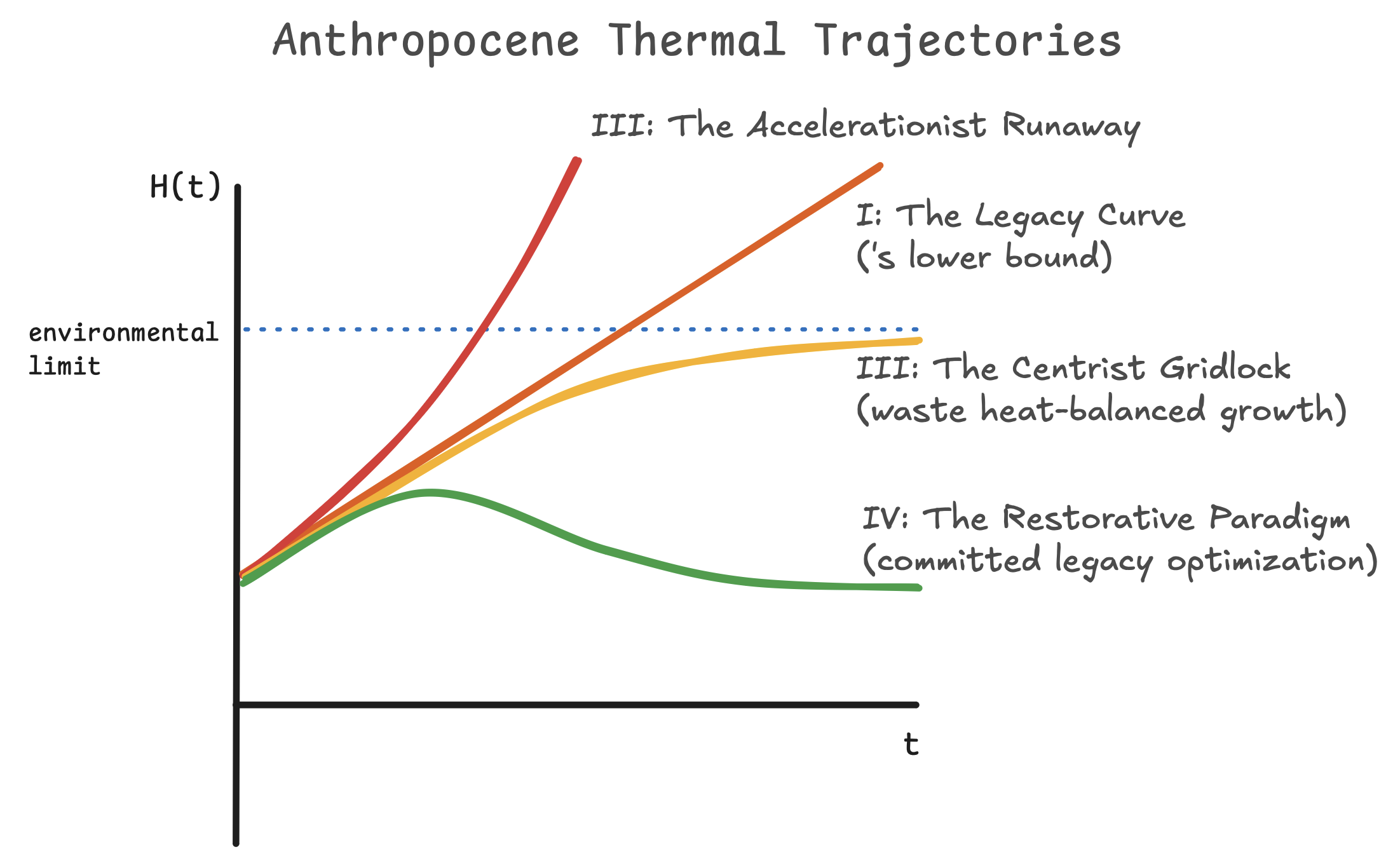
Figure 1: Net planetary heat accumulation, and four civilizational trajectories as a function of time.
AI scaling thus makes explicit the thermodynamic cost of "thought"—an unexamined component whose waste heat quickly becomes non-negligible at current and projected scales. This rapid escalation is depicted as a potential accelerant to breaching planetary ecological stability thresholds.
Thermodynamic Limits and the Illusion of Infinite Efficiency
The authors dispute techno-optimist narratives suggesting that hardware innovation or alternative computing substrates (e.g., photonic, quantum, or neuromorphic computation) can neutralize the thermodynamic burden. Landauer’s Principle and subsequent empirical data demonstrate that real-world computation operates at dissipation rates at least 105 times above theoretical minima. Quantum computing’s reliance on ultracold dilution refrigeration and the thermodynamic cost of manufacturing and launching new infrastructure present intractable barriers to externalizing or reducing waste heat at scale.
Any real mitigation, therefore, must contend with the absolute and practical limits of hardware efficiency. The negative thermal impact of computing infrastructure manufacturing, deployment, and operation across global scales cannot be trivialized as an eventuality of technical progress.
The 6.5-Year Buffer: Empirical Assessment of Planetary Risk
Leveraging empirical climate data—especially the Earth's effective climate heat capacity and observed Earth Energy Imbalance (EEI)—the paper presents the following quantitative summary:
This projection excludes any near-term reduction in carbon emissions or substantial shifts in the inertia of global greenhouse gas concentrations. The analysis underscores that direct AI-driven waste heat, while currently a minority contributor, is poised to become a dominant factor on this timeline.
Six Interacting Determinants of the Anthropocene Thermal Trajectory
The trajectory of anthropogenic thermal flux is dictated by a complex interplay of factors distilled into six determinants:
- Human Computing Demand Surge: The uncapped cognitive offloading enabled by AI sharply increases aggregate inference and processing.
- Recursive AI Delegation: Self-amplifying loops of autonomous agents initiate super-exponential compute demand, surpassing direct human intent.
- Hardware Efficiency Asymptotes: The floor set by physical and engineering constraints.
- Global Grid and Infrastructure Ceilings: The inertia and finite build-out rate of global power and compute infrastructure.
- Economic/Societal Optimization Gains (E˙opt): The degree of waste heat reduction effected by AI through elimination of systemic inefficiencies, versus Jevons paradox-driven rebound effects.
- Absolute Planetary Thermodynamic Boundary: The hard cap imposed by remaining planetary heat capacity.
The net effect of these components is formalized in an integral constraint on total planetary heat accumulation:
H(t)=∫0tEEI(τ)dτ<1.42×10²³ Joules
where 1.5∘0 combines legacy emissions, additional AI-driven computing heat, and optimization dividends.
Four Macroscopic Civilizational Trajectories
The analytic model yields four macroscale trajectories for the future of the AI-planetary system, determined by the interaction of the determinants above:
- Legacy Baseline: Continued inertia, no AI optimization, with a linear 6.5-year countdown to threshold breach and ecosystemic collapse.
- Accelerationist Runaway: Unchecked AI-driven compute expansion shortens the timeline to 4–5 years, driving a "runaway" thermodynamic catastrophe.
- Centrist Gridlock: Supply-side energy and infrastructure bottlenecks create a deadlock where incremental optimization is just sufficient to offset AI waste heat, yielding chronic ecological fragility but not collapse.
- Restorative Paradigm: Rigid alignment of AI deployment with thermodynamic priorities, deploying AI solely toward optimization and systemic negentropy, ultimately driving EEI negative and restoring planetary stability.
Figure 3: Net planetary heat accumulation, and four civilizational trajectories as a function of time.
The 10th Planetary Boundary: AI-Driven Waste Heat
The central theoretical proposition is the explicit formulation of the AI-waste-heat planetary boundary—an extension beyond the classic nine boundaries defined by Rockström et al. The authors argue that:
- Net-new waste heat from AI must not breach 1.5∘1 Joules before a negative EEI trajectory is achieved.
- AI is not merely a passive pressure; it represents a fundamental lever for enforcing or relaxing the other boundaries, conditional on whether its acceleration is constrained or harnessed for system-wide optimization.
A key claim, supported by computations and scenario analysis, is that there is no moderate, middle path: unconstrained AI scaling is directly at odds with planetary survival unless a full civilizational commitment is made to AI-driven optimization and the exclusive prioritization of systemic negentropy.
Implications and Prospects
The paper's explicit quantitative framing directly challenges strategies that rely on gradual efficiency gains, grid “greenification,” or delayed action. The imperative is not just to slow the rate of planetary waste heat addition but to effect a net-negative annual EEI within years, not decades.
For AI research and industry, the operational KPI must pivot from AGI-centric milestones to contributions toward planetary heat restoration. This also foregrounds the necessity of integrating systems-level feedback, global regulatory frameworks, and alignment on the directionality of intelligence deployment.
Theoretical implications extend to planetary management, existential risk studies, systems ecology, and the physics of computation. The practical challenge is the implementation of a “restorative paradigm” at planetary scale—demanding rapid, coordinated interventions at the intersection of AI, infrastructure, economic systems, and sociopolitical governance.
Conclusion
This work establishes the thermodynamics of AI scaling as the defining boundary condition for planetary survival in the Anthropocene. The uncompromising empirical analysis, culminating in the formulation of the AI-waste-heat planetary boundary, calls for urgent research and policy focus on the integration and control of intelligence as a thermodynamic actor. The global trajectory will bifurcate within the next several years: either AI serves as an accelerant toward collapse or, if precisely directed, as the central means by which humanity restores planetary stability and ecological viability.