Connection between the contextuality breaking and incompatibility breaking qubit channels
Published 6 Apr 2026 in quant-ph | (2604.04899v1)
Abstract: Contextuality and measurement incompatibility are two fundamental aspects of nonclassicality, and their manifestations in observed quantum correlations are often deeply interconnected. Recently, measurement incompatibility has been studied in connection with nonlocality, particularly in terms of their robustness under various quantum channels. This line of investigation helps establish a connection between the channels that break nonlocality and those that break incompatibility. In this study, we focus on an asymmetric bipartite Bell scenario involving three and four inputs on Alice and Bob sides, respectively, with each of these inputs having dichotomous outcomes. Under the assumption of locality, the observed statistics in this asymmetric scenario obeys the Elegant Bell inequality (EBI). Here, we use a different version of the EBI that relies on the assumption of the preparation noncontextuality. By taking the violation of this noncontextual version of EBI as a witness of preparation contextuality we establish a connection between the channels that break contextuality and the channels that break triple-wise measurement incompatibility. Our results suggest that any channel which breaks EBI contextuality will also break Clauser-Horne-Shimony-Holt (CHSH) nonlocality; however, the reverse does not hold. We also show that a depolarising channel that breaks N-wise incompatibility can also break a certain form of contextuality, witnessed by a generalised inequality involving N measurements on one wing of a bipartite Bell scenario.
The paper establishes a quantitative connection between contextuality-breaking and incompatibility-breaking qubit channels, with explicit noise thresholds derived for various models.
It analytically characterizes channel behavior in asymmetric Bell scenarios using depolarizing, amplitude damping, loss, and dephasing noise models.
The study reveals that while every contextuality-breaking channel also breaks CHSH nonlocality, the reverse does not hold, emphasizing a resource filter effect.
Connection between Contextuality-Breaking and Incompatibility-Breaking Qubit Channels
Introduction
This paper investigates the operational relationship between contextuality-breaking channels (CBC) and incompatibility-breaking channels (IBC) in the context of qubit systems, focusing on the dynamical degradation of quantum resources under quantum channels. The framework is built on an asymmetric bipartite Bell scenario with three dichotomic measurements for Alice and four for Bob, where contextuality is witnessed through a preparation noncontextual version of the Elegant Bell inequality (EBI). The paper formalizes both CBC and IBC, derives explicit criteria for different qubit channels, and provides a general quantitative connection between the breaking of contextuality and measurement incompatibility.
Theoretical Framework: Contextuality, Incompatibility, and Quantum Channels
Contextuality in operational quantum theories is captured via ontological models, where preparation noncontextuality means operationally equivalent preparations are mapped to identical ontic state distributions. The violation of preparation noncontextuality is denoted as preparation contextuality. In bipartite scenarios, contextuality can be detected through forms of Bell-type inequalities; the paper employs the EBI for an asymmetric measurement configuration.
Measurement incompatibility is addressed in the POVM framework, where incompatibility (the absence of a single global POVM as a post-processing parent for a set of measurements) is a strictly broader phenomenon than noncommutativity. In qubit systems, incompatibility is necessary and sufficient for Bell inequality violations only when the measurement settings are minimal (e.g., CHSH); for extended settings, this correspondence is only partial.
Quantum channels, modeled as completely positive trace-preserving (CPTP) maps, characteristically alter or destroy quantum nonclassical correlations such as nonlocality, contextuality, and measurement incompatibility. The central classes studied are nonlocality-breaking channels (NBC) and incompatibility-breaking channels (IBC), with specialized attention to their extensions for more complex measurement configurations.
Operational and Analytical Results
Contextuality-Breaking vs. Nonlocality-Breaking
The paper introduces and rigorously defines CBC with respect to EBI violations. Through explicit analysis, it demonstrates that for the studied asymmetric scenario, every CBC is also nonlocality-breaking with respect to CHSH (i.e., destroys all CHSH-type nonlocality), but the converse is generally false.
The inclusion relations between CHSH-NBC and EBI-CBC are characterized analytically for representative quantum channels (depolarizing, amplitude damping, loss, and dephasing), with precise threshold parameters determined for each.
Channel Thresholds for Contextuality and Nonlocality Breaking
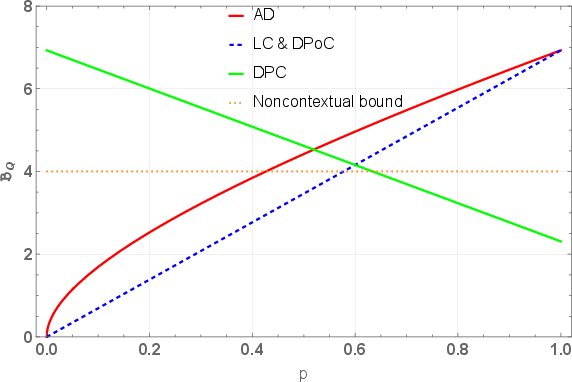
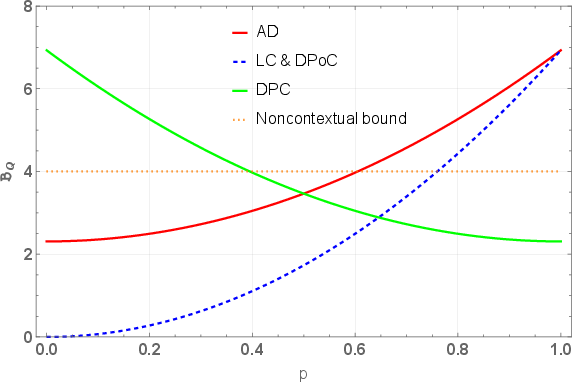
The maximum quantum value of the EBI Bell operator post channel action is computed, and threshold parameters for the various noise models are evaluated.
Figure 1: Quantum value of Bell functional BQ as a function of the channel parameter p for single- and two-qubit applications; reveals the precise parameter range for nonclassicality.
The two principal findings are:
There is a strict inclusion EBI-CBC⊂CHSH-NBC; there exist channels that break all CHSH nonlocality but do not break EBI-based contextuality.
For depolarizing and loss channels, EBI contextuality is broken for p≤1/3, while CHSH-nonlocality is broken for p≤1/2.
Connection to Measurement Incompatibility
For unital channels, a central theorem is established: a channel is EBI-contextuality-breaking if and only if its dual is 3-incompatibility-breaking. Formally, E is EBI-CBC ⇔E∗ is $3$-IBC. This operationalizes the intimate link between the loss of contextuality and the global joint measurability of three dichotomic qubit observables under noise.
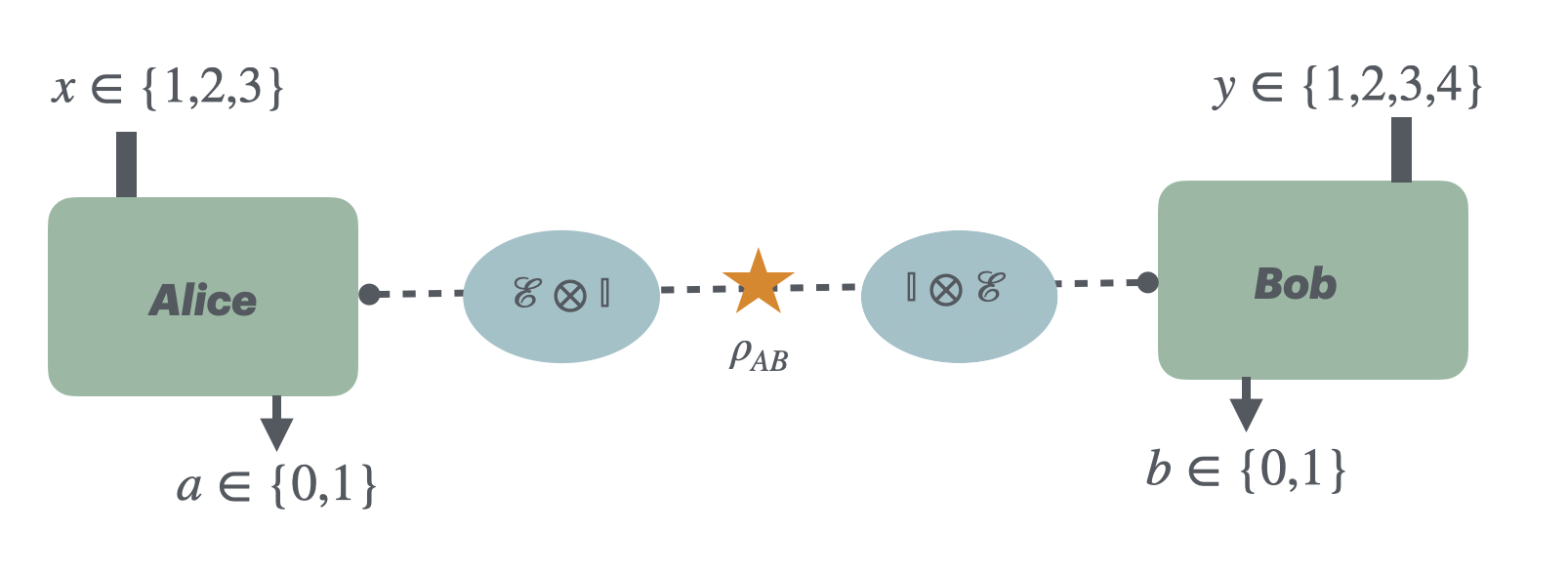
Figure 2: Action of contextuality-breaking channels E⊗I and p0 on the two-qubit state shared by Alice and Bob.
The relationship is generalized to p1-wise incompatibility breaking: for depolarizing noise, a channel is contextuality-breaking in a generalized Bell scenario (with p2 Alice measurements) if and only if the dual breaks p3-incompatibility for unbiased observables.
White-Noise Robustness
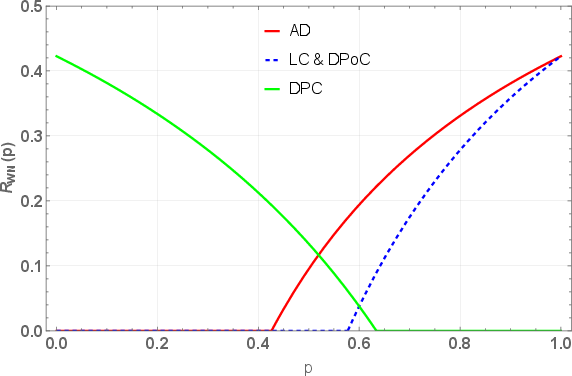
White-noise robustness p4 for EBI contextuality is defined and calculated, giving the amount of mixing with the maximally mixed state required to suppress all contextuality. The dependence of p5 on the channel parameter for the four considered noise models is analyzed and compared.
Figure 3: White-noise robustness p6 as a function of channel parameter p7 for depolarizing, amplitude damping, loss, and dephasing channels.
Robustness thresholds align with the analytic breaking conditions above, with dephasing channels exhibiting qualitatively distinct behavior.
Practical and Theoretical Implications
The results clarify the operational hierarchy of quantum resources under channel-induced decoherence: while all EBI-contextuality-breaking channels do break minimal (two-setting) nonlocality, the reverse fails in general for more extended measurement settings. This demonstrates a "resource filter" effect—destroying stronger forms of contextuality requires stronger (higher-threshold) or more decohering channels than those required to break nonlocality. In qubit systems, the connection between contextuality and p8-wise incompatibility breaking is quantitatively established for all p9 in the depolarizing scenario.
For quantum information protocols, these results indicate that certain forms of contextual quantum correlations (witnessed via asymmetric inequalities with more measurement settings) are inherently more robust to common types of noise than Bell-nonlocality. This has direct implications for scenarios relying on preparation contextuality, such as quantum communication or randomness generation certified via generalized Bell tests.
Future Directions
Several avenues for extension emerge:
Exploration of higher-dimensional systems and arbitrary POVMs beyond qubit dichotomic measurements.
Analysis of the activation phenomenon: whether collective or sequential application of noisy channels can restore contextuality, analogously to channel activation in nonlocality.
Integration with resource-theoretical approaches: classification of quantum channels according to the strongest quantum resource (entanglement, nonlocality, contextuality, incompatibility) that they break, producing a comprehensive hierarchy.
Conclusion
This work provides a precise operational connection between contextuality breaking and measurement incompatibility breaking under quantum channels for qubit systems. The strict inclusion of contextuality breaking within nonlocality breaking is established in asymmetric Bell scenarios, and explicit channel thresholds are determined analytically for all relevant qubit noise models. The results are generalized to arbitrary numbers of measurement settings and supported with robust quantitative analysis. This advances the resource-theoretic understanding of nonclassicality dynamics in quantum systems under noise (2604.04899).