- The paper introduces xRoute, a decentralized framework that enables policy-enforced multi-hop routing for cross-chain message delivery.
- The methodology decouples off-chain route computation from on-chain security enforcement, using cryptographic proofs to validate each routing hop.
- Evaluations demonstrate nearly 90% chain connectivity, scalable throughput of 32k messages/sec, and cost efficiency under $0.10 per multi-hop message.
Policy-Enabled Multi-Hop Routing for Cross-Chain Message Delivery: An In-Depth Analysis of xRoute
Motivation and Problem Statement
Blockchains are increasingly fragmented, as assets and applications are scattered across thousands of independent chains. Cross-chain interoperability is necessary to unlock composability and user utility, yet current bridging solutions are fraught with critical challenges: limited to direct connections, introducing centralizing trust assumptions (e.g., through hubs), and increasing user risk due to opaque route security and costs. Even advanced protocols like IBC offer only limited practical connectivity due to overhead in managing direct channels, and hub-and-spoke solutions trade decentralization and scalability for ease of connectivity. There is no support for application-level routing policies or systematic enforcement of security constraints during message delivery.
xRoute System Overview
xRoute is introduced as a decentralized, policy-driven framework for multi-hop cross-chain message routing, architected to strictly enforce security policies on-chain while optimizing preference policies off-chain. The design cleanly separates core concerns into on-chain and off-chain components, achieving composable routing policy expression, cryptoeconomic incentive alignment for relayers, and horizontal scalability.
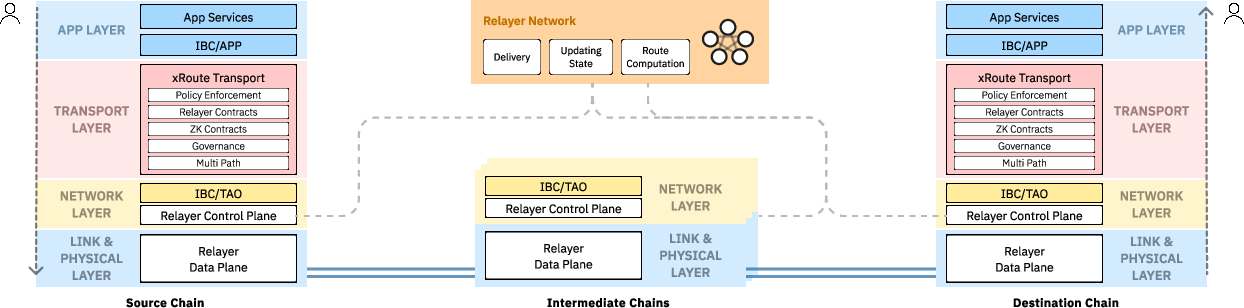
Figure 1: High-level xRoute system architecture, illustrating the division of responsibilities between on-chain policy and governance, and off-chain route computation and data relaying by decentralized relayer nodes.
The architecture employs a multi-layer abstraction:
- Application Layer provides a standardized service interface for cross-chain messaging.
- Policy Enforcement and Governance modules enable on-chain policy declaration, enforcement, and channel/chain mapping via decentralized voting.
- Transport and Multi-Path modules manage route validation, delivery atomicity, and optional multi-path redundancy for security.
- The Relayer Network, a dedicated permissionless BFT blockchain, orchestrates the off-chain computation and packet delivery, allowing horizontal scaling by specialization.
Multi-Hop Route Computation and Security Policy Enforcement
A core contribution is the decoupling of route computation (off-chain) and strict enforcement of security constraints (on-chain at the destination). Users/applications specify routing policies in terms of both hard security predicates (e.g., minimum Nakamoto coefficient, minimum validator set size) and preference metrics (fee bounds, latency).
Relayers compete and collaborate in the relayer network to compute feasible paths that satisfy these application-level policies. Security policies are strictly enforced by destination chains: relayers must provide cryptographic proofs (incremental Merkle and light-client proofs) that every chain on the proposed route meets each declared property. For example, Nakamoto coefficient constraints are validated against authenticated validator set hashes committed during client updates.
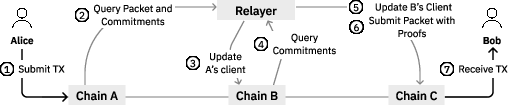
Figure 2: Sequence diagram of a multi-hop packet flow, showing state synchronization, packet relaying, and proof submission across all route hops.
Relayer Network Design
Unlike the legacy IBC model—where relayers must hold gas and run light clients for all hops in a path—xRoute’s relayer network introduces specialization. Each relayer only monitors and manages gas for the chains it stakes on, reducing operational burdens. They collectively construct and deliver packets through coordinated transactions, locked by an on-chain incentive structure that penalizes misbehavior.

Figure 3: Relayer network and management contract interaction, showing token staking, event coordination, multi-party packet routing, and escrow operations.
The relayer network operates as a BFT blockchain itself, ensuring liveness and safety under standard f<n/3 Byzantine conditions, and management contracts act as fee escrows and signature verifiers for end-user and relayer payments.
Multi-Path Delivery and Robustness
For higher security, xRoute’s multi-path module enables users to specify multiple disjoint delivery routes, requiring the destination to receive at least M successful receipts from N possible paths. This design provides Byzantine fault tolerance against intermediate chain compromise or network-level censorship, as only a minimal threshold of path successes are necessary for message acceptance.
Evaluation
xRoute is benchmarked against both direct IBC and hub-and-spoke (Axelar/Cosmos Hub) paradigms across Cosmos mainnet topologies. Key metrics include:
- Connectivity: With a minimum intermediate Nakamoto coefficient of 8, xRoute achieves nearly 90% chain-to-chain connectivity, in contrast to sub-15% for hub-and-spoke or direct-only approaches.
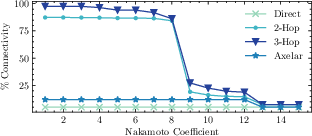
Figure 4: Impact of xRoute on chain-to-chain connectivity, subject to security threshold constraints on intermediates.
- Decentralization: Simulated removal of top-connected chains demonstrates that xRoute provides over 50% residual connectivity after removal of the top four, due to flexible multi-hop pathing and decentralized route selection; hub-and-spoke approaches degrade precipitously with hub loss.
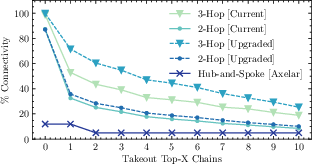
Figure 5: Residual connectivity as top-connected chains are removed; multi-hop routing enables robustness even under aggressive hub failures.
- Scalability: xRoute sustains over 32k cross-chain messages/sec before latency impact in a 500-chain simulation, while hub-and-spoke designs saturate at native chain throughput (~4k/sec).
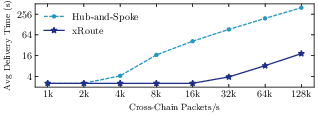
Figure 6: End-to-end cross-chain message delivery time as network load increases, illustrating superior xRoute scaling.
- On-Chain Costs: Gas overhead per hop is low (additional ~15k gas units per validator); amortized over channel reuse, cost per multi-hop message remains under $0.10 even at high validator counts and hop counts.
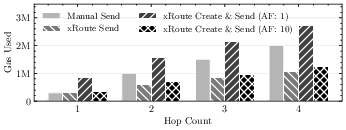
Figure 7: On-chain gas cost comparison between xRoute and manual multi-hop messaging; channel reuse amortizes setup cost in xRoute.
- DeFi Use-Case: StableSwap: A multi-chain stablecoin swap protocol leveraging xRoute obtains near-unified liquidity with 3-hop routing, avoiding the slippage-limited curve of single-chain liquidity pools.
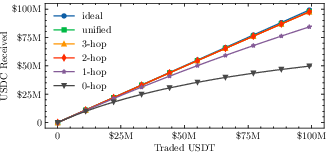
Figure 8: Comparison of stablecoin swap output between 0-hop (local), 1-hop, 3-hop, and unified pools; multi-hop achieves almost ideal liquidity utilization for large trades.
Alternative Routing Designs and Tradeoffs
The paper also investigates alternative designs, including:
- Single-relayer Routing: Simpler but operationally burdensome due to the need for universal monitoring/gas management.
- Zero-Knowledge Routing (zkRouter): Routes and preference policy satisfaction are proven via off-chain ZK proofs (RISC Zero), minimizing trust but imposing non-trivial proof generation costs.
- Link-State On-Chain Routing: Routing tables on-chain provide fast lookup but are rendered infeasible by excessive read/write gas costs.
Implications and Future Directions
Practically, xRoute provides a general-purpose, policy-enforceable, and dependable substrate for cross-chain applications, especially in DeFi contexts demanding robust composability and availability (e.g., multi-chain liquidity, arbitrage, and atomic contract execution). Theoretically, it establishes a blueprint for separating route discovery from cryptographic enforcement in decentralized settings, and demonstrates the possibility of fee-optimal, policy-respecting routing without new centralized trust anchors.
Open directions include integration with more expressive ZK-based routing proofs, further optimizations in relayer incentive compatibility, adaptation to non-IBC chains (heterogeneous light-client ecosystems), and applications to on-chain governance, oracle integration, and modular rollup interoperability.
Conclusion
xRoute substantially advances the state-of-the-art for secure, decentralized, composable multi-hop cross-chain message delivery. By allowing policy-enforced multi-hop routing without new trust assumptions, and by introducing scalable, incentive-aligned relayer coordination, the framework achieves high connectivity, robustness, and cost-efficiency unattainable in prior models. Its deployment and open-source implementation lay a foundation for practical multi-chain dApps, broadening compositional possibilities while minimizing centralization risks and operational overheads.
Reference: "Towards Policy-Enabled Multi-Hop Routing for Cross-Chain Message Delivery" (2604.04890)

