- The paper develops a perturbative framework that links GUT-induced variations in the fine structure constant (α) to parameters R and S, tested against primordial abundance data.
- It compares gravitational sector assumptions—varying particle masses versus varying Newton’s constant—to reveal distinct sensitivity patterns in Deuterium and Helium-4 predictions.
- Updated observational constraints yield α variations confined to tens of ppm, ruling out GUT-induced coupling changes as a standalone solution to the Lithium-7 problem.
Probing Unification Scenarios with Big Bang Nucleosynthesis
Introduction
This paper presents a comprehensive extension of the Python-based Big Bang Nucleosynthesis (BBN) simulation code, PRyMordial, designed to quantitatively constrain broad classes of Grand Unified Theories (GUTs) via their implications for the variation of fundamental coupling constants during the BBN epoch. The underlying motivation is that GUTs generically predict that nature's dimensionless couplings, such as the fine structure constant α, may have evolved between the early universe and the present epoch. BBN, as one of the earliest cosmological processes probed by robust observational data, is a sensitive laboratory for these variations since it depends critically on the values of these couplings.
A central emphasis of the study lies in dissecting the impact of alternative assumptions within the gravitational sector—namely, whether the "variation" is absorbed by particle masses or by Newton's constant GN. This enables a comprehensive mapping of the corresponding parameter space, utilizing a perturbative framework that links all relevant variations to Δα/α. The analysis is then systematically anchored to updated Deuterium and Helium-4 observations, aiming to isolate viable regions of GUT parameter space under each scenario and to interrogate the persistent "Lithium problem."
Parameterization of GUT-Induced Coupling Variations
The work employs a perturbative formalism where all relevant variations (masses, lifetimes, couplings) are parametrically connected to Δα/α via two additional free parameters, R (strong sector) and S (electroweak sector). This parameterization efficiently collapses the complexity of the broad GUT landscape into a computationally tractable framework. It accommodates both scenarios where the primary variation is attributed to particle masses (with GN fixed) and the complementary case where GN varies while particle masses are held fixed.
This framework yields explicit analytic expressions for the variations of all relevant quantities, including baryon masses, neutron-proton mass splitting, Fermi's constant GF, and the neutron lifetime, as functions of (Δα/α,R,S). Notably, the mapping admits both positive and negative values for GN0 and GN1, encapsulating a spectrum of GUT possibilities, including string-motivated dilaton models and less conventional cases.
Numerical Implementation and Validation
The modified PRyMordial code introduces sensitivity coefficients at the initialization stage for all affected physical parameters. Two independent choices for the gravitational sector—either mass variation or GN2 variation—are programmatically selectable, enabling direct comparison. The code is validated by ensuring consistency with previously published results in the limit of no variation and by comparing simulations to legacy analyses using earlier nuclear rates.
A key numerical feature is the robust assessment of the impact of updated nuclear reaction rate databases, specifically PRIMAT and NACRE II. Significant attention is given to the propagation of uncertainties from these rates, showing their dominant role in the final BBN abundance uncertainties.
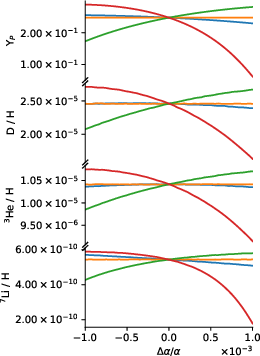
Figure 1: Primordial abundances as a function of GN3 for four representative GUT parameter choices, assuming varying masses and highlighting the sensitivity of light nuclei yields to both coupling variations and GUT structure.
Impact of Gravitational Sector Assumptions
Substantial differences arise depending on whether coupling variations are tied to particle mass variations or to varying GN4. In the varying-mass scenario, sensitivities of primordial Deuterium and Helium-4 are degenerate along a characteristic direction in GN5 space, which is empirically determined to follow GN6. When GN7 varies, the respective sensitivities become quasi-orthogonal, breaking the degeneracy in the combined fit to multiple abundances.
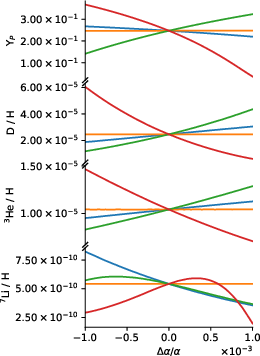
Figure 2: Primordial abundances as a function of GN8 under the assumption of varying GN9, emphasizing altered response curves especially for Helium-4 and Deuterium.
The empirical response surfaces are systematically explored and visualized through "cheese charts" and multi-dimensional scatter plots.
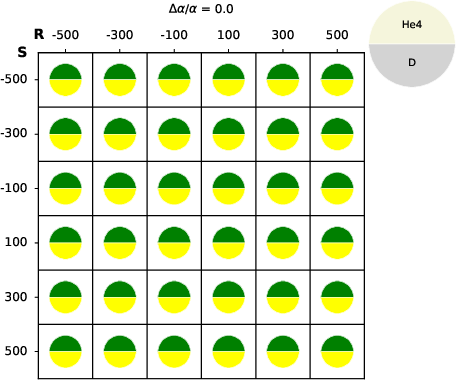
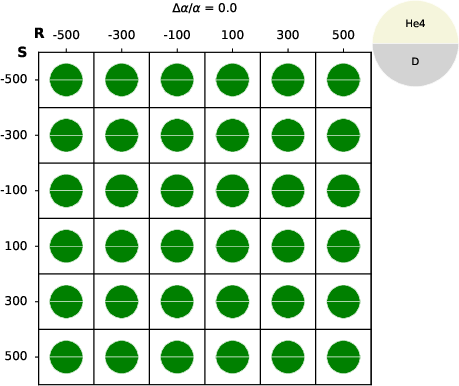
Figure 3: Cheese chart for Δα/α0, contrasting Helium-4 and Deuterium data and highlighting parametric fit quality under different nuclear rate inputs.
Constraints from Observations
Applying contemporary observations of primordial Deuterium and Helium-4, the authors perform a maximum-likelihood analysis in the Δα/α1 space, including both observational errors and simulation uncertainties. The following constraints are established:
- For the varying-mass scenario: Δα/α2 ppm (Δα/α3 CL)
- For the varying-Δα/α4 scenario: Δα/α5 ppm, Δα/α6, Δα/α7 (Δα/α8 CL)
The analysis establishes that Δα/α9 is decisively excluded absent extreme fine-tuning of Δα/α0 and Δα/α1.
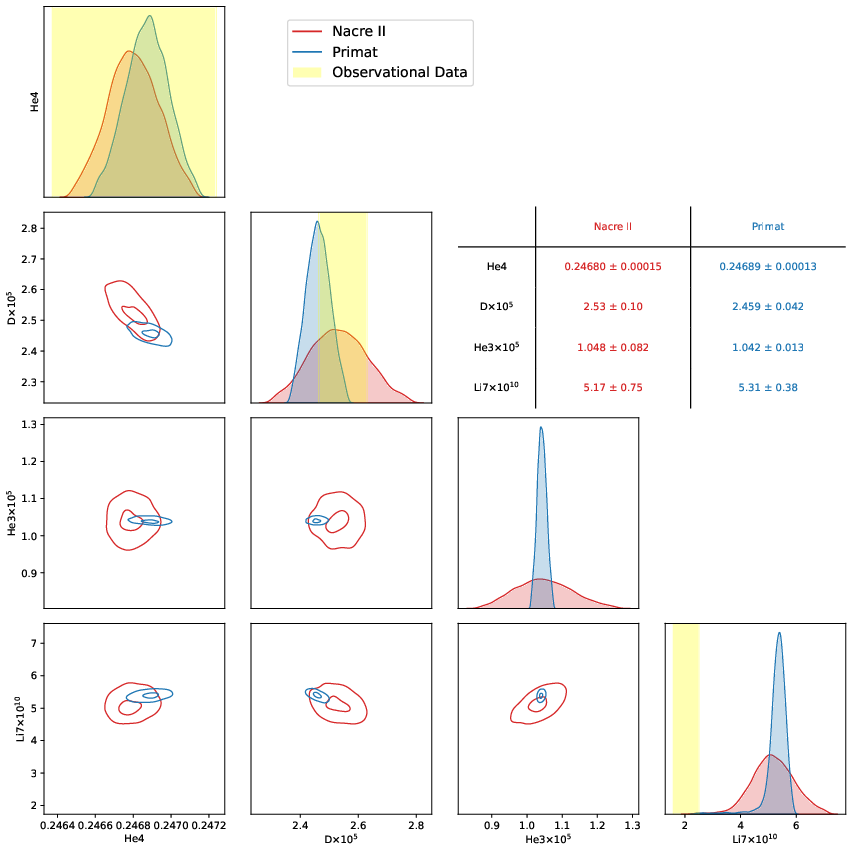
Figure 4: Probability distributions and confidence regions for the four BBN abundances under both NACRE II and PRIMAT nuclear rates, compared to observation, confirming the sensitivity of the fit to nuclear physics inputs.
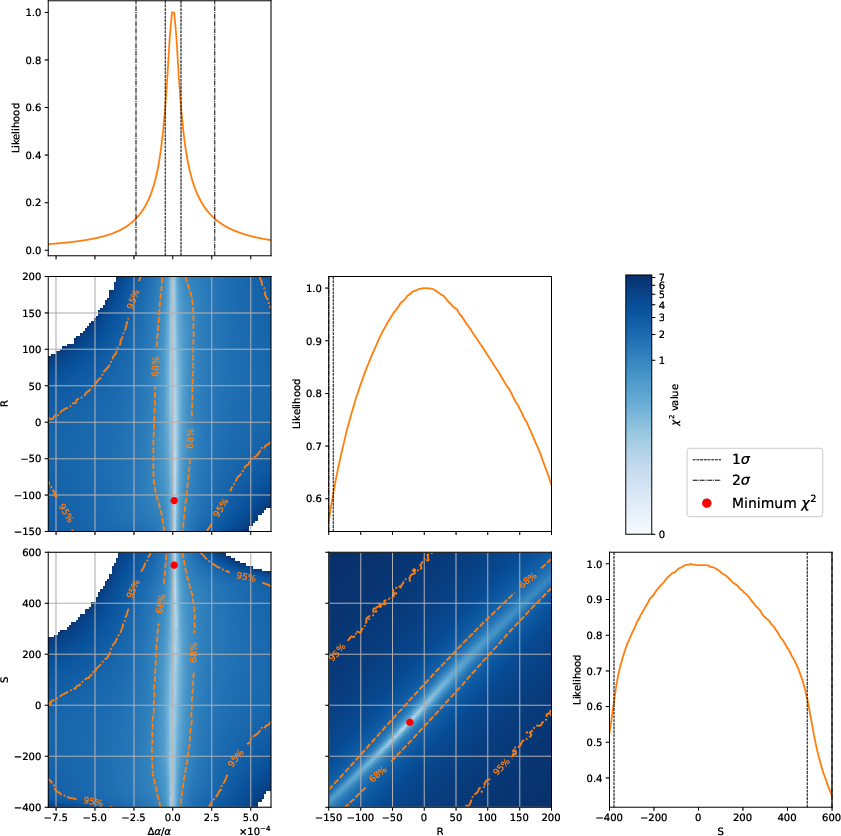
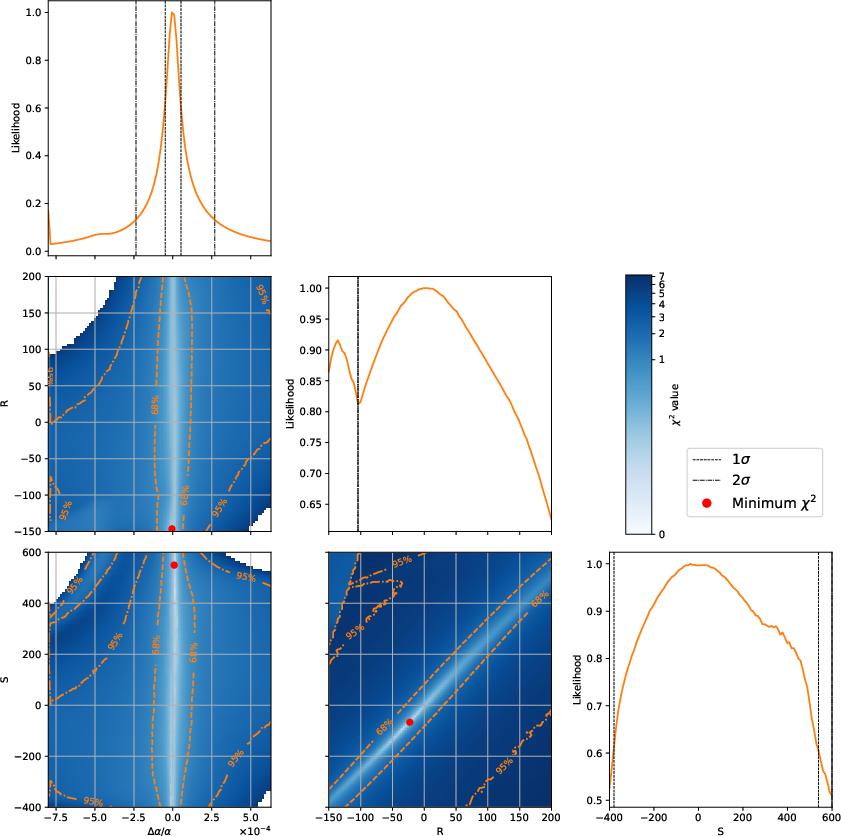
Figure 5: BBN constraints on GUT parameter space for varying masses, with and without simulation uncertainties, showing strong exclusion of large coupling variations and bounding Δα/α2 along characteristic directions.
The Lithium Problem
Even with the expanded GUT parameter space and accompanied coupling variations, the analysis demonstrates that no concordant solution to the cosmological Lithium-7 overproduction issue emerges. Model variants that satisfy Deuterium and Helium-4 constraints yield only minor (subdominant) reductions in predicted Lithium-7 abundance; achieving full alignment with observations would require additional non-GUT-driven mechanisms.
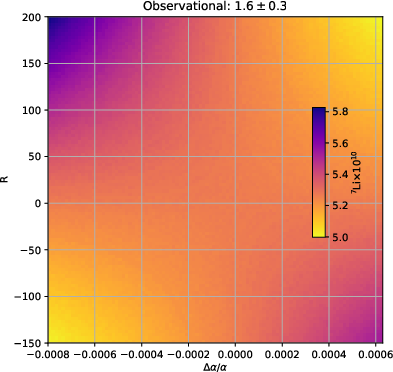
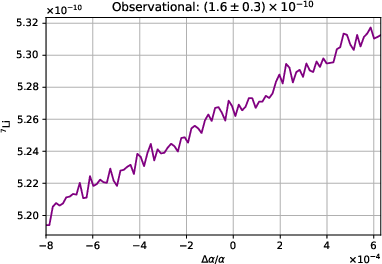
Figure 6: Predicted Lithium-7 abundances in the parameter regions preferred by Deuterium and Helium-4, illustrating the lack of a GUT-based resolution for the cosmological Lithium problem within allowed parameter ranges.
Implications and Future Directions
The simulation-based limits on the time evolution of Δα/α3 at the BBN epoch are constraining (tens of ppm), albeit less stringent than low-redshift limits from spectroscopic observations but much tighter than those from CMB data. These BBN-era constraints are robust to reasonable uncertainties in nuclear rates and are best exploited in combination with laboratory, CMB, and high-redshift measurements for global GUT tests.
A practical implication is the potential for next-generation spectroscopic facilities (e.g., ELT/ANDES) to drive uncertainty margins to the single digit ppm, and for multi-messenger astrophysics (compact stars, atomic clocks) to probe the universality of the GUT-induced coupling variation laws across vastly different densities and epochs.
The analysis also identifies the need for further work on incorporating consistent nuclear rate and binding energy perturbations and cross-comparison with future, improved observations.
Conclusion
The present work solidifies BBN as a sensitive and robust probe of coupling variation in the context of GUTs, implementing a flexible and thoroughly validated computational framework for parameter estimation. It provides comprehensive constraints on the fine structure constant and GUT-related parameters at Δα/α4, and reinforces the necessity for improved nuclear physics input and joint analyses across cosmological epochs and physical contexts. Importantly, it also rules out GUT-induced coupling variations as a standalone explanation for the primordial Lithium-7 discrepancy, highlighting the need for alternative or additional physical mechanisms.