- The paper achieves a first high-significance detection of the 3D galaxy-velocity power spectrum, recording a 17σ signal for LRGs via a novel kSZ reconstruction method.
- It employs a minimum-variance quadratic estimator and forward-modeling to mitigate foregrounds and systematic effects, enabling unbiased velocity field measurements.
- The results provide tight constraints on primordial non-Gaussianity and reveal a lower-than-expected velocity bias, offering new insights into baryonic feedback models.
Measurement of the Three-Dimensional Galaxy-Velocity Power Spectrum with the kSZ Effect: DESI DR2 and ACT DR6
Introduction and Scientific Context
This work presents a comprehensive analysis of the large-scale cosmic velocity field reconstructed via the kinematic Sunyaev-Zeldovich (kSZ) effect, using data from the Atacama Cosmology Telescope DR6 and DESI DR2 spectroscopic samples—luminous red galaxies (LRGs), emission-line galaxies (ELGs), and quasars (QSOs). By cross-correlating high-resolution CMB temperature maps with precise galaxy redshift catalogs, the authors reconstruct the radial velocity field and directly measure the galaxy-velocity and velocity-velocity power spectra in three dimensions, providing constraints on primordial non-Gaussianity (PNG), baryonic feedback, and cosmological growth on ultra-large scales (2604.04867).
The kSZ effect arises from CMB photons Doppler-shifted by free electrons in bulk motion, providing a direct probe of the dark matter velocity field traced by large-scale structure. Its utilization for velocity reconstruction, when combined with extensive spectroscopic redshift information, can circumvent key systematics limiting traditional galaxy clustering analyses, especially cosmic variance and observational starlight contamination.
The analysis leverages the ACT DR6 CMB maps at 90/150 GHz, employing tailored filtering to maximize the kSZ signal and mitigate foregrounds (tSZ, CIB, and primary CMB). CMB pixel weights remove high-noise and strong-foreground regions, while DESI DR2 provides well-characterized spectroscopic samples spanning $0.4∼5500 deg2.
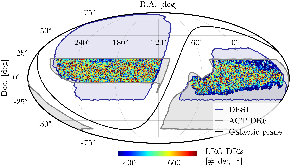
Figure 1: Angular density distribution of DESI DR2 LRGs before completeness correction, with the overlap with ACT DR6 shaded; regions with incomplete coverage shown in blue.
The velocity reconstruction uses a minimum-variance quadratic estimator combining the three-dimensional galaxy density with filtered CMB temperature values evaluated at galaxy positions. The estimator is normalized according to theoretical expectations for signal amplitude and subjected to mean subtraction in redshift bins to suppress slowly-varying foregrounds. Model predictions, mask effects, and covariances are forward-modeled using a "surrogate" methodology that simulates Gaussian random fields matched to the survey geometry and observational constraints, avoiding computationally prohibitive full N-body simulations.
Foreground leakage and survey window effects are meticulously characterized. The monopole of the galaxy-velocity power spectrum—sourced primarily by tSZ—is isolated to infer the amplitude and frequency dependence of residual foregrounds, and its leakage into the dipole (relevant for velocity field measurements) is explicitly modeled and shown to be small compared to statistical uncertainties.
Key Results
Foreground Characterization
(Maps such as those in Figure 2 reveal the impact foregrounds have on the measured monopoles.)
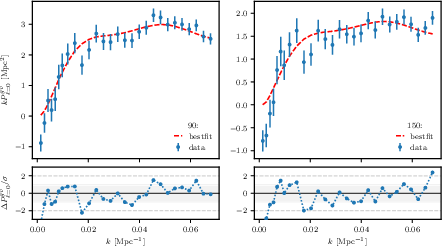
Figure 2: Monopole of the LRG galaxy-velocity power spectrum, demonstrating significant detection of foregrounds, especially tSZ, and validating modeling assumptions by reproducing frequency scaling.
The tSZ effect dominates the foreground contribution to the monopole, as confirmed by its frequency scaling. Combined, the robust modeling of foregrounds allows extraction of unbiased velocity dipole signals.
Galaxy-Velocity and Velocity-Velocity Spectrum Measurements
The galaxy-velocity dipole for LRGs is detected at 17σ significance, exceeding prior kSZ measurements by an order of magnitude, with parallel detections at 8.3σ (ELGs) and 6.8σ (QSOs). Notably, this is the first high-significance measurement for non-LRG tracers with spectroscopic redshifts in the kSZ context:
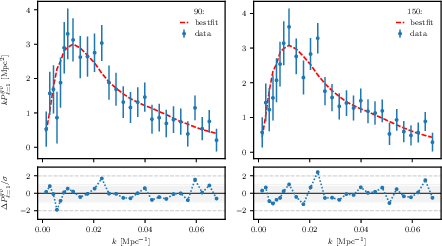
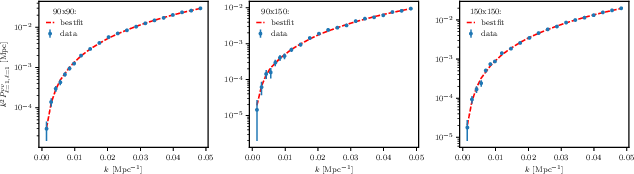
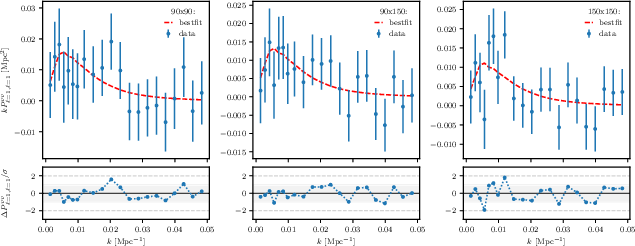
Figure 3: Blue points: measured LRG galaxy-velocity dipole; red dashed: best-fit theoretical prediction. The high SNR and fidelity to model highlight the precision of the measurement.
The three-dimensional velocity-velocity auto and cross-spectra are also measured for the first time in a wide-field spectroscopic sample, achieving 3.1σ significance with LRGs. The reconstructed velocity noise is shown to be lower than galaxy shot noise at k<0.004Mpc−1, demonstrating that kSZ velocity reconstruction can outperform galaxy density-based constraints on the largest scales with current-generation data.
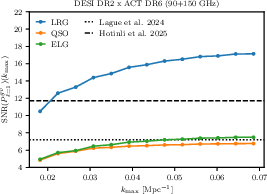
Figure 4: Evolution of the signal-to-noise ratio as a function of kmax: LRGs (blue), ELGs (green), and QSOs (orange) far surpass previous photometric or BOSS-based results, establishing the new SNR benchmark for spectroscopic kSZ analyses.
Constraints on Primordial Non-Gaussianity
The velocity- and galaxy-velocity measurements are translated into direct constraints on local-type PNG (fNL) via their distinctive scale-dependent biasing signature in the large-scale power spectrum. Combining tracers yields fNL=15.9±34.5 (68%), the tightest constraint to date from velocity field reconstructions, with negligible bias from systematics or foregrounds.
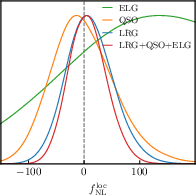
Figure 5: Posteriors on ∼5500 deg20: LRGs (blue), QSOs (orange), ELGs (green), and the multi-tracer combination (red). Agreement between tracers and precision of the joint constraint are evident.
Baryonic Feedback and ∼5500 deg21 Amplitude
A persistent finding is the low amplitude of the recovered kSZ signal relative to standard halo model predictions (Battaglia profile), indicated by ∼5500 deg22 for LRGs, QSOs, and even lower for ELGs. This is consistent with earlier kSZ and stacking studies and points to the necessity of stronger baryonic feedback in hydrodynamic simulations or revision of electron density models. The result is robust to detailed galaxy modeling since the velocity bias parameter is marginalized over in the analysis.
Velocity Reconstruction vs. Galaxy Density Approaches
The authors quantify that at ∼5500 deg23, the reconstructed velocity field noise is lower than galaxy shot noise, a regime where cosmic variance cancellation and cross-correlation with CMB lensing or other probes becomes particularly powerful.
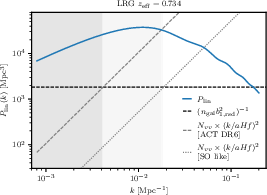
Figure 6: Linear matter power spectrum at ∼5500 deg24 compared to LRG shot noise (black dashed) and reconstructed velocity noise (gray dashed). Velocity reconstruction becomes the lowest noise probe for ∼5500 deg25, highlighting unique constraining power on ultra-large scales.
Implications and Future Prospects
Cosmological and Astrophysical Implications
- Ultra-Large-Scale Cosmology: The robust detection of the 3D velocity field and joint galaxy-velocity/velocity-velocity spectra, with systematics tightly controlled via spectroscopic data and CMB cross-correlation, enables unbiased measurements of PNG and opens avenues for further constraints once galaxy-galaxy spectra are unblinded and included in joint analyses (enabling maximum cosmic variance cancellation).
- Feedback and Ionized Gas Physics: The low ∼5500 deg26 amplitude, across distinct tracers and redshifts, strengthens the evidence for non-standard baryonic feedback models, requiring adjustment in the treatment of the circumgalactic and intergalactic electron density in ∼5500 deg27-body and hydrodynamic simulations [Battaglia2016].
- Survey Design and Future CMB Experiments: The methodology—demonstrating that velocity reconstruction can already match or out-perform galaxy density statistics at ultra-large scales—strongly motivates optimized cross-correlation analyses with next-generation CMB surveys (Simons Observatory, CMB-S4), and future spectroscopic efforts (DESI-II, Euclid, LSST, SPHEREx).
- Optimal Weighting and Multi-tracer Analysis: Incorporation of advanced weighting schemes, more accurate halo occupation models, and full sample variance cancellation with joint clustering/velocity analyses are projected to push velocity-based PNG constraints to ∼5500 deg28, providing a potential route to discrimination between single- and multi-field inflationary models.
Broader Methodological Advances
The surrogate methodology deployed allows for computationally efficient yet accurate forward-modeling of window, mask, and survey effects, making it scalable for future large datasets. The approach for foreground treatment—using spectroscopic redshifts and frequency scaling—is robust and extensible to future datasets, including intensity mapping and line surveys.
Conclusion
This work establishes a new precision benchmark for kSZ-based cosmic velocity field reconstruction with spectroscopic samples, robustly detecting the 3D galaxy-velocity and velocity-velocity spectra across multiple tracers and redshifts. It demonstrates, through rigorous modeling, that the observational noise floor in velocity field reconstructions can undercut that of galaxy density at the largest accessible scales, providing a powerful new lever arm for ultra-large-scale cosmology, primordial non-Gaussianity, and baryonic feedback models. The analysis framework, including computational, statistical, and foreground management innovations, is well-positioned to be applied to upcoming generations of CMB and LSS surveys, facilitating further theoretical and practical advances in cosmic structure mapping.