- The paper introduces a hybrid quantum-classical FNO that integrates a variational quantum circuit into spectral mixing, reducing parameters by up to 16%.
- It benchmarks the surrogate model on 3D laser processing simulations, achieving lower temperature and phase-fraction errors compared to classical approaches.
- The study demonstrates optimal quantum-classical partitioning, highlighting scalable surrogate modeling for real-time digital twin applications.
Hybrid Quantum-Classical Fourier Neural Operators for 3D Laser Processing Surrogate Modeling
Overview and Motivation
The paper "Hybrid Fourier Neural Operator for Surrogate Modeling of Laser Processing with a Quantum-Circuit Mixer" (2604.04828) presents a hybrid quantum-classical neural operator, HQ-LP-FNO, designed as a parameter-efficient and accurate surrogate model for 3D multiphysics phenomena in laser material processing. Classical Fourier Neural Operators (FNOs) excel at parameterizing solution operators for parametric PDEs but suffer from linear parameter growth with the number of retained Fourier modes due to dense mode-wise spectral mixing. This paper proposes augmenting the FNO spectral channel mixing with a variational quantum circuit (VQC) acting as a mode-shared mixer, dramatically reducing the parameter count while maintaining or improving predictive accuracy. The methodology is benchmarked on a demanding dataset comprising multiphysics simulations for Ti–6Al–4V laser tracks, covering conduction to keyhole regimes.
Surrogate Modeling Framework and Dataset
The surrogate target is three-dimensional, quasi-steady temperature and phase-fraction fields induced by high-energy laser processing, simulated using FLOW-3D WELD. The dataset spans a parametric window in laser power and scan speed, stratified by normalized enthalpy to ensure coverage of all process regimes.
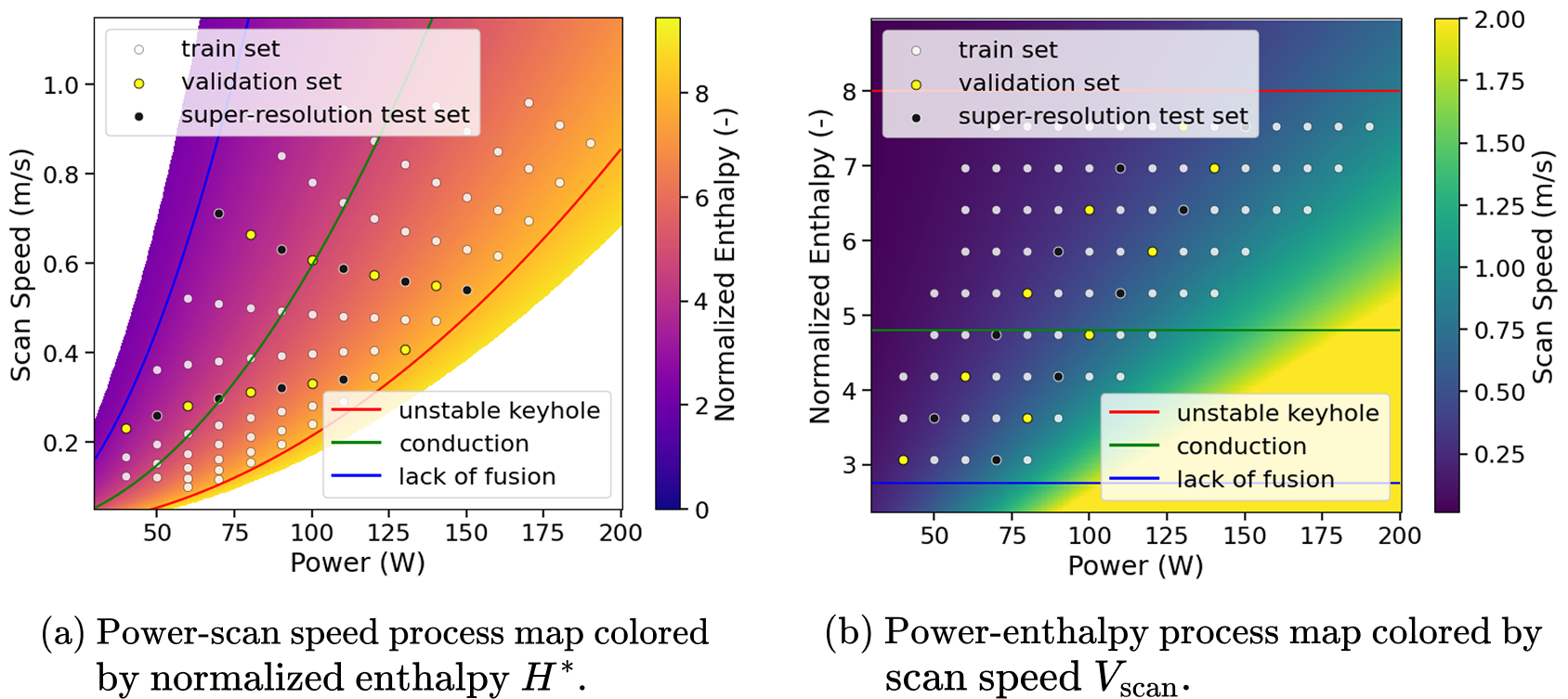
Figure 1: Parameter-space coverage of the high-fidelity FLOW-3D WELD simulation dataset over process power and scan speed, color-coded by normalized enthalpy.
In the surrogate modeling protocol, the network input at each spatial grid point consists of spatial coordinates, process parameters, and derived normalized enthalpy. Outputs are the predicted temperature and volume-of-fluid (VoF) metal fraction fields. For consistency, preprocessing and evaluation metrics are aligned with the established LP-FNO framework.
Hybrid Quantum-Classical FNO Architecture
The baseline LP-FNO architecture uses spectral convolution layers, where the dominant parameter cost arises from dense, per-mode channel mixing in Fourier space. The central technical innovation is the partitioned hybridization of the spectral convolution: the output channels at each retained mode are split between a quantum branch (processed by a mode-shared VQC) and a classical branch (processed by a mode-dependent dense matrix). The quantum branch's parameter count is independent of the number of retained modes.
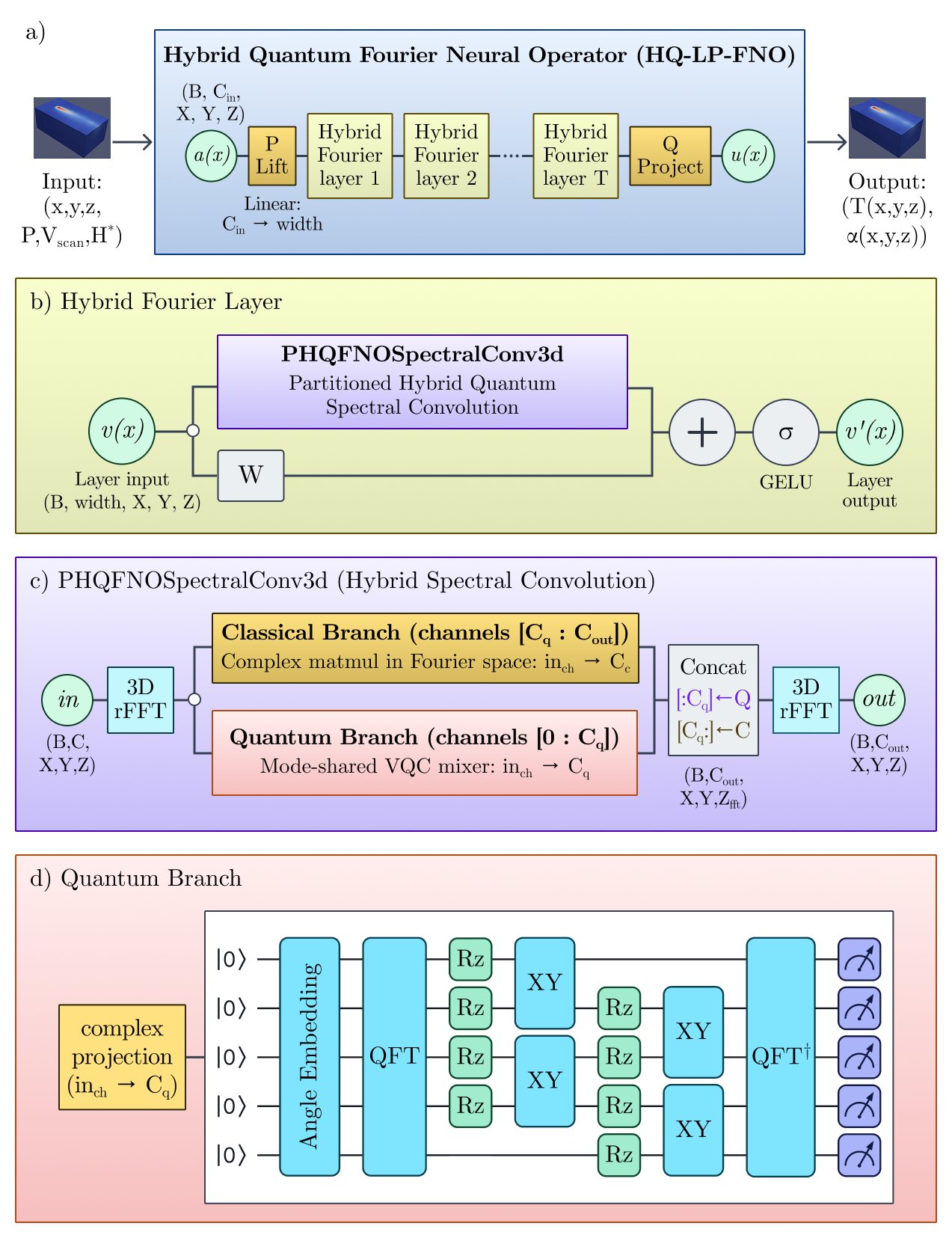
Figure 2: HQ-LP-FNO block diagram—inputs are lifted by a pointwise projection, then processed by hybrid Fourier layers using both dense and quantum spectral mixing. The quantum branch is realized as a mode-shared VQC integrated into the spectral path.
Specifically, for quantum-channel width Cq, the first Cq spectral channels across all modes are routed through the same VQC. This VQC is prefixed and postfixed by learned linear projections, uses robust input normalization, and internally comprises a QFT-mixer-iQFT structure based on odd-even IsingXY layers. The classical control, CM-LP-FNO, replaces the VQC with a bottleneck MLP of matched parameter count. This dual-ablation protocol rigorously separates the representational effect of mode-shared mixing from quantum-specific inductive biases.
Parameter-Accuracy Trade-Off and Results
A principal claim is that HQ-LP-FNO achieves strong parameter efficiency: at Cq=5, trainable parameters are reduced by 15.6% relative to the classical LP-FNO baseline. Mean absolute error for temperature is reduced from 2.89% to 2.56%, and phase-fraction MAE drops by 26%. Performance improvements are spatially localized, with largest temperature MAE reductions observed near the keyhole transition regime—regions that pose high regularity and nonlinearity challenges.
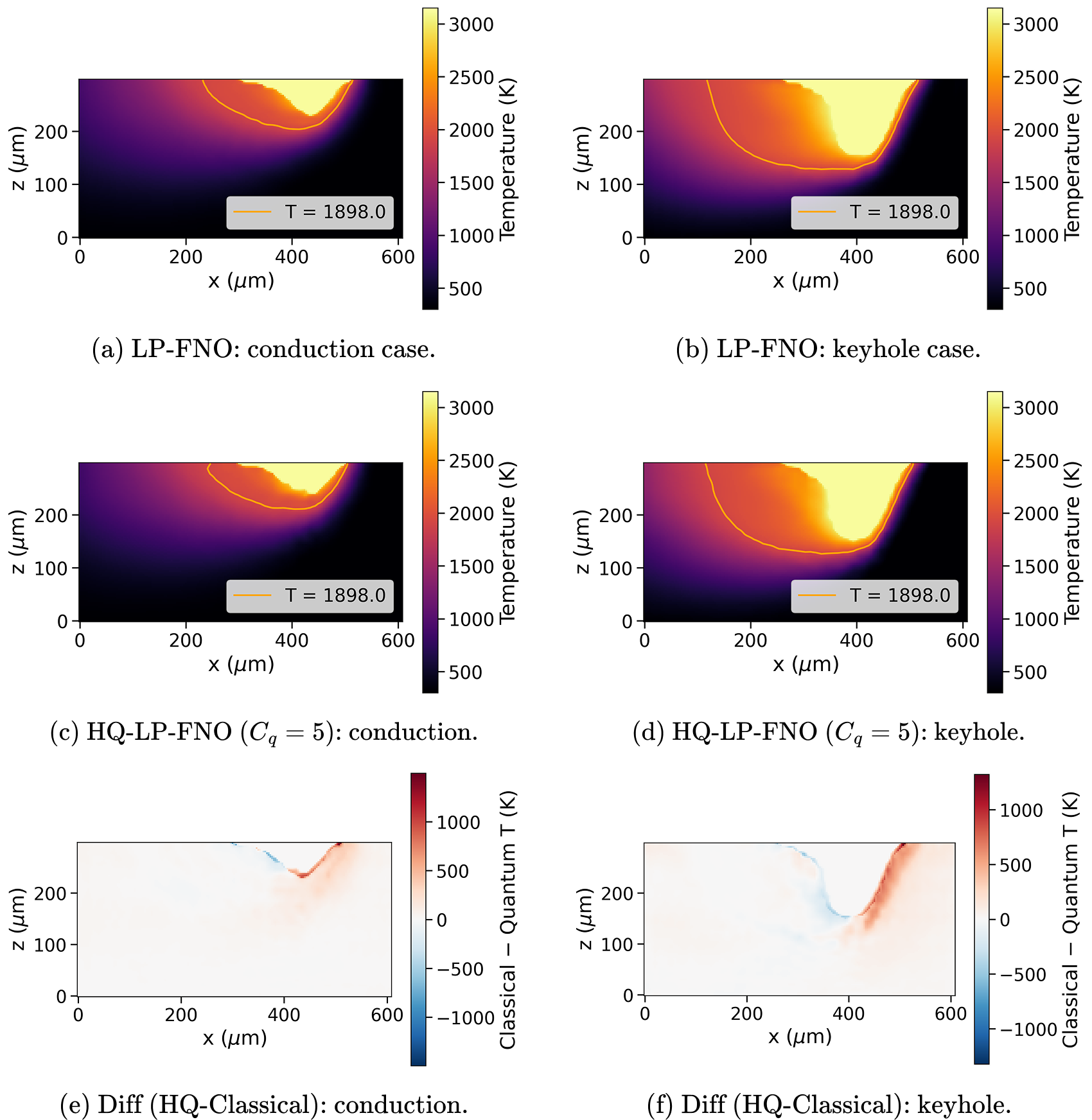
Figure 3: Qualitative comparison of classical (LP-FNO) and hybrid (HQ-LP-FNO) temperature field predictions for both conduction and keyhole cases, with error localization predominantly at interfaces.
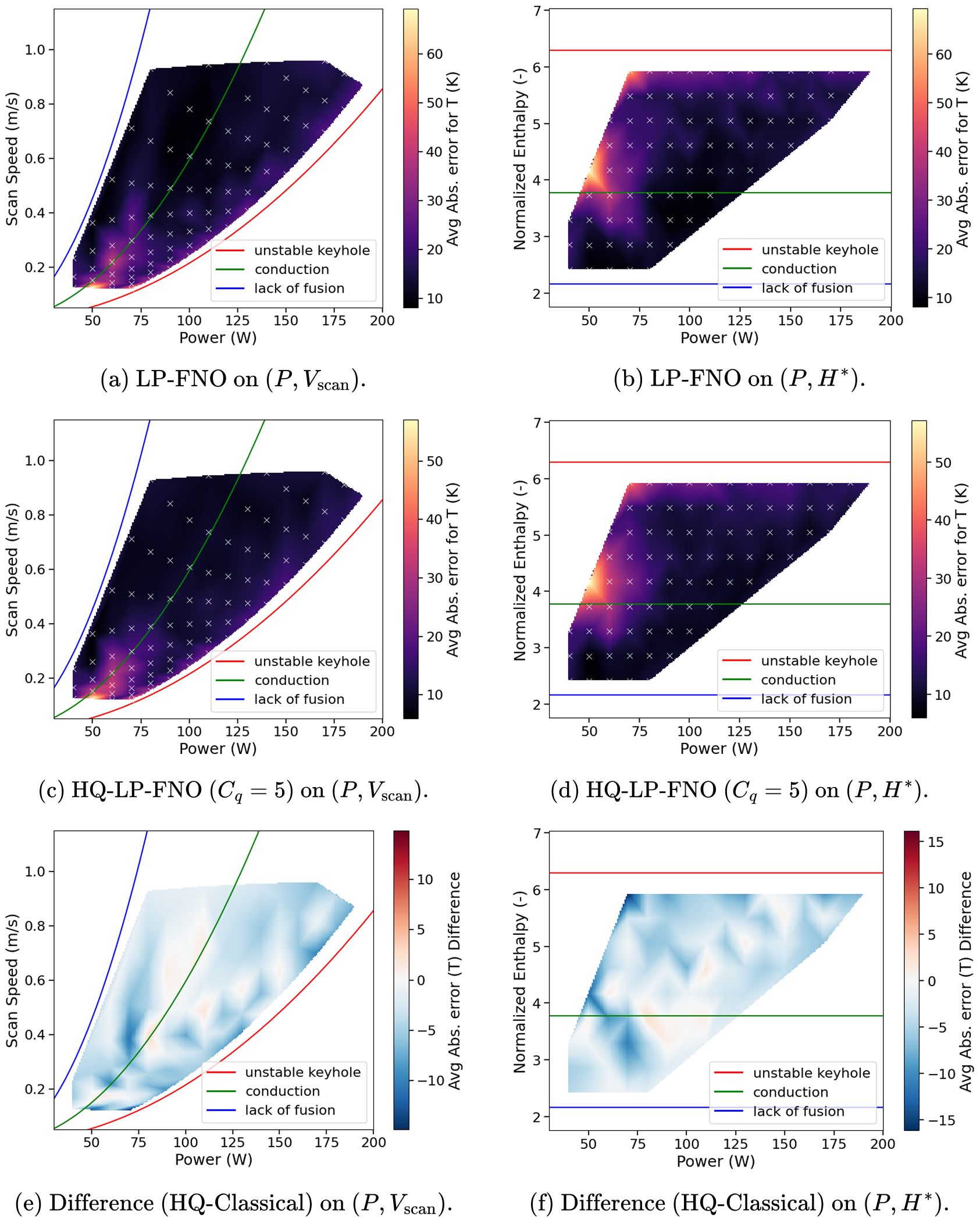
Figure 4: Localized absolute error maps in process space—differences between classical and hybrid models reveal broad MAE reductions across high-power, high-enthalpy regimes.
A sweep over Cq reveals non-monotonic performance: a moderate quantum allocation (Cq=3) attains the lowest relative temperature errors out of all configurations, outperforming both the fully classical and the larger-quantum-fraction models. This demonstrates an optimal classical-quantum partitioning point—maximal parameter efficiency with no loss (and in fact a slight improvement) in generalization performance. Notably, parameter-matched MLP controls achieve some metrics superior to the VQC, indicating that mode-shared mixing, not quantum-specific properties, drives the primary efficiency gains.
Quantum Circuit Analysis and Noise Robustness
The VQC architecture is analyzed for redundancy, trainability, and expressivity. ZX-calculus reduces to no redundant gates; the Fisher information matrix displays high diagonal dominance with a non-trivial set of active parameters, indicating resilience against barren plateaus at the tested depth and qubit count. Fourier analysis confirms high expressivity (all admissible frequency terms attested).
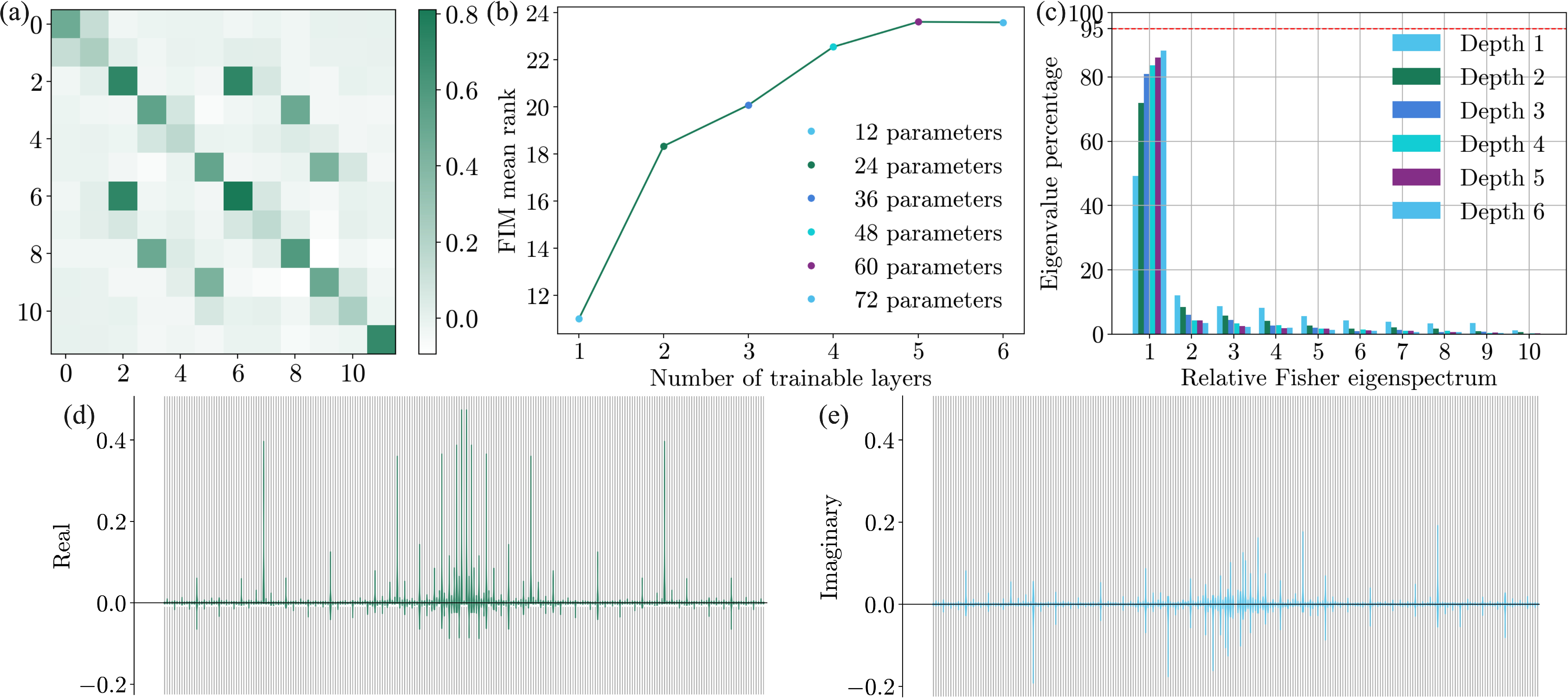
Figure 5: Quantum circuit diagnostics—FIM structure, rank, and eigenvalue distribution as a function of mixer depth and layer count, demonstrating trainability and architectural soundness.
Hardware viability is crucial for quantum advantage claims. The quantum branch is simulated under realistic ibm_torino backend-calibrated noise, and the output remains numerically stable across a broad range of measurement shots.
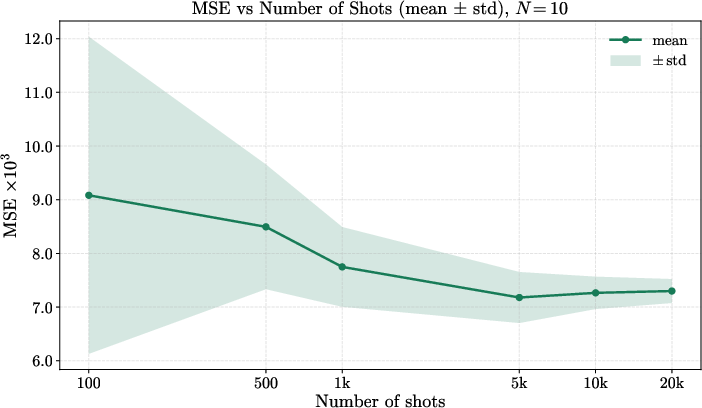
Figure 6: Mean squared error between noiseless and noisy VQC spectral mixer output versus shot number under ibm_torino noise, indicating rapid decay of sampling error and stable performance up to 5000 shots.
Impact and Future Directions
This research provides a rigorous, ablation-based demonstration that mode-shared spectral channel mixing—parameterized either via a compact VQC or a classical MLP—can substantially reduce spectral parameter count in 3D FNO surrogates without compromising accuracy. The hybrid quantum-classical approach is validated for multiphysics surrogate modeling, and the methodology establishes a framework for controlled quantum evaluation in physics-based learning.
Theoretical implications include the architectural role of global versus local channel mixer designs and the non-trivial emergence of optimal quantum-classical partitioning for PDE operator learning. For practical applications, HQ-LP-FNO supports more scalable surrogate modeling, potentially enabling closer integration with digital twins and uncertainty quantification workflows that demand real-time inference.
Conclusion
This work introduces and evaluates HQ-LP-FNO, a hybrid quantum-classical FNO realizing parameter-efficient surrogate modeling for nonlinear, three-dimensional laser material interaction. By partitioning spectral mixing and leveraging a mode-shared quantum circuit, the approach achieves up to 16% parameter reduction and improved mean error metrics relative to classical dense mixing, with ablation controls demonstrating that mode-shared mixing is the essential architectural driver. Quantum circuit analysis demonstrates hardware-viable robustness, and findings motivate future work on informed circuit designs, interface-aware training objectives, and ultimate benchmarking on quantum hardware (2604.04828).