- The paper introduces a symmetry-restored Q-PulsePol sequence that overcomes finite-pulse limitations in dynamic nuclear polarization for robust uni-modal transfer.
- It employs a bimodal Floquet analysis with phase corrections to suppress competing DQ and ZQ channels, thereby enhancing polarization transfer fidelity.
- Experimental and simulation results demonstrate that Q-PulsePol achieves steady, efficient nuclear polarization even at low microwave power and high-field conditions.
Quadrature-Symmetric PulsePol: Robust Quantum Control Beyond the Ideal Pulse Approximation
Introduction
The manuscript "Quadrature-Symmetric PulsePol for Robust Quantum Control Beyond the Ideal Pulse Approximation" (2604.04789) presents a rigorous theoretical and experimental investigation of finite-pulse effects in the PulsePol sequence for efficient dynamic nuclear polarization (DNP) via polarization transfer between electron and nuclear spins in solid-state systems. The authors identify a critical breakdown in polarization transfer efficiency when the idealized, infinitely strong (instantaneous) control pulse assumption fails—a scenario ubiquitously encountered at elevated magnetic fields or in power-limited devices. To address these limitations, they introduce Q-PulsePol, a minimally modified PulsePol sequence that restores key symmetry properties in the finite-pulse regime, thereby enabling uni-modal (single resonance pathway) DNP with high fidelity and robustness.
Background and Motivation
Solid-state electron spin systems, such as NV centers in diamond, underpin leading quantum information and hyperpolarization platforms due to their optical addressability and long coherence times. Extension of quantum lifetimes through nuclear spin hyperpolarization is fundamentally limited by poor thermal polarization of nuclei. DNP circumvents this via microwave (μw) driven polarization transfer. While continuous-wave DNP is prevalent, pulsed DNP sequences like NOVEL and PulsePol allow selective, coherent polarization transfer—offering substantial heating and selectivity advantages.
The canonical PulsePol sequence, known for its symmetry-based robustness, was shown to outperform NOVEL under ideal pulse approximations. However, as the pulse duration becomes a non-negligible fraction of the cycle period at experimental conditions (finite μw power, high field), the finite-pulse-induced Hamiltonian terms and associated symmetry breaking have been largely overlooked. The resulting activation of competing double quantum (DQ: flip-flip) and zero quantum (ZQ: flip-flop) channels destructively interferes, sharply decreasing net polarization transfer and bulk hyperpolarization.
Floquet Symmetry Analysis and Sequence Engineering
Leveraging a bimodal Floquet decomposition of the periodically driven, coupled electron-nucleus system, the authors comprehensively characterize transition-selectivity in DNP through two fundamental interaction-frame symmetries:
- Quadrature symmetry: The X(t) and Y(t) components of the electron spin trajectory must share a precisely quarter-cycle (Tc/4) phase relationship, ensuring that only one DNP transition (DQ or ZQ) is coherently addressed, with the other suppressed.
- XY time-reversal symmetry: For maximal transfer efficiency, the Y(t) trajectory must be the time-reversed counterpart of X(t), producing a strict 90∘ (circular) polarization in the effective driving, maximizing the corresponding Fourier coefficients.
These symmetries dictate that the Fourier coefficients ax(k) and ay(k) associated with the dominant k-th harmonic in the spin-operator expansion satisfy specific algebraic relations—achieved under ideal but not finite pulse conditions in standard PulsePol.
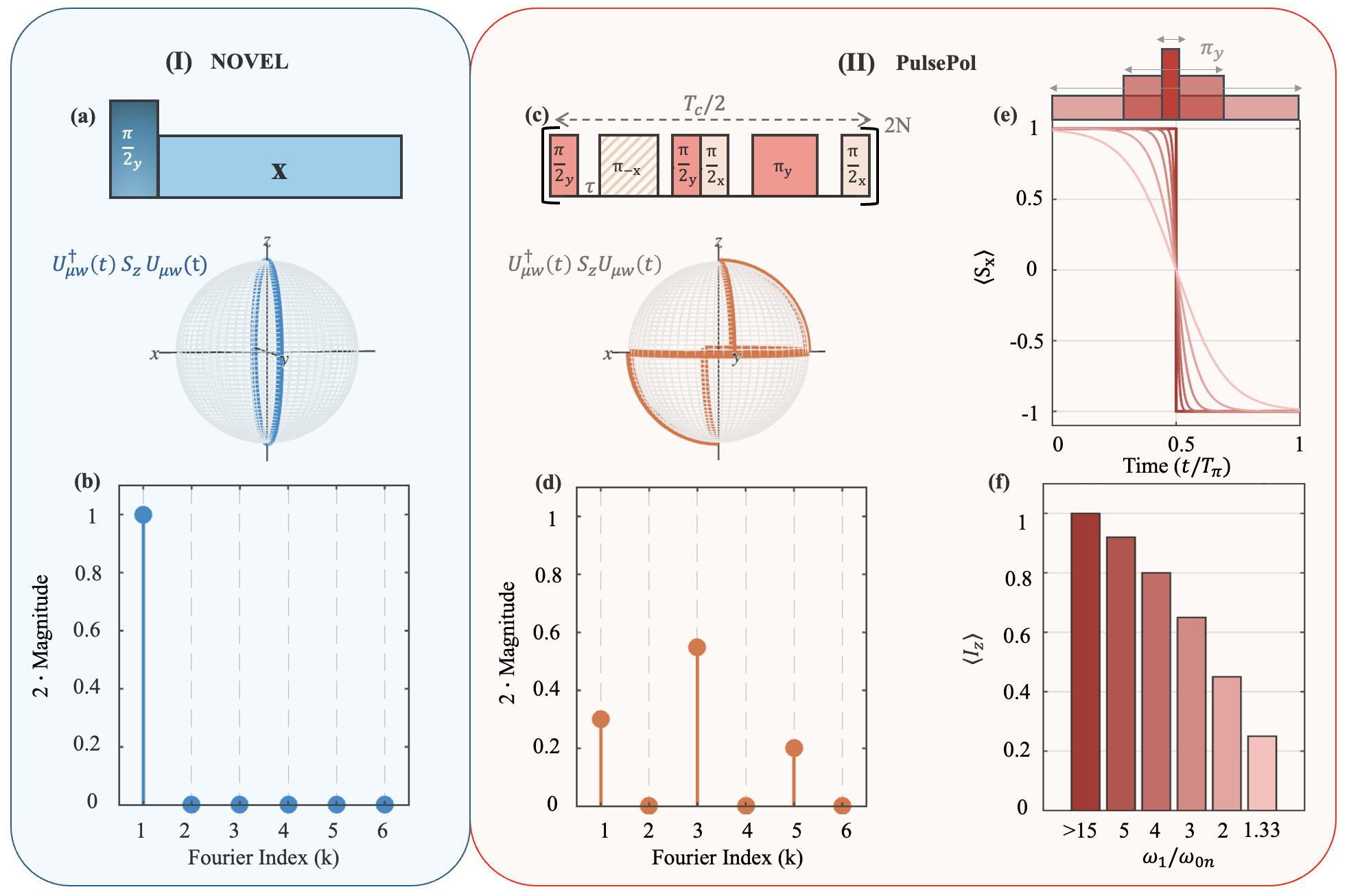
Figure 1: Comparison of NOVEL (single-mode) and PulsePol (multi-mode) spin trajectories, demonstrating rapid degradation of net nuclear polarization as pulse duration increases.
Empirical and simulated analyses reveal that the central −X inversion pulse of PulsePol disrupts the required quadrature symmetry under finite pulses, leading to spectral leakage and activation of undesirable DNP pathways.
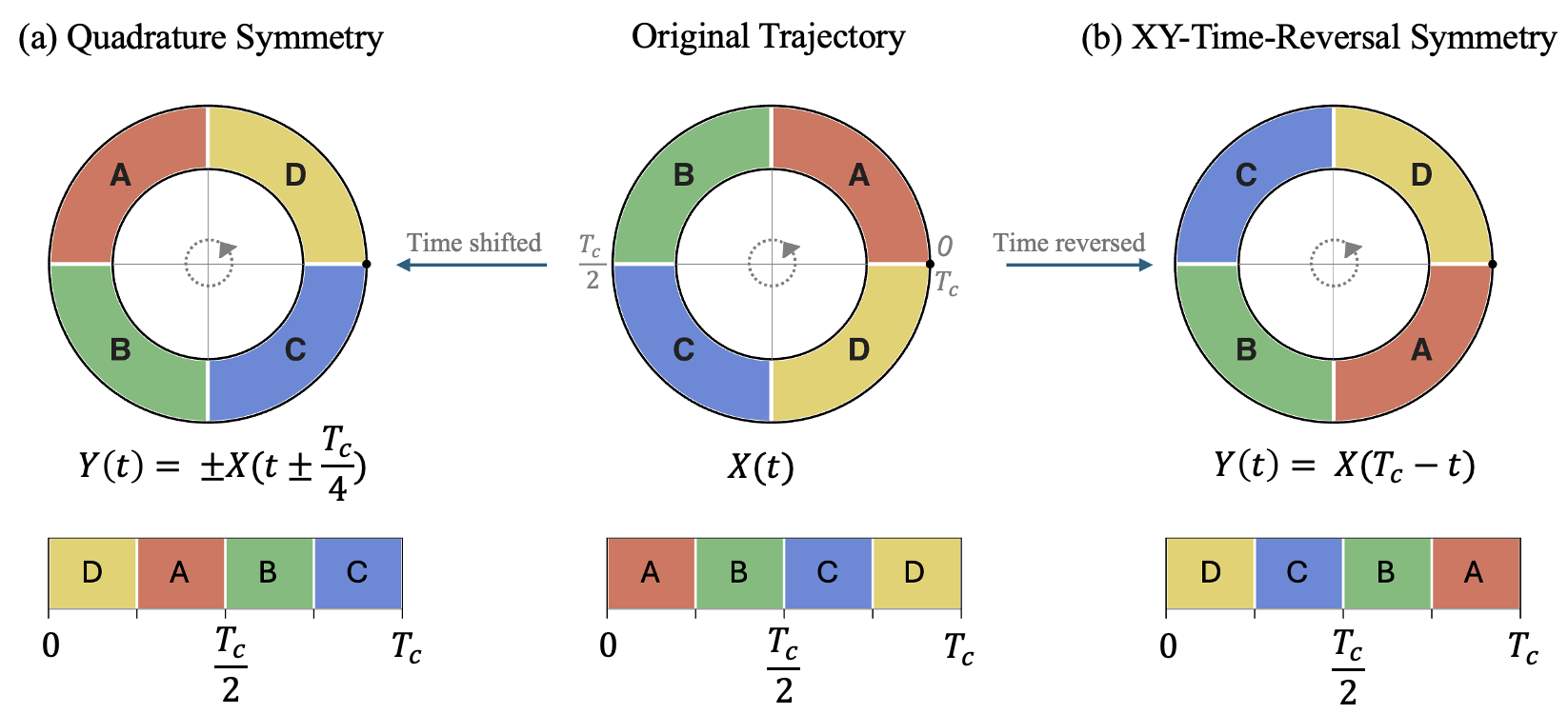
Figure 2: Depiction of quadrature and XY time-reversal operations within the periodic spin trajectory framework; symmetry breaking induces both DQ and ZQ transfer.
By introducing a phase correction—flipping the central pulse from Y(t)0 to Y(t)1—the modified Q-PulsePol sequence restores both Quadrature and XY time-reversal symmetry for any pulse duration, ensuring pure (uni-modal) DNP transition selectivity, and recovering the optimal scaling factors even under maximally finite conditions.
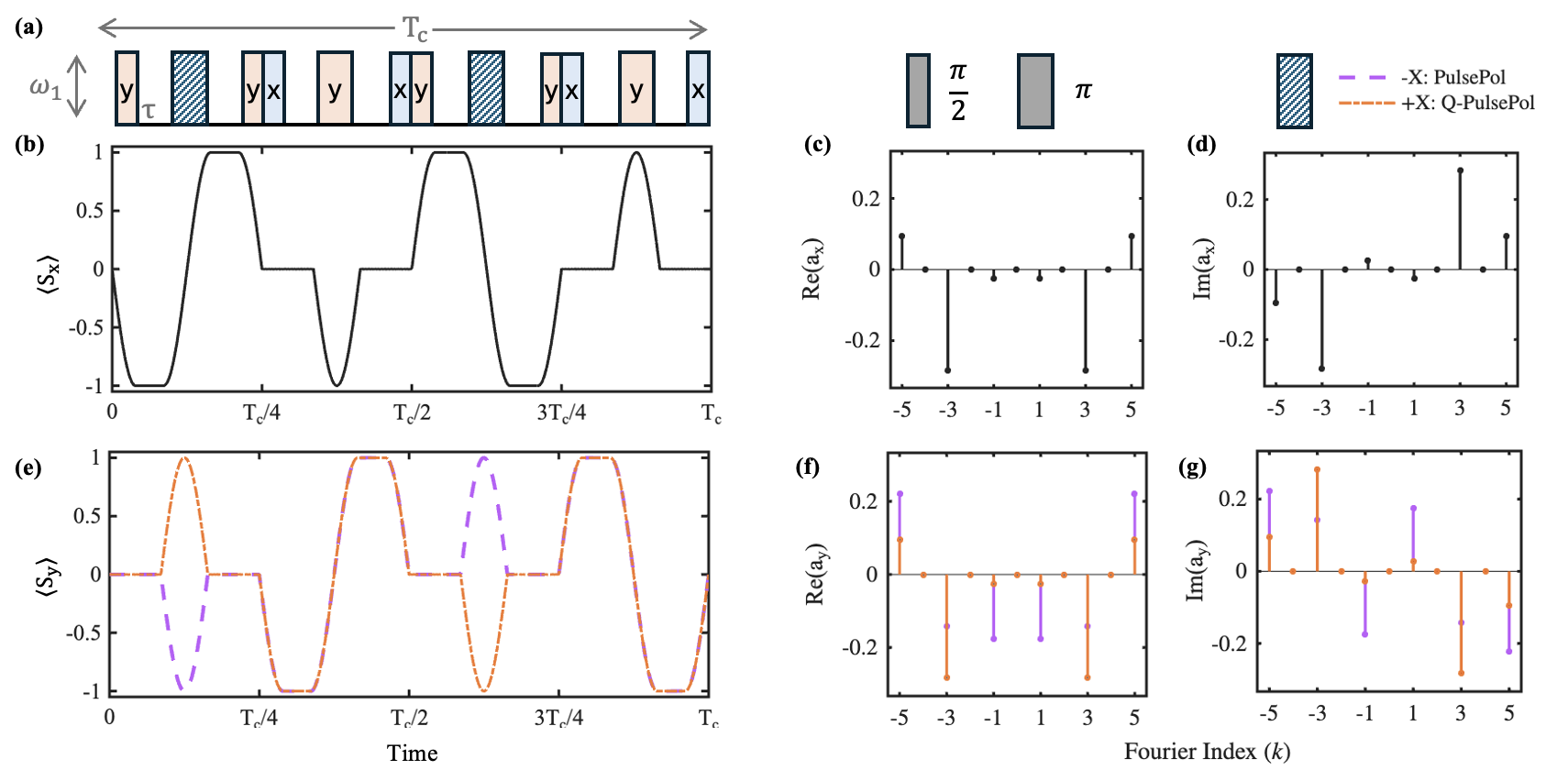
Figure 3: Fourier analysis showing that Q-PulsePol (orange) restores pure DQ selectivity and high scaling factor, while standard PulsePol (purple) activates both DQ/ZQ channels under finite-pulse conditions.
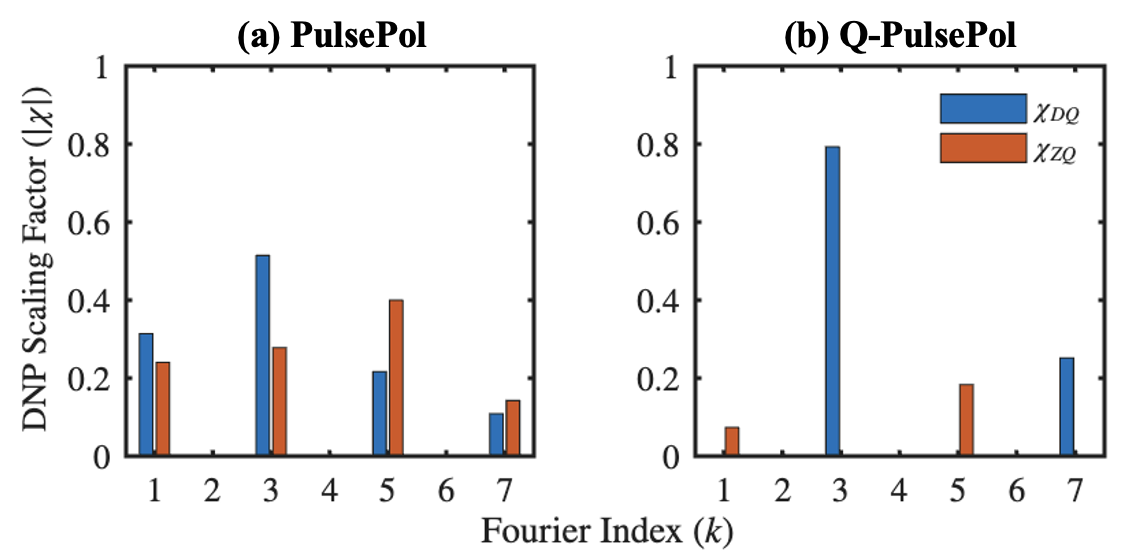
Figure 4: DQ/ZQ scaling factors for Q-PulsePol and PulsePol across harmonics; only Q-PulsePol ensures robust uni-modality at all relevant Y(t)2 under finite pulse durations.
Pulse Finiteness and Experimental Constraints
Defining a dimensionless finiteness parameter Y(t)3 (where Y(t)4 signifies pulses fully saturating Y(t)5), the effect of experimental hardware constraints is systematically addressed. Original PulsePol implementations (Y(t)6) operate in a regime where symmetry breaking is negligible; however, as μw nutation rates decrease or Y(t)7 increases (Y(t)8), the performance of PulsePol degrades, while Q-PulsePol maintains high amplitude in the critical Fourier coefficients, as shown both analytically and by numerical simulation.
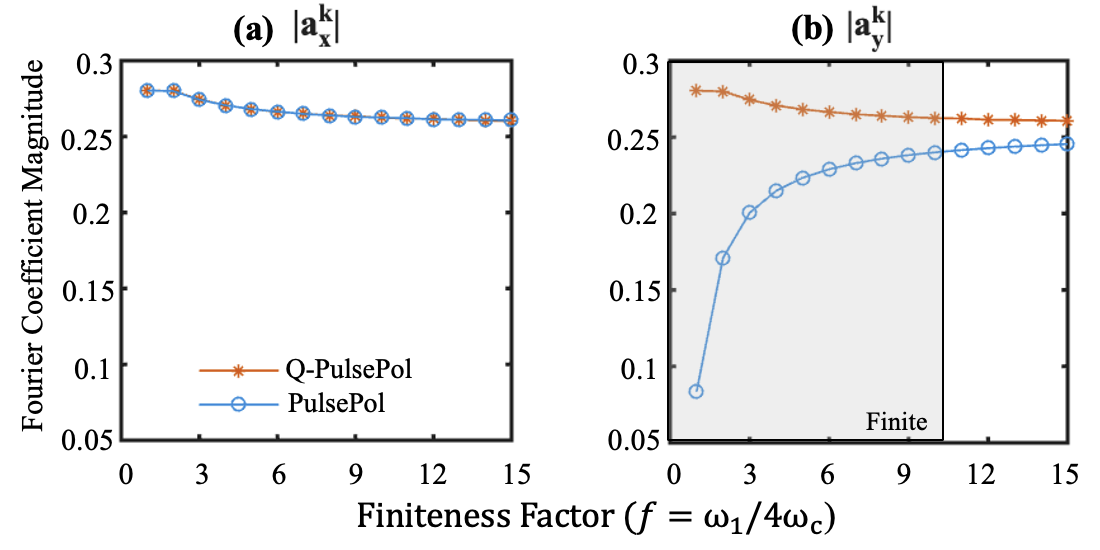
Figure 5: Evolution of the dominant Fourier coefficients Y(t)9 and Tc/40 as a function of pulse finiteness; Q-PulsePol preserves coefficients at low Tc/41, generic PulsePol does not.
Bulk Hyperpolarization Simulations
DNP contact curves in a model spin diffusion network confirm that Q-PulsePol enables robust and monotonic polarization build-up in the nuclear spin bath, while PulsePol produces only transient polarization that rapidly decays, reflecting destructive interference arising from pathway competition. Notably, Q-PulsePol’s performance is independent of μw nutation frequency, directly supporting device miniaturization and power reduction.
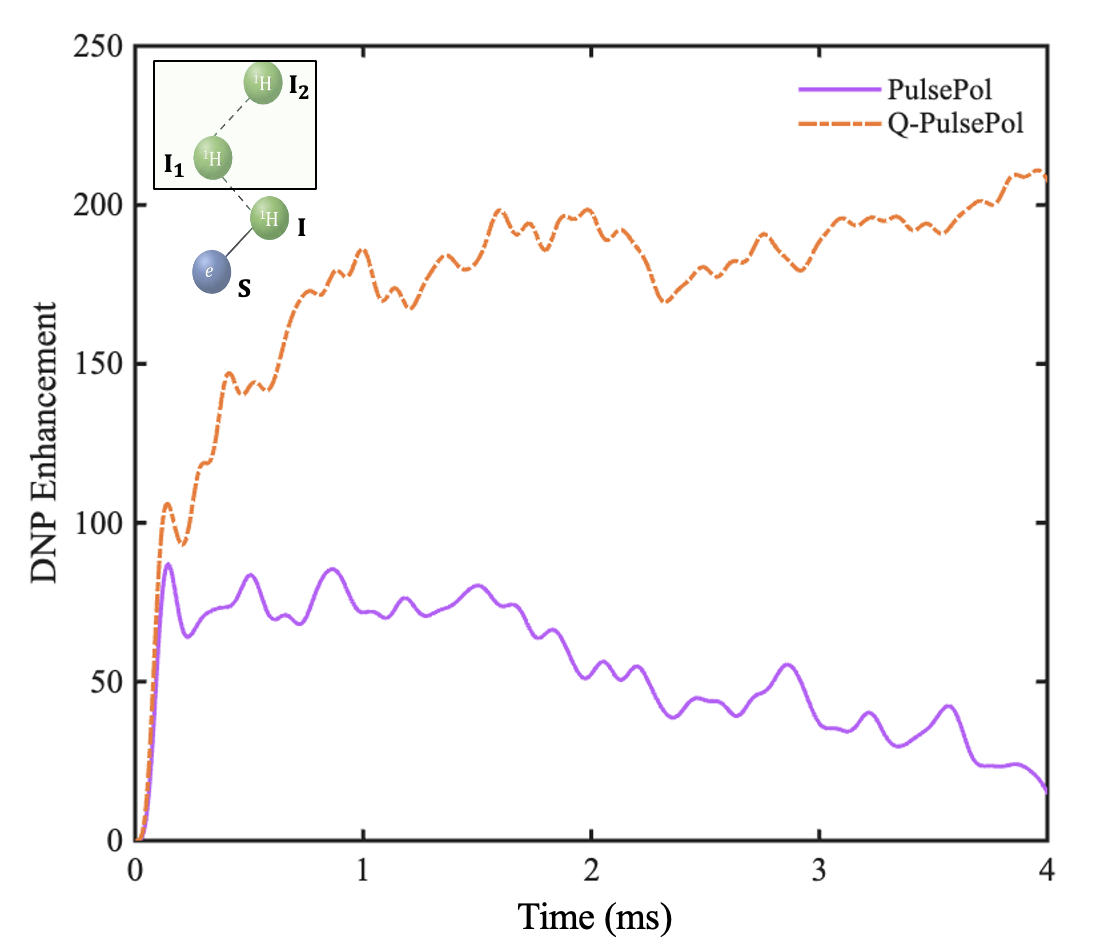
Figure 6: Simulated DNP build-up curves. Q-PulsePol (orange) enables steady, high-efficiency bulk nuclear polarization, while PulsePol (purple) saturates and declines due to non-selective pathways.
Experimental Demonstration
Experiments were performed in X-band (0.35 T) on a standard Trityl-doped frozen solution at 80 K. The DNP enhancement and offset profiles confirm that Q-PulsePol achieves higher or equal enhancement compared to PulsePol as μw power is reduced. Actual bulk polarization build-up curves show that Q-PulsePol yields monotonic increases, while PulsePol enhancement grows only briefly before declining—direct manifestation of the destructive ZQ/DQ interference in the latter. The optimal performance of Q-PulsePol is empirically confirmed across differing nutation frequencies, validating the theoretical framework.
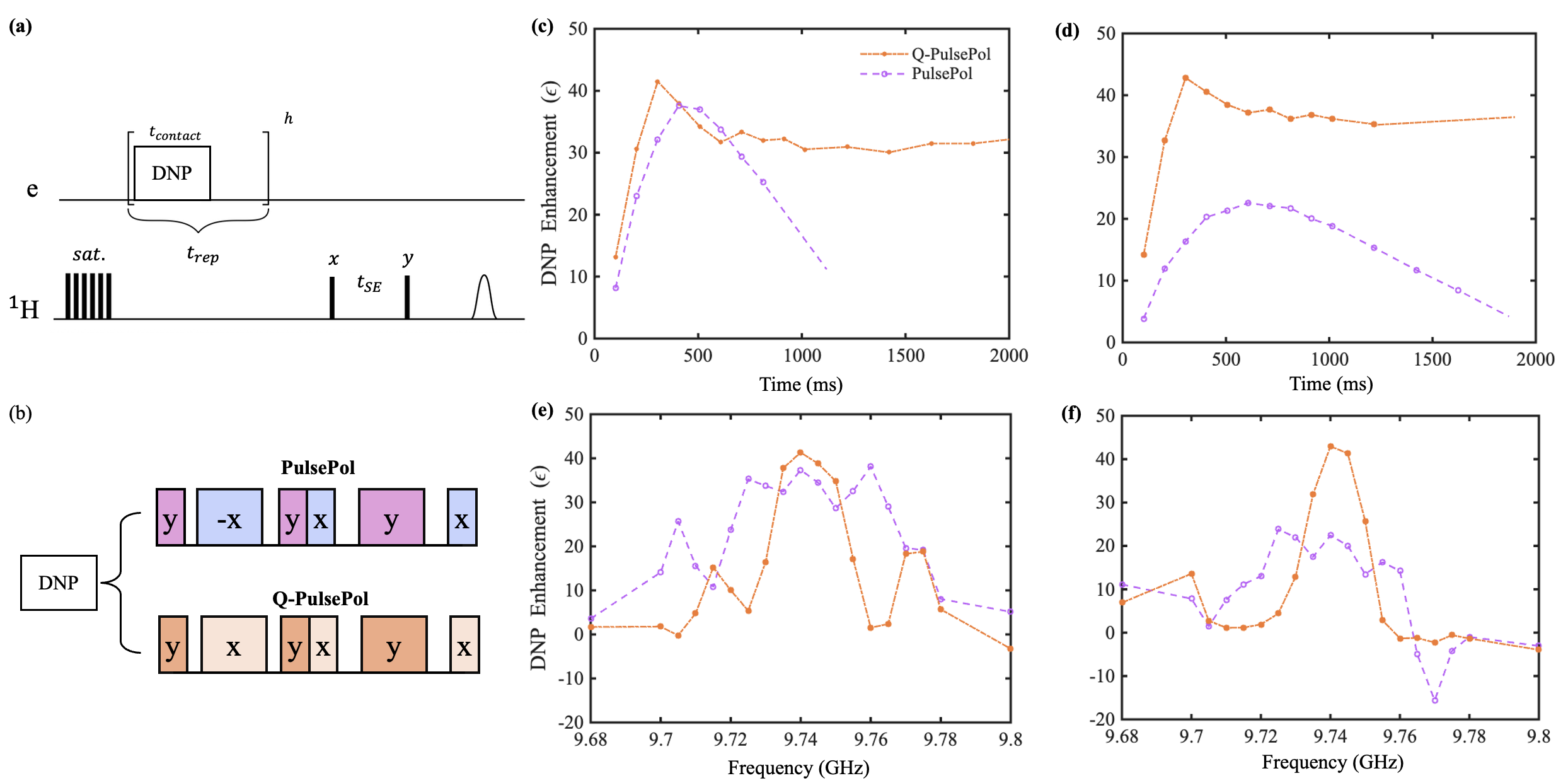
Figure 7: Experimental DNP enhancement and bulk build-up: Q-PulsePol provides robust, monotonic hyperpolarization even at low nutation rates, while PulsePol exhibits significant loss of efficiency.
Implications and Outlook
This work establishes that the breakdown of toggling-frame symmetries under experimentally realistic finite pulse durations critically limits the performance of established DNP pulse sequences, and demonstrates a minimal, symmetry-motivated modification (Q-PulsePol) that fully restores robust, uni-modal transfer. Practically, this enables efficient hyperpolarization in high-field or power-limited platforms without the need for high μw powers or ideal pulse approximation. The authors’ symmetry-based engineering framework can be immediately generalized—future developments could include optimizations for additional Hamiltonian constraints, Hamiltonian engineering for coupled multi-spin networks, or integration with advanced error-correcting quantum control schemas.
Conclusion
Q-PulsePol, derived via symmetry restoration in the Floquet interaction frame, ensures that pulsed DNP realizations in the finite-pulse (bounded control) regime retain maximal transfer efficiency and selectivity. The sequence’s robustness substantially broadens the viability of hardware-constrained quantum control and DNP protocols, with direct implications for high-field NMR/MRI, quantum memory applications, and nanoscale quantum sensor technology. The symmetry-based design strategy introduced here is poised to influence future pulse sequence engineering, particularly as quantum hardware moves toward realistic, non-ideal experimental conditions.