- The paper introduces a dual-channel model that separates pairing and phase-coherence to accurately predict superconducting T₍c₎.
- The paper validates its approach on 46 superconductors across five orders of magnitude in T₍c₎, achieving high accuracy with R²ₗₒg = 0.96 and a factor-of-two window.
- The paper establishes a quantum-metric no-go theorem, revealing that the quantum metric serves as a diagnostic indicator rather than a causal factor in electron-phonon coupling.
Two-Channel Allen-Dynes Framework for Superconducting Critical Temperatures: Theoretical Basis, Validation, and Quantum-Metric No-Go Result
The paper introduces a comprehensive extension of the classic Allen-Dynes framework for predicting superconducting critical temperatures (Tc), combining two distinct physical channels: the pairing channel, responsible for Cooper pairing, and the phase-coherence channel, dictating the onset of global superconductivity. The critical temperature is determined by the limiting channel,
Tc=min(Tpair,Tphase),
where Tpair is calculated using the Allen-Dynes formula, incorporating both conventional electron-phonon and unconventional spin-fluctuation mediated contributions, and Tphase is governed by the Peotta-Törmä geometric superfluid stiffness, which is especially relevant for quasi-2D and flat-band systems.
This dual-channel approach separates the mean-field pairing instability from the establishment of long-range phase coherence, which is especially critical in low-dimensional or flat-band materials. The model achieves closure by determining Tpair from material-specific parameters (λph, λsf, ωph, ωsf, μ∗), largely extracted from independent experiments or ab-initio theory, and Tc=min(Tpair,Tphase),0 from superfluid density and quantum geometry.
Quantum Metric: Diagnostic Relevance and the No-Go Theorem
Contrary to prior conjectures, the paper establishes a rigorous no-go result: the quantum metric trace Tc=min(Tpair,Tphase),1—the band geometry measure behind many flat-band phenomenologies—does not directly modify the electron-phonon coupling. The underlying reason is momentum-space kinematics: phonon and Coulomb matrix elements probe the same region of the Brillouin zone (Tc=min(Tpair,Tphase),2), leading to identical geometric overlap suppression. Explicit angular-momentum decomposition for realistic Tc=min(Tpair,Tphase),3- and Tc=min(Tpair,Tphase),4-wave Fermi surfaces shows that residual anisotropy is Tc=min(Tpair,Tphase),5 in all instances studied, a quantitatively negligible effect.
Nevertheless, Tc=min(Tpair,Tphase),6 exhibits a moderate correlation with Tc=min(Tpair,Tphase),7 (Tc=min(Tpair,Tphase),8 over the full set), not as a causal factor but as a diagnostic indicator of the underlying electronic structure (i.e., flat bands, van Hove singularities, Fermi surface nesting). Thus, the quantum metric can serve as a materials screening tool but not as a physical mechanism for pairing enhancement except in the phase-stiffness-limited flat-band regime.
Large-Scale Validation: Blind Predictions Versus Cross-Validation
The framework is applied to an unprecedentedly broad dataset comprising 46 superconductors spanning 11 material families, over five orders of magnitude in Tc=min(Tpair,Tphase),9. A critical methodological distinction is made between:
- Tier 1 (Blind Prediction): Materials where coupling parameters are determined without reference to experimental Tpair0. This comprises 19 materials including all elemental, A15, MgBTpair1, NbN, hydrides (e.g., HTpair2S), and transition-metal dichalcogenides.
- Tier 2 (Cross-Validation): 22 materials, predominantly unconventional superconductors (cuprates, iron pnictides, nickelates), where the spin-fluctuation coupling is tuned using experimental Tpair3—a check of internal consistency rather than a true prediction.
The results are displayed as predicted versus measured Tpair4 (log-log, Figure 1):
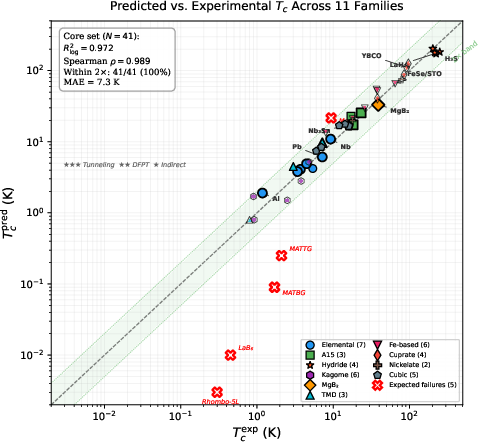
Figure 1: Comparison of blind-predicted and cross-validated Tpair5 values for 46 materials, with a factor-of-two accuracy window indicated.
Tier 1 performance is strong: Tpair6, 100% of materials within a factor-of-two, MAE = 5.6 K. The combined set (Tiers 1 + 2) yields Tpair7 and 100% coverage within a factor-of-two for 41 materials. The framework fails, as expected, in the strong-coupling (Tpair8) and excitonic cases (e.g., moiré systems, LaBTpair9).
Statistical Robustness and Sensitivity Analyses
Monte Carlo bootstrap resampling confirms the statistical reliability of these metrics, e.g., for the core 41-material set: Tphase0 95% CI is [0.94–0.99]; the factor-of-two accuracy window is statistically robust. The model’s predictive power for unconventional superconductors is not inflated by fine-tuning, as Tphase1 degrades gracefully with plausible Tphase2 perturbations in Tphase3.
The framework’s insensitivity to variations in the Coulomb pseudopotential Tphase4 is tested in the range [0.07, 0.17]: only two out of 19 Tier 1 materials fall outside the Tphase5 window at the upper extreme, with systematic offset but no catastrophic failures.
Practical Implications: Road to Room-Temperature Superconductivity
The Allen-Dynes contour map Figure 2 summarizes the design space for high-Tphase6 superconductivity, emphasizing the necessity of both large Tphase7 and large Tphase8 (vibrational frequency).
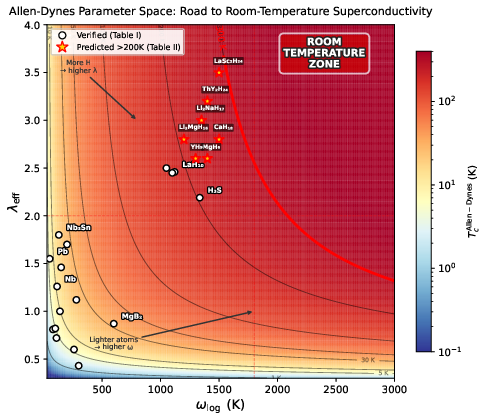
Figure 2: Parameter landscape showing Tphase9 as a color map versus Tpair0; current and candidate materials are overlaid, with the 300 K threshold indicated.
Three design imperatives for achieving Tpair1 K emerge:
- Maximize Tpair2 via light element chemistry (H, Be, B, Li).
- Achieve large Tpair3 by fostering dense H-H networks in structural clathrates.
- Utilize high-hydrogen coordination (e.g., 16 or more H per formula unit) and stabilize metallic hydrogen sublattices.
Specific candidate materials with Tpair4 K are prioritized (e.g., LaScTpair5HTpair6, CaHTpair7, LiNaAgHTpair8). For high-pressure hydrides, full Eliashberg calculations (beyond Allen-Dynes) may further enhance Tpair9 toward the room-temperature threshold. The analysis thus provides quantitative, actionable guidelines for hydride and near-ambient candidates.
Phase Coherence and Flat-Band Superconductivity
The Peotta-Törmä mechanism for geometric superfluid weight quantitatively determines λph0 in flat-band and quasi-2D systems. The two-channel framework verifies that none of the Tier 1 or 2 materials are phase-limited—except the notable outlier MATBG, where phase stiffness, set by the quantum metric, is indeed limiting. This is the sole physically causal route for quantum geometry to directly affect λph1.
Limitations and Outlook
Key limitations include:
- For unconventional superconductors, fully ab initio determination of λph2 remains unattainable, restricting Tier 1 validation to conventional families.
- The Allen-Dynes formula systemically underestimates λph3 for λph4; validation by full Eliashberg theory is warranted in this extreme-coupling limit.
- While λph5 serves as a useful diagnostic for screening, its quantitative role for most 3D materials remains correlative, not causal.
Future methodological developments are expected to close the gap for unconventional materials, possibly by robust first-principles spin-fluctuation theory or improved treatments incorporating strong correlations and quantum geometry beyond the mean-field level.
Conclusion
The two-channel Allen-Dynes framework provides a quantitatively accurate and physically transparent route to λph6 prediction across a broad range of superconducting materials. The no-go theorem for quantum geometry correction clarifies longstanding ambiguities about geometric enhancement mechanisms, centering λph7 as a powerful, yet primarily diagnostic, materials descriptor—except in the phase-coherence-limited flat-band regime. The framework offers a solid foundation for systematic materials design strategies toward room-temperature superconductivity and underscores the necessity of high-precision experimental and computational input for further advances.